

Image Credit: NASA and BP.Blogspot.com
By WUWT regular “Just The Facts”
Recently there has been significant attention focused on “The Pause” in Earth’s warming, the length of “The Pause” and where “Earth’s Temperature” may go from here, e.g.: “Over the past 15 years air temperatures at the Earth’s surface have been flat while greenhouse-gas emissions have continued to soar.” The Economist “Global warming stopped 16 years ago, reveals Met Office report quietly released… and here is the chart to prove it.” Daily Mail “Twenty-year hiatus in rising temperatures has climate scientists puzzled.” The Australian “Has the rise in temperatures ‘paused’?” Guardian “On Tuesday, news finally broke of a revised Met Office ‘decadal forecast’, which not only acknowledges the pause, but predicts it will continue at least until 2017.” Daily Mail “RSS global satellite temperatures confirm hiatus of global warming, while the general public and mainstream press are now recognizing the AWOL truth that skeptics long ago identified…global temperatures are trending towards cooling, not accelerating higher” C3 Headlines
From Werner Brozek’s recent article:
1. For GISS, the slope is flat since January 2001 or 12 years, 2 months. (goes to February)
2. For Hadcrut3, the slope is flat since April 1997 or 15 years, 11 months. (goes to February)
3. For a combination of GISS, Hadcrut3, UAH and RSS, the slope is flat since December 2000 or an even 12 years. (goes to November)
4. For Hadcrut4, the slope is flat since November 2000 or 12 years, 4 months. (goes to February)
5. For Hadsst2, the slope is flat from March 1, 1997 to March 31, 2013, or 16 years, 1 month.
From those data points it appears that The Pause is at least 12 years old, but let us dig deeper into the observational data to see “The Pause” in “Earth’s Temperature”.
Global Surface Temperatures:
Generally, when referring to Earth’s “climate” warming, proponents of the Catastrophic Anthropogenic Global Warming (CAGW) narrative refer to Earth’s Surface Temperature, e.g. “Global warming is the unusually rapid increase in Earth’s average surface temperature over the past century primarily due to the greenhouse gases released by people burning fossil fuels.” NASA Earth Observatory
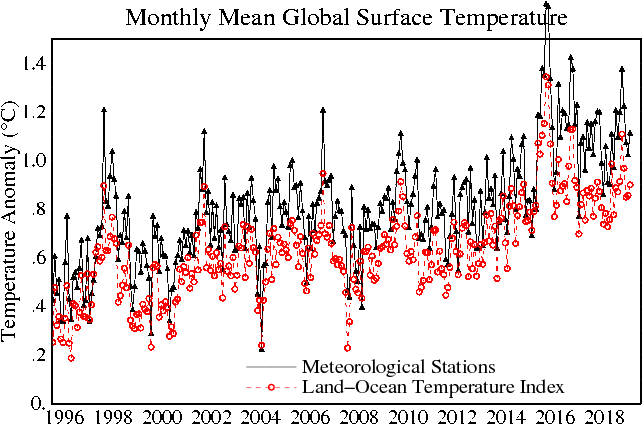
As such, here’s NASA’s Goddard Institute for Space Studies (GISS) Global Monthly Mean Surface Temperature Anomaly – 1996 to Present:
NOAA’s – National Climate Data Center – Year To Date Global Temperature Anomalies – 2012 ranked 10th:

NOAA’s – National Climate Data Center – Annual Global Land and Ocean Temperature Anomalies:

UK Met Office’s – Hadley Center – Climate Research Unit (CRU) Annual Global Average Land and Ocean Temperature Anomaly – 1850 to 2012

and the UK Met Office – Hadley Center – Climate Research Unit (CRU) Monthly Global Average Land Temperature – 1850 to 2012

The Pause appears to apparent in Earth’s Land and Surface Temperature record, and if anything the trend appears to be down in the last several years. However, the surface temperature records are burdened with issues of questionable siting, changes in siting, changes in equipment, changes in the number of measurement locations, modeling to fill in gaps in measurement locations, corrections to account for missing, erroneous or biased measurements, and the urban heat island effect. Thus to see the big picture on the temperature “Earth’s Temperature”, it also helps to look up.
Atmospheric Temperatures:
Since 1979 Earth’s “temperature” has also been measured via satellite. “The temperature measurements from space are verified by two direct and independent methods. The first involves actual in-situ measurements of the lower atmosphere made by balloon-borne observations around the world. The second uses intercalibration and comparison among identical experiments on different orbiting platforms. The result is that the satellite temperature measurements are accurate to within three one-hundredths of a degree Centigrade (0.03 C) when compared to ground-launched balloons taking measurements of the same region of the atmosphere at the same time.” NASA
Here is RSS Global Temperature Lower Troposphere (TLT) – Brightness Temperature Anomaly- 1979 to Present;


and this is the University of Alabama – Hunstville (UAH) Global Lower Atmosphere Temperature Anomalies – 1979 to Present:

Note: Per John Christy, RSS and UAH anomalies are not comparable because they use different base periods, i.e., “RSS only uses 1979-1998 (20 years) while UAH uses the WMO standard of 1981-2010.”
The March UAH Lower Atmosphere Temperature Anomaly was .18 degrees C above the 30 year average and RSS Global Global Lower Troposphere shows a .130 degrees C increase per decade.
When we look at Earth’s “canaries”, i.e. RSS Northern Polar Temperature Lower Troposphere (TLT) Brightness Temperature Anomaly;

appears to have paused and is currently below the 30 year average, and RSS Southern Polar Temperature Lower Troposphere (TLT) Brightness Temperature Anomaly;

looks like it has been in The Pause for its entire record.
To this point we’ve only addressed the Lower Troposphere Temperatures, the following Temperature Anomaly plots from RSS will increase in altitude as is illustrated here:
Here is RSS Temperature Middle Troposphere (TMT)- Brightness Temperature Anomaly- 1979 to Present;

According to Remote Sensing Systems, “For Channel (TLT) (Lower Troposphere) and Channel (TMT) (Middle Troposphere), the anomaly time series is dominated by ENSO events and slow tropospheric warming. The three primary El Niños during the past 20 years are clearly evident as peaks in the time series occurring during 1982-83, 1987-88, and 1997-98, with the most recent one being the largest.” RSS
Middle Tropospheric temperatures appear to show slow warming overlaid with the El Niño/La Niña Southern Oscillation (ENSO) cycle, including several comparatively large El Niño events. Middle Tropospheric temperatures appear to entered The Pause with the large El Niño in 1998.
Moving higher in the atmosphere, RSS Temperature Troposphere / Stratosphere (TTS) – Brightness Temperature Anomaly- 1987 to Present;

has been in The Pause since records began in 1987, with a trend of just -.002 K/C per decade.
The 1997-98 and 2009 – 10 El Niño events are still readily apparent in the Troposphere / Stratosphere plot above, as is a spike from the 1991 eruption of Mt. Pinatubo. Note that the effect of Mt. Pinatubo is the opposite in the Lower and Middle Troposphere versus the Troposphere / Stratosphere (TTS), i.e. “Large volcanic eruptions inject sulfur gases into the stratosphere; the gases convert into submicron particles (aerosol) with an e-folding time scale of about 1 year. The climate response to large eruptions (in historical times) lasts for several (2-3) years. The aerosol cloud causes cooling at the Earth’s surface, warming in stratosphere.”
Ellen Thomas, PHD Wesleyan University
It is interesting that, incorporating the impact of three significant surface driven warming events, Troposphere / Stratosphere Temperatures (TTS) have been quite stable, however there is a bit of regional variation here, e.g.:
RSS Northern Hemisphere Temperature Troposphere / Stratosphere (TTS) – Brightness Temperature Anomaly- 1987 to Present;

has been increasing by .041 K/C per decade, but is currently below average, whereas the RSS Southern Hemisphere Temperature Troposphere / Stratosphere (TTS) – Brightness Temperature Anomaly- 1987 to Present;

has been decreasing by -.045 K/C per decade, but is currently well above average after a recent spike.
Moving higher still in the atmosphere, the RSS Temperature Lower Stratosphere (TLS) – Brightness Temperature Anomaly – 1979 to Present;

“is dominated by stratospheric cooling, punctuated by dramatic warming events caused by the eruptions of El Chichon (1982) and Mt Pinatubo (1991).” RSS
The eruptions of El Chichon and Mt Pinatubo are readily apparent in the Apparent Atmospheric Transmission of Solar Radiation at Mauna Loa, Hawaii:

“The stratosphere” … “in contrast to the troposphere, is heated, as the result of near infrared absorption of solar energy at the top of the aerosol cloud, and increased infra-red absorption of long-wave radiation from the Earth’s surface.”
“The stratospheric warming in the region of the stratospheric cloud increases the latitudinal temperature gradient after an eruption at low latitudes, disturbing the stratospheric-troposphere circulation, increasing the difference in height of the troposphere between high and low latitudes, and increasing the strength of the jet stream (polar vortex, especially in the northern hemisphere). This leads to warming during the northern hemisphere winter following a tropical eruption, and this warming effect tends to be larger than the cooling effect described above.” Ellen Thomas, PHD Wesleyan University
The Lower Stratosphere experienced “dramatic warming events caused by the eruptions of El Chichon (1982) and Mt Pinatubo (1991).” RSS “The long-term, global-mean cooling of the lower stratosphere stems from two downward steps in temperature, both of which are coincident with the cessation of transient warming after the volcanic eruptions of El Chichon and Mt. Pinatubo.” … “Here we provide observational analyses that yield new insight into three key aspects of recent stratospheric climate change. First, we provide evidence that the unusual step-like behavior of global-mean stratospheric temperatures is dependent not only upon the trend but also on the temporal variability in global-mean ozone immediately following volcanic eruptions. Second, we argue that the warming/cooling pattern in global-mean temperatures following major volcanic eruptions is consistent with the competing radiative and chemical effects of volcanic eruptions on stratospheric temperature and ozone. Third, we reveal the contrasting latitudinal structures of recent stratospheric temperature and ozone trends are consistent with large-scale increases in the stratospheric overturning Brewer-Dobson circulation” David W. J. Thompson Colorado State University
Above the Stratosphere we have the Mesosphere and Thermosphere, neither of which have I identified current temperature time series for, but of note is that on “July 15, 2010” “A Puzzling Collapse of Earth’s Upper Atmosphere” occurred when “high above Earth’s surface where the atmosphere meets space, a rarefied layer of gas called “the thermosphere” recently collapsed and now is rebounding again.”

“This is the biggest contraction of the thermosphere in at least 43 years,” says John Emmert of the Naval Research Lab, lead author of a paper announcing the finding in the June 19th issue of the Geophysical Research Letters (GRL). “It’s a Space Age record.”
The collapse happened during the deep solar minimum of 2008-2009—a fact which comes as little surprise to researchers. The thermosphere always cools and contracts when solar activity is low. In this case, however, the magnitude of the collapse was two to three times greater than low solar activity could explain.
“Something is going on that we do not understand,” says Emmert.
The thermosphere ranges in altitude from 90 km to 600+ km. It is a realm of meteors, auroras and satellites, which skim through the thermosphere as they circle Earth. It is also where solar radiation makes first contact with our planet. The thermosphere intercepts extreme ultraviolet (EUV) photons from the sun before they can reach the ground. When solar activity is high, solar EUV warms the thermosphere, causing it to puff up like a marshmallow held over a camp fire. (This heating can raise temperatures as high as 1400 K—hence the name thermosphere.) When solar activity is low, the opposite happens.” NASA
In summary, Earth’s Lower and Middle Troposphere appear to have warmed slowly, overlaid with the El Niño/La Niña Southern Oscillation (ENSO) cycle, including four comparatively large El Niño events, and tempered by the cooling effects of the eruption of El Chichon (1982) and Mt Pinatubo (1991). Lower and Middle Tropospheric temperatures appear to have paused since the large El Niño in 1998. Tropospheric / Stratospheric temperatures appear to have been influenced by at least three significant surface driven warming events, the 1997-98 El Niño, and the eruptions of El Chichon in 1982 and Mt Pinatubo in 1991, but have maintained a stable overall trajectory. Stratospheric temperatures appear to have experienced two “dramatic warming events caused by the eruptions of El Chichon (1982) and Mt Pinatubo (1991).”, and “unusual step-like behavior of global-mean stratospheric temperatures” which has resulted in a significant stratospheric cooling during the last 30 years. Lastly, “during deep solar minimum of 2008-2009” “the biggest contraction of the thermosphere in at least 43 years” occurred and “The magnitude of the collapse was two to three times greater than low solar activity could explain.”
Ocean Temperatures:
“The oceans can hold much more heat than the atmosphere. Just the top 3.2 metres of ocean holds as much heat as all the world’s air.” Commonwealth of Australia – Bureau of Meteorology
From a surface perspective Hadley Center’s HadSST2 Global Sea Surface Temperature Anomaly;

and NOAA’s – National Climate Data Center – Global Sea Surface Temperature Anomaly;

both appear to be well into The Pause. Furthermore, the Pacific Decadal Oscillation (PDO) Index is currently approaching lows not seen since Earth’s last cooling period:

Per Bob Tisdale’s research (1, 2), Pacific Sea Surface Temperatures;

haven’t warmed in 19+ years, East Pacific Ocean Sea Surface Temperatures from pole to pole (90S-90N, 180-80W);

haven’t warmed in 31+ years and Southern Ocean Sea Surface Temperatures;

have been cooling for more than 3 decades.
Obviously Sea Surface temperature only scratch the surface, thus changes in Ocean Heat Content are important in understanding “Earth’s Temperature”. Here is NOAA’s NODC Global Ocean Heat Content from 0-700 Meters – 1955 to Present;

and here is the same from Ole Humlum’s valuable climate data site Climate4you.com, NODC Global Ocean Heat Content – 0-700 Meters – 1979 to Present:

It seems apparent from the plots above that Global Ocean Heat has increased over the last several decades, and has not paused per se, however the rate of increase seems to have slowed significantly since 2004.
Sea Level:
“Global sea level is currently rising as a result of both ocean thermal expansion and glacier melt, with each accounting for about half of the observed sea level rise, and each caused by recent increases in global mean temperature. For the period 1961-2003, the observed sea level rise due to thermal expansion was 0.42 millimeters per year and 0.69 millimeters per year due to total glacier melt (small glaciers, ice caps, ice sheets) (IPCC 2007). Between 1993 and 2003, the contribution to sea level rise increased for both sources to 1.60 millimeters per year and 1.19 millimeters per year respectively (IPCC 2007).” Source NSIDC
Global Mean Sea Level Change – 1993 to Present:

Global Mean Sea Level Change Map with a “Correction” of 0.3 mm/year added May, 5th 2011, due to a “Glacial Isostatic Adjustment (GIA)” – 1993 to Present;

While it appears that Sea Level Rise has continued recently;
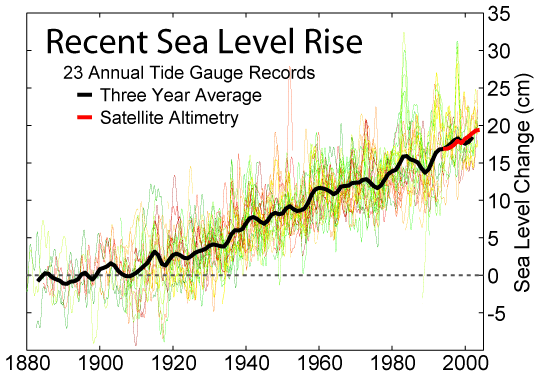
it is important to note that Sea Levels increased at a similar pace during the first half of the 20th century, before anthropogenic CO2 emissions were sufficient to have a significant influence on “Earth’s Temperature” and Sea Level:
Snow and Ice:
A proxy often cited when measuring “Earth’s Temperature” is amount of Snow and Ice on Earth. According to the United States Geological Survey (USGS), “The vast majority, almost 90 percent, of Earth’s ice mass is in Antarctica, while the Greenland ice cap contains 10 percent of the total global ice mass.” Source USGA
However, there is currently no generally accepted measure of ice volume, as Cryosat is still in validation and the accuracy of measurements from Grace are still being challenged. Sea Ice Area and Extent are cited as proxies for “Earth’s Temperature”, however there is significant evidence that the primary influences on Sea Ice Area and Extent are in fact wind and Atmospheric Oscillations.
With this said, here are
Global, Arctic & Antarctic Sea Ice Area from 1979 to Present;

Global Sea Ice Area Anomaly – 1979 to Present:

Northern Hemisphere Sea Ice Area Anomaly, 1979 to Present;

Southern Hemisphere Sea Ice Area Anomaly, 1979 to Present;

Arctic Sea Ice Extent – 15% or greater

Antarctic Sea Ice Extent – 15% or Greater;

and Sea Ice Extent – Change in Maximum, Mean and Minimum:

There appears to have been a negative trend in Northern Hemisphere Sea Ice Area and Extent, especially around Minimum and a positive trend in Southern Hemisphere Sea Ice Area and Extent, thus the resultant Global Sea Ice Area trend appears to be slightly negative. However, in recent years does appear to be a pause as a result of increases in Southern Hemisphere Sea Ice Area and Extent, balancing out decreases in Northern Hemisphere Sea Ice Area and Extent.
In terms of land based data, here is 20 Year Northern Hemisphere Snow Cover with 1995 – 2009 Climatology from NCEP/NCAR;

Northern Hemisphere Snow Cover Anomalies 1966 – Present from NCEP/NCAR;

Northern Hemisphere Winter Snow Extent – 1967 to Present from Rutgers University;

Northern Hemisphere Spring Snow Extent – 1967 to Present:

Northern Hemisphere Fall Snow Extent – 1967 to Present:

While none of the Snow plots offers a global perspective, when looking at the Northern Hemisphere, there appears to have been a slight increase in Snowcover and Winter Snow Extent, a decrease in Spring Snow Extent and no change in Fall Snow Extent over the historical record.
Based on the limited Global Ice and Snow measurements available, and noting the questionable value of Sea Ice Area and Extent as a proxy for temperature, not much inference can currently be drawn from Earth’s Ice and Snow measurements. However, there does appear to be a pause in Global Sea Ice Area.
Conclusion:
The Pause in “Earth’s Temperature” appears in many of Earth’s observational records, with The Pause lasting for at least a decade, and in reasonable portion of the records, it appears to have begun with the strong 1998 El Nino. The questions now are how long will The Pause last and where will “Earth’s Temperature” go from there?
Additional information on “Earth’s Temperature” can be found in the WUWT Reference Pages, including the Global Temperature Page and Global Climatic History Page
Please note that WUWT cannot vouch for the accuracy of the data/graphics within this article, nor influence the format or form of any of the graphics, as they are all linked from third party sources and WUWT is simply an aggregator. You can view each graphic at its source by simply clicking on it.
Pause??
For most of the time over the last several decades of global warming it would have been possible to claim (if you didn’t do any analysis and didn’t understand temperature/time series) that there was a “pause” in global temperature increase. See:
http://www.woodfortrees.org/plot/hadcrut4gl/from:1975/plot/hadcrut4gl/last:120/trend/plot/hadcrut4gl/from:1990/to:1997/trend/plot/hadcrut4gl/from:1980/to:1987.5/trend/plot/hadcrut4gl/from:1997.5/to:2003/trend
Meanwhile, temperatures have continued to increase.
Any reason for missing the summer Northern Hemisphere snow cover from the analysis?
Slioch says: April 16, 2013 at 1:01 am WoodForTrees.org – Paul Clark – Click the pic to view at source[/caption]
Pause??
For most of the time over the last several decades of global warming it would have been possible to claim (if you didn’t do any analysis and didn’t understand temperature/time series) that there was a “pause” in global temperature increase. See:
http://www.woodfortrees.org/plot/hadcrut4gl/from:1975/plot/hadcrut4gl/last:120/trend/plot/hadcrut4gl/from:1990/to:1997/trend/plot/hadcrut4gl/from:1980/to:1987.5/trend/plot/hadcrut4gl/from:1997.5/to:2003/trend
Which one of those lines is longest and which two lines are closest together?
[caption id="" align="alignnone" width="578"]
Werner Brozek says: April 15, 2013 at 9:32 pm
For example, do you perhaps want the maximum time above 6? years where the slope is at least -0.002? for example?
Can we do the period of decline that is statistically significant to two sigmas?
justthefactswuwt
“Which one of those lines is longest and which two lines are closest together?”
Answer: i) green, last ten years.
ii) green and turquoise
The implication of your questions is that although no-one claims that the first two declines shown on the above graph (ie from 1980 to 1987.5 and from 1990 to 1997) signified a real pause in global warming, the present decline (last ten years) does so.
The period during which those first two declines occurred is universally recognised as a period of global warming. Indeed, Clay Marley, April 14, 2013 at 12:02 pm, emphasised that point earlier, referring to, “a brief 20 year period of warming, from about 1978 to 1998”.
The present decline is just a few years longer than those previous declines, (though none of the decline trends shown are statistically significant).
Do you regard the present decline as signifying a pause in global warming when previous declines manifestly did not?
If ‘yes’, what is your justification for so doing?
If ‘no’, what are you on about?
Outstanding article JTF. Thanks. It’s a great compilation.
Pause, hiatus, peak, rest, the semantics are irrelevant. The fact the IPCC acknowledges this “plateauX” is relevant and important.
One wise commenter’s adage ” The truth is the daughter of time” , sums it well. We’ll see in time what the correct verb is.
I personally am ecstatic over the fact that we all aren’t doomed. Why is good news rejected readily while bad news sticks and sinks in?
“Verb” should be “verbage”. oops.
Wouldn’t it be more useful to consider a longer period of time? I’m new to this issue, but I do understand the idea of geologic time. Is a mere decade and a half really anything worth noting?
REPLY: We had less than 10 years up uptrend in June 1988 when James Hansen went before Congress and told them we had to do something. – Anthony
There’s a pretty detailed critique of the snow and ice portion of this post at the following:
http://tamino.wordpress.com/2013/04/15/not-just-the-facts-the-wrong-conclusions-too/#more-6639
Anthony: OK, I get your point although I did not know that. But the point is the same, wasn’t it? The short timescale really moots the discussion?
I mean isn’t the high variability in climate data explained by ‘weather’? And that’s why we use longer timescales? i admit I’m confused over this very long post because it is only talking about a short period of time and I don’t see how the decade and a half data is useful? In the end, the conclusions are that, yes, there’s a pause, and it’s clear in many different data sets and in the same (short) time period. But so what?
I recall seeing someplace a graph with a longer timescale showing similar episodic ‘pauses’ that were nonetheless buried in an overall and significant upward trend. That’s all.
msadesign:
I’m sure you have seen such a graph. It’s called “the escalator”. here it is:
http://www.skepticalscience.com/graphics.php?g=47
From claimsguy on April 16, 2013 at 10:41 am:
Don’t forget the matching WUWT article:
‘Skeptical Science’ Misrepresents Their Animation “The Escalator”
http://wattsupwiththat.com/2012/11/25/skeptical-science-misrepresents-their-animation-the-escalator/
Yeah, Hansen was forewarning Congress about impending warming (predicated on established physical processes), there would’ve been no point in him doing that after the fact.
REPLY: and…SCHWING! the point goes right over his head.- A
justthefactswuwt says:
April 16, 2013 at 5:54 am
Can we do the period of decline that is statistically significant to two sigmas?
No, we are not even close. When you have short times, the error bars are huge. And when the times are long, we just have not had that much cooling. The closest seems to be RSS from December 1997 and even that is -0.044 ±0.241 °C/decade (2σ). Hadcrut3 from that point is -0.010 ±0.146 °C/decade (2σ).
However even if we cannot show this to any significance, the diagrams I showed before clearly show the sine wave part and that we are on the way down.
msadesign says:
April 16, 2013 at 9:29 am
Wouldn’t it be more useful to consider a longer period of time? I’m new to this issue, but I do understand the idea of geologic time. Is a mere decade and a half really anything worth noting?
According to NOAA, 15 years of no change is significant in terms of how trustworthy their models are.
NOAA says the following:
”The simulations rule out (at the 95% level) zero trends for intervals of 15 yr or more, suggesting that an observed absence of warming of this duration is needed to create a discrepancy with the expected present-day warming rate.”
To verify this for yourself, see page 23 at:
http://www1.ncdc.noaa.gov/pub/data/cmb/bams-sotc/climate-assessment-2008-lo-rez.pdf
See:
http://newsbusters.org/blogs/noel-sheppard/2012/12/04/climate-realist-marc-morano-debates-bill-nye-science-guy-global-warmi#ixzz2E8w1uK5F
Here is part of the exchange between Nye and Morano:
“MORANO: Sure. Carbon dioxide is rising. What’s your point?
NYE: OK.
MORANO: No.
NYE: So here’s the point, is it’s rising extraordinarily fast. That’s the difference between the bad old days and now is it’s –”
Note that it is Nye who says that CO2 is “ rising extraordinarily fast”. See:
http://www.woodfortrees.org/plot/esrl-co2/from:1958
That makes it all the more puzzling why temperatures have not risen in 16 years or more on three data sets.
Slioch says: April 16, 2013 at 6:11 am
“Which one of those lines is longest and which two lines are closest together?”
Answer: i) green, last ten years.
ii) green and turquoise
The implication of your questions is that although no-one claims that the first two declines shown on the above graph (ie from 1980 to 1987.5 and from 1990 to 1997) signified a real pause in global warming, the present decline (last ten years) does so.
The period during which those first two declines occurred is universally recognised as a period of global warming. Indeed, Clay Marley, April 14, 2013 at 12:02 pm, emphasised that point earlier, referring to, “a brief 20 year period of warming, from about 1978 to 1998″.
The present decline is just a few years longer than those previous declines, (though none of the decline trends shown are statistically significant).
Do you regard the present decline as signifying a pause in global warming when previous declines manifestly did not?
If ‘yes’, what is your justification for so doing?
If ‘no’, what are you on about?
No, I regard the present 10 year decline in temperatures as interesting and worthy of more research and careful monitoring. I find the 12 – 16 year period of flat temperatures as evidence of The Pause in temperatures, which runs counter to the Catastrophic Anthropogenic Global Warming narrative.
wbrozek says: April 16, 2013 at 4:58 pm
No, we are not even close. When you have short times, the error bars are huge. And when the times are long, we just have not had that much cooling. The closest seems to be RSS from December 1997 and even that is -0.044 ±0.241 °C/decade (2σ). Hadcrut3 from that point is -0.010 ±0.146 °C/decade (2σ).
However even if we cannot show this to any significance, the diagrams I showed before clearly show the sine wave part and that we are on the way down.
Understood, but I think we want to be really careful with how talk about decline, as we have limited confidence in it and don’t want to do exactly what the Warmists have done, i.e. ignore the uncertainty in the rush to prove a point. I like your positioning of Pause versus Peak, as it raises the subject without getting too far into length or significance of the decline.
johnbelljubble says: April 16, 2013 at 4:52 am
Any reason for missing the summer Northern Hemisphere snow cover from the analysis?
The source, Rutgers University doesn’t appear to offer one, i.e.;
http://climate.rutgers.edu/snowcover/chart_seasonal.php?ui_set=nhland&ui_season=1
If someone can offer a reputable source for Summer Northern Hemisphere Snow Cover I’ll review it for inclusion.
garhighway says: April 16, 2013 at 9:53 am
There’s a pretty detailed critique of the snow and ice portion of this post at the following:
http://tamino.wordpress.com/2013/04/15/not-just-the-facts-the-wrong-conclusions-too/#more-6639
It’s pretty funny that Tamino managed to skip over all of the actual temperature records and relied on the proxy section that led off with this warning:
None of credible temperature records support the Warmists’ position, so Tamino is stuck parroting Arctic sea ice and deep ocean heat as the last bastions of collapsing ideology. Tamino admitted as much in a recent article:
Got it, so if you adjust the temperature data sets based on a bunch of assumptions you can tease a warming trend out of one of them. Now I’m convinced, there is definitely no pause, clearly there’s runaway rapid accelerating dangerous extreme disruptive global climate weirding warming change right around the corner…
From Tamino:
[Response: Got it: when “justthefactswuwt” is caught peddling falsehoods about ice and snow, he won’t admit he’s mistaken or even respond to that at all — instead he’ll change the subject.]
garhighway says: April 17, 2013 at 11:08 am Cryosphere Today – Arctic Climate Research at the University of Illinois – Click the pic to view at source[/caption]
 Data from Arctic Climate Research at the University of Illinois[/caption]
 Data from Arctic Climate Research at the University of Illinois[/caption]
From Tamino:
[Response: Got it: when “justthefactswuwt” is caught peddling falsehoods about ice and snow, he won’t admit he’s mistaken or even respond to that at all — instead he’ll change the subject.]
That’s pretty hypocritical coming coming from a guy who wouldn’t “admit he’s mistaken or even respond to that at all” when I destroyed his gibberish about Extreme Weather here:
http://wattsupwiththat.com/2012/11/23/crowdsourcing-the-wuwt-extreme-weather-reference-page/
Anyway, the only coherent argument I can distill from Tamino’s article is that he took issue with my statements that “in recent years does appear to be a pause as a result of increases in Southern Hemisphere Sea Ice Area and Extent, balancing out decreases in Northern Hemisphere Sea Ice Area and Extent.” and “there does appear to be a pause in Global Sea Ice Area.”
As such, here’s the chart I was referring to;
[caption id="" align="alignnone" width="640"]
here’s the associated data;
http://arctic.atmos.uiuc.edu/cryosphere/timeseries.global.anom.1979-2008
here’s a graph of the data since 2005;
[caption id="" align="alignnone" width="640"]
and here’s a graph of the data since 2006;
[caption id="" align="alignnone" width="640"]
The trend since 2005 is slightly negative, the trend since 2006 is slightly positive, hence The Pause in Global Sea Ice Area has lasted for between 6 to 7 years. Certainly not as long as The Pause in temperatures that Tamino so judiciously avoids, but a Pause nonetheless.
tamina has such a small following that his blog amounts to a thinly-populated echo chamber. He actually appears to believe that global warming is rising fast, and that the 2000s were the warmest decade, and that the rise in CO2 is the primary cause of global warming.
None of those assumptions are supported by verifiable scientific evidence or observations. CO2 continues its steady rise, with no commensurate global warming as was universally predicted by Hansen, Trenberth, the IPCC, and many others. In any other field of science, the fact that CO2 does not cause the predicted global warming would blow the CO2=AGW conjecture out of the water; grant funding would dry up, and honest scientists would be discussing why their CO2 conjecture was so very wrong.
But not in climate ‘science’, which is not science at all, but politics. Thus, tamina is playing politics, overlaid by a thin veneer of pseudo-‘science’. Unfortunately for him, the real world is busy falsifying his beliefs. And now the general public is beginning to wonder why the “carbon” scare is still being promoted. The answer, of course, is money, and lots of it. And the Sequester appears to have left that funding source unscathed.
At a loss myself and getting negative by the month…
http://nsidc.org/data/seaice_index/