

Image Credit: NASA and BP.Blogspot.com
By WUWT regular “Just The Facts”
Recently there has been significant attention focused on “The Pause” in Earth’s warming, the length of “The Pause” and where “Earth’s Temperature” may go from here, e.g.: “Over the past 15 years air temperatures at the Earth’s surface have been flat while greenhouse-gas emissions have continued to soar.” The Economist “Global warming stopped 16 years ago, reveals Met Office report quietly released… and here is the chart to prove it.” Daily Mail “Twenty-year hiatus in rising temperatures has climate scientists puzzled.” The Australian “Has the rise in temperatures ‘paused’?” Guardian “On Tuesday, news finally broke of a revised Met Office ‘decadal forecast’, which not only acknowledges the pause, but predicts it will continue at least until 2017.” Daily Mail “RSS global satellite temperatures confirm hiatus of global warming, while the general public and mainstream press are now recognizing the AWOL truth that skeptics long ago identified…global temperatures are trending towards cooling, not accelerating higher” C3 Headlines
From Werner Brozek’s recent article:
1. For GISS, the slope is flat since January 2001 or 12 years, 2 months. (goes to February)
2. For Hadcrut3, the slope is flat since April 1997 or 15 years, 11 months. (goes to February)
3. For a combination of GISS, Hadcrut3, UAH and RSS, the slope is flat since December 2000 or an even 12 years. (goes to November)
4. For Hadcrut4, the slope is flat since November 2000 or 12 years, 4 months. (goes to February)
5. For Hadsst2, the slope is flat from March 1, 1997 to March 31, 2013, or 16 years, 1 month.
From those data points it appears that The Pause is at least 12 years old, but let us dig deeper into the observational data to see “The Pause” in “Earth’s Temperature”.
Global Surface Temperatures:
Generally, when referring to Earth’s “climate” warming, proponents of the Catastrophic Anthropogenic Global Warming (CAGW) narrative refer to Earth’s Surface Temperature, e.g. “Global warming is the unusually rapid increase in Earth’s average surface temperature over the past century primarily due to the greenhouse gases released by people burning fossil fuels.” NASA Earth Observatory
As such, here’s NASA’s Goddard Institute for Space Studies (GISS) Global Monthly Mean Surface Temperature Anomaly – 1996 to Present:

NOAA’s – National Climate Data Center – Year To Date Global Temperature Anomalies – 2012 ranked 10th:
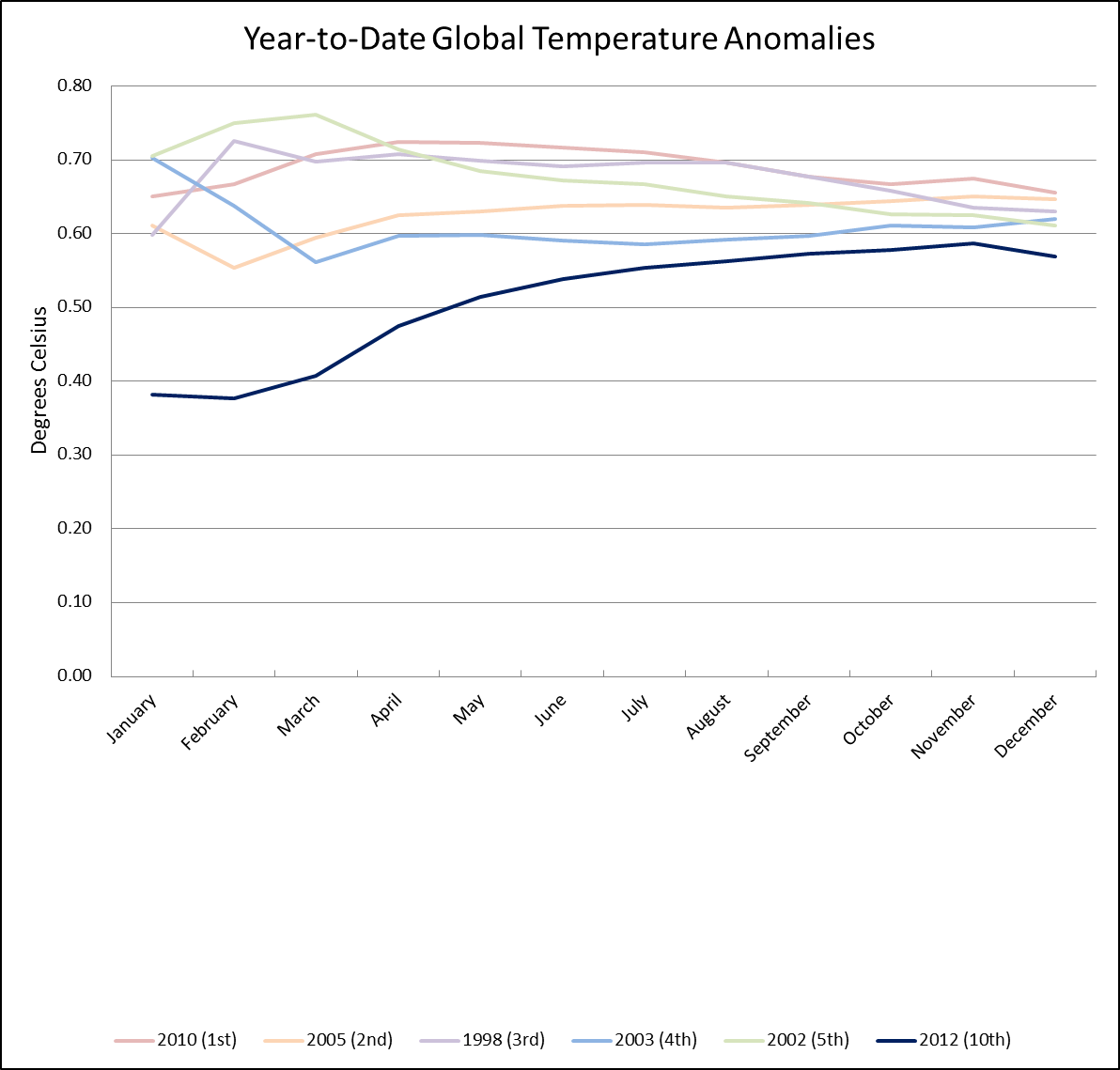
NOAA’s – National Climate Data Center – Annual Global Land and Ocean Temperature Anomalies:

UK Met Office’s – Hadley Center – Climate Research Unit (CRU) Annual Global Average Land and Ocean Temperature Anomaly – 1850 to 2012
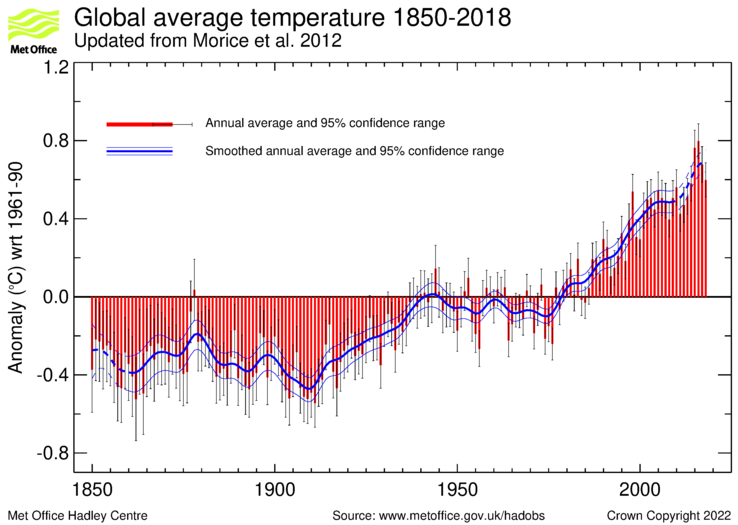
and the UK Met Office – Hadley Center – Climate Research Unit (CRU) Monthly Global Average Land Temperature – 1850 to 2012
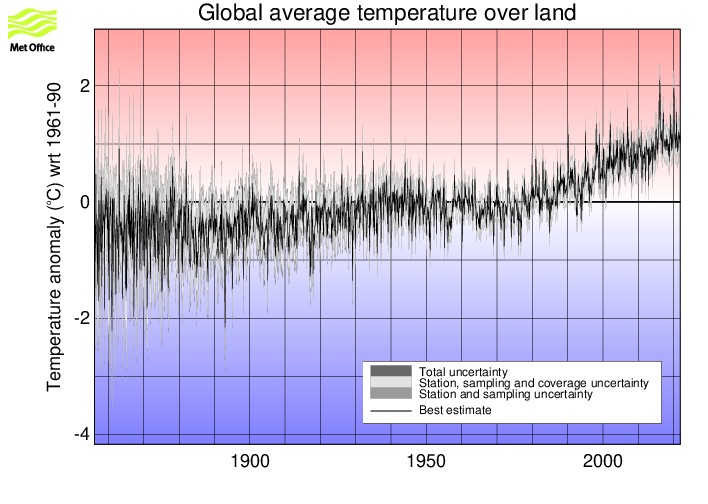
The Pause appears to apparent in Earth’s Land and Surface Temperature record, and if anything the trend appears to be down in the last several years. However, the surface temperature records are burdened with issues of questionable siting, changes in siting, changes in equipment, changes in the number of measurement locations, modeling to fill in gaps in measurement locations, corrections to account for missing, erroneous or biased measurements, and the urban heat island effect. Thus to see the big picture on the temperature “Earth’s Temperature”, it also helps to look up.
Atmospheric Temperatures:
Since 1979 Earth’s “temperature” has also been measured via satellite. “The temperature measurements from space are verified by two direct and independent methods. The first involves actual in-situ measurements of the lower atmosphere made by balloon-borne observations around the world. The second uses intercalibration and comparison among identical experiments on different orbiting platforms. The result is that the satellite temperature measurements are accurate to within three one-hundredths of a degree Centigrade (0.03 C) when compared to ground-launched balloons taking measurements of the same region of the atmosphere at the same time.” NASA
Here is RSS Global Temperature Lower Troposphere (TLT) – Brightness Temperature Anomaly- 1979 to Present;


and this is the University of Alabama – Hunstville (UAH) Global Lower Atmosphere Temperature Anomalies – 1979 to Present:
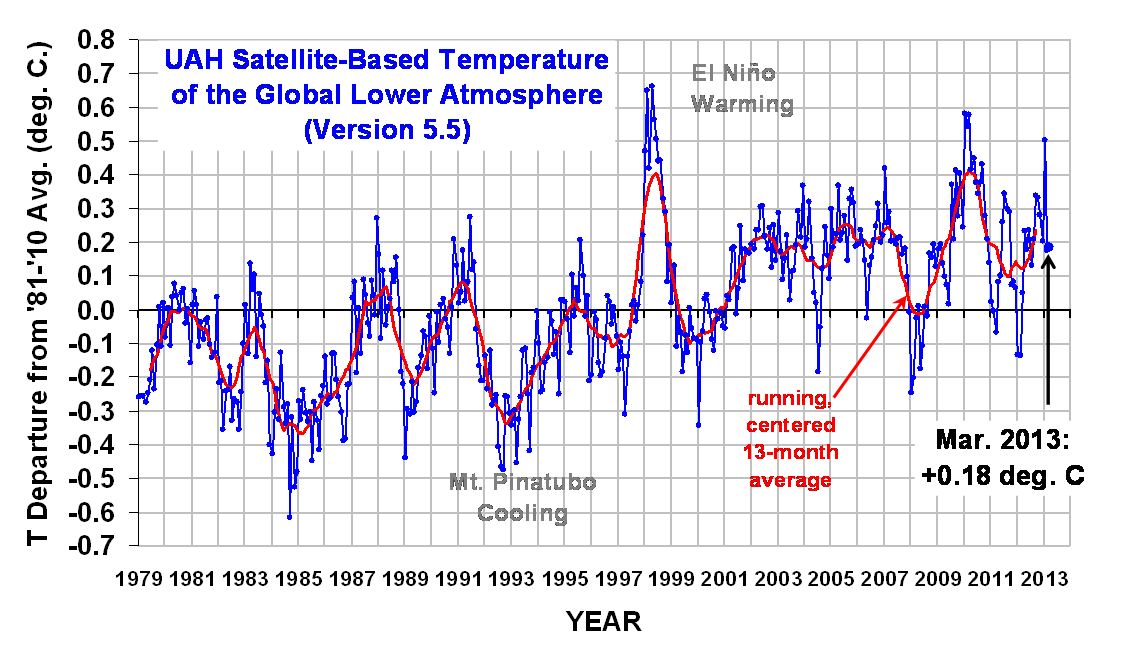
Note: Per John Christy, RSS and UAH anomalies are not comparable because they use different base periods, i.e., “RSS only uses 1979-1998 (20 years) while UAH uses the WMO standard of 1981-2010.”
The March UAH Lower Atmosphere Temperature Anomaly was .18 degrees C above the 30 year average and RSS Global Global Lower Troposphere shows a .130 degrees C increase per decade.
When we look at Earth’s “canaries”, i.e. RSS Northern Polar Temperature Lower Troposphere (TLT) Brightness Temperature Anomaly;

appears to have paused and is currently below the 30 year average, and RSS Southern Polar Temperature Lower Troposphere (TLT) Brightness Temperature Anomaly;

looks like it has been in The Pause for its entire record.
To this point we’ve only addressed the Lower Troposphere Temperatures, the following Temperature Anomaly plots from RSS will increase in altitude as is illustrated here:
Here is RSS Temperature Middle Troposphere (TMT)- Brightness Temperature Anomaly- 1979 to Present;

According to Remote Sensing Systems, “For Channel (TLT) (Lower Troposphere) and Channel (TMT) (Middle Troposphere), the anomaly time series is dominated by ENSO events and slow tropospheric warming. The three primary El Niños during the past 20 years are clearly evident as peaks in the time series occurring during 1982-83, 1987-88, and 1997-98, with the most recent one being the largest.” RSS
Middle Tropospheric temperatures appear to show slow warming overlaid with the El Niño/La Niña Southern Oscillation (ENSO) cycle, including several comparatively large El Niño events. Middle Tropospheric temperatures appear to entered The Pause with the large El Niño in 1998.
Moving higher in the atmosphere, RSS Temperature Troposphere / Stratosphere (TTS) – Brightness Temperature Anomaly- 1987 to Present;

has been in The Pause since records began in 1987, with a trend of just -.002 K/C per decade.
The 1997-98 and 2009 – 10 El Niño events are still readily apparent in the Troposphere / Stratosphere plot above, as is a spike from the 1991 eruption of Mt. Pinatubo. Note that the effect of Mt. Pinatubo is the opposite in the Lower and Middle Troposphere versus the Troposphere / Stratosphere (TTS), i.e. “Large volcanic eruptions inject sulfur gases into the stratosphere; the gases convert into submicron particles (aerosol) with an e-folding time scale of about 1 year. The climate response to large eruptions (in historical times) lasts for several (2-3) years. The aerosol cloud causes cooling at the Earth’s surface, warming in stratosphere.”
Ellen Thomas, PHD Wesleyan University
It is interesting that, incorporating the impact of three significant surface driven warming events, Troposphere / Stratosphere Temperatures (TTS) have been quite stable, however there is a bit of regional variation here, e.g.:
RSS Northern Hemisphere Temperature Troposphere / Stratosphere (TTS) – Brightness Temperature Anomaly- 1987 to Present;

has been increasing by .041 K/C per decade, but is currently below average, whereas the RSS Southern Hemisphere Temperature Troposphere / Stratosphere (TTS) – Brightness Temperature Anomaly- 1987 to Present;

has been decreasing by -.045 K/C per decade, but is currently well above average after a recent spike.
Moving higher still in the atmosphere, the RSS Temperature Lower Stratosphere (TLS) – Brightness Temperature Anomaly – 1979 to Present;

“is dominated by stratospheric cooling, punctuated by dramatic warming events caused by the eruptions of El Chichon (1982) and Mt Pinatubo (1991).” RSS
The eruptions of El Chichon and Mt Pinatubo are readily apparent in the Apparent Atmospheric Transmission of Solar Radiation at Mauna Loa, Hawaii:
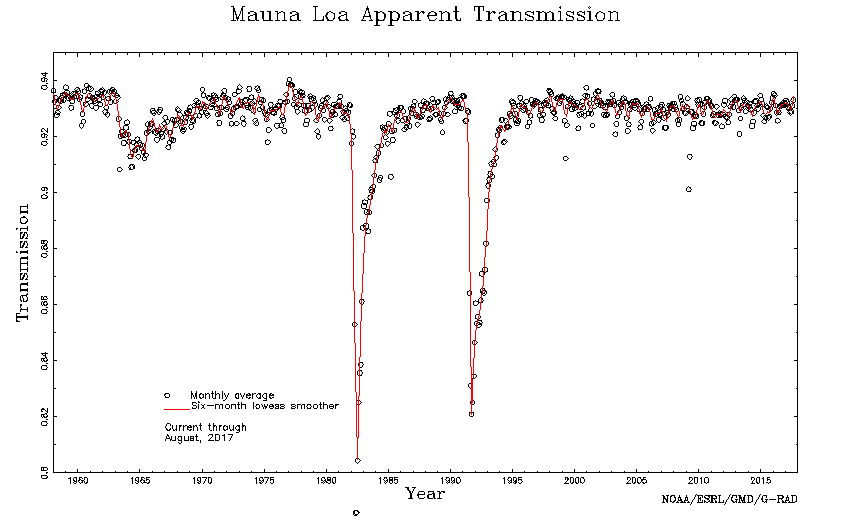
“The stratosphere” … “in contrast to the troposphere, is heated, as the result of near infrared absorption of solar energy at the top of the aerosol cloud, and increased infra-red absorption of long-wave radiation from the Earth’s surface.”
“The stratospheric warming in the region of the stratospheric cloud increases the latitudinal temperature gradient after an eruption at low latitudes, disturbing the stratospheric-troposphere circulation, increasing the difference in height of the troposphere between high and low latitudes, and increasing the strength of the jet stream (polar vortex, especially in the northern hemisphere). This leads to warming during the northern hemisphere winter following a tropical eruption, and this warming effect tends to be larger than the cooling effect described above.” Ellen Thomas, PHD Wesleyan University
The Lower Stratosphere experienced “dramatic warming events caused by the eruptions of El Chichon (1982) and Mt Pinatubo (1991).” RSS “The long-term, global-mean cooling of the lower stratosphere stems from two downward steps in temperature, both of which are coincident with the cessation of transient warming after the volcanic eruptions of El Chichon and Mt. Pinatubo.” … “Here we provide observational analyses that yield new insight into three key aspects of recent stratospheric climate change. First, we provide evidence that the unusual step-like behavior of global-mean stratospheric temperatures is dependent not only upon the trend but also on the temporal variability in global-mean ozone immediately following volcanic eruptions. Second, we argue that the warming/cooling pattern in global-mean temperatures following major volcanic eruptions is consistent with the competing radiative and chemical effects of volcanic eruptions on stratospheric temperature and ozone. Third, we reveal the contrasting latitudinal structures of recent stratospheric temperature and ozone trends are consistent with large-scale increases in the stratospheric overturning Brewer-Dobson circulation” David W. J. Thompson Colorado State University
Above the Stratosphere we have the Mesosphere and Thermosphere, neither of which have I identified current temperature time series for, but of note is that on “July 15, 2010” “A Puzzling Collapse of Earth’s Upper Atmosphere” occurred when “high above Earth’s surface where the atmosphere meets space, a rarefied layer of gas called “the thermosphere” recently collapsed and now is rebounding again.”

“This is the biggest contraction of the thermosphere in at least 43 years,” says John Emmert of the Naval Research Lab, lead author of a paper announcing the finding in the June 19th issue of the Geophysical Research Letters (GRL). “It’s a Space Age record.”
The collapse happened during the deep solar minimum of 2008-2009—a fact which comes as little surprise to researchers. The thermosphere always cools and contracts when solar activity is low. In this case, however, the magnitude of the collapse was two to three times greater than low solar activity could explain.
“Something is going on that we do not understand,” says Emmert.
The thermosphere ranges in altitude from 90 km to 600+ km. It is a realm of meteors, auroras and satellites, which skim through the thermosphere as they circle Earth. It is also where solar radiation makes first contact with our planet. The thermosphere intercepts extreme ultraviolet (EUV) photons from the sun before they can reach the ground. When solar activity is high, solar EUV warms the thermosphere, causing it to puff up like a marshmallow held over a camp fire. (This heating can raise temperatures as high as 1400 K—hence the name thermosphere.) When solar activity is low, the opposite happens.” NASA
In summary, Earth’s Lower and Middle Troposphere appear to have warmed slowly, overlaid with the El Niño/La Niña Southern Oscillation (ENSO) cycle, including four comparatively large El Niño events, and tempered by the cooling effects of the eruption of El Chichon (1982) and Mt Pinatubo (1991). Lower and Middle Tropospheric temperatures appear to have paused since the large El Niño in 1998. Tropospheric / Stratospheric temperatures appear to have been influenced by at least three significant surface driven warming events, the 1997-98 El Niño, and the eruptions of El Chichon in 1982 and Mt Pinatubo in 1991, but have maintained a stable overall trajectory. Stratospheric temperatures appear to have experienced two “dramatic warming events caused by the eruptions of El Chichon (1982) and Mt Pinatubo (1991).”, and “unusual step-like behavior of global-mean stratospheric temperatures” which has resulted in a significant stratospheric cooling during the last 30 years. Lastly, “during deep solar minimum of 2008-2009” “the biggest contraction of the thermosphere in at least 43 years” occurred and “The magnitude of the collapse was two to three times greater than low solar activity could explain.”
Ocean Temperatures:
“The oceans can hold much more heat than the atmosphere. Just the top 3.2 metres of ocean holds as much heat as all the world’s air.” Commonwealth of Australia – Bureau of Meteorology
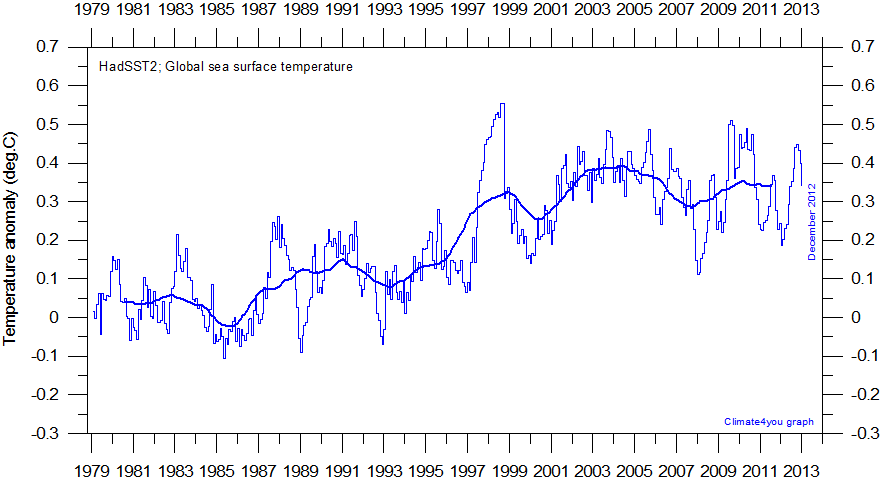
From a surface perspective Hadley Center’s HadSST2 Global Sea Surface Temperature Anomaly;
and NOAA’s – National Climate Data Center – Global Sea Surface Temperature Anomaly;
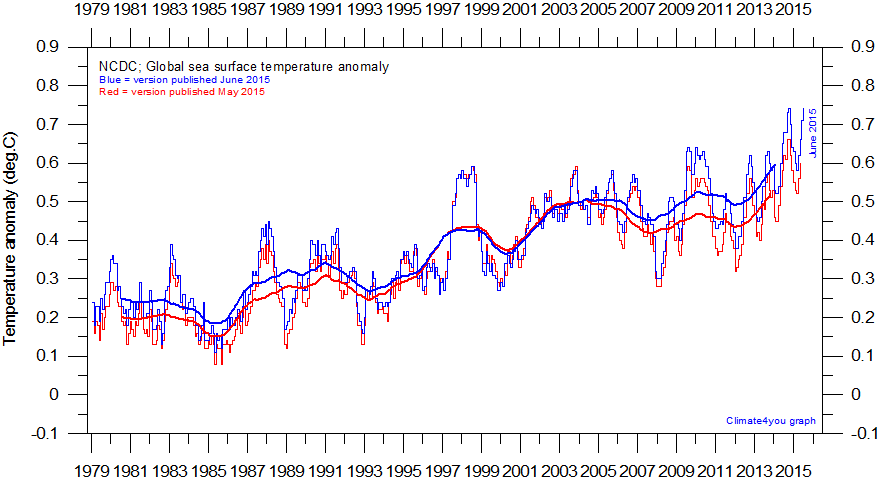
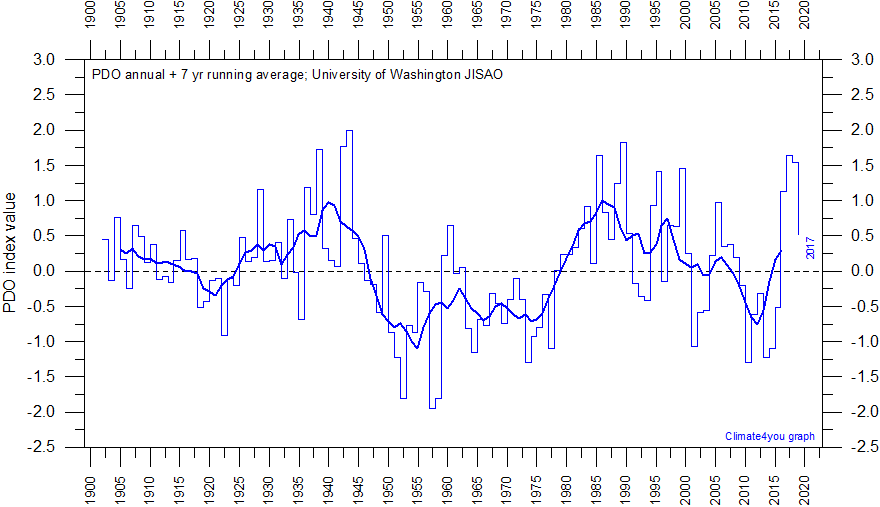
both appear to be well into The Pause. Furthermore, the Pacific Decadal Oscillation (PDO) Index is currently approaching lows not seen since Earth’s last cooling period:
Per Bob Tisdale’s research (1, 2), Pacific Sea Surface Temperatures;

haven’t warmed in 19+ years, East Pacific Ocean Sea Surface Temperatures from pole to pole (90S-90N, 180-80W);

haven’t warmed in 31+ years and Southern Ocean Sea Surface Temperatures;

have been cooling for more than 3 decades.
Obviously Sea Surface temperature only scratch the surface, thus changes in Ocean Heat Content are important in understanding “Earth’s Temperature”. Here is NOAA’s NODC Global Ocean Heat Content from 0-700 Meters – 1955 to Present;

and here is the same from Ole Humlum’s valuable climate data site Climate4you.com, NODC Global Ocean Heat Content – 0-700 Meters – 1979 to Present:
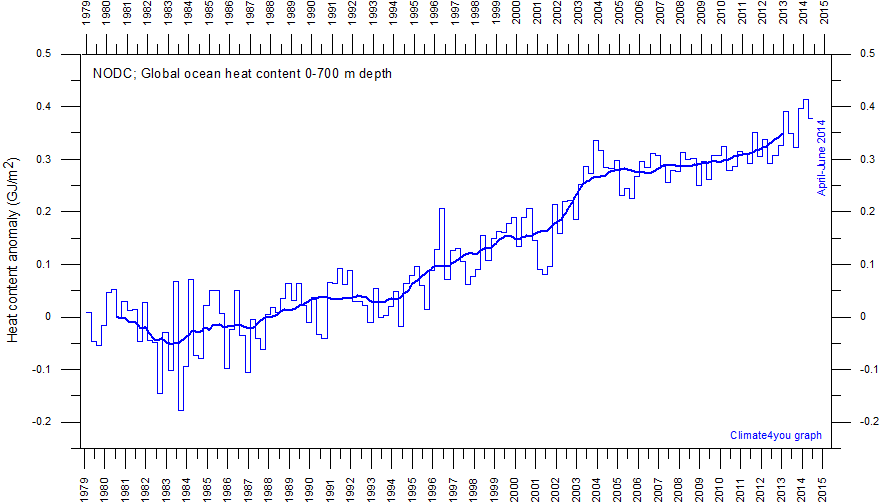
It seems apparent from the plots above that Global Ocean Heat has increased over the last several decades, and has not paused per se, however the rate of increase seems to have slowed significantly since 2004.
Sea Level:
“Global sea level is currently rising as a result of both ocean thermal expansion and glacier melt, with each accounting for about half of the observed sea level rise, and each caused by recent increases in global mean temperature. For the period 1961-2003, the observed sea level rise due to thermal expansion was 0.42 millimeters per year and 0.69 millimeters per year due to total glacier melt (small glaciers, ice caps, ice sheets) (IPCC 2007). Between 1993 and 2003, the contribution to sea level rise increased for both sources to 1.60 millimeters per year and 1.19 millimeters per year respectively (IPCC 2007).” Source NSIDC
Global Mean Sea Level Change – 1993 to Present:
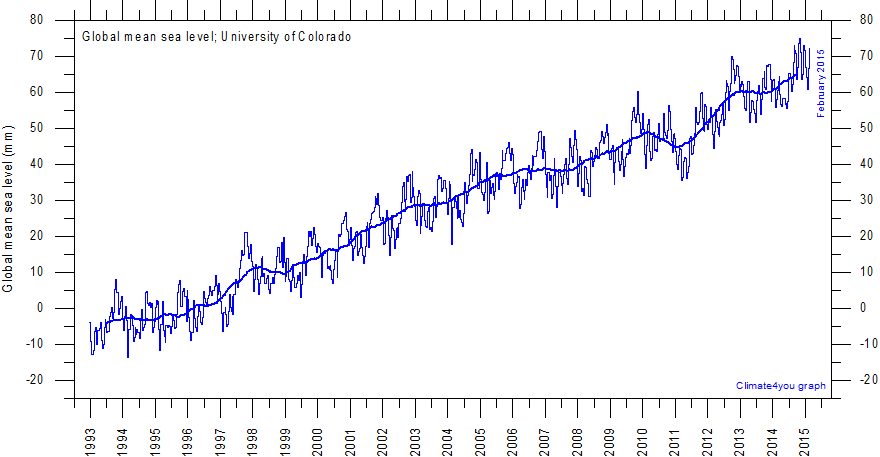
Global Mean Sea Level Change Map with a “Correction” of 0.3 mm/year added May, 5th 2011, due to a “Glacial Isostatic Adjustment (GIA)” – 1993 to Present;

While it appears that Sea Level Rise has continued recently;
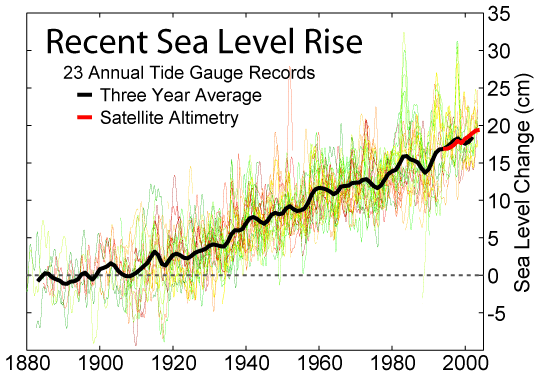
it is important to note that Sea Levels increased at a similar pace during the first half of the 20th century, before anthropogenic CO2 emissions were sufficient to have a significant influence on “Earth’s Temperature” and Sea Level:
Snow and Ice:
A proxy often cited when measuring “Earth’s Temperature” is amount of Snow and Ice on Earth. According to the United States Geological Survey (USGS), “The vast majority, almost 90 percent, of Earth’s ice mass is in Antarctica, while the Greenland ice cap contains 10 percent of the total global ice mass.” Source USGA
However, there is currently no generally accepted measure of ice volume, as Cryosat is still in validation and the accuracy of measurements from Grace are still being challenged. Sea Ice Area and Extent are cited as proxies for “Earth’s Temperature”, however there is significant evidence that the primary influences on Sea Ice Area and Extent are in fact wind and Atmospheric Oscillations.
With this said, here are
Global, Arctic & Antarctic Sea Ice Area from 1979 to Present;
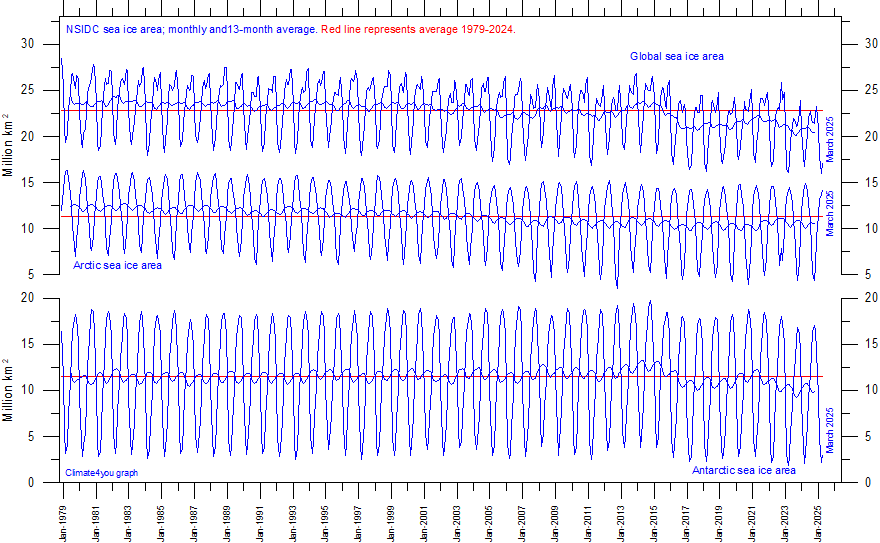
Global Sea Ice Area Anomaly – 1979 to Present:

Northern Hemisphere Sea Ice Area Anomaly, 1979 to Present;

Southern Hemisphere Sea Ice Area Anomaly, 1979 to Present;

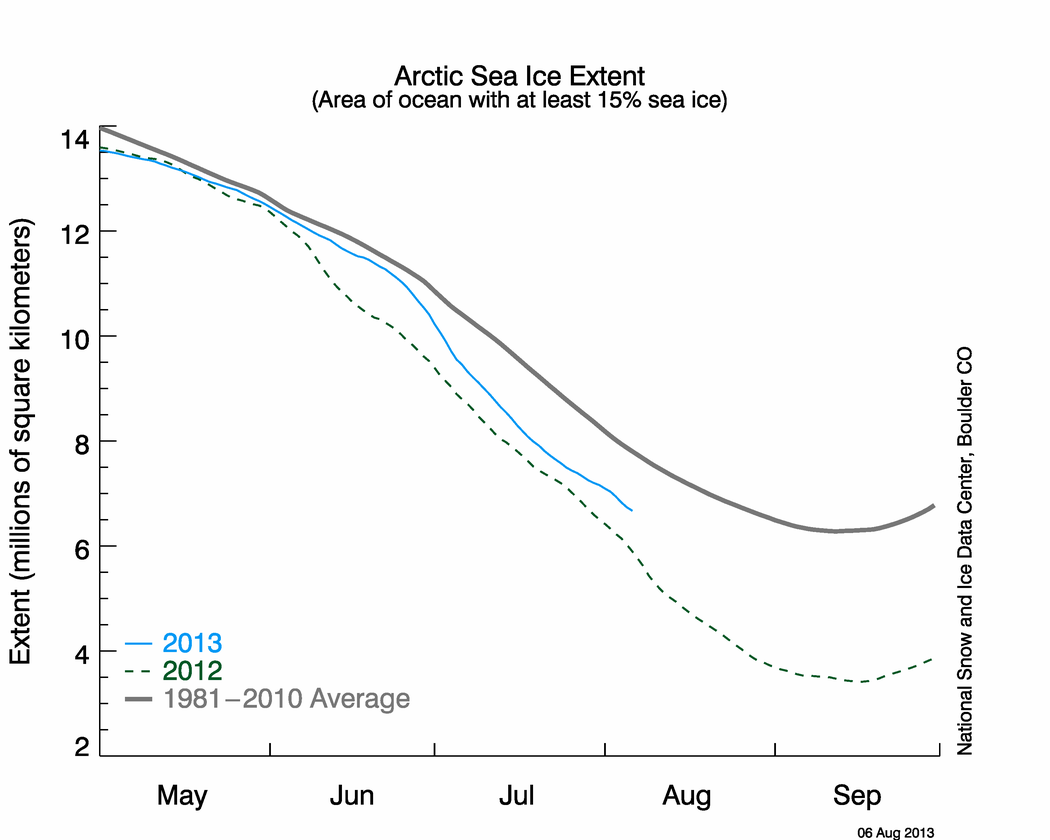
Arctic Sea Ice Extent – 15% or greater
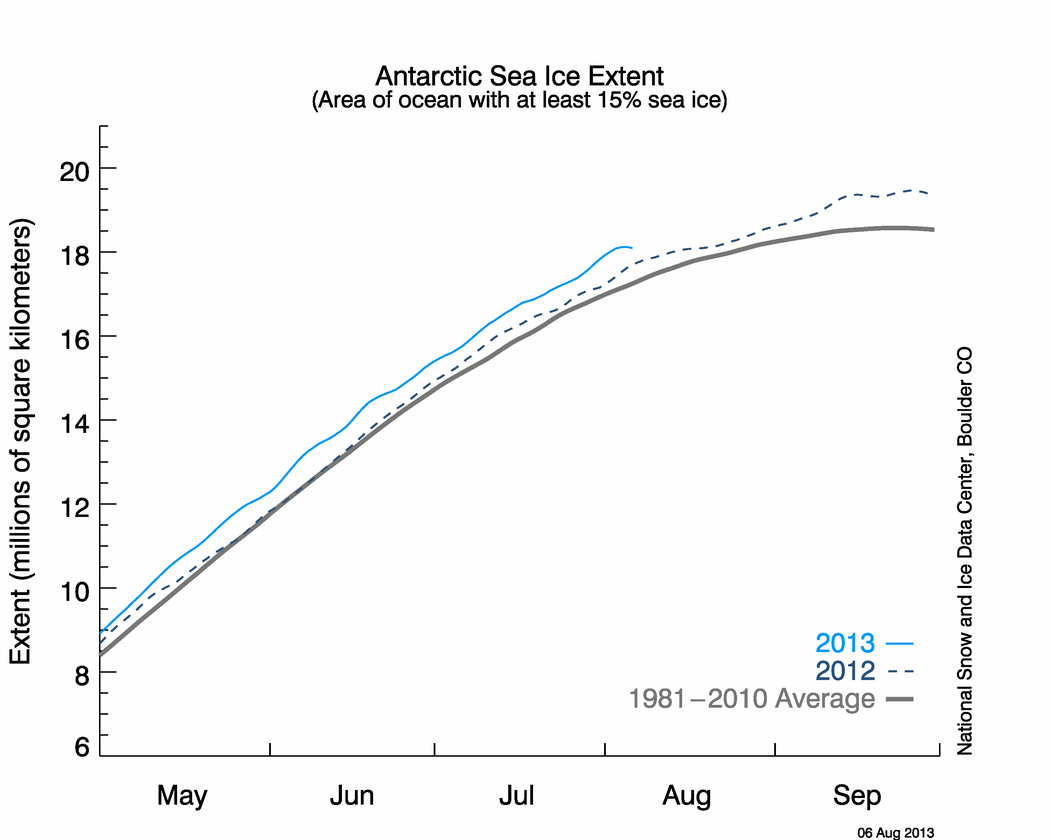
Antarctic Sea Ice Extent – 15% or Greater;
and Sea Ice Extent – Change in Maximum, Mean and Minimum:

There appears to have been a negative trend in Northern Hemisphere Sea Ice Area and Extent, especially around Minimum and a positive trend in Southern Hemisphere Sea Ice Area and Extent, thus the resultant Global Sea Ice Area trend appears to be slightly negative. However, in recent years does appear to be a pause as a result of increases in Southern Hemisphere Sea Ice Area and Extent, balancing out decreases in Northern Hemisphere Sea Ice Area and Extent.
In terms of land based data, here is 20 Year Northern Hemisphere Snow Cover with 1995 – 2009 Climatology from NCEP/NCAR;

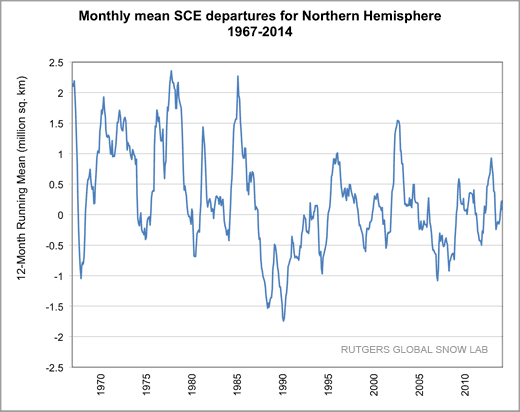
Northern Hemisphere Snow Cover Anomalies 1966 – Present from NCEP/NCAR;
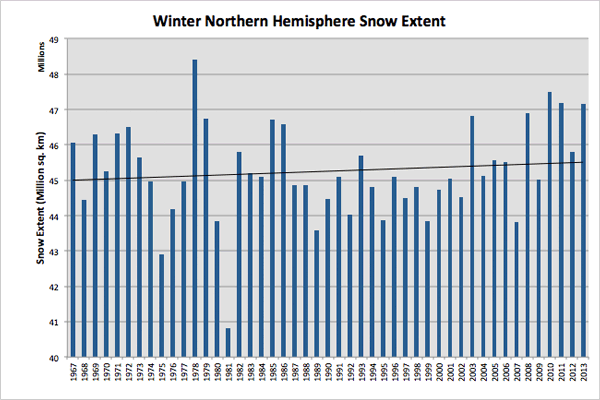
Northern Hemisphere Winter Snow Extent – 1967 to Present from Rutgers University;
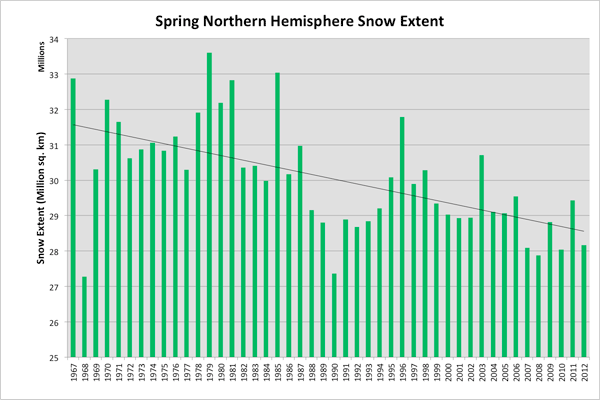
Northern Hemisphere Spring Snow Extent – 1967 to Present:
Northern Hemisphere Fall Snow Extent – 1967 to Present:
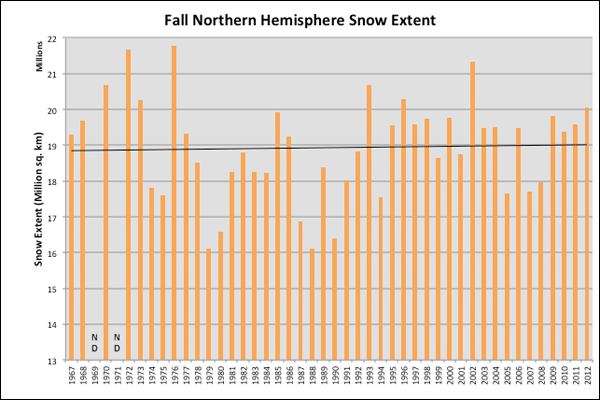
While none of the Snow plots offers a global perspective, when looking at the Northern Hemisphere, there appears to have been a slight increase in Snowcover and Winter Snow Extent, a decrease in Spring Snow Extent and no change in Fall Snow Extent over the historical record.
Based on the limited Global Ice and Snow measurements available, and noting the questionable value of Sea Ice Area and Extent as a proxy for temperature, not much inference can currently be drawn from Earth’s Ice and Snow measurements. However, there does appear to be a pause in Global Sea Ice Area.
Conclusion:
The Pause in “Earth’s Temperature” appears in many of Earth’s observational records, with The Pause lasting for at least a decade, and in reasonable portion of the records, it appears to have begun with the strong 1998 El Nino. The questions now are how long will The Pause last and where will “Earth’s Temperature” go from there?
Additional information on “Earth’s Temperature” can be found in the WUWT Reference Pages, including the Global Temperature Page and Global Climatic History Page
Please note that WUWT cannot vouch for the accuracy of the data/graphics within this article, nor influence the format or form of any of the graphics, as they are all linked from third party sources and WUWT is simply an aggregator. You can view each graphic at its source by simply clicking on it.
JTF, Nice work.
Just the facts? Well, pretty darn close. JP
The HadCRUT4 annual time series from the Met Office, is at
http://www.metoffice.gov.uk/hadobs/hadcrut4/diagnostics.html
HadCRUT4 includes 2012 and shows a near 0.05°C cooling from 2003 to 2012.
Anyone up for a betting pool based on Russian climatologists’ prognoses that beginning 2014 a 70-year “dead sun” Grand Solar Minimum will gather force, likely reaching the epic proportions of 1645 – 1715, when wolves froze to death in Rhineland forests and Louis XIV’s goblet frosted over at banquets in Versailles? If ice-breakup in Alaska excites the gambling confraternity, why not far more significant cooling just a year from now?
Habibullo Abdussamatov, Dr. Sc.
Head of Space Research Laboratory of the Pulkovo Observatory,
Head of the Russian/Ukrainian Joint Project Astrometria
Temporal changes in the power of the longwave radiation of the system Earth-atmosphere emitted to space always lag behind changes in the power of absorbed solar radiation due to slow change of its enthalpy.
That is why the debit and credit parts of the average annual energy budget of the terrestrial globe with its air and water envelope are practically always in an unbalanced state.
Average annual balance of the thermal budget of the system Earth-atmosphere during long time period will reliably determine the course and value of both an energy excess accumulated by the Earth or the energy deficit in the thermal budget which, with account for data of the TSI forecast, can define and predict well in advance the direction and amplitude of the forthcoming climate changes.
From early 90s we observe bicentennial decrease in both the TSI and the portion of its energy absorbed by the Earth.
The Earth as a planet will henceforward have negative balance in the energy budget which will result in the temperature drop in approximately 2014.
Due to increase of albedo and decrease of the greenhouse gases atmospheric concentration the absorbed portion of solar energy and the influence of the greenhouse effect will additionally decline.
The influence of the consecutive chain of feedback effects which can lead to additional drop of temperature will surpass the influence of the TSI decrease.
The onset of the deep bicentennial minimum of TSI is expected in 2042±11, that of the 19th Little Ice Age in the past 7500 years – in 2055±11.
See “Bicentennial Decrease of the Total Solar Irradiance Leads to Unbalanced Thermal Budget of the Earth and the Little Ice Age”, at http://www.ccsenet.org/journal/index.php/apr/article/view/14754 (Dr. Habibullo Abdussamatov, 2012, Applied Physics Research)
Doug Proctor writes:
“One would be to take the proxy data (easiest for tree-rings) of the last 150 years from a wide variety of places that have close, decent instrumental temperature records and compare the two.”
This is a beginning but it is way weak. Ground proxy studies in actual empirical research. Let me give you the flavor of this. Near each tree that you select as a tree ring proxy, select a few more. Use one of the additional as the null case. On the others, experiment. Add water to one. Fertilize another. Whatever is needed in that environment to determine what factors influence growth of trees. Carry on the experiment for decades, centuries if necessary. No climate scientist who uses proxies has ever performed experiments. All of them presume that tree rings are God’s chosen thermometers. None will discuss the matter. Yet they call themselves scientists.
Wanna’ mess with their minds? Just go around proclaiming that the ‘pause’ in the Earth’s cooling has finally ended! Shout it from the rooftops, “The cooling trend which continued unabated till the 1930s, 40s; leveled off and then briefly returned in the 70s and 80s, only to end, now appears to be resuming after this lengthy hiatus. After this, pause, the cooling trend has returned!”
Wanna’ really mess with their minds (or whatever organ substitutes for it)? Just scream, “Finally, finally the bitter cold cooling trend has returned! And it’s about time!”
Very enjoyable read about important information. The part about surface and ocean temperatures is more enjoyable, maybe because of your commentary. Emphasize the exceptional nature of satellite measurements of temperature. Use Mr. Tisdale’s work whenever possible.
Scary thought for the day:
Pause or Peak?
justthefactswuwt says: “Thus why is the PDO ‘a meaningless index for this discussion’?”
The PDO is an index that’s statistically created from the sea surface temperature anomalies of the North Pacific North of 20N. But it does not represent the sea surface temperature anomalies there. I believe, other than the Apparent Atmospheric Transmission of Solar Radiation, all of your other data represented temperature anomalies—except for the PDO index.
If you look at the map in the link you provided…
http://earthobservatory.nasa.gov/IOTD/view.php?id=8703
…the PDO data is derived from the sea surface temperatures north of 20N–about Hawaii, not the entire Pacific—where ENSO is dominant. Honolulu is at 21N. Looking at the map, one of the indicators of the cool PDO is the cool sea surface temperature anomalies of the eastern North Pacific, north of 20N, along the west coast of North America. But notice the area east of Japan. It’s called the Kuroshio-Oyashio Extension or KOE. The variations in the sea surface temperature of the KOE typically oppose those along the west coast of North America, especially when the PDO is at extreme high or low values. The sea surface temperature anomalies in the KOE are dominant in the area of the North Pacific north of 20N, not the eastern portion along the west coast of North America. Therefore, the sea surface temperature anomalies of the North Pacific, north of 20N, are generally inversely related to the PDO index.
Or another way to look at it, the PDO does not represent the sea surface temperature anomalies of the North Pacific North of 20N. Here’s a graph of the sea surface temperature anomalies for that region:
http://i45.tinypic.com/fkbspw.jpg
In no way does it look like the PDO index data.
Back to the post: You wrote, “Furthermore, the Pacific Decadal Oscillation (PDO) Index is currently approaching lows not seen since Earth’s last cooling period…”
Looking at the graph I provided, the actual sea surface temperature anomalies for that region have cooled since 2005, but, at best, based on the smoothed data, they’ve only cooled back to the levels they were at in 1995—not “since Earth’s last cooling period”.
For more information on the PDO–what is and what it isn’t–refer to:
http://bobtisdale.wordpress.com/2010/09/03/an-introduction-to-enso-amo-and-pdo-part-3/
And:
http://bobtisdale.wordpress.com/2010/09/14/an-inverse-relationship-between-the-pdo-and-north-pacific-sst-anomaly-residuals/
And:
http://bobtisdale.wordpress.com/2011/06/30/yet-even-more-discussions-about-the-pacific-decadal-oscillation-pdo/
Regards
justthefactswuwt, PS: Thanks for adding my graphs to your post.
Regards
“Between 1993 and 2003, the contribution to sea level rise increased for both sources to 1.60 millimeters per year and 1.19 millimeters per year respectively (IPCC 2007).” Source NSIDC”
For the casual reader, give a practical interpretation of the scale. Oceans rising 1.19 millimeters per year will rise 11.9 mm per decade, 119 mm per century, and 1.19 meter per millenium.
It’s not a ‘pause’ until the warminng resumes.
The PDO index is a number with + and – values but those “signs” do not mean warm and cool. It is unfortunate the technique used to derive the index gives the + & – signs as part of the output. In hindsight the creators ought to have used something such as the Eagle pattern and the Salmon pattern. Then folks could say the PDO was big Eagle pattern or little Eagle pattern, or strong Salmon and weak Salmon.
Think of looking at a pig’s bladder (rugby ball):
http://smythstoys.static.s3-website-eu-west-1.amazonaws.com/product_images/110832_L.jpg
Viewed in the manner shown, the shape is one thing; we can call that the “minus” pattern. Think of looking on it from the end, then it would look round or like a circle; call that the “plus” pattern.
Which is cool and which is warm?
Pattern!
Jimmy says: April 14, 2013 at 12:49 pm University of Colorado at Boulder – Click the pic to view at source[/caption]
Your second sea level graph is outdated, I’m guessing because you used the one that Anthony has embedded on his page. Here’s the link for the latest version: http://sealevel.colorado.edu/files/2013_rel2/sl_ns_global.png
The newest version, in addition to having data through early 2013 instead of just 2011, also seems to have some additional adjustments to the pre-2011 data. Not sure just what the justification is for those adjustments.
Updated in this article, as well as on the Ocean
http://wattsupwiththat.com/reference-pages/ocean-pages/ocean/
and Global Climate;
http://wattsupwiththat.com/reference-pages/global-weather-climate/global-climate/
Reference Pages:
Global Mean Sea Level Change Map with a “Correction” of 0.3 mm/year added May, 5th 2011, due to a “Glacial Isostatic Adjustment (GIA)” – 1993 to Present;
[caption id="" align="alignnone" width="578"]
Thank you
Just The Facts: Nice post, but you’ve got the RSS Northern Hemisphere Temperature graphs and NOAA Ocean Heat Content graphs muddled up…they need to be swapped over in location within the post.
“Just the top 3.2 metres of ocean holds as much heat as all the world’s air.”
Let’s check it: The mass of the amosphere is 5.148×10^21g, the weighted average (by air density) temperature of the lower 99% of the atmosphere mass (~33 kilometers) is 252.5°K, the average surface air temperature is 288.15°K, the ocean area is 361132000 km2, the average surface seawater density is 1,027 g/cm3, the mean surface seawater temperature is ~290.15°K, the heat capacity of the air is ~1.02 J.g-1.K-1, the heat capacity of the water is ~4.2 J.g-1.K-1.
The weight of the upper 1m of the ocean is
1,027.(3,61132×10^20)=3,70882564×10^20g
and has the heat capacity 4.2.(3,70882564×10^20) = 1.5×10^21J.K-1
so the upper 1m ocean heat content is (1.5×10^21).290.15K = 4.35×10^23J
the atmosphere has the heat capacity 1.02(5.148×10^21) = 5.25×10^21J.K-1
so the 99% of the atmosphere has the heat content (5.25×10^21).252.5K = 1.33×10^24J
1.33×10^24 divided by 4.35×10^23 = 3.057
Therefore so simplified the relative heat capacity equivalent to the whole atmosphere comes to me out being as the upper ~3.1 meters of the ocean which very well agrees with the Australian MetOffice number.
But one thing I still can’t understand which nobody still explained to me although I asked several times:
How it comes that while there’s the downward trend in the Sea Surface Temperature since the peak of the solar cycle 23 (http://www.woodfortrees.org/plot/hadsst2gl/from:2000.25/to:2013/plot/hadsst2gl/from:2000.25/to:2013/trend/plot/hadcrut4gl/from:2000.25/to:2013/plot/hadcrut4gl/from:2000.25/to:2013/trend) there’s still an upward trend in the Ocean Heat Content (http://www.nodc.noaa.gov/OC5/3M_HEAT_CONTENT//heat_content55-07.png).
Where all the heat to the sea comes from? One could say it is because there’s still like 0.031°C/decade upward trend of the average surface air temperature (the violet line) for the same period. The problem is that the average air temperature is ~3°K lower then the average sea surface temperature, so it would defy 2nd thermodynamic law if one claims that the air heats the water in the ocean. This looks to me something doesn’t ad up. Anybody?
Great information – when will the warmist admit failure to launch?
@ur momisugly The Inquirer. The Inquirer seems to have stopped inquiring. If CO2 retains heat in the atmosphere and CO2 is increasing in amount, why is the atmosphere not heating up anymore, for 15 years it has failed to heat? The sun is in a quiet period, possibly leading to a solar minimum. PDO is negative, AMO is soon negative and the Northern Hemisphere and Antarctica are experiencing nasty cold periods. It is time for more inquring.
SH sea ice extent is trending well above last year’s record levels.
SH sea ice is the climate metric that is least affected by local to regional scale anthropogenic effects, and is therefore the best measure of what is happening to the Earth’s climate, when all the other factors, aerosols, etc. are removed. And it clearly says the climate is cooling.
I am not lost for I stand among giants who tell me what they see.
Eugene WR Gallun
“Global sea level is currently rising as a result of both ocean thermal expansion and glacier melt, with each accounting for about half of the observed sea level rise, and each caused by recent increases in global mean temperature”
What about considering displacement? With underwater volcanic ejections and land erosion contributing to sea level rise. While subsidence contributes to level falls. I imagine that displacement is a difficult parameter to take into account, but I suspect a significant influence on sea levels.
Great post, i will have to read it a few more times though. My thoughts for this time…
If the large eruptions quoted can have such effects could numerous smaller ( and concentrated in Russia and Indonesia, as well as the western region of the ‘ring of fire’ ) also have an effect on climate; especially for the Pacific Ocean.
http://www.geocodezip.com/v2_activeVolcanos.asp
The info does seem to indicate that the globe is going through some sort of ‘phase change’ (an analogy) where the temperature increase then stays constant…could the flatline be due to a minimum in the TSI and an increase in thermal energy converted to mechanical energy (increase in turbulence and eddies in both the atmosphere and upper oceans)? Will the temperature continue to increase when some sort of limit is arrived and/or the TSI increases again (soon?)
It is fascinating that the info also seems to indicate that the globe is tending to a dramatic difference in ice content between the poles…does this imply a change in circumpolar Antarctic current to increase the mixing of the southern oceans? Reducing heat content there and conversely not mixing as much in the Arctic to enhance heat content in the northern part of the oceans…
Does an increase in volcanic activity and earthquakes ‘heat’ the oceans?
Reblogged this on The GOLDEN RULE and commented:
I realize that the general public can not be expected to fully comprehend the detail science aspects of global temperature trends, but this post is a very telling presentation and represents the type of information that supports the ‘skeptics’ beliefs and arguments.
It seriously challenges the “science” upon which the agenda driven climate scientists base their beliefs and arguments.
One needs to be sure that what they believe in is likely to correct. Especially as they are risking their own future well-being by following the carbon control trail. To believe in saving the planet is absolutely correct but to be misled by the ;climate change’ propaganda is unfortunate indeed.
Andres Valencia says: April 14, 2013 at 1:07 pm Met Office – Hadley Center – Click the pic to view at source[/caption]
The HadCRUT4 annual time series from the Met Office, is at
http://www.metoffice.gov.uk/hadobs/hadcrut4/diagnostics.html
HadCRUT4 includes 2012 and shows a near 0.05°C cooling from 2003 to 2012.
Updated within this article and on the Global Temperature reference page:
UK Met Office’s – Hadley Center – Climate Research Unit (CRU) Annual Global Average Land Temperature Anomaly – 1850 to 2012
[caption id="" align="alignnone" width="578"]
Thank you
Graham W says: April 14, 2013 at 3:17 pm
you’ve got the RSS Northern Hemisphere Temperature graphs and NOAA Ocean Heat Content graphs muddled up…they need to be swapped over in location within the post.
I am not sure what you mean, can you please provide additional details and links to the graphs that you think should be swapped?