
Image Credit: Carbon Dioxide Information Analysis Center
From CNN with comments below by WUWT regular Just The Facts:
Global warming has propelled Earth’s climate from one of its coldest decades since the last ice age to one of its hottest — in just one century.
A heat spike like this has never happened before, at least not in the last 11,300 years, said climatologist Shaun Marcott, who worked on a new study on global temperatures going back that far.
“If any period in time had a sustained temperature change similar to what we have today, we would have certainly seen that in our record,” he said. It is a good indicator of just how fast man-made climate change has progressed.
A century is a very short period of time for such a spike.
It’s supposed to be cold
The Earth was very cold at the turn of the 20th century. The decade from 1900 to 1909 was colder than 95% of the last 11,300 years, the study found.
Fast forward to the turn of the 21st century, and the opposite occurs. Between 2000 and 2009, it was hotter than about 75% of the last 11,300 years.
If not for man-made influences, the Earth would be in a very cold phase right now and getting even colder, according the joint study by Oregon State University and Harvard University. Marcott was the lead author of the report on its results. Read More
Here is the National Science Foundation article that the CNN article appears to be based upon and here is the paper, A Reconstruction of Regional and Global Temperature for the Past 11,300 Years, published in Science today. This is the abstract:
Surface temperature reconstructions of the past 1500 years suggest that recent warming is unprecedented in that time. Here we provide a broader perspective by reconstructing regional and global temperature anomalies for the past 11,300 years from 73 globally distributed records. Early Holocene (10,000 to 5000 years ago) warmth is followed by ~0.7°C cooling through the middle to late Holocene (<5000 years ago), culminating in the coolest temperatures of the Holocene during the Little Ice Age, about 200 years ago. This cooling is largely associated with ~2°C change in the North Atlantic. Current global temperatures of the past decade have not yet exceeded peak interglacial values but are warmer than during ~75% of the Holocene temperature history. Intergovernmental Panel on Climate Change model projections for 2100 exceed the full distribution of Holocene temperature under all plausible greenhouse gas emission scenarios.
While the warming of the second half of the 21st century, and its causes, are the subject of vigorous debate, the fundamentally erroneous element of the CNN article above is the attribution of warming from the first half of the 21st century to human influence. Per Overpeck et. al 1997:
“Together, they indicate that the Arctic has warmed up to 1.5°C since 1850 – the coolest interval of the Arctic “Little Ice Age.” Much of the recent Arctic warming took place between 1850 and 1920, most likely due to natural processes”

If you look at anthropogenic CO2 emissions;
it is apparent that the anthropogenic contribution to CO2 concentrations was minimal prior to 1945, thus attribution of the warming that occurred prior to 1945;

to “man-made influences”, is fundamentally erroneous. CNN should correct this error in their article.
For further information on Earth’s paleoclimate please visit WUWT’s under construction Paleoclimate Reference Page.
“If not for man-made influences, the Earth would be in a very cold phase right now and getting even colder, according the joint study by Oregon State University and Harvard University.”
…… And that would be a good thing ???????
Phobos says:
March 8, 2013 at 6:25 pm
“Clearly we have different standards.”
==========
Care to declare a standard ?
I came in late.
D.B. Stealey says: “My standard is real world evidence and empirical observations.”
The Young article is based on observations — better ones.
Using Marcott’s gift of hyperbole, could the following not also be said?
“If any period in time had sustained a 60% increase in annual CO2 emissions with no statistically significant warming trend observed, similar to what we have experienced over the past sixteen years, it would certainly be seen as a record lack of warming ” he said. It is a good indicator of just how fast man-made climate change has gone to hell.”
Isn’t this the study that doesn’t have the kind of granularity to make any conclusions about century scale trends?
Jeff Alberts says:
“Isn’t this the study that doesn’t have the kind of granularity to make any conclusions about century scale trends?”
a) Why do you need century-level granularity?
b) Are you suggesting the available data allows more resolution than these authors have obtained?
c) the paper, and its supplementary material, is very up front and careful about what their uncertainties and limitations are. That’s exactly how good science should be done.
@Mark Benson check your email
Phobos says: March 8, 2013 at 5:31 pm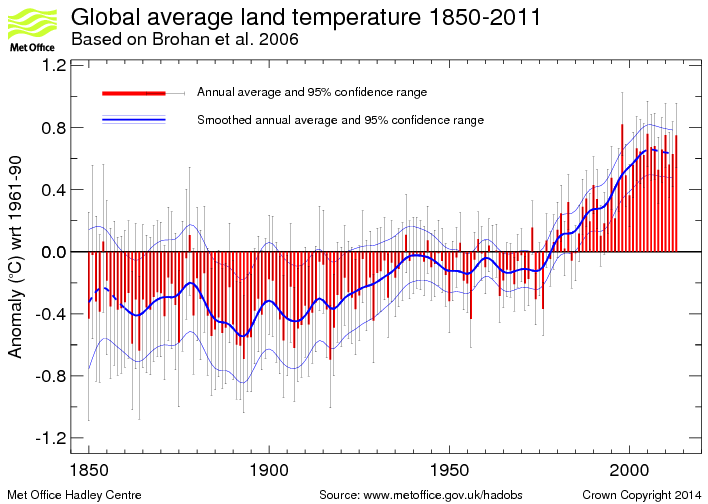 Met Office – Hadley Center – Click the pic to view at source[/caption]
justthefactswuwt says: “it is apparent that the vast majority of the increase occurred after 1945 and that “the anthropogenic contribution to CO2 concentrations was minimal prior to 1945″.
The data does not support this. You don’t have to cite any papers or eyeball any graphs — the data is available and you can easily calculate it for yourself. I have. The results are, combining fossil fuel emissions and land use changes, as I said: 23% of total carbon emissions occurred before 1945.
That is not “minimal.”
Firstly, if you look carefully at the Met Offices Annual Global Average Land Temperature Anomaly – 1850 to Present:
[caption id="" align="alignnone" width="578"]
you’ll note that the warming of the first half of the 21st century, actually started around 1895, when less than 8% of the purported anthropogenic CO2 contribution had occurred and ended in 1940, 5 years before the end point you used for your calculation.
Secondly, in Houghton & Hackler 2001;
http://cdiac.ornl.gov/ftp/ndp050/ndp050.pdf
they found that:
However, by Houghton, R.A. 2008 he managed to find that:
http://cdiac.esd.ornl.gov/trends/landuse/houghton/houghton.html
The IPCC even had to acknowledge Houghton’s numbers were suspect;
in AR4:
http://www.ipcc.ch/publications_and_data/ar4/wg1/en/ch7s7-3-1-3.html
If you use the highly suspect Houghton, R.A. 2008 500.6 Tg, starting point, versus the still questionable Houghton & Hackler 2001 starting point of 397 Tg it inflates your calculation by 26%.
Finally, according to Canadell et al. “Contributions to accelerating atmospheric CO2 growth from economic activity, carbon intensity, and efficiency of natural sinks”:
http://www.pnas.org/content/104/47/18866.long
and they found evidence “implying a decline in the efficiency of CO2 sinks on land and oceans in absorbing anthropogenic emission” since 1950, thus this absorption rate was likely significantly higher prior during the period of question. Even if we go with the present figure your calculation overestimates anthropogenic contribution to CO2 concentration by more than 50%.
It is thus apparent that the anthropogenic contribution to CO2 concentrations was “minimal” during the period of warming that occurred from 1895 to 1940. I await your response with bated breath…
Phobos! THERE you are! I’ve been looking all over for you. I’m sorry Stealey, did my pet troll crap on the floor again? I’ve been trying to train him, but he’s slow.
Phobos, regarding the crops, which is it that you claim is already reducing yields – is it increased temperature or decreased precipitation, and specifically which crops are we talking about?
(Moderators): if I cross the policy lines with respect to Phobos (I mention this because I know perfectly well I’m pushing as close to the line as I can and am doing it deliberately), I absolutely understand if you decide to snip my comments and I’m good with it. I understand this is Anthony’s home and generally rudeness isn’t acceptable. I’m just not sure how much leeway is appropriate in dealing with people like Phobos who clearly (in my view anyway) come here with no purpose except to be disruptive. At any rate, I absolutely mean no disrespect to our host and if I’m violating the rules and need a snipping I apologize for my error and hope no offense is taken.
Best regards,
Mark
justthefactswuwt: You haven’t taken into account that solar luminosity increased by about 0.6 W/m2 over the first half of the 20th century:
http://lasp.colorado.edu/sorce/tsi_data/TSI_TIM_Reconstruction.txt
The carbon numbers are pretty clear, and all tabulated for easy calculation. I gave the links above.
[snip – respond to the email – you don’t get to put the private communications in public comments – Anthony]
Note to commenters.
“Phobos” is a person known in the climate blogosphere who also operates a blog, who has been banned from WUWT for some very unsavory behavior and personal attacks upon me, both here and externally. The person was banned from here for that behavior, so the person created a new email account (which he never checked until I publicly asked for a check) and a fake sockpuppet persona to get around the ban. The person revealed their identity in an email to me on the “phobos” account they use when I inquired and made several taunts, plus bragged about using other fake identities here in the past with a promise to do it again in the future.
While it’s fine to discuss science and get into the rough and tumble of disagreements over it, creating fake identities for the purpose of circumventing a ban for bad behavior isn’t OK. The pattern of behavior here seemed familiar, and that is what made me ask about who was behind it.
So, back into the troll bin this person goes. It is unfortunate that some people simply don’t have integrity. – Anthony
I finally re-found the article that outlines the declining levels of oxygen, but it appears my points are lost in this cloud of CO2. Anyways…
http://www.i-sis.org.uk/O2DroppingFasterThanCO2Rising.php
It’s almost like these academes have had no formal education at any level at any time in their lives. Is it just me, or does anyone else picture in their minds Oregon State students and faculty spending most of their waking moments wearing beer helmets with multi-tubes feeding into their mouths?
Maybe it’s just my bad…
a) if you’re going to make conclusions about trends which occur in less than a century, it would seem to this complete layman that the data should support that.
b) I’m suggesting the exact opposite. That the available data doesn’t support their granularity claims of unprecedentedness in the 20th century.
c) Agreed. But I don’t have the background to be able to analyze it. I have to rely on others who don’t have a vested interest in the outcome.
Phobos says: March 8, 2013 at 8:07 pm
justthefactswuwt: You haven’t taken into account that solar luminosity increased by about 0.6 W/m2 over the first half of the 20th century:
http://lasp.colorado.edu/sorce/tsi_data/TSI_TIM_Reconstruction.txt
The carbon numbers are pretty clear, and all tabulated for easy calculation. I gave the links above.
So we can take your laughable redirection and non response as your acknowledgment that the anthropogenic contribution to CO2 concentrations was “minimal” during the period of warming that occurred between 1895 and 1940?
In case the previous citation is not read i boil it down to one quote:
“The crucial role of forests and phytoplankton [4] in oxygenating the earth shows how urgent it is to take oxygen accounting seriously in climate policies. Reductionist accounting for CO2 alone is insufficient, and even grossly misleading and dangerous.”
Phobos, thanks for the citation, the abstract clearly stated
“The integrated datasets are consistent with increasing pCO2 levels in response to ice-sheet expansion that reduced silicate weathering. Ultimately, the time period of elevated pCO2 levels is followed by geologic evidence of deglaciation.”
ie the ice sheets were expanding as CO2 levels were increasing – the proxies suggest CO2 ppm of 3000-5600 for that period.
“Phobos” has consistently lost the argument. He uses the usual tactics of re-framing the debate, moving the goal posts, changing the subject, and not answering questions; typical alarmist obfuscation tactics.
That is why the alarmist crowd runs and hides out from any honest, moderated debates: they always lose genuine debates, because their premise — runway, catastrophic anthropogenic global warming — has been so thoroughly debunked by real world facts. Because their premise is easily falsified, their conclusions are necessarily wrong.
Kudos to Anthony Watts for exposing this anonymous site pest/troll. No doubt the pest will now find another rock to hide under.
I don’t recall running into Phobos in my past. It would have been a nice sparing match on a site like ZeroHedge.com where I ran off a CIA agent not too long ago. Anthony has a lot of tolerance, I’m an example of that, but enough is enough some times.
Hi,
I know nothing about a previous ban to this Phobos, but I didn’t see him break any blog rules in this occasion. In fact he was doing us a favor by constantly introducing easily rebuttable information into the comments. It allows others to rebute it and leave the issue even more clear, plus makes him look the fool that he is. He was digging his own hole and now you have taken the shovel from him. It ruins the fun!
Nylo says:
March 8, 2013 at 10:33 pm
———————-
I like a good discussion or a good argument too, but talking with Phobos is like fighting with the black knight from a Monty Python skit. You can lop off his arm and he’ll insist he hasn’t been refuted, ignore the point, and come back with the same refuted argument under the cover of a different research paper. That’s just a troll pretending to have a discussion. Wade through the comments here and see:
http://wattsupwiththat.com/2013/02/25/fact-check-for-andrew-glickson-ocean-heat-has-paused-too/
****
Anthony Watts says:
March 8, 2013 at 9:29 pm
****
Thanks for stopping the incessant thread-bombing.
“A century is a very short period of time for such a spike.”
Not if the great Dr. Hansen puts his massaging gloves and homogenizes the early 20th century data. Guess he’ll have to revise that data down even more.
Cumulative Global Fossil Fuel CO2 Emissions added for reference: Carbon Dioxide Information Analysis Center – Click the pic to view at source[/caption]
[caption id="" align="alignnone" width="542"]
Carbon? Interesting that for PR reasons they switched from colorless CO2 to black carbon to make it sooty, coaly, dirty, but they lost the PR factor of tonnage: 337Gt of C as opposed to the more impressive 1,236Gt of CO2.