The December data from NOAA’s Space Weather Prediction Center is in, and it looks more and more like the peak of solar cycle 24 has been reached, and that we are now past it. Even with documented problems like “sunspot count inflation” the sunspot count for December is quite low:
![sunspot[1]](http://wattsupwiththat.files.wordpress.com/2013/01/sunspot1.gif)
Note the large difference between the prediction line in red, and the counts. There are other indications that our sun remains in a slump.
The 10.7cm solar radio flux seems to have peaked also.
![f10[1]](http://wattsupwiththat.files.wordpress.com/2013/01/f101.gif)
And, the Ap solar geomagnetic index has dropped to its observed second lowest value again (for recent years), which last happened in November 2011:
![Ap[1]](http://wattsupwiththat.files.wordpress.com/2013/01/ap1.gif)
Dr. David Hathaway updated his forecast recently. Here is the plot:
![ssn_predict_l[1]](http://wattsupwiththat.files.wordpress.com/2013/01/ssn_predict_l1.gif)
He thinks it will be the fall of 2013 though before the peak is reached
The current prediction for Sunspot Cycle 24 gives a smoothed sunspot number maximum of about 69 in the Fall of 2013. The smoothed sunspot number has already reached 67 (in February 2012)due to the strong peak in late 2011 so the official maximum will be at least this high and this late. We are currently over four years into Cycle 24. The current predicted and observed size makes this the smallest sunspot cycle since Cycle 14 which had a maximum of 64.2 in February of 1906.
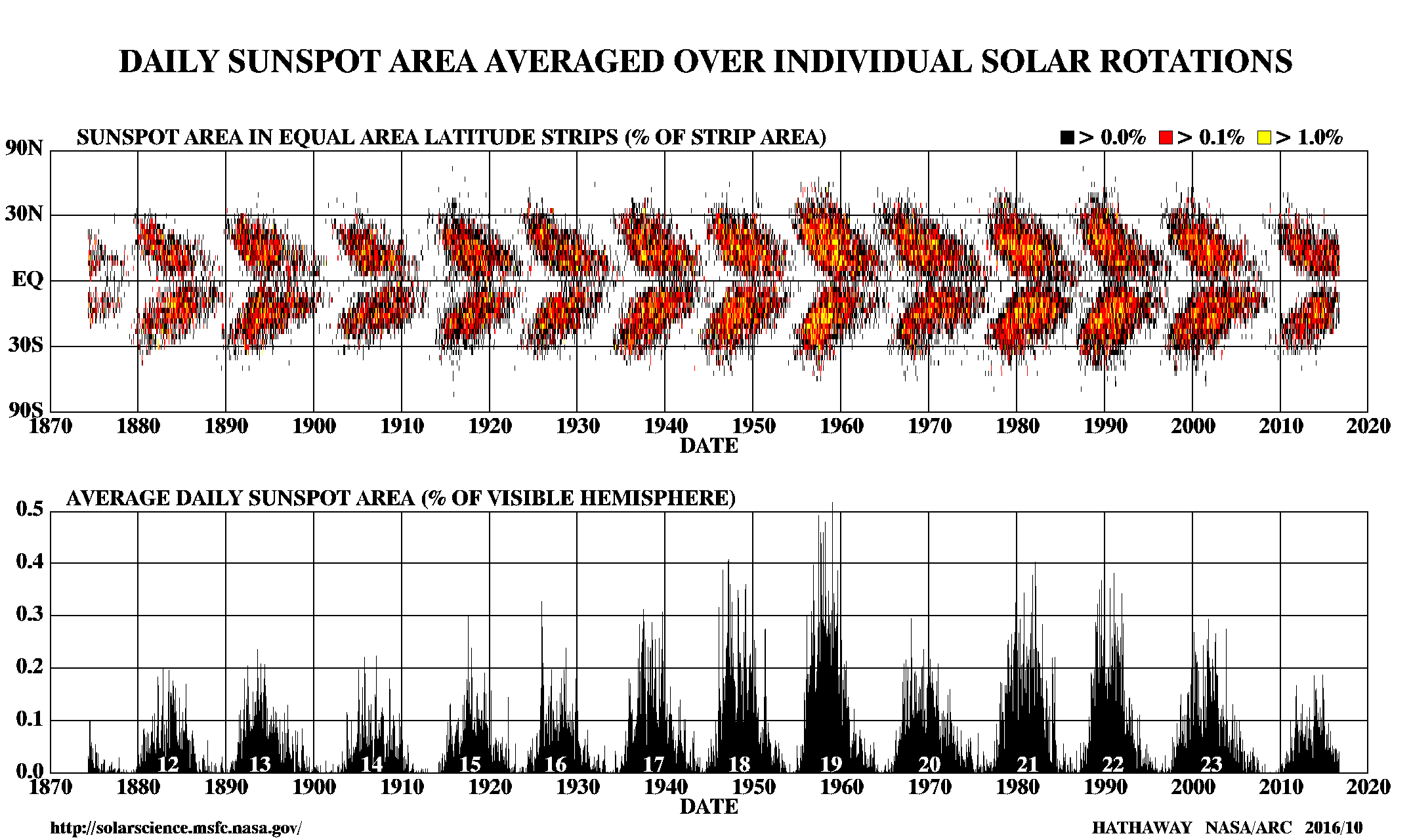
The prediction method has been slightly revised. The previous method found a fit for both the amplitude and the starting time of the cycle along with a weighted estimate of the amplitude from precursor predictions (polar fields and geomagnetic activity near cycle minimum). Recent work [see Hathaway Solar Physics; 273, 221 (2011)] indicates that the equatorward drift of the sunspot latitudes as seen in the Butterfly Diagram follows a standard path for all cycles provided the dates are taken relative to a starting time determined by fitting the full cycle. Using data for the current sunspot cycle indicates a starting date of May of 2008. Fixing this date and then finding the cycle amplitude that best fits the sunspot number data yields the current (revised) prediction.
Perhaps, the sun right now seems to be having a spot resurgence:
![latest_512_4500[2]](http://wattsupwiththat.files.wordpress.com/2013/01/latest_512_45002.jpg?quality=83)
In other news, Dr. Svalgaard’s plot:
Solar Polar Fields – Mt. Wilson and Wilcox Combined -1966 to Present

…looks like it is getting ready to flip, suggesting the peak of Cycle 24 is imminent if not already past.
His predictions for cycle 24 are looking better and better.
HenryP says:
January 13, 2013 at 3:06 pm
You are playing clue-less
Easy, when faced with such towering intellectual and analytically genius
Leif Svalgaard says:
January 12, 2013 at 1:38 pm
Jim G says:
January 12, 2013 at 1:16 pm
they, among other variables, could mitigate any time line comparisons
“‘could’? first show that they actually do. You make the assumption that there MUST be a causal connection, and anything that comes in the way of showing that ‘could’ be due to mitigating effects that louse up the comparisons.”
You are the one making bold statements of no climatic effects due to solar cycles regarding periods of time where the other variables are unknown, not I. You state your hypotheses as facts, not I. I just keep my mind open to other possibilities in the face of lack of availability of reliable observational data. Skeptical science vs consensus science.
Jim G says:
January 14, 2013 at 9:48 am
You are the one making bold statements of no climatic effects due to solar cycles regarding periods of time where the other variables are unknown, not I.
Not quite correct. I’m saying that the Sun has not varied as much as people would like to think.
You state your hypotheses as facts, not I. I just keep my mind open to other possibilities in the face of lack of availability of reliable observational data.
If there is no reliable data, there is nothing to fill your open mind.
Skeptical science vs consensus science.
In this game, consensus science is the notion that the Sun has varied enough to cause climate change [e.g. between 1700 and 1975]. Skeptical science is my view that the Sun has not. Which of those two camps are you in?
Leif Svalgaard says:
“Skeptical science vs consensus science.
In this game, consensus science is the notion that the Sun has varied enough to cause climate change [e.g. between 1700 and 1975]. Skeptical science is my view that the Sun has not. Which of those two camps are you in?”
By definition, being an open minded skeptic, I will join neither “camp” and look at both as hypotheses and neither as fact until more reliable observational data is available. Just like with dark matter. I do have a “gut feel” on issues but do not state them as fact and find the certainty that many “scientists” indicate in their statements regrettable to the advancement of real science.
Jim G says:
January 14, 2013 at 11:35 am
By definition, being an open minded skeptic, I will join neither “camp” and look at both as hypotheses and neither as fact until more reliable observational data is available.
In science almost everything is preliminary and subject to revision. It is always a judgement call what ‘reliable’ is. The solar data is judged [by me, based on my knowledge of them] to reliable enough the draw the conclusions I have drawn. The climate data is a bit less reliable, but we have to go by what we have. Scientists may not always state the uncertainties because it becomes cumbersome to always have to say ‘that everything is preliminary and subject to revision’ after every statement ever made. The uncertainty is always implicitly understood.
Leif Svalgaard says:
January 14, 2013 at 11:57 am
Jim G says:
January 14, 2013 at 11:35 am
By definition, being an open minded skeptic, I will join neither “camp” and look at both as hypotheses and neither as fact until more reliable observational data is available.
“In science almost everything is preliminary and subject to revision. It is always a judgement call what ‘reliable’ is. The solar data is judged [by me, based on my knowledge of them] to reliable enough the draw the conclusions I have drawn. The climate data is a bit less reliable, but we have to go by what we have. Scientists may not always state the uncertainties because it becomes cumbersome to always have to say ‘that everything is preliminary and subject to revision’ after every statement ever made. The uncertainty is always implicitly understood.”
Well said! The problem is mostly with popular publications that state hypothetical as fact for the consumption of the general public I wrote up the following before you even responded above:
My gut feeling on your hypothesis regarding the historical variability of the sun is that it is probably fairly accurate, however, your hypothesis on its effect upon climate, not so much, as there are too many unknown exogenous variables that cannot even be estimated well historically. As far as dark matter, my gut feel is that there is plenty of baryonic dark matter out there, possibly way more than is currently estimated but I will await further proof of the existence of the nonbaryonic dark matter, particularly in the quantities currently popularly hypothesized as well as keep my mind open to possible finer tuning of how gravity operates on the grand scale of the universe.
Jim G says:
January 14, 2013 at 12:08 pm
My gut feeling on your hypothesis regarding the historical variability of the sun is that it is probably fairly accurate, however, your hypothesis on its effect upon climate, not so much, as there are too many unknown exogenous variables that cannot even be estimated well historically.
That applies as well to the notion that the Sun is the major driver. What you are saying is that there are too many things in play, so we cannot honestly blare the ‘it is the Sun, Stupid’ mantra.
As far as dark matter, my gut feel is that there is plenty of baryonic dark matter out there, possibly way more than is currently estimated but I will await further proof of the existence of the nonbaryonic dark matter, particularly in the quantities currently popularly hypothesized as well as keep my mind open to possible finer tuning of how gravity operates on the grand scale of the universe.
Getting of topic now, but http://www,leif.org/EOS/CosmicSoundWaves.pdf may show you that we don’t need quantum gravity for this. Freshman physics will do just fine.
Leif Svalgaard says:
Your link brought me to some advertising for ladies shoes among othe things. Here is one that worked for me.
[PDF]
Cosmic sound waves rulesdcc3.ucsd.edu/~ir118/MAE87S08/CosmicSoundWaves.pdf
Baryon acoustic oscillations (sound waves propagating through the denser early universe), are one of the variables that seem to indicate that the universe is infinite in size, not just unbounded, as present big ang theory indicates, but infinite in the mass and energy it contains. The implication is that it is also infinite in time as well. This would mean that any “big bang” was not the beginning of the universe but a “local event” with significant implications for many present day theories. Bob Berman, an Astronomy Magazine contibutor, did a very interesting article on this a few months ago. One of the many implications of this, if it is correct, is that either an infinite number of things will happen (have happened) or a finite number of things will happen (have happened) an infinite number of times. Also, “local” rules of physics may not rule in other parts of an infinite universe. I don’t know about you, but I am finding it difficult to wrap my “open mind” around this one, but it may be the ultimate skeptics journey.
Jim G says:
January 14, 2013 at 3:30 pm
indicate that the universe is infinite in size, not just unbounded, as present big bang theory indicates, but infinite in the mass and energy it contains.
I don’t think the sounds waves indicate that, but I have not problem with an infinite Universe, or even with infinitely many universes. Big Big theory does not indicate otherwise.
The implication is that it is also infinite in time as well.
This is not implicated. Time could be generated at the BB itself. But I have no problem with a ‘time’ before the BB.
Also, “local” rules of physics may not rule in other parts of an infinite universe.
As far as we can tell they rule in the Universe we observe and that is good enough for us [for me at least].
I don’t know about you, but I am finding it difficult to wrap my “open mind” around this one, but it may be the ultimate skeptics journey.
Perhaps it is not open enough?
But, in any event, no open mind is needed, just simple physics and modern high-precision observations.
Leif Svalgaard says:
Perhaps your mind is more open, at least at times, than is indicated by many of your responses. Don’t let it snap shut. If you have the time, read the Berman article. He interviewed some interesting people for the column. Have a good day!
Jim G says:
January 15, 2013 at 11:02 am
Perhaps your mind is more open, at least at times, than is indicated by many of your responses.
The responses have nothing to do with open/closed mind, but with healthy skepticism.
read the Berman article.
I don’t have a subscription, but it has long been evident that the Universe is not closed [thus not finite]. The very same evidence that forces Dark Matter on us shows that ‘Omega’ is unity. ‘Omega’ is the ratio of the actual density to the ‘critical’ density, that determines if the Universe is closed [finite but unbounded] or open [infinite].
Leif,
Here’s my try at a cut and paste of the article:
Infinite universe
November 2012: Recent studies indicate that we can’t see even a small piece of the cosmos
By Bob Berman — Published: September 24, 2012
When a sample size is zero, no conclusions are trustworthy.
The evidence keeps flooding in. It now truly appears that the universe is infinite.
This is no small piece of news. The implications are enormous.
First, though, how do we know? How could we know? It actually has been creeping up on us since the 1990s. Many separate areas of investigation — like baryon acoustic oscillations (sound waves propagating through the denser early universe), the way type Ia supernovae compare with redshift, the Hubble constant, and the flat topology of space — all point the same way.
I spoke with Shirley Ho earlier this year. She’s part of the Lawrence Berkeley National Laboratory team that just studied 900,000 galaxies to give us the best-ever view of cosmic large-scale structure.
“Our results support an infinite universe,” she says.
It’s a huge change from the prevailing model of a finite but unbounded cosmos, with a specific quantity of matter and energy but no walls. In the old model, curved space would let a seemingly straight-traveling astronaut zoom past a galaxy a second time, maybe 200 billion years later. But infinity changes things. It means space never ends. It’s a matrix of limitless galaxies, stars, planets, and energy.
California Institute of Technology theoretical physicist Sean Carroll cautiously noted last spring that while a finite universe would be provable, scientists can never prove infinity. Nonetheless, given the current data, he feels the universe “probably is infinite.”
If so, he adds, “then either an infinite number of different things happen or a finite number of things happen an infinite number of times. Either possibility is pretty mind-boggling.”
It means the Big Bang was probably just a local event, a big to-do in the ’hood, confined to only the observable universe. As for the larger universe beyond, if there were a birth, says University of Chicago cosmologist Rocky Kolb, it would have “started out everywhere at once, as infinite from the beginning.”
This doesn’t bother everyone. Last April, Debra Elmegreen, then president of the American Astronomical Society, shrugged it off: “Even if we can only observe a very small fraction of the universe, that’s plenty to keep us busy.”
But she slightly misspoke. It’s not a very small percentage that’s observable. You see, any fraction of infinity is essentially zero. It means we cannot see even a few paintbrush strokes of the celestial masterwork. All we can ever hope to study is 0 percent.
Says State University of New York physics professor Tarun Biswas, “All scientific theories are models of nature based on observation. The problem with cosmology is that its current model is based on almost negligible observational data. It would still not be a problem if people did not take it so seriously.”
Take the idea that everything started from nothingness — that the positive attractive force of all mass and gravity is balanced by the negative repulsiveness of dark energy. The plus and minus cancel out. This universe is zilch.
Is this valid reasoning or technobabble? In my opinion, you can’t get something from true nothingness. Moreover, calling things positive and negative and then saying they cancel into blankness doesn’t mean they are actually positive or negative except as mental classifications.
You want the truth? No one knows how the universe materialized or if it even had a birth. The Big Bang’s zero moment remains an utter enigma. Indeed, many such speculations produce eye rolls from physicists like Biswas who believe some shred of observational evidence still has a place in science.
In any case, current ideas about the Big Bang don’t carry us beyond square one because no one knows anything about the infinite universe from which it arose. We can only guess about the larger cosmos. Will its assumed homogeneity someday be replaced by vast neighborhoods ruled by separate physical laws? It’s far too soon to say. But it’s not too soon to start telling kids that the galaxies and stars probably go on and on without end. And, yes, no one can picture this.
Astronomy has become a dichotomy. On the one hand, we have facts like the martian rotation period of 24h, 37m, 23s that are rock solid. We know how the stars shine. It’s an exciting time. But bedrock cosmology issues — Was the universe born? What’s its size? What’s it really made of? — remain enigmas. Worse, an infinite universe means that these basics may be unknowable.
Elmegreen might be content with her 200 billion galaxies. And sure, this playground is vast. It’ll definitely keep us busy. But, face it, our intellects hate blank spaces, especially when they’re enormous. An unknown infinite cosmos isn’t a comfortable development.
The good news? You won’t be reminded about it. Most astronomers will ignore infinity. They’ll focus on the observable portion, the 0 percent that is ours to explore. What else can they do?
So I’ll calm down. I won’t keep bringing this up. I’m just going through some sort of celestial Kübler-Ross grief stage, and hopefully I’m on my way to acceptance
Jim G says:
January 15, 2013 at 12:23 pm
Here’s my try at a cut and paste of the article
Thank you for the effort. But the infinite Universe is actually old news. The crucial data is the value of Omega [which is unity for an open, infinite Universe]. It is actually that value that shows us that Dark Matter and Dark energy together make up 95% of our universe. The 5% baryons being fixed by the acoustic peaks. If there were no DM+DE then Omega would be 0.05 and the Universe would be closed and finite.
Leif Svalgaard says:
“But the infinite Universe is actually old news.”
Actually, it is still pretty flimsy theory, not news, the term “news” would give it more the weight of fact. But I find it very interesting theory. Much of what you put great weight upon is descriptive terminology needed to describe mathematical constructs which are used to describe observed effects. When the observations change new constructs are needed. Advances in technology continually result in new observations which do not completely agree with old observations and new contructs are needed. Keep that mind open.
Jim G says:
January 15, 2013 at 1:36 pm
“But the infinite Universe is actually old news.”
Actually, it is still pretty flimsy theory
I have difficulty getting across to you that this is not ‘flimsy theory’, but based on measurements of incredible precision. E.g. http://www.leif.org/EOS/FanPrecisionCosmology.pdf or this video:
http://techtv.mit.edu/videos/16437-precision-cosmology
Now, I’ll not ask you to open your mind, but rather to consider the talks carefully and tell me where the flimsiness is.
Leif Svalgaard says:
Yes I did go to your link, and ,yes, I have seen it all before, and no, unbounded is not the same as infinite in mass and energy, flimsy because like the article says, if truly infinite, any sample of infinity is still a zero % sample upon which to base anything, Thought you said “I don’t think the sounds waves indicate that” then you say it’s “old news”. ?? Also, most who are conjecturing on this, which is all that can really be done, feel that if infinite in size, mass and energy means it also had no beginning (as in a big bang) but always existed. But even if it did have a beginning the big bang signatures are probably something derived from an occurance in our infinitesimally small corner of an infinite universe and not from the beginning of an infinite universe itself. I know that these considerations do not necessarily fit with derivations of the answers, per your link.
Jim G says:
January 16, 2013 at 11:01 am
flimsy because like the article says, if truly infinite, any sample of infinity is still a zero % sample upon which to base anything
All our science today is based on our observations of that zero % sample, so is ‘flimsy’?
You are selling, but I’m not buying.
Be careful with that word ‘infinite’. The integers 1,2,3,4,5,… are a zero % sample of the real numbers [with decimals: 3.14159265,…] but the laws of addition and subtraction we derive from integers [1+1=2, etc] are also valid for infinitely many more real numbers, and are not flimsy.
leif says
but the laws of addition and subtraction we derive from integers [1+1=2, etc] are also valid for infinitely many more real numbers, and are not flimsy.
henry says
I am so glad that you figured out that the answer to simple questions (as posed by me to you earlier up in this thread) have tremendous eternal implications/
Jesus said: I am the the alpha and omega, the beginning and the end
http://www.shroud.com/
from the point where I had figured out that there is no such thing as co-incidence
http://blogs.24.com/henryp/2011/07/23/why-do-i-believe-in-god/
I came to realize that there truly is only one port to enter infinity
namely: by faith
Ephesians 2:8
Leif Svalgaard says:
Pi, infinite & nonrepeating.
HenryP says:
January 16, 2013 at 12:10 pm
I came to realize that there truly is only one port to enter infinity namely: by faith
As your logic doesn’t work to well, faith is a good crutch.
Jim G says:
January 16, 2013 at 12:38 pm
Pi, infinite & nonrepeating.
Any sequence, no matter how long, would repeat, and not only once, but infinitely many times.
Jim G says:
January 16, 2013 at 12:38 pm
Pi, infinite & nonrepeating.
“Any sequence, no matter how long, would repeat, and not only once, but infinitely many times.”
You, of course, mean infinite sequence, not just “any sequence”.. The definition of Pi is an infinite, nonrepeating decimal number. Look it up. I believe insertion of the term, regularly repeating, as with some predictable pattern, may clarify as I also see your point that one could find segments which repeat an infinite number of times, in an infinite sequence. Seems there are always problems with infinities.
Jim G says:
January 16, 2013 at 2:12 pm
Seems there are always problems with infinities.
There you have it. Arguments invoking infinities get you in trouble. And there are infinities greater than other infinities, actually infinitely many of then.
Jim G said
I know that these considerations do not necessarily fit with derivations of the answers, per your link.
Henry@jim
Leif is good with general knowledge but his understanding of statistics, e.g. sampling and sampling techniques, and other stats is very poor. Perhaps he should do the relevant courses.
It is a waste of time to engage with him on such issues.
Henry@jim
Funny. It seems the post where I made the quote from is not yet up here.
Leif says
http://www.leif.org/research/FFT-SSN-1700-2013.png
Henry @ur momisugly leif
in the graph you quoted there I take it that SSN stands for SunSpot Number,
can I ask: what does FFT stand for?
SSN is not one of my favorite parameters to use, as such observations are heavily laden with error due to human bias, e.g. strength of eyes.
Do you perhaps have a similar graph using another solar parameter ?