The December data from NOAA’s Space Weather Prediction Center is in, and it looks more and more like the peak of solar cycle 24 has been reached, and that we are now past it. Even with documented problems like “sunspot count inflation” the sunspot count for December is quite low:
![sunspot[1]](http://wattsupwiththat.files.wordpress.com/2013/01/sunspot1.gif)
Note the large difference between the prediction line in red, and the counts. There are other indications that our sun remains in a slump.
The 10.7cm solar radio flux seems to have peaked also.
![f10[1]](http://wattsupwiththat.files.wordpress.com/2013/01/f101.gif)
And, the Ap solar geomagnetic index has dropped to its observed second lowest value again (for recent years), which last happened in November 2011:
![Ap[1]](http://wattsupwiththat.files.wordpress.com/2013/01/ap1.gif)
Dr. David Hathaway updated his forecast recently. Here is the plot:
![ssn_predict_l[1]](http://wattsupwiththat.files.wordpress.com/2013/01/ssn_predict_l1.gif)
He thinks it will be the fall of 2013 though before the peak is reached
The current prediction for Sunspot Cycle 24 gives a smoothed sunspot number maximum of about 69 in the Fall of 2013. The smoothed sunspot number has already reached 67 (in February 2012)due to the strong peak in late 2011 so the official maximum will be at least this high and this late. We are currently over four years into Cycle 24. The current predicted and observed size makes this the smallest sunspot cycle since Cycle 14 which had a maximum of 64.2 in February of 1906.
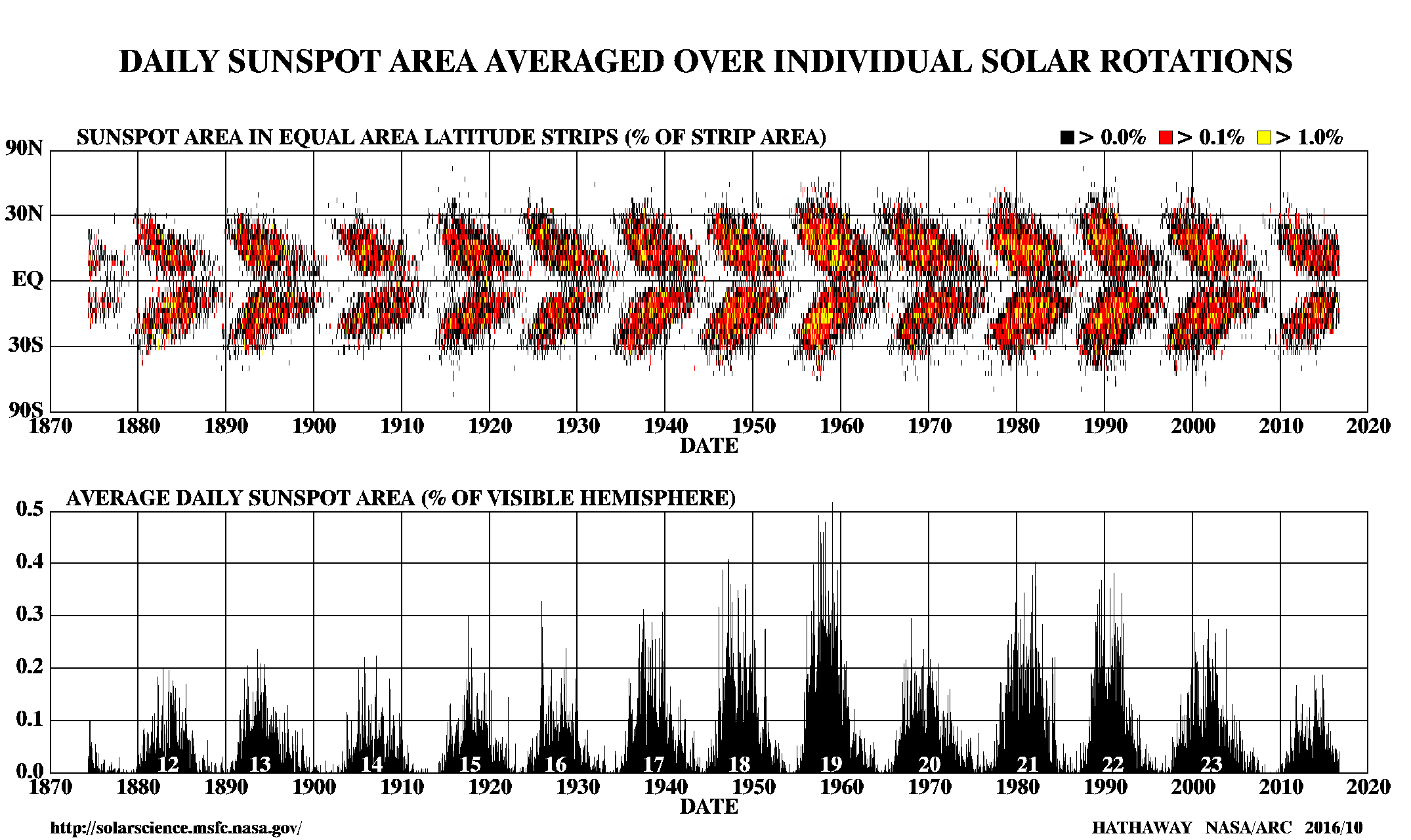
The prediction method has been slightly revised. The previous method found a fit for both the amplitude and the starting time of the cycle along with a weighted estimate of the amplitude from precursor predictions (polar fields and geomagnetic activity near cycle minimum). Recent work [see Hathaway Solar Physics; 273, 221 (2011)] indicates that the equatorward drift of the sunspot latitudes as seen in the Butterfly Diagram follows a standard path for all cycles provided the dates are taken relative to a starting time determined by fitting the full cycle. Using data for the current sunspot cycle indicates a starting date of May of 2008. Fixing this date and then finding the cycle amplitude that best fits the sunspot number data yields the current (revised) prediction.
Perhaps, the sun right now seems to be having a spot resurgence:
![latest_512_4500[2]](http://wattsupwiththat.files.wordpress.com/2013/01/latest_512_45002.jpg?quality=83)
In other news, Dr. Svalgaard’s plot:
Solar Polar Fields – Mt. Wilson and Wilcox Combined -1966 to Present

…looks like it is getting ready to flip, suggesting the peak of Cycle 24 is imminent if not already past.
His predictions for cycle 24 are looking better and better.
Leif says
Either way, it seems to lead to a clear 80 – 100 year weather cycle
But since there is no corresponding solar cycle, whatever you claim is not due to the sun, obviously.
Henry says
But I already showed you that it does exist and you agreed?
It is the Gleissberg 88-year solar cycle
JOURNAL OF GEOPHYSICAL RESEARCH, VOL. 108, 1003, 15 PP., 2003
doi:10.1029/2002JA009390
Persistence of the Gleissberg 88-year solar cycle over the last ∼12,000years: Evidence from cosmogenic isotopes
Alexei N. Peristykh
Department of Geosciences, University of Arizona, Tucson, Arizona, USA
Paul E. Damon
Department of Geosciences, University of Arizona, Tucson, Arizona, USA
link: http://www.agu.org/pubs/crossref/2003/2002JA009390.shtml
Among other longer-than-22-year periods in Fourier spectra of various solar–terrestrial records, the 88-year cycle is unique, because it can be directly linked to the cyclic activity of sunspot formation. Variations of amplitude as well as of period of the Schwabe 11-year cycle of sunspot activity have actually been known for a long time and a ca. 80-year cycle was detected in those variations. Manifestations of such secular periodic processes were reported in a broad variety of solar, solar–terrestrial,and terrestrial climatic phenomena. Confirmation of the existence of the Gleissberg cycle in long solar–terrestrial records as well as the question of its stability is of great significance for solar dynamo theories. For that perspective, we examined the longest detailed cosmogenic isotope record—
etc.
Since you are not a chemist but a solar specialist I think it is rather pointless for me going to show you all the chemistry that would proof that the amount of CFC’s or CFHC’s is so small as to have little effect on the ozone; it is indeed very small compared to the natural processes where by chlorine is produced under UV at TOA.
As I said before there is more going on TOA as what you all think. Hence we are cooling. Until 2039, unless you can make a better fit for my data:
http://blogs.24.com/henryp/2012/10/02/best-sine-wave-fit-for-the-drop-in-global-maximum-temperatures/#comment-217
what fit would you propose?
HenryP says:
January 12, 2013 at 3:31 pm
Persistence of the Gleissberg 88-year solar cycle over the last ∼12,000 years: Evidence from cosmogenic isotopes
There is, indeed, such a cycle when considering those very long time scales, but that is irrelevant when discussing climate change the last 300 years, during which the Gleissberg cycle has been 105 years long, not 88 years.
Since you are not a chemist but a solar specialist I think it is rather pointless for me going to show you all the chemistry that would proof that the amount of CFC’s or CFHC’s is so small as to have little effect on the ozone; it is indeed very small compared to the natural processes where by chlorine is produced under UV at TOA.
Here is what my daughter-in-law who is our resident ozone expert has to say [in peer-reviewed, invited, 2006 paper in Nature magazine]: “By the end of the 21st century, provided the concentrations of ozone-depleting substances decrease, ozone levels are expected to be dominated by temperature, atmospheric dynamics and the abundances of trace gases, including water vapour, methane and N2O. For example, future growth in N2O, due in part to increased fertilizer production, could lead to decreases in ozone.”
She does believe that the effect of the Montreal Protocol is uncertain and probably much smaller or irrelevant now that we have stopped putting CFCs up there.
what fit would you propose?
curve fitting to non-existent cycle has no predictive power.
leif says
Persistence of the Gleissberg 88-year solar cycle over the last ∼12,000 years: Evidence from cosmogenic isotopes
There is, indeed, such a cycle when considering those very long time scales,
……..curve fitting to non-existent cycle has no predictive power.
henry says
translation: 1) it exists 2) it does not exist
henry says
whatever fit you use (for my data) , it will show the root – where warming decelerated to 0.000K/annum, and cooling started as having occurred in 1995. This simple fact is a natural conclusion from the data. Remember : this is energy-in (maxima). Means may lag a few years. Earth max.energy out apparently occurred in 1998.
Ozone started increasing in 1995, as noted both from measurements in the NH and SH.
The best fit I get for the curve going back in time where I have no reliable data (before 1974) is a sine wave, wavelength 88 years, with the same root – where cooling stopped and warming started as having occurred somewhere in 1951. Around the same time ozone was found starting to decline.
Ozone is not the only compound back radiating a substantial amount of sunlight;
It seems Trenberth et al did not even know this. I doubt if you daughter-in-law knows.
Let us do a multiple choice question for Leif
If you add 1 + 1 , what do you get?
which is the correct answer
a) 0
b) 1
c) 2
Do your best!
*the answer is 2
HenryP says:
January 12, 2013 at 10:03 pm
The best fit I get for the curve going back in time where I have no reliable data (before 1974) is a sine wave,
so you get the ‘best fit’ to no reliable data…
HenryP says:
January 12, 2013 at 9:30 pm
translation: 1) it exists 2) it does not exist
Since there has been no solar variation with a 88 year period the last 300 years, whatever you think you find is not related to the Sun. So, 2) is your choice.
leif says
so you get the ‘best fit’ to no reliable data…
henry says
I did find some complete reasonably reliable data going back to 1942 from one station, in Anchorage, which confirmed that my fit is correct. See the graph below the first graph showing the global results.
http://blogs.24.com/henryp/2012/10/02/best-sine-wave-fit-for-the-drop-in-global-maximum-temperatures/
Leif says
2) is your choice
Henry says
the answer is c)
you cannot even get that one right.
HenryP says:
January 12, 2013 at 11:03 pm
I did find some complete reasonably reliable data going back to 1942 from one station, in Anchorage, which confirmed that my fit is correct.
Is that the only station [among hundreds] that you could find supporting your fit?
If so, that is called confirmation bias.
Leif says
Is that the only station [among hundreds] that you could find supporting your fit?
Henry says
if you can find me a station with data like this (uncorrected)
http://www.tutiempo.net/clima/Anchorage_Elmendorf_Air_Force_Base/702720.htm
(especially data for maxima)
I will analyse it for you.
HenryP says:
January 13, 2013 at 10:42 am
if you can find me a station with data like this (uncorrected)
There are hundreds, you must not have looked very hard.
HenryP says:
January 13, 2013 at 10:42 am
if you can find me a station with data like this (uncorrected)
http://eca.knmi.nl/utils/mapserver/lengthseries.php?elementid=tg&blendid=nonblend&CMD=ZOOM_IN#bottom
henry@leif
the data you provide is not in a presentable form.
here is the problem:
you get stations with some records going back in time but then there are big gaps, e.g.
http://www.tutiempo.net/clima/Reykjavik/40300.htm
which is pretty useless
you have to find a station with no gaps back to 1942
it is not so easy.
HenryP says:
January 13, 2013 at 11:27 am
the data you provide is not in a presentable form.
It is trivial to turn the data into any [better] format you wish.
HenryP says:
January 13, 2013 at 11:35 am
you get stations with some records going back in time but then there are big gaps, e.g.
http://www.tutiempo.net/clima/Reykjavik/40300.htm
which is pretty useless
Gaps are not a real problem.The data can still be fitted to any curve like desire. And of the 417 stations with records longer than 100 years there are very many with no gaps.
you have to find a station with no gaps back to 1942
No, you have to find such stations or show that aren’t any..
HenryP says:
January 13, 2013 at 10:42 am
if you can find me a station with data like this (uncorrected)
Which has gaps too:
2001 3.1 7.9 -0.9 – 12.0 135 107 3 50 0 0
2002 – – – – – 159 83 2 38 0 0
2003 3.9 8.5 -0.2 – 9.7 138 72 4 16 0 1
2004 3.7 8.7 -0.6 – 9.0 128 98 4 43 0 0
2005 – – – – – – – – – – –
2006 2.1 6.7 -1.9
HenryP says:
January 13, 2013 at 11:35 am
you get stations with some records going back in time
Here is a complete list: http://www.leif.org/research/STATIONS.TXT
the gaps at 2002 and 2005 in Anchorage are due to one single month’s missing data, namely may and november
which can be estimated by taking the average of may’s 2002 ‘s 16 available days of data and november 2005 is estimated by taking the november 2004 and november 2006 results divided by two.
In the case of Reykjavik you do not have records for many years, period.
You cannot do a fit with that.
rubbish in= rubbish out
HenryP says:
January 13, 2013 at 12:51 pm
In the case of Reykjavik you do not have records for many years […] You cannot do a fit with that.
Of course one can. It is easy. But why get stuck on Reykavik? There are hundreds of other stations with more than 100 years of data [as I showed you].
Anyway, never mind my high standards of finding COMPLETE daily data
I am not the only one who came to the same conclusion
here is a paper relevant to our discussion here,
http://wmbriggs.com/blog/?p=4630
I quote
5. Conclusion
LL demonstrates that the 20th century’s global warming was predominantly a natural 100-year fluctuation. The leftovers are caused by UHI, the warming effect by increasing station elevation, changes to the screens and their environments in the 1970s, variations in the sun’s magnetic field that could influence the amount of clouds, warming caused by increasing anthropogenic CO2, and further unknown effects. However, the station density over the Earth is strongly irregular, which makes any global record but also the results given by LL disputable. The SH stations of the GISS data pool show less warming (resp. stronger cooling) than the NH ones. Since the available stations worldwide are concentrated in the NH, the real mean of the 20th century warming could be even somewhat smaller than LL have evaluated.
end quote
Henry@Leif
do you see now agree that there is a 80-100 year cycle, causing (most) of the observed warming?
HenryP says:
January 13, 2013 at 1:13 pm
Anyway, never mind my high standards of finding COMPLETE daily data
As you have not examined many stations you do not have a high standard. It is rather low,actually.
LL demonstrates that the 20th century’s global warming was predominantly a natural 100-year fluctuation.
So, no 80 or 88-yr cycle. Try to fit your ‘data’ to a 100-yr sine curve,then.
Leif says
As you have not examined many stations you do not have a high standard. It is rather low,actually.
Henry says
You could not even produce one station with complete daily data, for me, with only one or two months missing daily data.
Remember that I have done a fit from all measurements of maxima obtained from 47 weather stations selected randomly but balanced by latitude and 70/30 @sea and inland (longitude does not matter as earth turns every 24 hours and the seasonal shift in earth’s axis does not matter either if you look at yearly average temperature results). By looking at a disproportional amount of NH stations versus SH, LL is biased.
The summary of all my results is that the speed of warming/cooling for maxima in degrees C/ annum now is: 0.036 from 1974 (38 yrs), 0.029 from 1980 (32 yrs), 0.014 from 1990 (22 years) and -0.016 from 2000 (12 years).
If you try a binomial plot (parabolic) with these particular data you get very high correlation (0.998) but it would mean tremendous cooling rates in the decades ahead, such as we have not seen before.
If you can come up with any other plot for the above data that would be better or just as good as the sine wave with 88 years wave length, be my guest.
I would appreciate your help.
As to your question about the difference in lengths between LL and me, (100 vs 88) remember that I have been looking at maxima (energy-in) whereas LL is looking at means (energy-out)
obviously there must be quite some lag?
HenryP says:
January 13, 2013 at 1:34 pm
You could not even produce one station with complete daily data, for me, with only one or two months missing daily data.
It is for you to examine the data, since you are making the claims. So, you better start now [many hundreds to examine – so no time to waste]
I would appreciate your help.
I have helped you a lot by finding hundreds of stations with very long records. So, now you can go and do something useful with them.
Henry@leif
clearly you have no understanding of stats + my standards.
Anyway, I am glad you now agree with me that there is a natural 80-100 year cycle, causing (most) of the observed warming.
HenryP says:
January 13, 2013 at 1:54 pm
clearly you have no understanding of stats + my standards.
Enough to understand that when presented with the opportunity to examine orders of magnitudes more data you refuse [afraid of what you might fine?].
Anyway, I am glad you now agree with me that there is a natural 80-100 year cycle, causing (most) of the observed warming.
there are lots of natural variations [most people prefer a 60-yr cycle], but there is no 80-100-yr cycle in warming. We have now quite different [higher] temperatures than 100 years ago. You claim an almost perfect fit [0.998] with your 88-yr curve. See if also get that with the 100 year curve you claimed LL found..
You are playing clue-less