The December data from NOAA’s Space Weather Prediction Center is in, and it looks more and more like the peak of solar cycle 24 has been reached, and that we are now past it. Even with documented problems like “sunspot count inflation” the sunspot count for December is quite low:
![sunspot[1]](http://wattsupwiththat.files.wordpress.com/2013/01/sunspot1.gif)
Note the large difference between the prediction line in red, and the counts. There are other indications that our sun remains in a slump.
The 10.7cm solar radio flux seems to have peaked also.
![f10[1]](http://wattsupwiththat.files.wordpress.com/2013/01/f101.gif)
And, the Ap solar geomagnetic index has dropped to its observed second lowest value again (for recent years), which last happened in November 2011:
![Ap[1]](http://wattsupwiththat.files.wordpress.com/2013/01/ap1.gif)
Dr. David Hathaway updated his forecast recently. Here is the plot:
![ssn_predict_l[1]](http://wattsupwiththat.files.wordpress.com/2013/01/ssn_predict_l1.gif)
He thinks it will be the fall of 2013 though before the peak is reached
The current prediction for Sunspot Cycle 24 gives a smoothed sunspot number maximum of about 69 in the Fall of 2013. The smoothed sunspot number has already reached 67 (in February 2012)due to the strong peak in late 2011 so the official maximum will be at least this high and this late. We are currently over four years into Cycle 24. The current predicted and observed size makes this the smallest sunspot cycle since Cycle 14 which had a maximum of 64.2 in February of 1906.
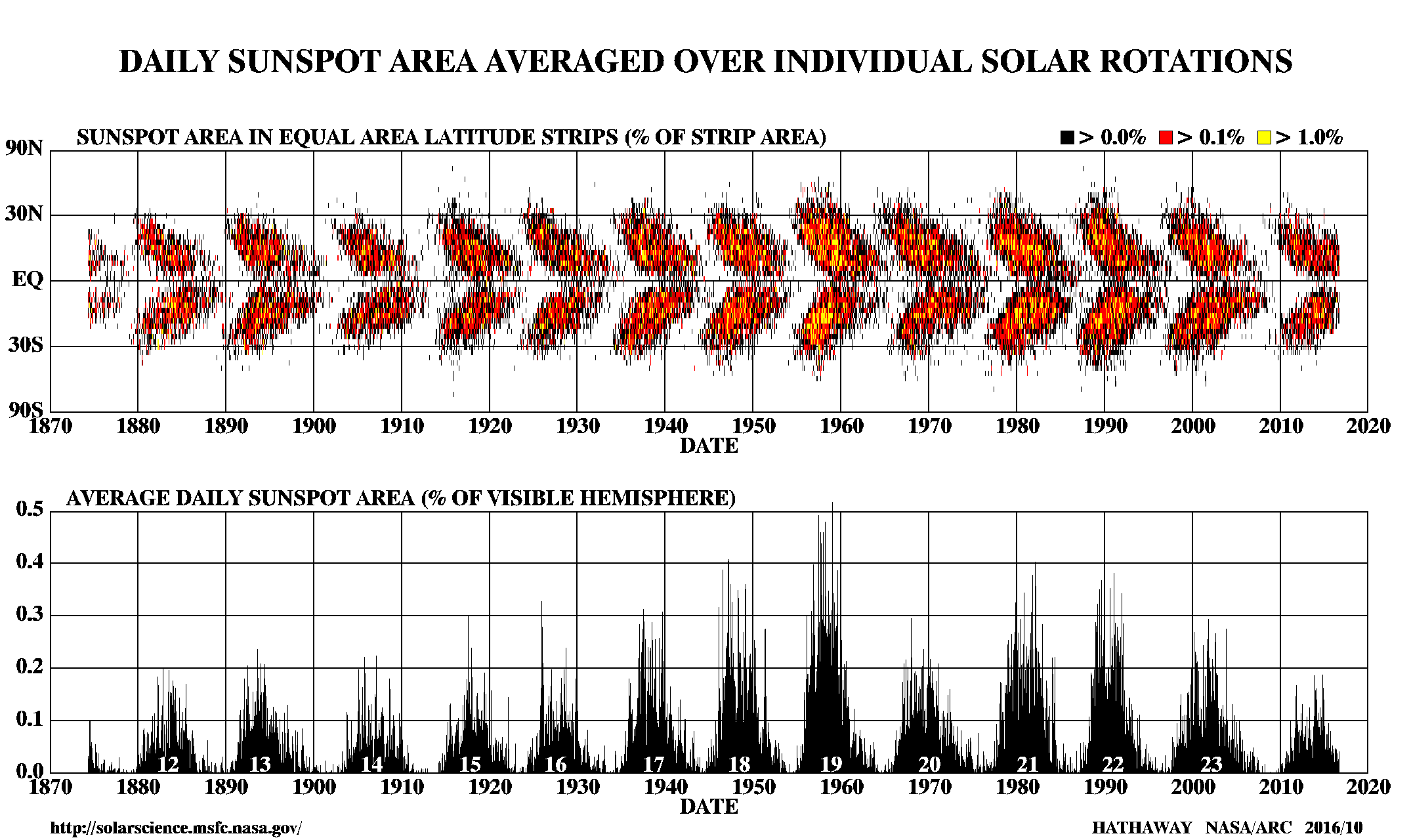
The prediction method has been slightly revised. The previous method found a fit for both the amplitude and the starting time of the cycle along with a weighted estimate of the amplitude from precursor predictions (polar fields and geomagnetic activity near cycle minimum). Recent work [see Hathaway Solar Physics; 273, 221 (2011)] indicates that the equatorward drift of the sunspot latitudes as seen in the Butterfly Diagram follows a standard path for all cycles provided the dates are taken relative to a starting time determined by fitting the full cycle. Using data for the current sunspot cycle indicates a starting date of May of 2008. Fixing this date and then finding the cycle amplitude that best fits the sunspot number data yields the current (revised) prediction.
Perhaps, the sun right now seems to be having a spot resurgence:
![latest_512_4500[2]](http://wattsupwiththat.files.wordpress.com/2013/01/latest_512_45002.jpg?quality=83)
In other news, Dr. Svalgaard’s plot:
Solar Polar Fields – Mt. Wilson and Wilcox Combined -1966 to Present

…looks like it is getting ready to flip, suggesting the peak of Cycle 24 is imminent if not already past.
His predictions for cycle 24 are looking better and better.
I think something that has been missed in the attempts to prove a GCR climate linkage is that the comparisons to cloud coverage data have been done mainly using a global scale. The reality is that the GCR cloud linkage should only be seen strongly in areas of the atmosphere where lack of cloud formation nuclei is the limiting factor in cloud formation. In areas where moisture content of the atmosphere is the limiting factor, changes in GCR flux should not have a noticeable effect, and may actually have a reverse effect on cloud formation by providing even more nuclei for limited moisture volumes to condense around, thus further reducing the moisture available to form clouds that would have any impact on climate.
With regard to that concept, I have always looked at the tropical pacific as the most likely place to be able to see GCR flux amplification of the solar impact on climate, because the abundant moisture in the atmosphere and the relative lack of land areas make cloud formation nuclei likely to be the limiting factor on cloud formation. I find it interesting that NCAR is out looking for a mechanism for the larger than expected effect of the 11 year solar cycle in this area. My advice is to stop sampling water and start sampling air and GCRs in the tropical pacific troposphere.
OT slightly – we seem to have a real La Nina starting, as I’ve been predicting for a while now. Also the south Atlantic is very cold. There could be an “Atlantic La Nina” if there is such a thing.
http://www.clivar.org/organization/vamos/Meetings/VPM11_present/We8_Grodsky.pdf
Leif, if I may: You have been extremely conservative concerning papers which point to solar influences. Have you seen any papers, over the past few decades, which in your opinion, have a real chance of being accurate, re: solar climate change / cooling?
Hi Otter, for what its worth, I think most wuwt followers have concluded that solar cycles and Earth significant variation in climate is linked. In the UK, the correlation has been high. Hot weather back in SC22-23, punctuated with cold winters during the solar minima, then very cold winters during SC23-24 minimum, and since then cool weather during SC24.
Same for most countries I think.
Lief is undoubtedly amongst the most knowledgeable on solar stuff, but his conservative nature means he’s not as open to conjecture as he ought to be, when so much new data is coming in from new sensors.
He won’t even look at the electric universe theory. … I rest my case.
http://www.youtube.com/thunderboltsproject
So it sounds like we will stay with the 0.1 degree temperature variation until more reactionary measures are required with more actual data. The problem here is that there may be few solar cycle sets that overlap good temperature data to do any meaningful modeling. This is comparable to taking an average of economic cycles that are already known to be structurally different from the latest one and a new normal going forward. There are not enough relevant cycles to work with. That kind of admission is quite different than taking the gross average of the cycles anyway without mentioning the pitfalls and the structural differences if any are known. Or maybe solar science does not really know any of the structural differences in cycles and it is all chart watching and averaging!
Leif Svalgaard says:
Solar activity always proceeds in ‘episodes’ of 0.8-1.6 yr duration. It is not known what causes those. They could be random fluctuations of a complex system.
Orbit of Venus is 224.7 Earth days : 224d / 365d=0,61y
inferior conjunction (Earth and Venus in line with Sun) every 584 days, on average.
584/365=1.6 years.
Due to the close orbit of Venus it’s mutual gravitational attraction with the sun is comparable to that of the gas giants Jupiter and Saturn.
That , of course, is “numerology” but it could also be the case that: they could be NON random fluctuations of a complex system.
Just sayin’.
Jim G says:
January 9, 2013 at 8:54 am
Looks like your “humbling” citation occured concurrently with some very cool temperatures. What say you?
Since cycle 24 [which is much like cycle 14] occurs concurrently with the ‘hottest years, evah’ what more is there to say?
tallbloke says:
January 9, 2013 at 9:01 am
“His predictions for cycle 24 are looking better and better.”
Only if you ignore the inflated spot count mentioned in the last solar thread.
nonsense, as we predict the ‘inflated count’, i.e. the current sunspot numbers.
crosspatch says:
January 9, 2013 at 9:22 am
While correlation is not causation, there does seem to be a striking correlation between solar grand minima and periods of cooler climate during the late Holocene.
From page 14 of NRC report: “This model, which also predicts strong TSI driving of climate throughout the Holocene, cannot be correct.”
page 19: it is clear that the current evidence for solar forcing from paleoclimate is very limited, and most records do not provide the necessary resolution or signal strength to detect a solar signal if it is present.
page 20: more than 90 percent of the variance in temperatures can be accounted for by non-solar forcing factors and internal modes of variability.
William Astley says:
January 9, 2013 at 9:58 am
Theoretically what is the minimum solar wind speed? It would be interesting to compare daily minimum to that theoretically value as solar cycle 24 progresses. I would expect the observed solar wind speed minimum to fall below theoretical minimum.
The minimum speed is 254 km/s, basically the escape velocity at the height where the solar wind originates. It is not likely that that the solar wind speed will fall below that. One way out of this would be to postulate that that height is becoming larger, but that sort of goes in the wrong direction as one would expect a weaker sun have a lower height of escape.
What is the minimum theoretical value of the solar polar large scale magnetic field?
Presumable zero. But nobody knows.
what is the minimum field strength of individual sunspots such that they will be broken apart by turbulence in the solar convection zone.
Not quite the way it works, but it seems that sunspots do not [cannot?] form with a field waeker than 1500 Gauss.
Barbee says:
January 9, 2013 at 10:12 am
Please help me understand how to reconcile the reported SS# of 117 on the “World Climate Widget” to the story above.
NOAA [which supplies the data for the Widget] uses a different SSN scale that the official number. To comvert the NOAA number to the official SSN, multiply by 0.72.
meemoe_uk says:
January 9, 2013 at 10:51 am
He won’t even look at the electric universe theory. … I rest my case.
On the contrary, I have looked carefully at the EU ‘theory’ but found it severely wanting [if not out-right nonsense], so I don’t think you have a case…
Way back in pre history, NASA, as I was told, predicted, and wrote about, future events, one memorable one being that we were in for a `major` high when it came to SC 24.
Apparently one heretic even went as far as to claim, writing in the public domain no less, that NASA was `just plain wrong`,
and they were. which is unfortunate really as that demoted the heretic to just being one of the good guys,
wfrumkin says:
January 9, 2013 at 5:15 am
It appears that the sun had two peaks every cycle and January is the start of the second peak. I am wondering if that dicrotic notch in the graph has a theory to explain it? Can we say yet that last month was the mid point of the cycle?
—
The dual peak might be interpreted as the northern and southern hemispheres of the sun peaking slightly out of phase by a year or so.
Steve climate models predict GHG warming is globally monotonic. Models also predict a noisy climate (high frequency warming and cooling jitter), but fail to predict decadal periods of stasis in global temperatures or extended global cooling trends, e.g., see “Future Temperature Changes.”
Leif Svalgaard says:
January 9, 2013 at 11:2
tallbloke says:
“His predictions for cycle 24 are looking better and better.”
Only if you ignore the inflated spot count mentioned in the last solar thread.
nonsense, as we predict the ‘inflated count’, i.e. the current sunspot numbers.
Nice bit of circular reasoning Leif. 🙂
Current cycle, very very low, as predicted by planetary theorists over a decade ago.
So, count every speck and pore as a sunspot, to bump up the numbers as much as possible.
Cycle 19, very very high according to Waldmeier.
So, make an adjustment to reduce the number, to make it look like the Sun is more constant than it really is. Suits the people paying the piper anyway.
Steven Mosher says:
January 9, 2013 at 8:23 am
…….
The geo-polar temperature amplification is strongest in the high latitudes where the solar/earth magnetic field effect is at its strongest
http://www.vukcevic.talktalk.net/ATO.htm
Leif Svalgaard says:
January 9, 2013 at 11:23 am
Jim G says:
January 9, 2013 at 8:54 am
Looks like your “humbling” citation occured concurrently with some very cool temperatures. What say you?
“Since cycle 24 [which is much like cycle 14] occurs concurrently with the ‘hottest years, evah’ what more is there to say?”
Here is an instance where more recent data may be significanly scewed to the hot side by poor site selection, UHI effects, and outright skulduggery that did not exist at the beginning of the 20th century. Recent reported thermometry for surface temps may not be that reliable and there are no satelite comparisons from 1902-1913.
This is not to say that TSI is the only potential factor for those temps measured in those earlier times. As a matter of fact one might consider possible delayed effects of previous solar upswings or downturns or oceanic occillations both then and now affecting either positively or negatively upon temperature at a given time. Bottom line, I would agree that a sample of one or two events does not make for a great statistical fit, particularly with all of the other potential causal variables being unknown for the past situation. Plus, there has been no warming for the past 16 years.
It will be getting colder. The sun plays a bigger role than it is getting credit for. The 1902-1913 Solar Cycle is, indeed, “humbling”.
We know that climate cooled during a period that had several grand solar minima in rapid sequence (of which the Maunder was one).
We also know there was another such period earlier than that (Homeric Minimum) where we saw climate impacts corresponding with a grand minimum. I also stated that we will have to wait and see what such things as cloud cover do. While I believe the two comments from pages 19 and 20 are what the researchers believe to be true today, beliefs in the scientific community have been changed due to new information all the time. A lot of people doubted continental drift, too. I am interested to know IF there is a change in cloud cover. We already DO know that there has been a change in stratospheric temperature (it has been generally cooling). I don’t think I stated that I believe that these ARE what is happening so much as I tried to say that it will be interesting to watch this unfold and see IF it is. A 2% change in cloud cover, for example, that corresponds to an increase in GCR counts that also corresponds with cooling would be significant support for Svensmark.
Yes, correlation is not causation, but we have been seeing the correlation multiple times … what exactly the causal mechanism is remains to be seen.
It is possible that all of this can be explained in changes to the NAO. It could be just due to the unique configuration of the Northern Hemisphere that changes in wind/pressure patterns cause a much stronger change in climate over land masses of Europe and North America where a lot of people live than it does in the Southern Hemisphere. Maybe this is due to the fact that there is relatively little land in the higher latitude temperature region in the Southern Hemisphere than in the Northern and so we don’t see as dramatic a change over as much of an area of land as we see in the NH.
In other words, a small solar might cause changes in wind patterns that result in what are actually fairly local changes in conditions but it just so happens that the locality of those changes is where a lot of our food is grown and a lot of people live. A killing frost in a relatively small area results in famine over a much larger area.
But any notion that somehow the LIA and the several solar grand minima that occurred during that period are somehow just coincidence seems a bit of a reach. I would still keep my mind open to the possibility with the caveat that maybe we don’t understand exactly WHY but should probably accept that it DOES.
Has anyone yet seen a grand solar minimum with an associated sudden significant increase in temperature? I do note that a paper rather recently from Dr. Jones at UEA shows the LIA turning up in Patagonia, too. It had been previously thought to be mainly a Northern Hemisphere event. But is might just be because there is little land in the Southern Hemisphere at the latitudes where the impact from such an event would be felt.
For example, the amount of land impacted by changes at 45 degrees latitude is much different in the NH than it is in the SH. Things that make dramatic changes in the NH may go practically unnoticed in the SH.
Just wait, everybody is going to start freaking out about the higher solar activity this month. I wouldn’t be surprised if a lower end X flare didn’t start the usual chorus of Carrington end-of-civilization caterwauling. And by Feb-Mar it will be back down again. And having predicted that, I would not be surprised if the Sun didn’t do just the opposite. I just don’t expect it.
tallbloke says:
January 9, 2013 at 12:01 pm
So, count every speck and pore as a sunspot, to bump up the numbers as much as possible.
As usual, you have no idea what you are talking about. If anything the current cycle is undercounted.
vukcevic says:
January 9, 2013 at 12:17 pm
the solar/earth magnetic field effect is at its strongest
There is no such effect.
Jim G says:
January 9, 2013 at 12:19 pm
Bottom line, I would agree that a sample of one or two events does not make for a great statistical fit
Yet you try anyway…
crosspatch says:
January 9, 2013 at 12:38 pm
We know that climate cooled during a period that had several grand solar minima in rapid sequence
But we do not know if those are related.
Has anyone yet seen a grand solar minimum with an associated sudden significant increase in temperature?
Of course, yes, but when that is pointed out, various excuses are produced: the data is poor, the grand minimum was too short, etc.
Leif Svalgaard says:
January 9, 2013 at 11:23 am
Since cycle 24 [which is much like cycle 14]
So you think that there is an internal 100 year memory, or it is 105 year planetary cycle
as identified by vukcevic nearly 10 years ago:
http://www.vukcevic.talktalk.net/LFC4.htm
‘Proper’ solar scientists do not have a ‘consensus’ theory of causes of sunspot cycles repeatability, do you have one?
‘Pseudo scientists’, mainly ‘planetarists’ consider gravity , angular momentum and other mechanical forces, which act along strait line, so no planetary alignment can be synchronized with solar cycles.
I am unique among ‘planetarists’ to promote electro-magnetic feedback between solar magnetic field and planetary magnetospheres, mainly caused by the CME forming temporary electric and magnetic circuits from solar corona to planets magnetosphere. While they last ‘magnetic ropes’ linking the sun and Jupiter magnetosphere (partially affected by Saturn’s presence) are wound up into Parker spiral due to sun’s rotation.
Magnetic ropes along Parker spiral form an angular alignment which identifies rise and fall of the solar cycles along 105 year ‘grand’ cycles.
http://www.vukcevic.talktalk.net/J-S-angle.htm
Graph 3 in the link will tell you why cycle 24 may resemble SC14.
The above is basis of my hypothesis for calculating evolution of solar activity
http://www.vukcevic.talktalk.net/SSN.htm
Now Dr. Svalgaard what is your hypothesis on which you base your statement :
“Since cycle 24 [which is much like cycle 14]” ?
vukcevic says:
January 9, 2013 at 1:41 pm
So you think that there is an internal 100 year memory
Dynamo theory easily can produce such longer ‘cycles’, except they are not strict cycles [and neither are the Sun’s].
I am unique among ‘planetarists’ to promote electro-magnetic feedback
Being unique does not make one right [more often it makes you wrong], and as we have discussed ad nauseam, electric and magnetic feedback cannot propagate upstream. Your use of ‘electro-magnetic’ is misleading. Either say electromagnetic [which is normally used about light] or electric/magnetic. But since what you do is not science, perhaps it does matter what you terminology you prefer.
Now Dr. Svalgaard what is your hypothesis on which you base your statement :
“Since cycle 24 [which is much like cycle 14]” ?
On observations, on observations, Vuk; e.g. http://www.leif.org/research/SC14-and-24.png
an 11-yr temperature variation of the order of 0.1 degrees simply due to the solar cycle variation of TSI. Beyond that, I don’t think any mechanisms or variations have been established.
And they won’t have the mechanisms until we actually have a couple of decades of Maunder type minimum. We know that solar UV has a large effect on the upper atmosphere. We also know that solar UV photons are far more energetic than IR photons.
That will be the direction of the connection.
Leif Svalgaard says:
January 9, 2013 at 2:11 pm
Dynamo theory easily can produce such longer ‘cycles’
Not much of an answer, unless you can tell us how dynamo can do it, and obviously you can’t.
On observations, on observations
Observation without contemplation tells very little:
http://www.leif.org/research/SC14-and-24.png
Observation and the contemplation tells much, much more
http://www.vukcevic.talktalk.net/J-S-angle.htm
http://www.vukcevic.talktalk.net/SSN.htm
See you, when you can answer the question:
Do you think that there is an internal ~ 100 year memory, or is is the 105 year planetary cycle
as identified by vukcevic nearly 10 years ago:
http://www.vukcevic.talktalk.net/LFC4.htm
denniswingo says:
January 9, 2013 at 2:21 pm
“Beyond that, I don’t think any mechanisms or variations have been established.”
And they won’t have the mechanisms until we actually have a couple of decades of Maunder type minimum.
And what will we do if the temperature doesn’t drop correspondingly? Take that as vindication of AGW? If temperatures drop, then it could still be part of longer-term of non-solar climate trends [like for the first Maunder Minimum, perhaps] So, I think a Maunder Minimum is not going to make any difference. People are too set in their misconceptions [either way].
vukcevic says:
January 9, 2013 at 2:33 pm
“Dynamo theory easily can produce such longer ‘cycles’”
Not much of an answer, unless you can tell us how dynamo can do it, and obviously you can’t.
Your ignorance about this is no excuse. There are many ways the dynamo can do this: e.g.
http://solarphysics.livingreviews.org/open?pubNo=lrsp-2005-2&page=articlesu27.html
Do you think that there is an internal ~ 100 year memory, or is is the 105 year planetary cycle
I thought the answer was clear. But to re-iterate: No, to both questions.
vukcevic says:
January 9, 2013 at 2:33 pm
“Dynamo theory easily can produce such longer ‘cycles’”
Not much of an answer, unless you can tell us how dynamo can do it, and obviously you can’t.
Your ignorance about this is no excuse. There are many ways the dynamo can do this: …
I won’t inundate you with papers you wouldn’t [and couldn’t] read in the first place, but here is another one to give other readers an idea: http://www.aip.de/groups/MHD/publications/99/maunder2.pdf
Leif Svalgaard says
Jim G says:
January 9, 2013 at 12:19 pm
“Bottom line, I would agree that a sample of one or two events does not make for a great statistical fit
Yet you try anyway…”
Admittedly anecdotal evidence,so don’t stoop to your old levels of snide response, I only asked what you had to say about it. You were the one quoting cycle 14 in the first place, which “just happened to be” a very cool period. Just trying to pry your mind open a tiny bit to the possibility that the sun plays a larger roll in climate than you give it credit for. Read the rest of what I said. I should have known better than to give you a stick to beat me with.
Warm regards,
Jim G says:
January 9, 2013 at 3:44 pm
You were the one quoting cycle 14 in the first place, which “just happened to be” a very cool period.
And one of the largest cycles [#4] http://www.solen.info/solar/cycl4.html just happened to be in a cold period too. My point was [and is] that such random quoting serves little purpose and does little to ‘pry my mind open’ [be careful the brain doesn’t fall out of the your open mind] for solar influence.
@vukcevic
What do you mean by “electro-magnetic feedback”? This sounds to me like reverberation, are you using data from stellar seismology, how are you getting this signal? it may not be what you think it is. but, interestingly enough reverb has well known workable mathematical properties.
It’s a possibility that you maybe detecting our planets this way, I’m not saying that you are only that what you described sounds like an echo.