The December data from NOAA’s Space Weather Prediction Center is in, and it looks more and more like the peak of solar cycle 24 has been reached, and that we are now past it. Even with documented problems like “sunspot count inflation” the sunspot count for December is quite low:
![sunspot[1]](http://wattsupwiththat.files.wordpress.com/2013/01/sunspot1.gif)
Note the large difference between the prediction line in red, and the counts. There are other indications that our sun remains in a slump.
The 10.7cm solar radio flux seems to have peaked also.
![f10[1]](http://wattsupwiththat.files.wordpress.com/2013/01/f101.gif)
And, the Ap solar geomagnetic index has dropped to its observed second lowest value again (for recent years), which last happened in November 2011:
![Ap[1]](http://wattsupwiththat.files.wordpress.com/2013/01/ap1.gif)
Dr. David Hathaway updated his forecast recently. Here is the plot:
![ssn_predict_l[1]](http://wattsupwiththat.files.wordpress.com/2013/01/ssn_predict_l1.gif)
He thinks it will be the fall of 2013 though before the peak is reached
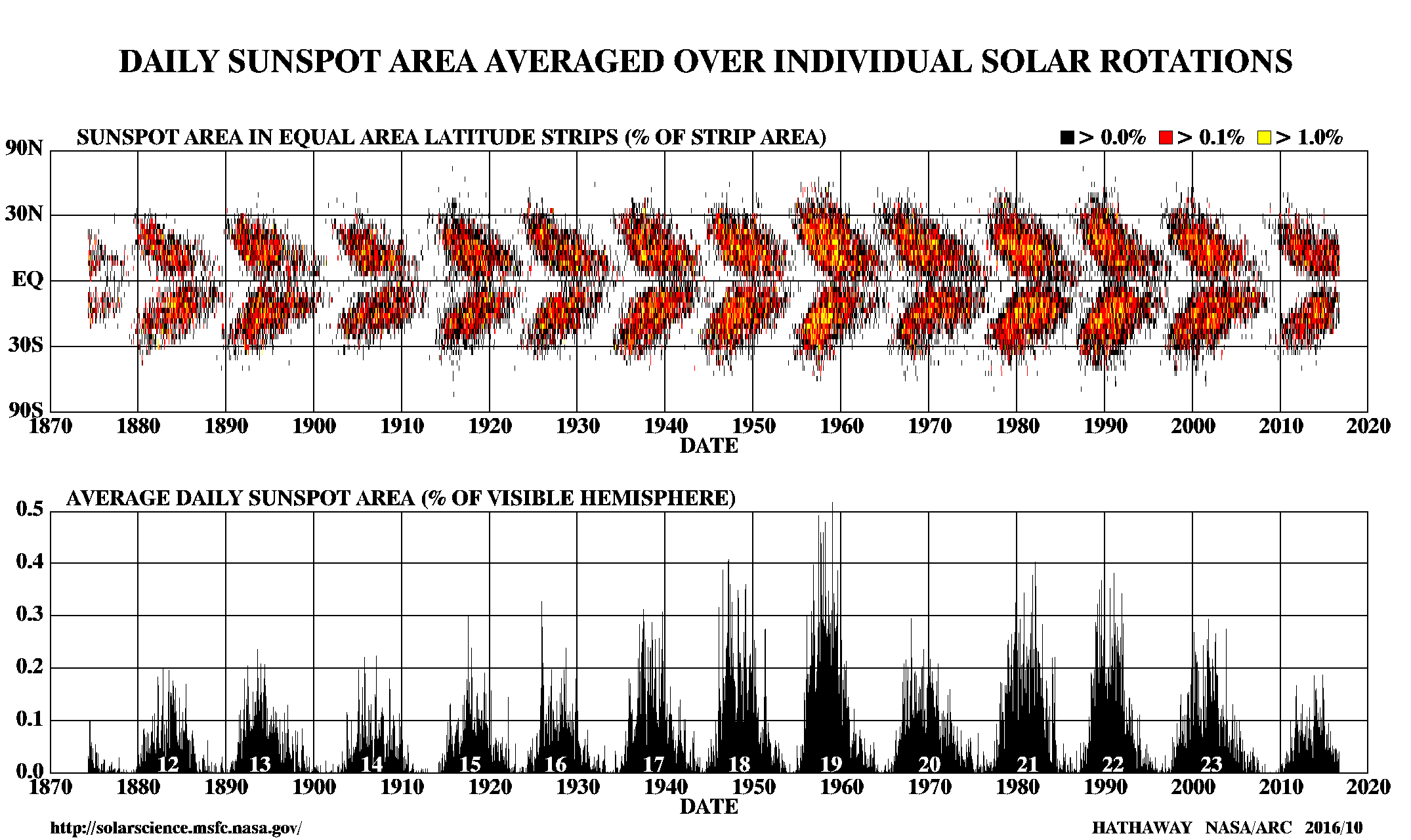
The current prediction for Sunspot Cycle 24 gives a smoothed sunspot number maximum of about 69 in the Fall of 2013. The smoothed sunspot number has already reached 67 (in February 2012)due to the strong peak in late 2011 so the official maximum will be at least this high and this late. We are currently over four years into Cycle 24. The current predicted and observed size makes this the smallest sunspot cycle since Cycle 14 which had a maximum of 64.2 in February of 1906.
The prediction method has been slightly revised. The previous method found a fit for both the amplitude and the starting time of the cycle along with a weighted estimate of the amplitude from precursor predictions (polar fields and geomagnetic activity near cycle minimum). Recent work [see Hathaway Solar Physics; 273, 221 (2011)] indicates that the equatorward drift of the sunspot latitudes as seen in the Butterfly Diagram follows a standard path for all cycles provided the dates are taken relative to a starting time determined by fitting the full cycle. Using data for the current sunspot cycle indicates a starting date of May of 2008. Fixing this date and then finding the cycle amplitude that best fits the sunspot number data yields the current (revised) prediction.
Perhaps, the sun right now seems to be having a spot resurgence:
![latest_512_4500[2]](http://wattsupwiththat.files.wordpress.com/2013/01/latest_512_45002.jpg?quality=83)
In other news, Dr. Svalgaard’s plot:
Solar Polar Fields – Mt. Wilson and Wilcox Combined -1966 to Present

…looks like it is getting ready to flip, suggesting the peak of Cycle 24 is imminent if not already past.
His predictions for cycle 24 are looking better and better.
Ok! After 400 years we are able to count Sunspots, Great. The spots appear to be strongly correlated to the Sun’s output.
The question of this Millennium is what causes the output of the Sun to rise and fall? Spots are just a “result”. Internal “surface plasma flows” must be driven by something that we can measure!
Where does the fusion of the Sun actually take place? At the center of the core or at the surface of the core? Almost all physical processes follow a sine wave [Fourier Series]. What is the Fourier Series for the Sun?
van Loon says:
January 9, 2013 at 7:22 am
The sunspot peak was in the northern autumn of 2012. Forget the fcsts, nobody can forecast the sun’s variation with any accuracy.
November 2011 rather?
Leif says:
“There should be [and people claim they find it] an 11-yr temperature variation of the order of 0.1 degrees simply due to the solar cycle variation of TSI. Beyond that, I don’t think any mechanisms or variations have been established.”
http://en.wikipedia.org/wiki/Solar_variation#Changes_in_ultraviolet_irradiance
Do you think the UV component which appears to vary much more strongly might play a role?
As noted in the Wikipedia entry, people suggest a mechanism.
1.5% between cycles, 4.3% in proxy study, that’s 15-40x larger than TSI in variation.
Darren says:
January 9, 2013 at 4:19 am
sun, i am disappoint
====================
Kovana’s mum, perhaps?
Mr Lynn says:
January 9, 2013 at 7:52 am
Apparently this Mark Lynas has been active in the Climatist cult, too. Wonder if he’ll return to science there, too.
Not according to his OP-Ed in today’s Times:
“Don’t be fooled: man-made global warming does exist
Temperatures before long are likely to be higher than for 50 million years”
milodonharlani says:
January 9, 2013 at 7:31 am
PS: Not surprisingly, climate “scientists” blame the extreme cold on global warming, to which cause without evidence (indeed in the face of all actual evidence) they attribute last year’s Arctic ice melt.
###################################
actually, it was predicted. Here is a hint. Global warming is not homogenuous ( some places cool, but more places warm) and its not monotonic– you will have cool periods, but long term trends are positive.
valid Debates:
1. what is the spatial distribution of warmer places and cooler places.
2. what is the temporal variability ( how long do plateaus last )
3. What is slope of the long term trend.
Now, if AGW predicted that it would get warmer everywhere day upon day, it would easy to dismiss. Alas, it does not. Believing that AGW predicts homogenuous monotonic warming is fooling yourself. And we know what feynman said about fooling yourself.
If you want to see how to avoid fooling yourself watch how Leif reasons. That is science. he’s been at it for decades.
REPLY: Both Leif and Mosher should have a look at the next story from NASA – Anthony
***
Leif Svalgaard says:
January 9, 2013 at 6:11 am
***
Dr S, the cycle14 graph you linked seems to show an intra-cycling of around 8 months time-period. Just random, or is there some underlying process?
Mike McMillan says:
January 9, 2013 at 4:27 am
If that spike a year ago was it, not good. Long way to go to get up to the red curve, and the red curve isn’t anything to brag about.
Fortunately we have excellent natural gas production to keep us warm, but unfortunately someone is intent on shutting down our coal fired electricity.
A picture just flashed into my mind of a windfarm buried in snow!
If things go on as they are then Leif and Mosher will crash and burn.
That NASA story is remarkably similar to my New Climate Model published on this site.
Dave D says:
January 9, 2013 at 5:57 am
educated people – with the most to lose, knew this Warming would not continue ad infinitum, even though their models said so.
Models work by projecting the past. They can’t predict the future!
Dr. Lurtz said:
“The spots appear to be strongly correlated to the Sun’s output. ”
I think you meant magnetic activity . The Sun’s total orbit-adjusted output (TSI), is pretty close to a constant, with only a 0.7% variance over solar cycles.
“Almost all physical processes follow a sine wave [Fourier Series].”
I think you meant to say: some physical processes can be modelled using Fourier series to approximate smooth functions in the models and some process measurements can be analyzed using Fourier analysis to decompose spatio-temporal measurements into their corresponding spectra.
“What is the Fourier Series for the Sun?”
I think you meant to ask “What is the frequency spectrum of electromagnetic radiation given off by the Sun?” Start here: http://en.wikipedia.org/wiki/Sunlight
Once more I play the stick in the mud. This will not, have any impact on the narrative. In fact, having a quiet sun is quite convenient for the Ordo CAGW of the Church of Marx. Expect the team to play this up. A cooling sun will be used to explain the lack of predicted warming. The “calculated/predicted/pulled out of the …” cooling effect will be added to the temps to arrive at the “true”, blessed by Hansen, temperature which will coincidentally match predictions precisely.
An inactive sun can be responsible for global cooling, while an active sun has no effect. The lefty mind is quite capable of believing two completely contradictory theorems without any problem, as they demonstrate time and time again.
nemo says:
January 9, 2013 at 8:20 am
Do you think the UV component which appears to vary much more strongly might play a role?
If it did then the 11-yr solar cycle should be strong in temperatures and it is not.
Steven Mosher says:
January 9, 2013 at 8:23 am
REPLY: Both Leif and Mosher should have a look at the next story from NASA – Anthony
I did. Here are some quotes from the Report:
[page 7]: “Ongoing discussion of the role of solar variations in the early 20th century has given rise to the unfounded conjecture that the observed increase in temperature in the last half century could also be due to changes in TSI rather than to anthropogenic influences”
[page 14]: Foukal stressed that there is no evidence for the large (~0.3 percent) increase in TSI during the early 20th century reported in a recent, widely quoted, study based on 10Be. That level of increase in TSI would require the complete disappearance of the quiet network and internetwork going back in time to 1900. This requirement contradicts the presence of a fully developed network on Ca K spectroheliograms available since the 1890s. Foukal asserted that this model, which also predicts strong TSI driving of climate throughout the Holocene, cannot be correct.
[page 17]: In response to a question from the audience on the “climate/cosmic ray hypothesis” (i.e., that cosmic rays decreased over the last half of the 20th century and that this decrease is linked to the climate change of the past 30 years), Muscheler stated that proxy data indicate that the cosmic-ray flux actually decreased early in the 20th century, but recently the level has been steady and high. Based on the proposed link between increased GCR flux and cloudiness, one might have expected that the late 20th century would be cooler than the early 20th century—a state that was not observed.
[page 19]: However, he asserted that it is clear that the current evidence for solar forcing from paleoclimate is very limited, and most records do not provide the necessary resolution or signal strength to detect a solar signal if it is present.
[page 20]: Ka-Kit Tung examined this matter by focusing on the longest instrumental temperature record, from central England, which extends back over 350 years, as well as estimates of the global surface temperature instrument record since 1850 to help define a component of these records due to unforced internal variability likely associated with the AMO. This analysis suggests that more than 90 percent of the variance in temperatures can be accounted for by non-solar forcing factors and internal modes of variability.
[page 27]: Although there is a 5-20 percent change in GCR-induced ionization in the troposphere over the solar cycle, this results (due to a number of dampening factors) in a smaller increase in nucleation rates, an even smaller increase in cloud condensation nuclei, and finally, a still smaller change in cloud amount. Thus it appears that the ion-aerosol clear-sky mechanism is too weak to explain the observed cloud changes, even with favorable assumptions for model inputs.
Leif Svalgaard says:
“General comment: when discussing when maximum is it is humbling to consider cycle 14: http://www.solen.info/solar/cycl14.html”
RECORD AMO LEVELS DURING RECENT EXTREME WARM AND COLD PERIODS
1900-1926 COOL PERIODS [AMO NEGATIVE]
Lowest global temperature anomalies ever especially 1902-1913
1904 -0.345[ 4th lowest ever
1913 -0 .386[ 2ND lowest ever]
1920 -0.330[6th lowest ever
Source: http://icecap.us/images/uploads/amoarticlel.pdf
Looks like your “humbling” citation occured concurrently with some very cool temperatures. What say you?
beng says:
January 9, 2013 at 8:23 am
Dr S, the cycle14 graph you linked seems to show an intra-cycling of around 8 months time-period. Just random, or is there some underlying process?
Solar activity always proceeds in ‘episodes’ of 0.8-1.6 yr duration. It is not known what causes those. They could be random fluctuations of a complex system.
Aside from the global climate implications, this is REALLY hurting amateur radio.
“His predictions for cycle 24 are looking better and better.”
Only if you ignore the inflated spot count mentioned in the last solar thread.
vukcevic says: January 9, 2013 at 4:09 am
January 2013 has stated with a bit of spurt:
http://www.vukcevic.talktalk.net/SSN.htm
but is it going to last?
Looking at the graph, it seems like every time a month (or two) is an outlier the next month (or two) swings the other way.
Re: sun and climate.
While correlation is not causation, there does seem to be a striking correlation between solar grand minima and periods of cooler climate during the late Holocene. I am starting to place more confidence personally into two notions: 1. reduction in UV has a significant impact while overall TSI doesn’t change very much. 2. Svensmark’s notion of GCRs having an impact on cloud formation. Either one is potentially significant but if both are working as some hypothesize they are, it could make a significant difference in surface climate during periods of weaker solar activity. Svensmark claims that only a 1%-2% variation in clouds is enough to create the conditions we notice during periods of weak cycles. So a combination of increased low cloud cover and reduced ozone formation might be enough to explain what we have seen in the past.
I’ll be waiting to see what if any change we see in cloud formation, particularly over the coming normal solar minimum between 24 and 25.
Sunspot group 11654 looking decent, as it comes around into view. However, I’m telling you, these sunspots are nothing, compared to ones we had when I was a kid.
“What were they like, Grandpa?”
“Well, I kid you not, but one day, when the sun was barely seen through a thin overcast, I was out hunting dinosaurs in the woods, and happened to glance up at the sun, and…”
The Russians have it figured out. The Central Bank of Russia issues gold and silver bullion pieces that ‘must be accepted’ as legal tender
Most of the Russian income is from selling natural gas and oil to the EU. They suspect that in a year or so ‘the Euro’ – EU currency may hit rocks, hence their commodity sales will be priced in the ‘bullion’ equivalent.
It’s looking more and more as if the main peak has been reached for this cycle. While a secondary peak is possible it is unlikely to exceed the first major peak.
Theoretically what is the minimum solar wind speed? It would be interesting to compare daily minimum to that theoretically value as solar cycle 24 progresses. I would expect the observed solar wind speed minimum to fall below theoretical minimum.
What is the minimum theoretical value of the solar polar large scale magnetic field? It would be interesting to compare the theoretical minimum to observations. The field strength of individual sunspots continues to decline. A portion of the magnetic field of individual sunspots is pulled off the sun and moved into the heliosphere. If one flips the problem around (i.e. Try to come up with a theoretical model where it is possible to have an interruption to the solar magnetic field mechanism.) what is the minimum field strength of individual sunspots such that they will be broken apart by turbulence in the solar convection zone.
Comment:
There is observational evidence of a imminent major Icelandic eruption. It is going to be a race: Svensmark cooling against the next major volcanic eruption. If I understand the third solar mechanism, Svensmark’s mechanism is being inhibited by the solar magnetic cycle change. The gig is up, for the extreme AGW paradigm if there is unequivocal cooling.
However the paper concluded that, “in the absence of volcanic eruptions, global temperature is predicted to continue to rise, with each year from 2013 onwards having a 50 % chance of exceeding the current observed record”.
When it becomes apparent that we are heading into another period of real cooling, then the alarmist voices will become completely shrill and they will call for ever more dangerous and totalitarian actions by governments.
Andrew,
Please help me understand how to reconcile the reported SS# of 117 on the “World Climate Widget” to the story above. Is there are formula I can use? (Clearly the diff is related to what Leif’s story explained about inflated SS#’s?)
Last month the widget reported the SS# as: 61. That seemed to make sense to me. But now? Now I see that what I thought I understood was merely a coincidence-and it’s a little frustrating.
P.S. I REALLY appreciate all the free tools ‘at-a-glance’ that you offer your readers. You’re da’ best! Thanks much.