From USA Today: Report: Climate change behind rise in weather disasters
12:53PM EST October 10. 2012 – The number of natural disasters per year has been rising dramatically on all continents since 1980, but the trend is steepest for North America where countries have been battered by hurricanes, tornadoes, floods, searing heat and drought, a new report says.
The study being released today by Munich Re, the world’s largest reinsurance firm, sees climate change driving the increase and predicts those influences will continue in years ahead, though a number of experts question that conclusion.
Whatever the causes, the report shows that if you thought the weather has been getting worse, you’re right.
Two words: Oh, please. This is easily dispelled by looking at the data. Apparently Doyle Rice can’t be bothered to do some basic research.
Time for a graphjam, starting with this:

But wait, there’s more:
How about Hurricanes?

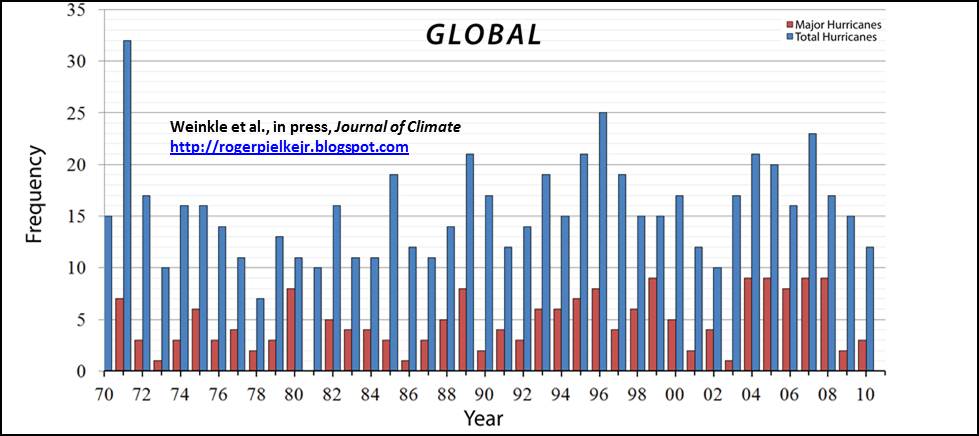
How about heat waves?
Droughts
Finally I wonder why Doyle Rice takes the word of a company with a vested interest in such a report? Showing that there are “more disasters” is a prelude to an insurance rate increase justification.
To his credit, he at least got some other views:
However, other experts take issue with Munich Re’s findings. “Thirty years is not an appropriate length of time for a climate analysis, much less finding causal factors like climate change,” says Roger Pielke, a professor of environmental studies at the University of Colorado.
Another reinsurer, Axa, isn’t quite sure of the link either: “While a clear upward trend arises from the figure with respect to the number of reported natural events, the attribution of this rise to a climate change signal should be investigated very cautiously,” the French company says in its report “Climate Risks” released earlier this month.
Atmospheric scientist Clifford Mass of the University of Washington also has a problem with Munich Re’s findings, saying that once the data are adjusted for population there is no recent upward trend in tornado or hurricane damages. Also, he adds that there is no evidence that global warming is causing more extreme weather in the USA.
Hoppe, however, says that even if we adjust for population spread and increased property values, Munich Re still says there were significant increases in the costs of weather disasters over the past few years.
But that doesn’t excuse him saying:
Whatever the causes, the report shows that if you thought the weather has been getting worse, you’re right.
When the data doesn’t support it. Once again it is time to review the essay I wrote last year:
You can send Doyle Rice a message here on the right sidebar.
The study being released today by Munich Re, the world’s largest reinsurance firm, sees climate change driving the increase and predicts those influences will continue in years ahead, though a number of experts question that conclusion.
They of course are not even a tiny bit influenced by the way that higher risks are accompanied by higher premiums.
It’s always rather suspicious when a primary source happens to be an insurance company. In particular when the media that is supposed to provide valid and substantiated information cannot do so, then we have a major problem on our hands. A more thorough investigation of the true nature of global warming needs to be addressed so that the public can decide for themselves.
I see some opportunities to make accusations of cherrypicking, which could have been avoided.
One item: The graphs for incidence of tornadoes F2 and stronger. These start with the 1970’s, which had a significant amount of tornado trouble on a single very bad day in April 1973. 2011
was similar in having a bad April outbreak. If the tornado graphs included the 1960’s and 1950’s, I think the declining trend would still be there.
Another item: Graphs showing number of severe weather incidents and new records by decade. I see graphs counting the 2010s, even though that decade has less than 3 years so far.
A further item: Hurricane strikes vs. atmospheric CO2. It is unsourced, and does not mention
how much time each 10 ppm band covers. Lower ones probably cover more time. I wonder if the highest one is complete, since CO2 is still below 395 ppm. If that was “strikes per year” rather than count, then I would consider it more resistant to accusations of cherrypicking.
There is an explanation why most forms of severe weather in the northern hemisphere are in a state of decline as a result of global warming: In general, extratropical windstorms (other than tropical cyclones) feed from horizontal temperature gradient. This includes severe thunderstorm winds, and large and moderately large tornadoes and intense tornadoes. As predicted by “the models”, the globe has warmed more in and near the Arctic than elsewhere. This reduces horizontal temperature gradient in the extratropical northern hemisphere.
The decreasing horizontal temperature gradient probably results in extratropical lows and highs being less intense in terms of pressure, which could lead to a decline in temperature extremes.