
At The Register, Andrew Orlowski attended the talk and has a news article describing Steve McIntyre’s talk at the Institute of Materials, Minerals and Mining, which was an event hosted by the Global Warming Policy Foundation.
McIntyre’s statement on wind power is interesting:
The entire rationale of policy in US and Europe has been to ignore what’s happening in China and India and hope that petty acts of virtuous behaviour in both countries will cure the problem,” he said. “Even if you install windmills you’re not going to change the trend of overall CO2 emissions.”
Actually, it is worse than that. As Bishop Hill reports, it turns out that windmills in the UK at net positive for CO2 emissions. He writes:
Ever since Gordon Hughes’ report noted that wind power was more likely to produce more carbon dioxide emissions than [natural] gas, I have been looking for the figures behind the claim. In the comments, someone has now posted some details that seem to meet the bill. Although these are not Hughes’ own numbers -they were submitted in evidence to Parliament by an engineer – I assume they are similar.
[A]s wind rarely produces more than 25% of its faceplate capacity it needs 75% backup – which due to the necessity of fast response times needs OCGT generation (CCGT can respond quickly but the heat-exchanger systems upon which their increased efficiency relies, cannot – so CCGT behaves like OCGT under these circumstances). CCGT produces 0.4 tonnes of CO2 per MWh, OCGT produces 0.6 tonnes. Thus 0.6 tonnes x 75% = 0.45 tonnes. Conclusion: Wind + OCGT backup produces more 0.05 tonnes of CO2 per MWh than continuous CCGT.
In case you are not familiar with the terms:
OCGT = Open Cycle Gas Turbine

- In a gas turbine, large volumes of filtered air are fed in the compressor section of the engine. In an OCGT the multistage compressor squeezes the air to from normal pressure up to 40 times atmospheric pressure depending on the type of turbine.
- Fuel is distributed to the various combustion chambers surrounding the gas turbine. This then mixes with the compressed air and ignition and combustion takes place.
- The combustion gasses expand rapidly and this energy is transmitted to the axial turbine blades which drive the rotor shaft.
- The rotor torque is transmitted to both the compressor section of the gas turbine and the external electrical generator.
In a combined cycle gas turbine (CCGT), the hot exhaust gases of a gas turbine, or turbines, are used to provide all, or a portion of, the heat source for a heat exchanger (called a heat recovery steam generator) to supply a steam turbine.

So I think the time has come to stop tilting at windmills. End the subsidies that make them temporarily attractive and let shale gas step in and help solve the emissions problem as it has already been doing:
PITTSBURGH (AP) — In a surprising turnaround, the amount of carbon dioxide being released into the atmosphere in the U.S. has fallen dramatically to its lowest level in 20 years, and government officials say the biggest reason is that cheap and plentiful natural gas has led many power plant operators to switch from dirtier-burning coal.
http://news.yahoo.com/ap-impact-co2-emissions-us-drop-20-low-174616030–finance.html
Everyone acts so surprised by this news, but I had it on WUWT over a month ago.
USA CO2 emissions may drop to 1990 levels this year

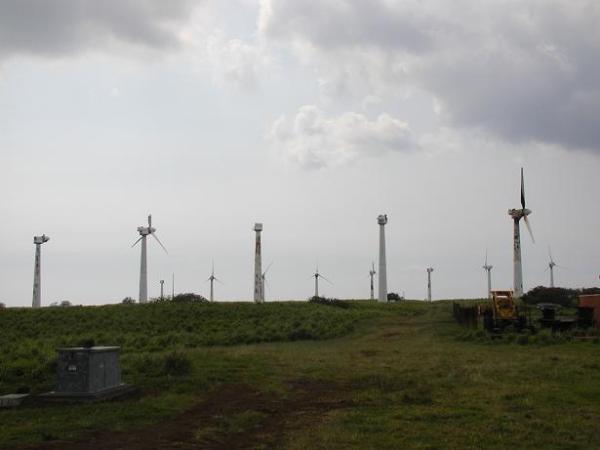
I predict that in a few years, when the subsidies run out, many wind farms will look like this one in Hawaii, now abandoned because it it too expensive to maintain:
Related, via Jo Nova:
Hydroelectricity produces 16% of the total. But all the vanity renewables bundled together make about 3.5% of total. Wind power is a major global industry but it’s only making 1.4% of total electricity. And solar is so pathetically low that it needs to be bundled with ‘tidal & wave’ power to even rate 0.1% (after rounding up). If world’s solar powered units all broke tonight, it would not dent global electricity production a jot. No one connected to a grid would notice.
UPDATE: Hans Labohm writes in with a supporting study:
Dear Anthony,
In The Netherlands Kees le Pair (Dutchman) has recently completed his
analysis on wind energy over here.
It confirms the conclusions of Hughes.
The English version of his report can be found here:
http://www.clepair.net/statlineanalyse201208.html
FYI.
Best,
Hans H.J. Labohm
Even the “see spot run” language doesn’t help Richard Courtney’s understanding as demonstrated in his “perfunctory” response (August 19, 2012 at 12:33 am), under time pressure he says, where he spends several minutes stamping his feet to say “you’re wrong”.
Thanks to Geoff Sherrington for his post (August 19, 2012 at 3:04 am) elevating the discussion by pointing to the report:
http://bravenewclimate.files.wordpress.com/2010/01/lang_2010_emissions_cuts_realities_v1a1.pdf
Emission Cuts Realities – Electricity Generation
Cost and CO2 emissions projections for different electricity generation options for Australia to 2050
By Peter Lang, January 2010
Fig. 7 of this report shows CO2 reductions for wind and solar contrary to Courtney’s feet-stamping protestations. More importantly, Lang estimates a cost on each tonne of CO2 emissions avoided in his Chart 11 for the various technologies studied. These costs range from about $50/tonne for nuclear & CCGT plants to $200/tonne for solar & wind & gas (Australian dollars I assume — see his report for his definitions).
Oscar Wilde wrote that some people know the cost of everything and the value of nothing. In an effort to avoid that description, I’ll offer the value of CO2 emission avoidance is the cost of the damage to the environment ascribed to it by the IPCC. From Climate Change 2007: Synthesis Report — An Assessment of the IPCC, p. 69, “Peer-reviewed estimates of the social cost of carbon (net economic costs of damages from climate change aggregated across the globe and discounted to the present) for 2005 have an average value of US$12 per tonne of CO2, . . . .”
We do have the problem of reconciling the different units of currency and the 45 year difference in dollars, but it seems to me that the cost of avoiding CO2 emissions is not supported by the value accorded avoiding damage to the environment.
German Renewable Electricity production 1st half of 2012 = 25.1% (source BDEW)
Windenergie 9.2 %
Biomasse 5.7 %
Wasserkraft 4.0 %
Photovoltaic 5.3 %
Sonstiges 0.9 %
AC vs DC power transmission. If I recall my history correctly, Edison promoted DC power and Westinghouse promoted AC power. Edison lost because DC power would require generators placed along the lines at rather short intervals to keep the lines charged. AC power did not.
steve:
At August 19, 2012 at 9:41 am you say
No! Whether or not the UK has 85 GWe of generating capacity is not relevant to the increase in generation that is needed for the grid to accept windpower and remain reliable.
Please read what I wrote or – preferably – the reference which I provided and was reporting.
The scenario studies considered windpower supply to the grid as percentages of grid supply. It clearly shows that for a supply of 400 TWh the needed operating plant capacity increases from 68.5 GWe to 85 GWe when the percentage of windpower increases from 2% (0.5 GWe) to 20% (85 GWe).
Please note that as I said – and referenced – these estimates are from UK’s National Grid Corporation.
Richard
Philip Lee:
re your post at August 19, 2012 at 10:31 am
I have repeatedly taken time to explain the issues to you. You have ignored everything I have said (repeatedly) and have responded with unfounded and unjustifiable insults.
I will not bother to waste any more time on your posts whether or not they are addressed to me.
Richard
As usual you fellows are arguing inconsequential details. You have accepted that man made CO2 is causing global warming. The saintly Mr. McIntyre certainly has accepted it. He is just arguing statistical details. You have lost the war even if you win some battles.
George Steiner:
Please explain the relevance to this thread of your post at August 19, 2012 at 12:59 pm
Richard
@richard
and my point is we don’t need to increase conventional plant at all. just not dismantle it. wind power will offset conventional generation and when its production is negligible, the demand will be made up by our currently available production.
national grid scenarios are not the only scenarios. and they won’t necessarily be objective. that said they are useful. but my firm impression after having studied this is that wind power offsets conventional generation. timing and unpredictability issues are small and can be overcome.
George Steiner says:
August 19, 2012 at 12:59 pm
As usual you fellows are arguing inconsequential details. You have accepted that man made CO2 is causing global warming. The saintly Mr. McIntyre certainly has accepted it. He is just arguing statistical details. You have lost the war even if you win some battles.
>>>>>>>>>>>>>>>>>>>>
If you are so silly to think that the war is simply about CO2 causing warming, then you have much to learn.
steve;
and my point is we don’t need to increase conventional plant at all. just not dismantle it. wind power will offset conventional generation and when its production is negligible, the demand will be made up by our currently available production.
>>>>>>>>>>>>>>>>
Except that in the real world power demands are not flat, they are increasing. There is no conventional capacity to not dismantle. Build new capacity with wind power = build new conventional capacity too.
From there it justs gets worse. You’ve now doubled your capital cost for the capacity you want because you have to build it twice. Then the efficiency of the conventional capacity gets crushed to a fraction of what it could be because you cannot run it at maximum efficiency, so you wind up burning way more fuel than you otherwise would have, so you dramaticaly increase operating costs on top of your doubled capital investment. Then you have to take into account that the captial costs are going to be even higher because the lifetime of a conventional power plant being brought up and down, even if it was designed to do so (which the existing conventional plants aren’t btw) dramaticaly reduces the life of the plant, so you will actually have to build two or three of them in the same timeframe that you otherwise would have built one.
That anyone other than people whose jobs depend on building and maintaining wind power actually think the idea has merit is beyond me.
On the contrary, the only reasons advanced for subsidizing and building ‘alternative’ or ‘renewable’ energy systems like wind and solar are (a) to reduce CO2 emissions to avoid man-made ‘global warming’ (or ‘climate change’); (b) to reduce our dependence on foreign sources of energy, namely oil; (c) to save money. If anthropogenic CO2 does not cause global warming (as it does not); and if ‘alternative’ energies would not do much (if anything) to reduce oil imports (new domestic fuels will do much more); and if ‘alternative’ energies would not save any money (but actually raise electricity rates to industry and homes); then there is no reason to even consider them, and much of this thread, while intensely interesting, would be essentially academic.
/Mr Lynn
steve:
Pretending you were saying something else when proved wrong is not nice.
At August 19, 2012 at 8:07 am you asserted
(emphasis added: RSC)
At August 19, 2012 at 8:52 am I referenced and quoted analysis from the UK’s National Grid Corporation which shows your assertion is plain wrong: significant windpower on the grid requires much more “backup” so there is large increase to total requirement for operating generating plant.
At August 19, 2012 at 9:41 am you made a post that displayed a misunderstanding of the analysis.
So, at August 19, 2012 at 12:10 pm I replied to explain that misunderstanding.
Now, at August 19, 2012 at 1:29 pm you respond to that explanation saying
No! That was not your point. And if it were then so what? Significant use of windpower does require additional generating plant to operate.
Richard
Mr Lynn:
I respectfully suggest that you have misread the discussions on this thread because (at August 19, 2012 at 2:36 pm) you say
(a) Much of this thread is about the fact that windpower increases emissions from a gridded electricity supply system.
(b) Windpower increases fuel use and, therefore, cannot reduce fuel demand. Also, oil is not normally used for power generation so windpower cannot displace much use of oil.
(c) Most of this thread is about the fact that the use of windpower increases the costs of power generation.
Hence, according to your argument this thread is not “essentially academic”. And this true whether or not anthropogenic CO2 causes global warming.
Richard
Richard
Please check out this info.
http://www.nationalgrid.com/uk/Electricity/Data/Realtime/Demand/Demand8.htm
It shows that the daily change in power provided by the national grid is varying by up to 15 GW – this is NORMAL.
The NG do not throw in the towel with this variation. There is adequate capacity to cover the peak and they have “no problem” throttling back the stations to keep frequencies in check during the troughs.
When wind power generates more than nuclear ( these are not easy to control to different power levels, so usually provide the base load (less than 22GW) then the grid may have a problem chosing to kill a nuke or cut a few turbines on the grid. Until then there are few additional problems.
a number of these posts deal with windtubines and spinnig reserves etc:
http://climateandstuff.blogspot.co.uk/search/label/windturbines
@richard
with respect, my point is exactly what I want my point to be.
and my point is, that in my opinion, having significant wind on the UK system does not require the building of new conventional plant. the plant we have will back up any future installed wind when wind output is low. – if we have not dismantled it by then.
Granted, the arguments you and some others offer here do much to obviate the usual reasons for promoting wind power, and thus I will concede are of more than academic interest; that was a bit of hyperbole.
However, I don’t think George Steiner’s point should be so easily dismissed. We would not be having this discussion if the governments of Europe, Australia, and the USA had not completely bought into the idée fixe that mankind’s use of fossil fuels is driving the Earth toward the precipice of catastrophic global warming. Without that ideological dogma, the other arguments (supply, price) would carry little weight. The driving factor is not whether anthropogenic CO2 actually causes global warming, but whether The Powers That Be believe that it does.
Absent that, nobody would have bothered with all these wind farms. And we have to be careful not to get so far into the weeds (to use the current cliche) that we end up seeming to concede the CO2 claim. If wind power actually produces more CO2, that is only an argument against it if you are a CAGW advocate.
/Mr Lynn
Mr Lynn;
If wind power actually produces more CO2, that is only an argument against it if you are a CAGW advocate.
>>>>>>>>>>>>>>>>
I fail to follow your reasoning. Wind power has neither economic benefits nor CO2 reduction benefits. Yet the CAGW crowd advocates for it anyway. Either they have been duped into believing it has benefits which it doesn’t, or they know full well that it doesn’t and don’t care because it serves their agenda. Either way it is one more demonstration of the hollow case for CAGW.
If you’re a CAGW zealot, then “It produces more (not less) CO2” would definitely be an argument against wind power. If your not, then, “Hey, what’s wrong with a little more CO2? Good for plants!”
/Mr Lynn
That’s “If YOU’RE not. . .” Typing too fast late at night. /Mr L
Mr Lynn
If your not, then, “Hey, what’s wrong with a little more CO2? Good for plants!”
>>>>>>>>>>>>>>>>>>>>
The marginal increase in CO2 driven by wind farms cannot possibly compensate via benefit to plants for the economic disadvantage. For the money lost we could increase crop production by far more for far less.
I think wind power advocates, who aren’t all CAGW nutters, would also argue from a position of energy security. There is an implicit subsidy for oil use due to the occasional wars that are fought, oil supply being one of the causes.
steve:
I hope you are not offended by my answering two of your post in this single response: I do not intend any confusion.
Firstly, your post at August 19, 2012 at 5:01 pm is – to put it politely – unhelpful. It says
You are making a ‘humpty dumpty’ argument (i.e. “my words mean whatever I want them to mean when I want them to mean it”).
You made an assertion which I showed was wrong so you claimed you were talking about something else. Such behaviour inhibits rational discussion.
And as I said at August 19, 2012 at 3:03 pm, your ‘something else’ is irrelevant. This is because additional operating plant increases costs, fuel usage and emissions whether the equipment for that additional operation already exists or needs to be built.
Then at August 20, 2012 at 12:06 am
Perhaps. If so, then they are mistaken for the reasons I stated to Mr Lyn at August 19, 2012 at 3:48 pm; i.e.
Richard
SergeiMK:
Thankyou for the links you provide to me at August 19, 2012 at 3:49 pm . I already had them but others following this thread may find them useful.
Yes, as I have repeatedly said and explained, at present trivial levels of windpower in the UK do not cause problems to the grid. The link you provide to UK National Grid data confirms this.
But as I also explained (repeatedly) at higher levels of windpower input to the grid there is substantial additional generating capacity needed for risk management. My post at August 19, 2012 at 8:52 am quotes and references estimates of this additional need made by the UK’s National Grid Corporation.
The National Grid Corporation needs to get such estimates right because it operates the grid. If it overestimate the need for generating capacity then it is accountable for wasted investment, and if it underestimates the need then it is accountable for power cuts.
Hence, I will accept the estimate of the National Grid Corporation in preference to that of the pro-AGW propaganda blog of the other link you provide.
Richard
@richard
windpower reduces fuel use. because the plants that it needs to back it up don’t need to be running.
if you think running windpower increases energy use then that is your perogative but I don’t think we can have a useful debate and can agree to differ. plus i have to go to work
Building windfarms creates roads and power cables that reach all the way to new brownfield sites where once there were greenfield sites.
Windfarms are very profitable without any subsidy. But only once they are converted to housing.
Which fortunately, they can be. Unlike most low ground which is already built on in the UK or prone to flooding.
That’s why the need to have backup power generation running with extra costs and no CO2 reduction is entirley irrelevant.
In the UK this all about manipulating the planning laws to enable the exploitation of marginal agricultural land for housing.