
From ChicoEr.com
Flying close enough to Earth that in astronomic terms one could feel the breeze as it passed, a small asteroid flashed by just after midnight today.
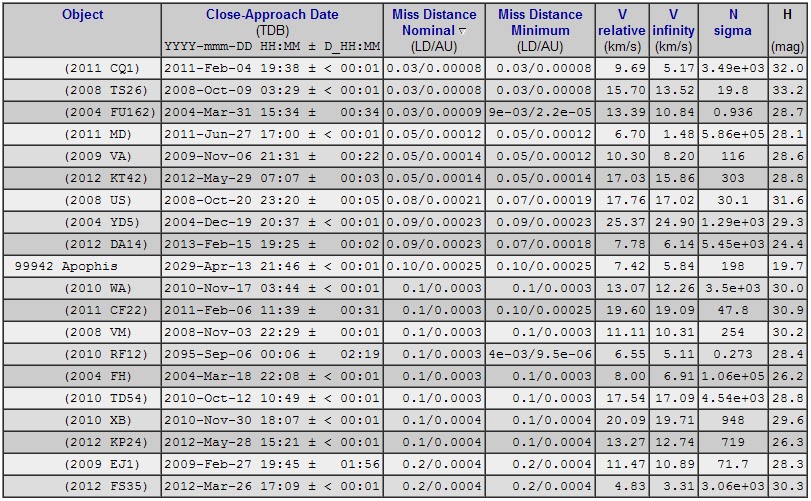
NASA reported the space rock, with the unimaginative name of 2012 KT42, was just 8,700 miles above the atmosphere when it went by.
While the asteroid’s approach is actually within the orbit’s geosynchronous satellites, it is not of the sort to inspire fears of global destruction.
NASA estimates the object is roughly 10 to 30 feet in diameter. It is still not tiny. The fireball that flashed over California earlier this year and dropped fragments of itself over the Sierra Nevada, was said to be abut the size of a mini-van.
From Spaceweather.com
SMALL ASTEROID BUZZES EARTH: Newly-discovered asteroid 2012 KT42 is flying past Earth today (May 29th) only ~14,000 km above the planet’s surface. This means 2012 KT42 will actually fly inside the Clark Belt of geosynchronous satellites. The 3- to 10-meter wide asteroid ranks # 6 on the top 20 list of closest-approachers to Earth. According to the asteroid’s orbit, there is no danger of a collision. Even if it did hit, this space rock is too small to cause significant damage. It would likely disintegrate almost entirely in the atmosphere, peppering the ground below with relatively small meteorites.


Brian H:
“And I’m fairly sure the area destroyed was circular, not square . . .”
More like an ellipsoid I would expect, given that it probably did not come down perpendicular to the ground. Anyway, I love the imagery of a meteorite leaving a square impact! That’s a lot more fun. LOL!
Blogger Astrobob reports variable speeds (doubled) and irregular magnitudes as the asteroid passed.
http://astrobob.areavoices.com/2012/05/29/25-minutes-with-asteroid-2012-kt42/
“But one aspect is unusual about 2012 KT42: it experiences not only a flyby, but also an eclipse and a transit during the same flyby. …Now, I have looked a bit into eclipses experienced by asteroids while approaching the Earth-Moon system, and I don’t recall this ever happening before, so it’s a first. So far no observations have been reported during the partial eclipse period, but it will be interesting to see how the brightness changes.” ~Pasquale Tricarico
http://orbit.psi.edu/~tricaric/2012KT42.html
Minor typo, but for an important person:
“This means 2012 KT42 will actually fly inside the Clark Belt of geosynchronous satellites.” I assume you meant Clarke Belt for Arthur C Clarke who first proposed the idea of communication satellites in synchronous orbit (and weather satellites, and other good uses).
We spend a few million a year on cataloging asteroids which are, albeit extremely remote, a REAL threat but then we waste billions per year on the thoroughly FAKE threat of ‘climate disaster’. Many many people need to be thrown OUT of office in Washington DC.
Venus transit coming up…
President: We didn’t see this thing coming?
Truman: Well, our object collison budget’s a million dollars. That allows us to track about 3% of the sky, and beg’n your pardon sir, but it’s a big-ass sky.
– The Armageddon Prophecy
Sorry, asteroids don’t have the same wonderful properties of AGW.
Asteroids are some random event that is physics in the Universe. Yes, the threat is real, clearly, but it’s natural. I wonder if the greens think we should do nothing to mitigate Asteroid collisions.
AGW on the other hand has all kinds of wonderful guilt for people. We are destroying the natural order, and if only we all hated our humanity, hated our technology, we could live in static harmony with the wonderful religious experience of Gaia.
Actually, no meteorite or fragments or impact point have ever been found there. It was apparently a pure air burst, probably an iceberg from afar …
An interesting point about asteroid 2012KP24 is that it was discovered by the Catalina Sky Survey only a few days ago, on May 23. It is travelling at about 30,000 miles per hour.
Discovery data here:
http://www.minorplanetcenter.net/mpec/K12/K12K52.html
Orbit diagram and details here:
http://ssd.jpl.nasa.gov/sbdb.cgi?sstr=2012%20KP24;orb=1;cov=0;log=0;cad=1#cad
Sorry Garry Stotel 90×90=8100 not 800
Still could be devastating if it was bigger and closer.
I should clarify that 2012 KP24 is not 2012 KT42. Apologies for confusing two different asteroids.
An asteroid that could be very interesting is asteroid 2011 AG5 as this open letter from Rusty Schweickart, an Apollo 9 Astronaut, to NASA makes clear:
“If there is in fact an impending impact in 2040, what actions must we take and by when to prevent it? If, based on engineering examination, we can wait until after the 2013 or 2015 tracking opportunities, as your last letter states, that’s great! But we believe there are some subtleties that must be considered before asserting this.
“For a series of very specific reasons I believe that the Deep Impact analogy (in which you suggest no action re AG5 is necessary now given NASA’s success in intercepting Comet Tempel 1 in 2005) is weak and may lead us to a false sense of security. If deflecting asteroid AG5 turns out to be significantly more difficult, then we may find that by waiting until after the 2013 apparition, it will be too late to prevent AG5 from passing through the 2023 keyhole. In other words we will have waited too long to act which would have potentially deadly consequences. For these reasons I believe a more thorough engineering analysis of a deflection campaign for AG5 is warranted now.”
Something for 17 year olds to think about.
http://ssd.jpl.nasa.gov/sbdb.cgi?sstr=2011%20AG5;orb=1;cov=0;log=0;cad=0#orb
Forty-two. We just missed the answer. 😉
A 2009 news article about the trouble NASA has getting adequate funding for asteroid tracking.
http://minnesota.publicradio.org/display/web/2009/08/12/nasa-asteroid-watch/?refid=0
Paltry amounts of money compared to the billion$ they are throwing down the toilet to ‘combat climate change’.
Bernd Felsche says:
May 30, 2012 at 4:44 am
+++++++++++++++++
Hehheh. Never trust a Vogon :o]
Mike M says:
May 30, 2012 at 5:57 am
””””””””””””””””””””””””””’
Astronomy & Astrophysics is publishing a new study of the orbital evolution of minor planets Ceres and Vesta by J. Laskar, M. Gastineau, J.-B. Delisle, A. Farrès, and A. Fienga
Published in Astronomy & Astrophysics, 2011, vol. 532, L4 –
“Ceres and Vesta gravitationally interact together and with the other planets of the Solar System. Because of these interactions, they are continuously pulled or pushed slightly out of their initial orbit. Calculations show that, after some time, these effects do not average out. Consequently, the bodies leave their initial orbits and, more importantly, their orbits are chaotic, meaning that we cannot predict their positions . . . Ceres and Vesta gravitationally interact with the Earth, whose orbit also becomes unpredictable after only 60 million years. This means that the Earth’s eccentricity, which affects the large climatic variations on its surface, cannot be traced back more than 60 million years ago. This is indeed bad news for Paleoclimate studies.
“Ceres and Vesta thus appear to be the main limiting factors for any precise reconstruction of the Earth orbit, which is fundamental for the astronomical calibration of geological timescales. Moreover, collisions of Ceres and Vesta are possible, with a collision probability of 0.2% per Gyr.”
So was I. It was a spectacular night sky here in rural country. Truly breathtaking. I saw nothing unusual whizzing by unfortunately. I can only feel pity, for those who have no darkened sky, to view. Light pollution has condemned a whole generation to a washed out display of our universe. Pity. GK
mfo says:
“This means that the Earth’s eccentricity, which affects the large climatic variations on its surface, cannot be traced back more than 60 million years ago. This is indeed bad news for Paleoclimate studies.”
I doubt that assessment very much. Considering that the relative difference between Earth’s mass of 5900 E21 kg and the mass of Ceres, 0.87 E21 kg (0.015% mass of earth) and Vesta is 0.3 E21 kg (.005% mass of Earth) together with the fact that they are orbiting in the same general direction as us in only a slightly higher orbit tells me that they cannot possibly have altered earth’s average distance from the Sun very much at all. Yes, I agree they are another factor in climate reconstruction in regard to eccentricity etc. but can’t possibly be in the same league as things like plate tectonics and wildly stronger concentrations of CO2 over the last 500 million years.
climatereflections says:
May 29, 2012 at 6:33 pm
Check out Meteor Crater, AZ. Much more square than round.
“P.S. to above note to Garry Stotel;
And I’m fairly sure the area destroyed was circular, not square, so the area would have been
π x 45^2 = ~6362 sq. mi.”
Hey come on guys, what about if the asteroid was a cube? That would mean the blast area and hole would be square. Right? Science and Maths was always my strong point. lol.
Speaking of impact craters…shouldn’t some be elliptical?
Unlike the tectonic plate stress building up off the coast of Oregon, meteor collisions have no memory, so if there was an even chance of a collision in the next 100 years a century ago, there’s an even chance today.
Even if there is an asteroid heading directly to devastate and end life on Earth, the astronomers/scientists would never tell us. It is better that we don’t know and life ends with the blink of an eye. Ignorance is truly bliss……Hug your loved ones closer together and tell them how much you love them…
Apropos of impact craters, no, none are elliptical.
I am assured that it doesn’t matter what the angle of approach is, or how irregularly shaped the object is, the impact crater will alawys be elliptical. I teseted it in a sandpit, and I see it on the moon, but I confess I don’t understand why it is so.
Oops- pardon my typo above.
The sentence should read: “I am assured that it doesn’t matter what the angle of approach is, or how irregularly shaped the object is, the impact crater will always be circular. “