by John R. Christy and Roy W. Spencer
University of Alabama in Huntsville
A new paper by Stephen Po-Chedley and Quang Fu (2012) (hereafter PCF) was sent to us at the end of April 2012 in page-proof form as an article to appear soon in the Journal of Atmospheric and Oceanic Technology. The topic of the paper is an analysis of a single satellite’s impact on the rarely-used, multi-satellite deep-layer global temperature of the mid-troposphere or TMT. Some of you have been waiting for our response, but this was delayed by the fact that one of us (J. Christy) was out of the country when the UW press release was issued and just returned on Tuesday the 8th.
There are numerous incorrect and misleading assumptions in this paper. Neither one of us was aware of the paper until it was sent to us by Po-Chedley two weeks ago, so the paper was written and reviewed in complete absence of the authors of the dataset itself. In some cases this might be a normal activity, but in a situation where complicated algorithms are involved, it is clear that PCF did not have a sufficient understanding of the construction methodology.
By way of summary, here are our main conclusions regarding the new PCF paper:
1) the authors’ methodology is qualitative and irreproducible
2) the author’s are uninformed on the complexity of the UAH satellite merging algorithm
3) the authors use the RSS (Remotes Sensing Systems) satellite dataset as “verification” for their proposed UAH NOAA-9 calibration target adjustment for TMT, but barely mention that their TLT (lower tropospheric) results are insignificant and that trends are essentially identical between UAH and RSS without any adjustment in the NOAA-9 calibration coefficient
4) the authors neglected the main TMT differences among the datasets – and instead try to explain the UAH v. RSS trend difference by only two years of NOAA-9 data, while missing all of the publications which document other issues such as RSS problems with applying the diurnal correction.
The paper specifically claims to show that a calibration target coefficient of one satellite, NOAA-9, should be a value different than that calculated directly from empirical data in UAH’s version of the dataset. With an adjustment to the time series guesstimated by PCF, this increases the UAH overall global trend by +0.042 °C/decade. Their new UAH trend, being +0.042 warmer, then becomes the same as the TMT trend from RSS. This, they conclude, indicates a verification of their exercise.
More importantly, with regard to the most publicized UAH dataset, the temperature of the lower troposphere (TLT), there was no similar analysis done by PCF – an indication that their re-calculations would not support their desired outcome for this dataset, as we shall demonstrate below.
All of this will soon be moot, anyway. Since last year we have been working on v6.0 of the UAH datasets which should be ready with the tropospheric temperature datasets before summer is out. These will include (1) a new, more defensible objective empirical calculation to correct for the drift of the satellites through the diurnal cycle, and (2) a new hot calibration target effective emissivity adjustment which results in better agreement between simultaneously operating satellites at the calibration step, making the post-calibration hot-target adjustment PCF criticizes unnecessary. So, since our new v6.0 dataset is close to completion and submission for publication, we have chosen this venue to document PCF’s misinformation in a rather informal, but reproducible, way rather than bother to submit a journal rebuttal addressing the older dataset. However, to show that version 5.4 of our datasets was credible, we discuss these issues below.
The Lower Tropospheric Temperatures (TLT)
We shall return to TMT below, but most of the research and popular use of the UAH datasets have focused on the lower tropospheric temperature, or TLT (surface to about 300 hPa, i.e. without stratospheric impact). Thus, we shall begin our discussion with TLT because it is rightly seen as a more useful variable because it documents the bulk heat content of the troposphere with very little influence from the stratosphere. And [this is important in the TMT discussion] the same hot-target coefficients for NOAA-9 were used in TLT as in TMT.
PCF focused on the deep layer TMT, i.e. temperature of the surface to about 75 hPa, which includes quite a bit of signal above 300 hPa. As such, TMT includes a good portion of the lower stratosphere – a key weakness when utilizing radiosondes which went through significant changes and adjustments during this time. [This was a period when many stations converted to the Vaisala 80 radiosonde which introduced temperature shifts throughout the atmosphere (Christy and Norris 2004).]
As indicated in their paper, it seems PCF’s goal was to explain the differences in trend between RSS and UAH, but the history of this effort has always been to find error with UAH’s products rather than in other products (as we shall see below). With us shut out of the peer-review cycle it is easy to assume an underlying bias of the authors.
Lord Kelvin told us that “All science is numbers”, so here are some numbers. First, let’s look at the “global” trends of UAH and RSS for TLT (70S to 82.5N) for Jan 1979 to Apr 2012:
+0.137 °C/decade UAH LT (70S-82.5N)
+0.134 °C/decade RSS LT (70S-82.5N)
These trends are, for all practical purposes, identical. This, however, hides the fact that there are indeed differences between the two time series that, for one reason or another, are balanced out when calculating the linear trend over the entire 30+ year period. As several papers have documented (see Christy et al. 2011, or C11, for the list – by the way, C11 was not cited by PCF) the evidence indicates RSS contains a spurious warming in the 1990’s then a spurious cooling from around 2002 onward (note that the RSS temperature anomaly for last month, April, 2012, was 0.08°C cooler than our UAH anomaly).
This behavior arises, we believe, from an over-correction of the drift of the satellites by RSS (in the 1990’s the satellites drifted to cooler times of day, so the correction must add warming, and in the 2000’s the satellites drifted to warmer times of day so a correction is needed to cool things down.) These corrections are needed (except for the Aqua satellite operating since 2002, which has no diurnal drift and which we use as an anchor in the UAH dataset) but if not of the right magnitude they will easily affect the trend.
In a single paragraph, PCF admit that the UAH TLT time series has no significant hot-target relationship with radiosonde comparisons (which for TLT are more robust) over the NOAA-9 period. However, they then utilize circular reasoning to claim that since RSS and UAH have a bit of disagreement in that 2-year period, and RSS must be correct, that then means UAH has a problem. So, this type of logic, as stated by PCF, points to their bias – assume that RSS is correct which then implies UAH is the problem. This requires one to ignore the many publications that show the opposite.
Note too that in their press release, PCF claim that observations and models now are closer together for this key parameter (temperature of the bulk troposphere) if one artificially increases the trend in UAH data. This is a questionable claim as evidence shows TLT for CMIP3 and CMIP5 models averages about +0.26 °C/decade (beginning in 1979) whereas UAH *and* RSS datasets are slightly below +0.14 °C/decade, about a factor of 2 difference between models and observations. We shall let the reader decide if the PCF press-release claim is accurate.
The key point for the discussion here (and below) is that TLT uses the same hot-target coefficients as TMT, yet we see no problem related to it for the many evaluation studies we have published. Indeed this was the specific result found in Christy and Norris 2004 – again, work not cited by PCF.
The Mid-Tropospheric Temperature (TMT)
About 12 years ago we discovered that even though two different satellites were looking at the same globe at the same time, there were differences in their measurements beyond a simple bias (time-invariant offset). We learned that these were related to the variations in the temperature of the instrument itself. If the instrument warmed or cooled (differing solar angles as it orbited or drifted), so did the calculated temperature. We used the thermistors embedded in the hot-target plate to track the instrument temperature, hence the metric is often called the “hot target temperature coefficient.”
To compensate for this error, we devised a method to calculate a coefficient that when multiplied by the hot target temperature would remove this variation for each satellite. Note that the coefficients were calculated from the satellite data, they were not estimated in an ad hoc fashion.
The calculation of this coefficient depends on a number of things, (a) the magnitude of the already-removed satellite drift correction (i.e. diurnal correction), (b) the way the inter-satellite differences are smoothed, and (c) the sequence in which the satellites are merged.
Since UAH and RSS perform these processes differently, the coefficients so calculated will be different. Again recall that the UAH (and RSS) coefficients are calculated from a system of equations, they are not invented. The coefficients are calculated to produce the largest decrease in inter-satellite error characteristics in each dataset.
To make a long story short, PCF focused on the 26-month period of NOAA-9 operation, basically 1985-86. They then used radiosondes over this period to estimate the hot-target coefficient as +0.048 rather than UAH’s calculated value of +0.0986. [Note, the language in PCF is confusing, as we cannot tell if they conclude our coefficient is too high by 0.051 or should actually be 0.051. We shall assume they believe our coefficient is too high by 0.051 to give them the benefit of the doubt.]
Recall, radiosondes were having significant shifts with the levels monitored by TMT primarily with the switch to Vaisala 80 sondes, and so over small, 26-month periods, just about any result might be expected. [We reproduced PCF’s Fig. 2 using only US VIZ sondes (which had no instrument changes in the 26-month period and span the globe from the western tropical Pacific to Alaska to the Caribbean Sea) and found an explained variance of less than 4% – an insignificant value.]
Another problematic aspect of PCF’s methodology is that when looking at the merged time series, one does not see just NOAA-9’s influence, but the impact of all of the other satellites which provided data during 1985-86, i.e. NOAA-6, -7 and -8 as well. So, it is improper to assume one may pick out NOAA-9’s impact individually from the merged satellite series.
That PCF had little understanding of the UAH algorithm is demonstrated by the following simple test. We substituted the PCF value of +0.048 directly into our code. The increase in trend over our v5.4 TMT dataset was only +0.022 °C/decade for 1979-2009 (not 0.042), and +0.019 °C/decade for 1979-2012.
To put it another way, PCF overestimated the impact of the NOAA-9 coefficient by a factor of about 2 when they artificially reconstructed our dataset using 0.048 as the NOAA-9 coefficient. In fact, if we use an implausible target coefficient of zero, we still can’t return a trend difference greater than +0.037 °C/decade. Thus PCF have incorrectly assumed something about the construction methodology of our time series that gave them a result which is demonstrated here to be faulty.
In addition, by changing the coefficient to +0.048 in an ad hoc fashion, they create greater errors in NOAA-9’s comparisons to other satellites. Had they contacted us at any point about this, we would have helped them to understand the techniques. [There were 4 emails from Po-Chedley in Aug and Sep 2011, but this dealt with very basic facts about the dataset, not the construction methodology. Incidently, these emails were exchanged well after C11 was published.]
PCF brought in a third dataset, STAR, but this one uses the same diurnal corrections and sequential merging methodology as RSS, so it is not a truly independent test. As shown in C11, STAR is clearly the outlier for overall trend values due to a different method of debiasing the various satellite data and a differing treatment of the fundamental brightness temperature calibration.
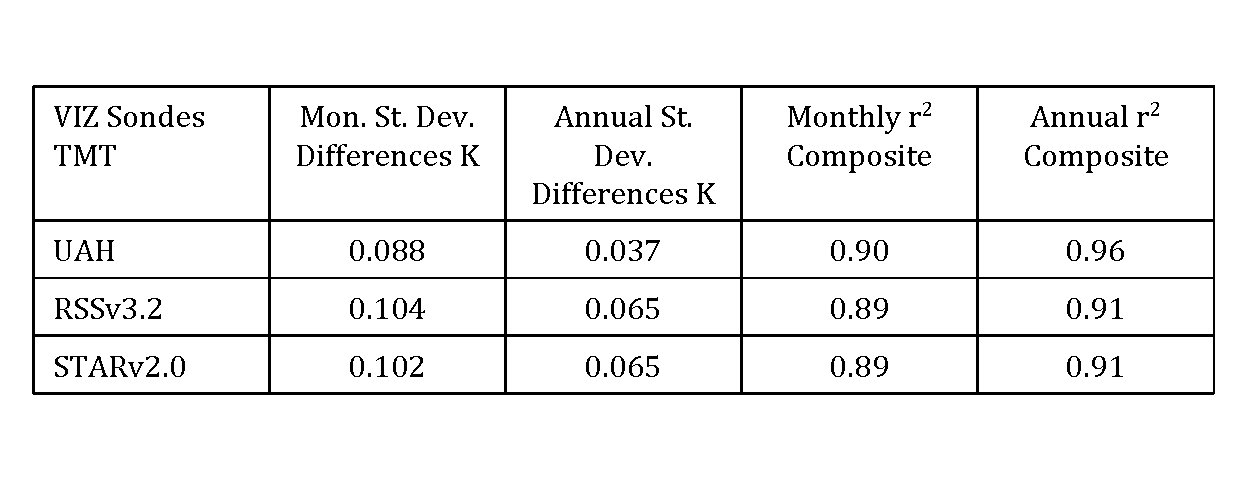
We have additional information regarding UAH’s relatively low error statistics. Using radiosondes to evaluate microwave temperatures requires great care. In our tests, we concentrated on sondes which had documented characteristics and a high degree of consistency such as the US VIZ and Australian sondes. These comparisons have been published a number of times, but most recently updated in C11.
Here are the comparisons for the US VIZ radiosonde network (stretching from the western tropical Pacific to Alaska down across the conterminous US and to the Caribbean.) As you can see, UAH MT provides the lowest error magnitudes and highest reproducibility of the three data sets. Similar results were found for the Australian comparisons.
For data through April 2012 we have the following global TMT trends: UAH +0.045, RSS +0.079 and STAR +0.124 °C/decade. So, RSS, in the middle, is closer to UAH than STAR, yet PCF chose to examine UAH as the “problem” dataset. Had PCF wanted to pick some low-hanging fruit regarding the differences between UAH, RSS and STAR, they would have (a) looked at the diurnal differences between UAH and RSS (see publications) or (b) looked at a simple time series of differences between the three datasets (below). One thing that pops out is a spurious upward shift in STAR TMT relative to UAH and RSS of about +0.06 °C on precisely 1 Jan 2001 – an obvious beginning-of-year glitch. Why not look there?

The Bottom Line
In conclusion, we believe that the result in PCF was a rather uninformed attempt to find fault with the UAH global temperature dataset, using an ad hoc adjustment to a single, short-lived satellite while overlooking the greater problems which have been documented (published or as demonstrated in the figure above) regarding the other datasets.
And think about this. If PCF is correct that we should be using a revised NOAA-9 coefficient, and since we use the same coefficient in both TMT and TLT, then the near perfect agreement currently between RSS and UAH for TLT will disappear; our TLT trend will become warmer, and then RSS will have the lowest warming trend of all the satellite datasets. The authors of the new study cannot have it both ways, claiming their new adjustment brings RSS and UAH closer together for TMT (a seldom used temperature index), but then driving the UAH and RSS trends for TLT farther apart, leaving RSS with essentially the same warming trend that UAH had before.
Since it is now within 3 months of the publication cutoff for research to be included in the IPCC AR5, one is tempted to conclude that PCF will be well-received by the Lead Authors (some of whom are closely associated with the RSS dataset) without critical evaluation such as briefly performed here. However, we cannot predict what the AR5 outcome will be or, for that matter, what waning influence the IPCC might still exert.
That PCF brushed aside the fact that the UAH and RSS trends for the LOWER troposphere are essentially identical (for which the UAH NOAA-9 coefficient is the same) seems to us to be a diversionary tactic we have seen before: create a strawman problem which will allow the next IPCC report to make a dismissive statement about the validity of an uncooperative dataset with a minimum of evidence. We hope that rationality instead prevails.
References
Christy, J.R. and W. B. Norris, 2004: What may we conclude about global tropospheric temperature trends? Geophys. Res. Lett. 31, No. 6.
Christy, J.R., R.W. Spencer and W.B Norris (deceased), 2011: The role of remote sensing in monitoring global bulk tropospheric temperatures. Int. J. Remote Sens. 32, 671-685, DOI:10.1080/01431161.2010.517803.
Po-Chedley, S. and Q. Fu, 2012: A bias in the midtropospheric channel warm target factor on the NOAA-9 Microwave Sounding Unit. J. Atmos. Oceanic Tech. DOI: 10.1175/JTECH-D-11-00147.1.
Friends:
re:
Tom says:
May 11, 2012 at 10:35 pm
In other words, the troll claims a single example equates to “usually”.
Of coursed, the troll knows his/her/their/its post is patently ridiculous. Indeed, the stupidity of the post is intentional because his/her/their/its purpose is to disrupt proper discussion. And refutation of such stupidity is a disruption.
So, ignore everytrhing posted by the troll.
And I really do wish there was some way to cut-off the pay given to the professional trolls who currently infest WUWT.
Richard
Willis said: “… And your link doesn’t work.”
Thats too funny! 🙂
@Tom
Let the grown ups worry about the science. I’m still waiting for the proof of that “double standard” you’ve been driveling on about for 2 days. Sure you haven’t forgotten. Have you?
….Cut/paste….
What proof do you have that Spencer/Christy have ever attacked another scientist’s work and published it in a scientific journal, without first requesting input from the author of that work? I want the name of the article, which scientific journal it was published in, the name of the author(s) who’s work was being attacked, and a credible link proving that Spency/Christy wrote the paper in complete absense of the original author.
Willis Eschenbach says:
May 11, 2012 at 9:21 pm
Phil. says:
May 11, 2012 at 4:47 pm
… Hardly, UAH has had 7 corrections which changed the trend of the data (usually first pointed out by others) …
Cite? Like any new and complex method of measurement, they and others have found errors. However, yours is the first claim I’ve found that the errors were “usually first pointed out by others”. What’s your evidence for that claim?
When S&C first published they came out with a very low rate of cooling which several groups came out with criticisms of, Mears et al. which later produced the RSS data, Vinnakov et al., Fu et al. etc. Different defects were pointed out including: orbital decay, diurnal drift, target calibration, the effect of high ice, stratospheric contribution etc. The largest change of these was the one detailed by the RSS group which pointed out problems with NOAA-11, basically the adjustment was applied with the wrong sign, this was fixed in version 5.2. As I recall Fu et al. first pointed out that there was a problem with this satellite but didn’t identify the specific problem.
“In this work, we extend our method to TLT. InFig.1, BandC, we show a color- coded time-latitude plot of the corrections applied to TLT. For most latitudes, the Christy et al. TLT correction is of opposite sign from our TLT correction and from the corrections applied by either group for the middle/upper troposphere (fig. S2).”
http://www.ssmi.com/papers/mears_science_2005.pdf
Another major correction identified by others was addressing orbital decay:
Wentz, Frank J.; Matthias Schabel (13 August 1998). “Effects of orbital decay on satellite-derived lower-tropospheric temperature trends”. Letters to Nature 394: 661-661.
This resulted in version D, these two corrections resulted in a trend adjustment of +0.135.
OK Willis, I’m working this morning so didn’t have time to go into more detail?
davidmhoffer says:
May 11, 2012 at 8:13 pm
Interestingly S&C are producing a new version of their software which will process the data differently and make PCF’s corrections “moot”, they apparently address the very factors which PCF investigate>>>>
It would be hard for anyone who actually read what they wrote and even half way understood it to conclude that this remark deserves to be called anything but bullsh*t. Have you no shame?
Apparently your problem is that you only half way understood it, I suggest you read the following and cut the gratuitous insults.
“All of this will soon be moot, anyway. Since last year we have been working on v6.0 of the UAH datasets which should be ready with the tropospheric temperature datasets before summer is out. These will include (1) a new, more defensible objective empirical calculation to correct for the drift of the satellites through the diurnal cycle, and (2) a new hot calibration target effective emissivity adjustment which results in better agreement between simultaneously operating satellites at the calibration step, making the post-calibration hot-target adjustment PCF criticizes unnecessary. So, since our new v6.0 dataset is close to completion and submission for publication, we have chosen this venue to document PCF’s misinformation in a rather informal, but reproducible, way rather than bother to submit a journal rebuttal addressing the older dataset.”
Phil;
Apparently your problem is that you only half way understood it, I suggest you read the following and cut the gratuitous insults.>>>>>>>
Nope, I understood it. You said: “they apparently address the very factors which PCF investigate”
And then you quoted from the article: “making the post-calibration hot-target adjustment PCF criticizes unnecessary”
In brief, their new methodology no longer requires the step that PCF claim they were doing wrong. They in no way shape or form addressed the factors PCF brought up in their new methodology. If they had, the step being criticized would still be there, modified in some manner to take into account PCF’s criticisms. They found a way to obtain the correct data without taking the step being discussed by PCF at all. That is hardly addressing the factors that PCF raised.
And I think you know that.
I think you don’t care.
I think you have no shame.
And you protests of ad hominem attacks are pointless in the face of the manner in which you have carefully and obviously twisted the issue to your own purposes. Slimey comments deserve to be called slimey.
davidmhoffer says:
May 12, 2012 at 8:14 am
Phil;
Apparently your problem is that you only half way understood it, I suggest you read the following and cut the gratuitous insults.>>>>>>>
Nope, I understood it. You said: “they apparently address the very factors which PCF investigate”
And then you quoted from the article: “making the post-calibration hot-target adjustment PCF criticizes unnecessary”
Exactly, their new methodology which does not yet exist, when it does then the other experts in the field will no doubt address it, but until then version 5.4 is the existing version and papers and criticism about it are appropriate.
In brief, their new methodology will no longer requires the step that PCF claim they were doing wrong. They in no way shape or form addressed the factors PCF brought up in their new methodology how could they it doesn’t exist. If they had, the step being criticized would still be there, modified in some manner to take into account PCF’s criticisms. They have apparently found a way to obtain the correct data without taking the step being discussed by PCF at all. That is hardly addressing the factors that PCF raised. indeed it does because they claim to have rendered that correction moot
My corrections in bold.
And I think you know that.
I think you don’t care.
I think you have no shame.
That would appear to be your approach, the idea that S&C are planning to introduce new software to exist identified problems at some time in the future doesn’t mean that their existing product is immune to criticism.
And you protests of ad hominem attacks are pointless in the face of the manner in which you have carefully and obviously twisted the issue to your own purposes. Slimey comments deserve to be called slimey.
You’re the one doing the twisting.
You’re the one doing the twisting.
>>>>>
I shall let those whose reading comprehension and interest have brought them this far to draw their own conclusions.
Been following this argument…. Applying reading comprehension….. Agree with David.
“making the …. adjustment unnecessary” has a very different meaning than “addresses the factors which PCF investigate”. One implies the issue is moot, while the other implies the issues is valid.
Very subtle…. Very tricksey of Phil.
Phil. says:
May 12, 2012 at 7:31 am
Come back when you have time. That in no way provides the citations necessary to support your claim, which was:
You claimed 7 errors. Identify them. You claim that the majority of the errors were found by others. Identify who found them. Provide citations for your claims.
w.
PS: To help you to identify the seven errors you claim were found (but have failed to identify), here’s my list of the twelve errors I know were found in the processing, along with estimates of their effect on the results, from the UAH MSU T2LT “README” file. As far as I know, only one of these was identified by an outside group, although I’m happy to be corrected in this matter.
…
Update 8 April 2002 **********************
…
…
…
…
…
…
…
…
…
…
… your turn, Phil …
I think he’s using wikipedia. But please continue. I am very interested to see where this goes.
Willis Eschenbach:
re. your post at May 12, 2012 at 10:09 am
Excellent. Well done.
Please continue demolishing Phil’s assertions because his assertions could seem to have some merit to on-lookers (unlike the comments of Tom that are obviously silly).
Richard
Well Willis it’s Mother’s day weekend so I’ll probably get to it on Monday. Please note that I have provided citations for two version changes originated by others, D and 5.2.
Phil. says:
May 12, 2012 at 3:09 pm
You’ll have to be more specific, what is version change “D”? Everyone knows that the error leading to version 5.2 was discovered by Mears et al., but what is “D”?
In any case, I’ve documented 12 errors. All but one of them, as far as I know, were discovered by S&C.
Curiously, AFAIK the claimed change recommended by Fu has been adopted by RSS (but not UAH), along with its oddity—it leads to a negative weighting for part of the data, which is a physical impossibility. So if it’s the Fu claim you are referring to, I fear you haven’t dug deeply enough.
w.
Version D was related to orbital decay and was discovered to be an issue back in 1998 (I did some research). You can read more about it here.
http://www.ncdc.noaa.gov/temp-and-precip/msu/uah-msu.pdf
Jump to the sections on “previous studies” and “new discoveries” if you don’t feel like reading the whole thing.
Frankly, I don’t see what the big deal is. There was no “mistake” being corrected, it was just new research being incorporated into the work by a responsible scientist. I’m guessing back then things were different as collaboration seems to have been the rule and not the exception.
I’d like to see what more Phil comes up, but in any case, I believe he has 2 out of 7 (or 12 depending on who’s count). He needs at least 2 more (or 5 more) for his “usually first pointed out by others” claim to be valid.
I also think his “applied the wrong sign” spitball is another tricksy word twisting game.
The citation: “…..the Christy et al. TLT correction is of opposite sign from our TLT correction ….”
has a different meaning than
“Christy applied the wrong sign.”
The cited version implies that the two papers disagree with what a correction should be, and that they happen to be in opposite directions. Phil’s version implies Christy just made a basic math error. So subtle…. so tricksy……
I see that our pal Phil never came back with the rest of those citations like he said he would. This thread is dead, and no one will probably see this, but just because I hate loose ends…..
So it’s now confirmed. Phil’s assertion that corrections to the UAH data is “usually pointed out by others” was a bald-faced lie.
Wah.
I came back to this thread for the express purpose of making a snarky remark should Phil fail to show as promised. But some guy beat me to it. Who? I dunno. Just some guy.
I always try and get my buddy from SacU to come into these forums and test out his thinking, but alas, here I am. Is there any thoughts or links to respond in kind to his following post?
=====================================
Interesting find. I would like to share with you a few references from a different perspective if i may though.
In 2009, a study was conducted to see what people though about global climate change. Though nearly 40% of the general public said they did not think humans had any significant impact on climate change, more than 95% of actively publishing climatologists reported that they do think humans significantly affect our climate through our gas emissions. (http://tigger.uic.edu/~pdoran/012009_Doran_final.pdf)
I also think it could be useful to define the changes that have recently been of interest to climate researchers, and there is a great reference list attached to this page (http://www.ucsusa.org/assets/documents/global_warming/humanfingerprintshighres.pdf). These studies are a good place to start if you are interested in hearing an opposing argument, or if you are looking for credible evidence that climate change is actually happening.
Lastly, its perfectly ok to question science. It is by skepticism that truth is sought, and i encourage you to question these findings. I happened upon something that very clearly outlines the position of uncertainty and what exactly it means when conducting research and analyzing data. (http://www.ucsusa.org/global_warming/science_and_impacts/science/certainty-vs-uncertainty.html) I feel that this is an important concept when looking at these studies.
I agree that those who make absolute claims about what exactly will happen to our atmosphere as time goes by are out of line, and that cuts both ways. Lets question everything, even our impulse to reject each other’s claims. If i can see your side clearer and you can see mine clearer as well, maybe we will both be one step closer to the truth.
Willis Eschenbach says:
May 12, 2012 at 7:47 pm
Phil. says:
May 12, 2012 at 3:09 pm
Well Willis it’s Mother’s day weekend so I’ll probably get to it on Monday. Please note that I have provided citations for two version changes originated by others, D and 5.2.
You’ll have to be more specific, what is version change “D”? Everyone knows that the error leading to version 5.2 was discovered by Mears et al., but what is “D”?
In any case, I’ve documented 12 errors. All but one of them, as far as I know, were discovered by S&C.
See above, I’ve already cited two.
Given the level of detail you’ve asked for Willis, i’m going to take a bit longer to put together a full response with full citations.
The versions were first identified by letter: A,B,C,D, then number: 5.0, 5.1, 5.2, 5.3, 5.4 and next will be 6.0.
Version D addressed orbital decay and was identified in the following:
Wentz, Frank J.; Matthias Schabel (13 August 1998). “Effects of orbital decay on satellite-derived lower-tropospheric temperature trends”. Letters to Nature 394: 661-661.
Ha ha! Yup, the low hanging fruit is used up and he still falls short. Get ready for some tricksy word-craftery….. I’m sure he’ll figure out something clever buried in those details……
You should see how much arm-twisting it took to get my friend to admit his statement was based on 79 people for his consensus stat! http://www.facebook.com/sean.giordano/posts/132746873526843?