Note: I’m blogging this from Atlanta, where I am at the TWC Pioneers reunion. Bob was kind enough to provide this post so I can relax a bit (though I think I’ll chase a NOAA USHCN weather station today anyway). His figure 10 (below) is interesting, his figure 11 even more so. – Anthony

Guest post by Bob Tisdale
With the recent release of the CRUTEM4 data came the expected two-sided discussion (argument) about the changes from the earlier version of the dataset, CRUTEM3. One side claimed the adjustments were needed, while the other side protested the increase in global surface temperature anomalies. There were also differences of opinion about where the adjustments were made. Some claimed the added Arctic surface stations were the sole contributors to the trend, and others countered that the adjustments and dataset additions impacted data globally.
Who was right about the locations of the additions and adjustments? And when did the adjustments and additions have the greatest impact in recent decades?
The changes impacted the land surface temperature anomaly data globally. The Jones et al (2012) paper Hemispheric and large-scale land surface air temperature variations: An extensive revision and an update to 2010 discussed them in detail.
To illustrate the answer those questions in ways not presented in the paper, we’ll look at the CRUTEM3 and CRUTEM4 land surface temperature anomaly data from January 1975 to the end of the CRUTEM4 data in December 2010. That period represents the late 20thCentury warming period as it continues to present, and it’s also 36 years long so we can divide the data into two equal 18-year periods. And we’ll compare the trends of the two datasets on time series and zonal-mean (latitudinal) bases. Let’s start with the trends for the two periods on zonal mean bases just get an idea of where around the globe those changes took place.
TRENDS ON ZONAL MEAN BASES
The trends of the two datasets from the beginning of the recent warming period (January 1975) to December 1992, and the differences in the trends, are shown Figures 1 and 2. The linear trends were determined at each 5 degree latitude band and plotted in centered 5 degree increments, from 55S to 85N. (Note: The Climate Research Unit [CRU] of the University of East Anglia does present Antarctic land surface temperature anomaly data, but it is sporadic and would require me to infill some missing data for the trend analyses, so I excluded the Antarctic data in the zonal mean graphs, and only those graphs. All data is included in the global time-series graphs.) To calculate the differences, the trend of CRUTEM3 at each 5 degree latitude band was subtracted from the corresponding CRUTEM4 trend. Over this period of 1975-1992, compared to CRUTEM3, the new and improved CRUTEM4 land surface temperature anomaly data has higher linear trends in the Northern Hemisphere from about 35N to 75N, but lower trends between 10S and 35N, overlooking that little blip about 27N. CRUTEM3 also has significantly higher trends than the updated CRUTEM4 north of 75N.

Figure 1
HHHHHHHHHHHHHHHHHHHHHHHHHHHHHHHHHHHHHHHHH

Figure 2
A few things to keep in mind: In a few of the zonal-mean graphs, there are major differences between the trends of the CRUTEM3 and CRUTEM4 data at the latitude of 82.5N. But the percentage of land at that latitude is minimal, only about 12%, the rest being ocean. (And, yes, there is sea surface temperature data at that latitude, even more so with a satellite-based sea surface temperature dataset.) So a major correction there doesn’t have a major impact on global surface temperature anomalies when the CRUTEM3(4) data is combined with HADSST2(3) data to form HadCRUT3(4). (High temperature anomalies simply look impressive at that latitude on maps that blow the Arctic out of proportion.) The zonal mean graphs of the land surface temperature linear trends in this post are also not weighted by latitude; corrections at low latitudes have a much greater impact on global temperatures than at high latitudes. And, of course, the CRUTEM data only represents land surface temperatures, but the oceans cover a much greater portion of the surface of the globe. Figure 3 compares the percentages of land and ocean surface area from 90S to 90N on a latitudinal basis, where the surface area percentages have also been weighted by latitude. The percentages of land surface area in 5 degree latitude bands were determined using a land mask calculator at the KNMI Climate Explorer.

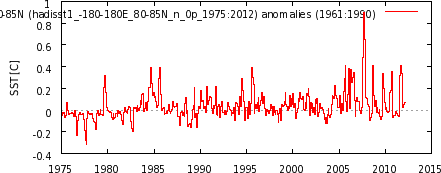

Figure 3
Before we compare the trends of the two datasets during the second period, I wanted to compare the trends of 1975-1992 and 1993-2010. We could use either dataset for this, so I’ve used the newer CRUTEM4. Refer to Figure 4. The biggest difference in the trends of the two periods is the absence of the exaggerated warming in the Arctic during the early period of 1975 to 1992. That is, there’s little polar amplification during that period. Of course, you ask yourself, why? The first thing that comes to mind is the eruption of Mount Pinatubo, but I prepared a few more trend graphs on zonal mean bases that ended before and after 1992 (started in 1975) and the polar amplification was still absent for a few years before and after that volcanic eruption. (I have not presented those additional graphs.) What caused the shift toward polar amplification in the land surface temperature data during the period after 1992? Maybe a reader who’s studied the Arctic can fill us in. But we’re getting sidetracked.

Figure 4
Figures 5 and 6 compare CRUTEM3 and CRUTEM4 trends during the period of 1993 to 2010. The CRUTEM4 trends are noticeably higher than CRUTEM3 in the Southern Hemisphere from 40S to 10S, and they are significantly higher in the Northern Hemisphere, with the difference in trends peaking at the latitude band of 70N-75N.

Figure 5
HHHHHHHHHHHHHHHHHHHHHHHHHHHHHHHHHHHHHHHHH

Figure 6
Figure 7 compares the differences in trends between CRUTEM3 and CRUTEM4 for the two periods of 1975-1992 and 1993-2010. Not too surprisingly, the additions and adjustments to CRUTEM4 from 1993-2010 had a greater impact than during the earlier period.

Figure 7
A QUICK LOOK AT LONG-TERM TRENDS
For those interested, Figure 8 presents the same CRUTEM3 and CRUTEM4 trends comparison on a zonal mean basis, but with the data starting in 1900. I thought many would be interested to see that the CRUTEM datasets showed no trend since 1900 just north of the equator (0-5N). I find it interesting because there’s also been no trend in NINO3.4 sea surface temperature anomalies (an El Niño-Southern Oscillation index, with the coordinates of 5S-5N, 170W-120W) over that period, too, based on HADISST data. Just a curiosity that I’ve never seen presented before.

Figure 8
THE NUMBER OF STATIONS
There was a step decrease in the early 1990s in the number of Northern Hemisphere surface stations used in CRUTEM3. That station dropout had come under scrutiny in recent years, with some analyses suggesting that the cutback in the number of stations was, in part, responsible for the increased warming since that time. That drop in surface station quantity was addressed in Jones et al (2012) toward the beginning of the paper. It seems as though they made an effort to put that complaint to rest with their discussion of the increased number of stations and their Figure 1, presented here as Figure 9. They eliminated the sudden dropout of stations…and, to contradict the naysayers, when they added the surface stations, the surface temperature trends increased.

Figure 9
GIF ANIMATIONS OF MAPS SHOWING ADDITIONAL GRID COVERAGE
CRU definitely added data in the Arctic; see Animation 1, which presents the grids covered and color-coded temperature anomalies for CRUTEM3 and CRUTEM4 in the Arctic.

Animation 1
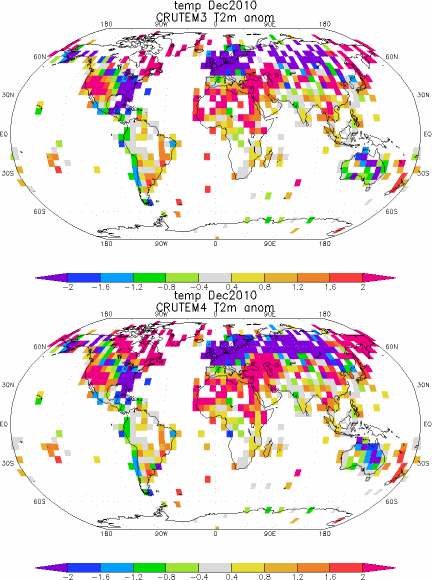
But they also added data elsewhere globally, as shown in Animation 2.
Animation 2
A DISCUSSION ABOUT SEA SURFACE AND LAND SURFACE TEMPERATURES
Land surface temperature records and sea surface temperature records both show that surface temperatures have warmed since 1901, Figure 10, with the land surface temperatures mimicking and exaggerating the variations in sea surface temperature—as they should.
Figure 10
But as we can see in Figure 11, the land surface temperatures have warmed much more rapidly than sea surface temperatures in recent decades.

Figure 11
Let’s consider for a few moments that exaggerated warming of land surface temperatures that occurred in recent decades. We understand that the sea surface temperature data is biased toward being a Southern Hemisphere dataset, because the surface area of the Southern Hemisphere oceans is 1.4 times greater than that of the Northern Hemisphere oceans, and we understand that the natural variations in the sea surface temperature anomalies of the Northern Hemisphere oceans are greater than the Southern Hemisphere. The variations in the Northern Hemisphere sea surface temperatures include the Atlantic Multidecadal Oscillation (AMO) in the North Atlantic and an unnamed mode of multidecadal variability in the North Pacific [not the PDO] that appears to have a frequency and magnitude similar to the AMO, though they’re slightly out of synch. (See the discussion under the heading of PACIFIC DECADAL VARIABILITY toward the end of the post here.) We also understand that the land surface temperature data is greatly biased toward being a Northern Hemisphere dataset, since there’s about 2.2 times more land surface area in the Northern Hemisphere than in the Southern Hemisphere. So, considering the additional land surface area of the Northern Hemisphere and the additional multidecadal variability of the sea surface temperature anomalies there, we would expect some additional natural exaggeration of the land surface temperature data in response to the additional variations in the Northern Hemisphere sea surface temperatures. But how much should be expected? How much of the exaggeration in land surface temperature anomalies occurs naturally or is the result of continuous upward data adjustments?
![an unnamed mode of multidecadal variability in the North Pacific [not the PDO] that appears to have a frequency and magnitude similar to the AMO](http://i56.tinypic.com/t9zhua.jpg)
TIME-SERIES COMPARISONS
Figure 12 is a time-series graph of CRUTEM3 and CRUTEM4 land surface temperature anomalies for the period of January 1975 to December 1992, the first half of term being discussed. The two datasets are so similar for much of the period that it’s difficult to differentiate between the two. As you’ll note, there’s a very slight difference in the linear trends. But if you scroll back up to Figures 1 and 2, there were changes at all latitudes, some of them significant changes. Somehow all of those changes resulted in very little change in the overall global land surface trends with the update from CRUTEM3 to CRUTEM4.

Figure 12
On the other hand, during the period of January 1993 to December 2010, Figure 13, the new and improved CRUTEM4 data has a trend that’s approximately 0.05 deg C/decade higher than the CRUTEM3 data.

Figure 13
To some, 0.05 deg C/decade may not seem like a significant amount, but it changed the years of the record high temperature anomaly. With CRUTEM3, the record year was 1998, but with CRUTEM4, its 2007, with 2010 a close second (not illustrated). Figure 14 illustrates the difference between the two datasets with CRUTEM3 subtracted from CRUTEM4. I’ve also smoothed the difference with a 13-month running-average filter to reduce the noise. Two of the greatest adjustments came during what was once the record year, 1998, and toward the end of datasets, around 2007, just when it was needed to have 2007 as the warmest year.

Figure 14
CLOSING
The adjustments shown in Figure 14 might lead some readers to believe the Climate Research Unit went to all that work with the single-minded goal of raising the land surface temperature anomalies after 1998 so that their records could show that global warming continued. Yup. Those adjustments just might lead people to believe that. But maybe we also need to consider the locations of the new 5X5 grids that contain data and the land surface temperature anomaly patterns in 1998 and 2007. Figures 15 and 16 present the CRUTEM3 and CRUTEM4 zonal mean land surface temperature anomalies (not trends) for the years of 1998 and 2007. And Animations 3 and 4 present maps of the temperature anomalies, and grids with and without data, during those two years for the two datasets. I’ll let you decide.

Figure 15 – (1998)
HHHHHHHHHHHHHHHHHHHHHHHHHHHHHHHHHHHHHHHHH

Figure 16 – (2007)
HHHHHHHHHHHHHHHHHHHHHHHHHHHHHHHHHHHHHHHHH

Animation 3 – (1998)
HHHHHHHHHHHHHHHHHHHHHHHHHHHHHHHHHHHHHHHHH

Animation 4 – (2007)
HHHHHHHHHHHHHHHHHHHHHHHHHHHHHHHHHHHHHHHHH
BEFORE YOU JUMP TO CONCLUSIONS
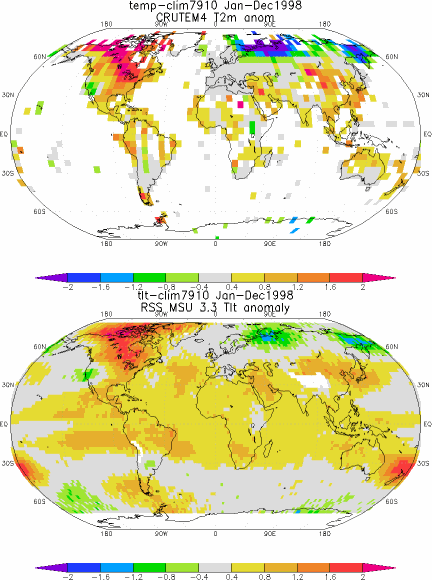
For the next two animations of global temperature anomalies, we’ll need to switch the base years for anomalies to a period that will work with RSS Lower Troposphere Temperature (TLT) anomalies and CRUTEM4, so we’ll use 1979 to 2010. Animations 5 and 6 compare the global CRUTEM4 land surface temperature anomalies to the Remote Sensing Systems (RSS) Lower Troposphere Temperature anomalies for 1998 and 2007. Again, I’ll let you decide.
Animation 5 – (1998 with RSS)
HHHHHHHHHHHHHHHHHHHHHHHHHHHHHHHHHHHHHHHHH

Animation 6 – (2007 with RSS)
HHHHHHHHHHHHHHHHHHHHHHHHHHHHHHHHHHHHHHHHH
MY FIRST BOOK
The IPCC claims that only the rise in anthropogenic greenhouse gases can explain the warming over the past 30 years. Satellite-based sea surface temperature disagrees with the IPCC’s claims. Most, if not all, of the rise in global sea surface temperature is shown to be the result of a natural process called the El Niño-Southern Oscillation, or ENSO. This is discussed in detail in my first book, If the IPCC was Selling Manmade Global Warming as a Product, Would the FTC Stop their deceptive Ads?, which is available in pdf and Kindle editions. A copy of the introduction, table of contents, and closing can be found here.
SOURCES
The monthly CRUTEM3 and CRUTEM4 data used in the time-series and zonal-mean graphs and the maps, including the RSS TLT anomalies, are available through the KNMI Climate Explorer.
The annual CRUTEM4 data used in Figures 10 and 11 is available at the Hadley Centre’s webpage here, specifically the annual data here, and the HADSST3 data is available through the KNMI Climate Explorer here.
Valiant attempt at an answer there Dirk, but the ‘mass consumer market’ has yet to make use of CNG refueling stations with the ‘same success’ as we have for normal ‘liquid refueling’ mass consumer market, including such ‘habits’ by the customers as drive-offs with the filler attached, smoking while filling/fueling, inattention during hookup resulting in spillage; when it comes to ‘fueling with a high-pressure gas, what could possibly go wrong – go wrong – go wrong – go wrong …
Checking in on CNG: Accidents Will Happen
CNG and Hydrogen Vehicle Fuel Tank Failure Incidents, Testing, and Preventive Measures
Robert Zalosh
I wonder, in those states where the roads are heavily ‘salted’, at the inspections any more frequent?
What does it cost to replace a tank, and given the inspection interval cited just above, might this be some multiple of 3 years or 36,000 miles?
Honda’s “How to handle a CNG vehicle involved in an accident” guide:
Emergency Response Guide
Prepared for Fire Service, Law Enforcement, Emergency Medical, and Professional
Towing Personnel by American Honda Motor Co., Inc.
Honda CNG Vehicle
.
Another excellent Tisdale article.
And FYI:
Trust in science and scientists is rapidly eroding due to the AGW scam. And rate of retractions in scientific papers skyrockets.
[source]
Lots of wriggly lines and detailed discussion for the experts.
Any chance of a sim-ple sum-ma-ry of the main points in eas-y words for those of us who are in-ter-est-ed but not ex-perts?
Otherwise, we’re doomed.
lgl says @ur momisugly April 28, 2012 at 1:55 pm: “What’s the problem?”
Perhaps I am not understanding your intent or your graph, but I see a problem with your graph. Likely, the point of the graph is that all three measures end up in the same place. But you get there by starting off in different places. For example, UAH starts off over 0.1 degree higher than CRU4. If all measures started in the same place, then you would see a noticeable difference at the end.
http://www.woodfortrees.org/plot/hadsst2gl/from:1980/mean:12/plot/crutem4vgl/from:1980/mean:12/offset/scale:0.5/plot/uah/from:1980/mean:12/scale:0.6/offset
Still looks like about 0.2C warming bias in Hadcrut vs UAH
The big “political” change in Hadcrut4 vs Hadcrut 3 is to minimize 1998 and maximize 2007 – I call BS.
lgl says:
April 28, 2012 at 1:55 pm
“What’s the problem?
lgl, you obviously didnt’t read the post or as is common with warmists, ignored the very data in front of your eyes.
The graph you linked to actually demonstrates Mr Tisdale’s very point, that is that CRUTEM4 has been modified to make 2007 the warmest year on record while CRUTEM3 had 1998 as the warmest year on record.
As is indictaded by your link, CRUTEM4 now disagrees with both UAH and HADSST, thats an “own goal”.
Well done. Couldn’t have said it better myself.
Someone please explain how near surface temperature trends can exceed tropospheric trends based on greenhouse effect theory. Thanks.
RoHa: Whatcha wanna know?
Alvin says:
April 28, 2012 at 10:46 am
@jim, even better: What about all those drive-offs where the soccer moms leave the filling nozzle in the vehicle?
The idea that LPG/CNG is unsafe is simply false. All the evidence shows LPG and CNG vehicles are safer than petrol vehicles. Where I live in Perth pretty much every service station has a LPG pump. If the LPG hose isn’t connected to a tank, the supply of LPG simply cuts off. So while you can pump petrol onto the station forecourt ground, you can’t pump LPG. And even if you could the LPG would dissapate pretty much instantaneously (at least in the climate here). Which is why LPG/CNG vehicles are safer in an accident.
Its my understanding that CNG isn’t suitable for small vehicles, because you need a bigger heavier tank, but LPG is fine for cars and SUVs.
The real problem is that vehicle manufacturers fueled by government subsidies wasted billions on electric and hybrid vehicles that hardly anyone wants (at their real cost), while LPG/CNG vehicles were neglected (excepting bus manufacturers). Even today, almost all the factory produced LPG/CNG passenger vehicles are in places like Iran and Brazil.
Must be chilly climate weather, it appears all of the trolls are deep in their pits.
Terrific post Bob. It’s amazing what errors in thermometer reading those CRU climate scientists can dredge up stuck in their tiny offices with piles of lost papers hiding the lost temps prior to their previous adjustments.
Maybe they discovered those temperature errors whilst traveling on those exotic junkets?
Hmm, let’s see, when did the real warmup of the Siberian stations happen? Could it have been about the time the stations stopped receiving their fuel allotments based on how cold the temperature was??? You couldn’t trust Siberian weather reports during the cold war, I heard that some of those stations would report 5C low just to make sure they didn’t run short of fuel oil to heat their stations, and Moscow would short them if they thought it was not so bad. I don’t know how long that arrangement continued after Yeltson came to power, so an exact date for when the incentives to fudge the data low ended is unknown to me, but I’m sure there is someone out there that knows this.
The smoother and steeper the warmists make the warming trendline up to the present, the more devastating for their cause when that trendline is broken by a cooling trend. I.e., it will be harder for them to claim that it’s just a blip, because they’ve smoothed out the other blips.
Figures lie, and liars figure. Don’t like the way the data looks? Well, just make adjustments until it looks like you want it. Boy, that’s real science, isn’t it? /sarc
> kasphar says:
> April 28, 2012 at 2:55 pm
> Hottest years 1-5 for the following data sets.
> NASA GISS 2010 2005 2007 1998 2009
> CRUTEM 3 1998 2010 2005 2003 2002
> CRUTEM 4 2007 2010 2005 1998 2006
> So the hottest year is????????
None of these year averages is remotely ‘hot’, so asking
which is the ‘hottest’ is meaningless.
Apologies – Correction to plot only.
http://www.woodfortrees.org/plot/uah/from:1980/mean:12/plot/hadcrut3gl/from:1980/mean:12/plot/hadcrut4gl/from:1980/mean:12
The most important adjustment is the reassignment of bucket measurements to ERI:
This is an extremely dubiuous overwriting of 30% of data. The reasoning is very weak to say the least. And then they claim that by doubting and overwriting the content of historic documents, they “correct the uncertainty”. Of course, uncertainty cannot be “corrected”. Instead they increase uncertainty by doubting the content of historic logs. This single episode contributed about 1/3 of the warming since the last cyclical peak in the 1940s. The warming would be 0.2 degree instead of 0.3 degrees in 70 years or 0.3 degrees insted of 0.45 degrees per century.
—————————————
“It is likely that many ships that are listed as using buckets actually used the ERI method (see end Section 3.2). To correct the uncertainty arising from this, 30+-10% of bucket observations were reassigned as ERI observations.”
Section 3.2:
“It is probable that some observations recorded as being from buckets were made by the ERI method. The Norwegian contribution to WMO Tech note 2 (Amot [1954]) states that the ERI method was preferred owing to the dangers involved in deploying a bucket. This is consistent with the rst issue of WMO Pub 47 (1955), in which 80% of Norwegian ships were using ERI measurements. US Weather Bureau instructions (Bureau [1938]) state that the \condenserintake method is the simpler and shorter means of obtaining the water temperature” and that some observers took ERI measurements \if the severity of the weather [was] such as to exclude the possibility of making a bucket observation”. The only quantitative reference to the practice is in the 1956 UK Handbook of Meteorological Instruments HMSO [1956] which states that ships that travel faster than 15 knots should use the ERI method in preference to the bucket method for safety reasons. Approximately 30% of ships travelled at this speed between 1940 and 1970.”
http://climateaudit.org/2011/07/12/hadsst3/
Steven Mosher (April 28, 2012 at 2:04 pm):
“bob the correct way to compare the land to sst is to compute the land sea contrast. it is roughly constant at 1.6.”
WT…_?
“Hmm, let’s see, when did the real warmup of the Siberian stations happen?”
I remember a few years ago (2005-ish?) comparing trends between the surface and satellite data for Siberia and the warming trend was much greater in the surface data that satellite. So I’m sure there’s been real warming, but nowhere near as much as the surface measurements show.
lgl asked (April 28, 2012 at 1:30 pm)
“Paul, which of the JapaneseSeaLevel is the NPI?”
Neither — see here:
http://judithcurry.com/2012/04/06/aerosols-and-atlantic-aberrations/#comment-190763
It’s *another metric (an analogous one) that I have *not illustrated that’s coherent with *interannual NPI. (I’ve presented that result via backchannels, but not in public.)
In the Climate Etc. thread to which I’ve linked, you’ll find plenty of related notes which I volunteered on a day when I had some extra time — for example:
“Mainstream Climate Scientists:
The calculations to get this [ http://i43.tinypic.com/o52jbd.png ] result can be done in a spreadsheet in a few minutes. Don’t underestimate the depth of the fundamental reforms demanded by this sheer simplicity. Contact me if you need help. […] All the info needed to crack the code of ENSO is now publicly available. We shall see if any climate scientist is willing & able to follow through.”
Best Regards.
All the land surface temperature analyses are proof one thing, that Confirmation Bias is a real phenomena.
TomRude (April 28, 2012 at 4:52 pm) wrote:
“Clearly this is a case of fiddling it until they get the answer they wanted. The rest is noise, pun intended… 😉 “
We got a lesson on ‘Texas Sharpshooting’ over at Climate Etc. a few weeks back:
Eyal Porat (April 6, 2012 at 10:42 am):
“This is a classic case of shooting the arrow (anthropogenic CO2 global warming) and then drawing the target around it (computerized models).”
http://judithcurry.com/2012/04/06/aerosols-and-atlantic-aberrations/#comment-190615
…And to quote one of our fellow fire-breathing Canadians:
“We don’t need a cure for the weight of the world
Cuz it’s floatin’ ’round in the universe
Just swing it like it’s tied by a string that you hold
AND LET IT GO” — Dragonette – LET IT GO
Josh should do a cartoon on the red tape being used to hold together the “C” (& the “A”) in cagw.
Reblogged this on The GOLDEN RULE and commented:
Cooking the global warming figures.
and for land-only
http://www.woodfortrees.org/plot/uah-land/from:1980/mean:12/plot/crutem3vgl/from:1980/mean:12/plot/crutem4vgl/from:1980/mean:12
This is interesting
http://www.woodfortrees.org/plot/hadsst2gl/from:1980/mean:12/plot/uah/from:1980/mean:12/plot/uah-land/from:1980/mean:12
Bob has done a great job, here.
But there are two snags.
One snag is that whatever the temperature readings have been doing, it doesn’t even begin to demonstrate that anthropogenic CO2 emissions have any significant influence whatever.
Second snag is that ANYTHING produced by Jones, Briffa and the other con men and incompetents at UEA is hugely suspect.
Once you trash people’s trust you can’t just soldier on and expect to be taken seriously.
Especially when it is the basis for Trillion dollar expenditure. And that every scare story built upon their ‘science’ has been comprehensively falsified.