There’s a new paper in PNAS worth having a look at. It seems the authors found some very strong evidence for a comet or asteroid impact during the period known as the Younger Dryas. According to Wikipedia:
The Younger Dryas stadial, also referred to as the Big Freeze, was a geologically brief (1,300 ± 70 years) period of cold climatic conditions and drought which occurred between approximately 12,800 and 11,500 years BP (Before Present). The Younger Dryas stadial is thought to have been caused by the collapse of the North American ice sheets, although rival theories have been proposed.
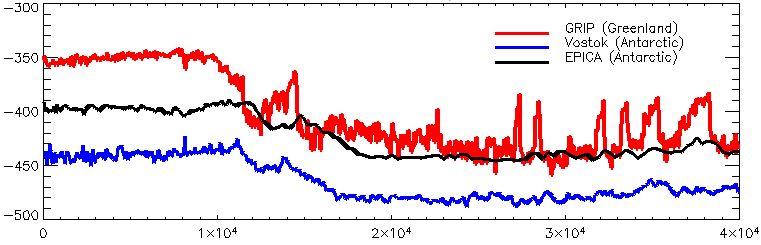
With this new paper, this may be one of those “case closed” moments in science showing that “climate change”/ice sheet collapse itself wasn’t to blame for the cold event, but the climate changed due to the impact event. This rather undoes the claims last year covered on WUWT in the story Sudden Clovis climate death by comet – “bogus”. I’d say it is pretty hard to argue with micro magnetic impact spherules dated to the time.
Evidence from central Mexico supporting the Younger Dryas extraterrestrial impact hypothesis

Abstract
We report the discovery in Lake Cuitzeo in central Mexico of a black, carbon-rich, lacustrine layer, containing nanodiamonds, microspherules, and other unusual materials that date to the early Younger Dryas and are interpreted to result from an extraterrestrial impact. These proxies were found in a 27-m-long core as part of an interdisciplinary effort to extract a paleoclimate record back through the previous interglacial.
Our attention focused early on an anomalous, 10-cm-thick, carbon-rich layer at a depth of 2.8 m that dates to 12.9 ka and coincides with a suite of anomalous coeval environmental and biotic changes independently recognized in other regional lake sequences.
Collectively, these changes have produced the most distinctive boundary layer in the late Quaternary record. This layer contains a diverse, abundant assemblage of impact-related markers, including nanodiamonds, carbon spherules, and magnetic spherules with rapid melting/quenching textures, all reaching synchronous peaks immediately beneath a layer containing the largest peak of charcoal in the core. Analyses by multiple methods demonstrate the presence of three allotropes of nanodiamond: n-diamond, i-carbon, and hexagonal nanodiamond (lonsdaleite), in order of estimated relative abundance.
This nanodiamond-rich layer is consistent with the Younger Dryas boundary layer found at numerous sites across North America, Greenland, and Western Europe. We have examined multiple hypotheses to account for these observations and find the evidence cannot be explained by any known terrestrial mechanism. It is, however, consistent with the Younger Dryas boundary impact hypothesis postulating a major extraterrestrial impact involving multiple airburst(s) and and/or ground impact(s) at 12.9 ka.
…

…
Summary
Synchronous peaks in multiple YDB markers dating to 12.9 ka were previously found at numerous sites across North and South America and in Western Europe. At Lake Cuitzeo, magnetic impact spherules, CSps, and NDs form abundance peaks within a 10 cm layer of sediment that dates to the early part of the YD, beginning at 12.9 ka. These peaks coincide with anomalous environmental, geochemical, and biotic changes evident at Lake Cuitzeo and in other regional records, consistent with the occurrence of an unusual event. Analyses of YDB acid-resistant extracts using STEM, EDS, HRTEM, SAD, FFT, EELS, and EFTEM indicate that Lake Cuitzeo nanoparticles are dominantly crystalline carbon and display d-spacings that match various ND allotropes, including lonsdaleite. These results are consistent with reports of abundant NDs in the YDB in North America and Western Europe.
Although the origin of these YDB markers remains speculative, any viable hypothesis must account for coeval abundance peaks in NDs, magnetic impact spherules, CSps, and charcoal in Lake Cuitzeo, along with apparently synchronous peaks at other sites, spanning a wide area of Earth’s surface. Multiple hypotheses have been proposed to explain these YDB peaks in markers, and all but one can be rejected. For example, the magnetic impact spherules and NDs cannot result from the influx of cosmic material or from any known regular terrestrial mechanism, including wildfires, volcanism, anthropogenesis, or alternatively, misidentification of proxies. Currently, only one known
event, a cosmic impact, can explain the diverse, widely distributed assemblage of proxies. In the entire geologic record, there are only two known continent-wide layers with abundance peaks in NDs, impact spherules, CSps, and aciniform soot, and those
are the KPg impact boundary at 65 Ma and the YDB boundary at 12.9 ka.
If you’re interested, the paper is published with unrestricted access on the PNAS website.
Or, you can read a full PDF copy that’s been mirrored on Dropbox.com at: http://dl.dropbox.com/u/2268163/Mexico%20YD%20Paper.pdf
h/t to reader Dennis Cox
Steve Garcia said
Quote
The Ice sheet did not recede enough by 12.9kya to use the St Lawrence,
Unquote
Niagara falls formed just at this time.
It is very clear that this major event had several impacts that directly affected climate. Dust, Muck, Fresh water into the far north and Gulf of St Lawrence, Melting of huge Ice Sheets, vast African dust storms and possibly a move of the rotational pole. Combine all of these and you have a 1,000 year winter, massive tsunamis, extinctions and mythology.
What other evidence is there? Well there is a totally independent and uncontaminated date source. It has been demonstrated and supported with astronomical data that the Giza alignment indicates a date of 10,500 BC, the very date of the Younger Dryas initiation event. Is that a co-incidence?
Consider this
http://home.hiwaay.net/~jalison/index.html
There is so much evidence, so much supporting data and so many powerful inputs that a single unrelated event could not have bought about a 1,000 year climate change on its own. Just where did 1,000 feet and more of alluvial muck come form , how was it formed?
As an example, it has only recently been determined that the Minoan civilisation ended with the eruption of Thera and the resulting Tsunami. However it was thought that this was just coastal but recent finds have found Tsunami muck over 100 feet above the shoreline thus demonstrating that the level of destruction was much greater than thought.
@John 6:39 pm:
“Why big game? Because mammoth tusks were found at the various Alaska sites and were mined in vast quantity in the late 1800s from a small island in the East Siberian Sea. Unless herds of Siberian Mammoth decided it was the place to die, someone either herded them there or dragged the tusks to that location.”
I trust that last was tongue-in-cheek, but even if not, it is a new perspective for me. Those two possibilities never occurred to me, but they are as good as mine. Which doesn’t say much!
…Yeah, those mammoth skeletons – much more than just tusks, as you certainly know – were not just on one island, but on the whole of the Liakhov and the New Siberian Islands, plus/including Wrangel where the mini mammoths survived a bit longer, those islands – just how or why did those mammoths end up there? Especially the Berskova one with the buttercups in its stomach. Buttercups don’t grow there, and there isn’t enough vegetable matter to pee on, so what did they eat – herded or not? If you figure it out, then tell me. My old Plan B backup explanation was a polar shift, which is about the only explanation that doesn’t dispute the facts of the mammoths and their tummies – but it disputes everything else we know , or think we know.
Berskova wasn’t on those islands, but the principle remains your question: WTF were they bloody doing up there? When mammoth’s hair is NOT designed for cold, when mammoth remains are ALSO found in Mexico, when mammoths in ASIA died off at the same time as the ones in N.A. – what can possibly have been going on back then? Did their being there have any connection to the extinction event itself – no matter whether climate or Clovis overkill or comet? Occam’s razor fails us. No simple explanation exists. Even Holmes’ deduction fails us. I think we don’t have enough facts to ask the right question. But yours are as good as mine or anybody else’s.
But are you ready for this?… Mammoths weren’t the only big skeletons found on the New Siberian and Liakhov Islands.
One must first credit Whitley with knowing the difference between horse bones and ‘elephants’ – which latter I assume are mammoths. Rhinos and buffaloes, too – if for no other reason than scale. The real weird one is rhinos! The nearest rhinos now are south of the Himalayas. NO ONE would suggest those rhinos were herded up to those islands, nor that they happened to wander there while foraging – not then the nearest forage for them is about 1,000 to the south.
Whatever we try to assign the exitnction to, climate or Clovis man or impactor, it still doesn’t explain what the heck they were doing there in the first place. And if Clovis man killed ’em all in N.A., who killed them all in Siberia????? Every answer is insufficient.
Steve Garcia
@John –
Accounts from early expeditions exist, if not exactly journals. In 1829 German scientist G.A. Erman went there to measure the magnetic field. Here is some of what he said:
And Edward von Toll visited from 1885 to 1902, and
On another island Toll found mammoth bones and other bones, plus fossilized trees with leaves and cones, making him to write,
Scary, isn’t it??? Whatever killed the mammoths seems to have also killed the trees – and not only killed them but swept the islands clean (as it is today) and piled the trees and bones high into hills, literally. It certainly wasn’t climate change. And Clovis man was a LONG way off in the USA and Mexico. Clovis spears were pretty high tech for their day, but. . .
Steve Garcia
So to summarize. Sudden cooling events during the ice age are known as Heinrich events and there were six official cooling events from the end of the Eemian to the Holocene. During these cooling events the GISP data shows sudden cooling of around 6C, from already cold ice age conditions, in a matter of a few decades, and perhaps as little as a few years.
There are also 25 sudden warming events known as Dansgaard-Oeschger events where temperatures warmed in a matter of decades and summer temperatures may have been almost as warm as today. As for the cause – no one knows. All we do know is that Ice Age climate was extremely unstable with annual variance being an order of magnitude greater than the benign Holocene interglacial where we reside today. For more information see ” Climate Change in Prehistory: The End of the Reign of Chaos” by the late and brilliant William J. Burroughs.
Was the Younger Dryas another Heinrich event? It is thought it might have been, but the cause is unknown. Was a bolide responsible? Maybe, but then we need to explain the other Heinrich events. Did the Y-D kill off the mammoths and other megafauna. We don’t know, but consider that megafauna survived all previous Ice Ages and the only new factor that appeared on the scene were human hunters. The arrival of humans also coincided with megafauna extinctions in Australia, New Zealand and Europe. See “Twilight of the Mammoths” by Paul S. Martin to follow the timeline of extinctions and the arrival of stone age hunters.
Did Solutrean hunters make it to North America? Certainly the NA mitochondrial X lineage makes it seem that something like this may have happened and certainly the similarity of Clovis points to Solutrean points is very intriguing. All of this shows how little we know and how much we need still need to learn to understand the Ice Age world.
micro magnetic impact spherules….
Isn’t that in some breakfast cereal?
Dont forget the giant Elk. A site in Alaska has hundreds of thousands, all in one spot. As Steve said, how did they all get there.
All a good scientist can do is look at all the data and develop an idea as to how that data occurred and then demonstrate it. This event has so much data and so many strange things happening and in plain sight, indeed whole Islands made of mega fauna bones. Thus one must consider all the possible scenarios no matter how way out.
The data just cannot be ignored or just hand waved away.
There’s no need for impacts to do anything in the atmosphere directly. We dont need (to be looking for) large impact craters or associated evidence of ejecta when a series of small impacts mostly hitting the ocean could conceivably stir up the ocean bringing the frigid water at depth to the surface and insta-chilling the atmosphere. Do that in Winter far enough North and the effect could be an instant mini iceage.
Some effort should be expended towards adding electricity to the impact equation. An impacting body with a large static charge differential may well have arced to earth before impact and vaporized into an exceedingly hot plasma which maintained its inertia tho not is concentration of mass and thus no crater.
Hate to rain on your parade, but from memory there are two hemispheres to the globe, a extra-terestrial impact would most likely cause climate shifts in both hemispheres (volcanic eruptions indicate that mixing occurs. Yet the younger Dryas appears to be only a northern hemisphere issue.
This would tend to back up ocean circulation theory as being a cause
The large mega-mammals find in Mammoth Cave in Kentucky were said to have been deposited there by flood, as a river/streams runs through it. I’ve read claims that the Berskova Mammoth was not in very good shape, by someone who was also there. There was some wild exaggeration maybe. If I find the link to it, I’ll try to look for it.
I bet if you look around Post hoc, you will find plenty of discovered Mammoth remains from South America. I’ve seen where they’d been written about.
10 m broken rock hill with black glazes, W of Rancho Alegre Road, S of
Coyote Trail, W of Hwy 14, S of Santa Fe, New Mexico, tour of 50
photos 1 MB size each via DropBox: Rich Murray 2011.07.28 2011.08.03
http://rmforall.blogspot.com/2011/08/10-m-broken-rock-hill-with-black-glazes.html
http://rmforall.blogspot.com/2011/08/35479730-106085926-1865-km-el-top-10-m.html
photos 3-5 of 50
http://tech.groups.yahoo.com/group/astrodeep/message/92
What Bill Illis and Don Easterbrook said, plus…
According to the serially flawed Firestone et al., 2007, the Carolina Bays were formed by a massive bolide (air bursting chondrite meteor/asteroid), which also triggered the onset of the Younger Dryas stadial (cold period), caused the extinction of the North American megafauna and destroyed the Clovis culture.
About half-a-dozen papers over the last four years have shot down every single point of Firestone et al., 2007. The most effective was Paquay et al., 2009. Paquay could not reproduce the iridium anomalies that Firestone claimed to be associated with the onset of the Younger Dryas. Paquay also looked at the entire platinum group…
Paquay PGE Plot
Paquay noted that the presence of nanodiamonds without “a defined geochemical anomaly” is not a “robust diagnostic of an airburst event.”
Melott et al., 2010 did find a nitrate spike associated with the onset of the Younger Dryas, comparable to the one associated with the Tunguska bolide. But a bolide powerful enough to trigger the Younger Dryas would have been ~6 orders of magnitude larger than Tunguska…
Melott Nitrate Plot
Carlson, 2010 noted that the Younger Dryas nitrate increase was not unique. The previous stadial was also associated with a nitrate increase…
Carlson Nitrate Plot
So… There is no clear geochemical signature of a bolide at the Younger Dryas. While Tunguska exhibits a clear platinum group anomaly…
Tunguska PGE Plot
The Younger Dryas exhibits no evidence of a major bolide. Furthermore, Scott et al., 2010 found the carbonaceous spherules to “have morphologies and internal structures identical to fungal sclerotia (such as Sclerotium and Cenococcum).”
Tunguska was thought to have been a 50-80 m carbonaceous chondrite that exploded at an altitude of 5-10 km.
The Carolina Bays are assumed by some to be crater-like in appearance and consistent with a Tunguska-style bolide. Despite the fact that the Tunguska bolide did not cause a distinctly clear crater (although a fragment of it might have caused one).
The Barringer Crater was caused by an impacting 10-50 m nickel-iron meteor 40-50 thousand years ago. Its explosive intensity was similar to Tunguska; but it impacted the ground rather than exploding in the atmosphere. It left a big hole in the ground, filled with lechaterlierite (fused silica glass) and meteoric material…
Barringer Crater Geologic Map
Barringer Crater Cross Section
The Carolina Bays are semi circular depressions in sandy alluvial and eolian Pleistocene-aged sediments, filled with Holocene-aged mud, muck & peat. They are ubiquitous on flat, low-lying Atlantic and Gulf of Mexico coastal plains. They are not craters nor are they even remotely analogous to Tunguska. The Elizabethtown NC quadrangle is loaded with Carolina Bay features…
Elizabethtown Surficial Geology Map
The Carolina Bays are generally NW-SE trending semicircular swampy areas occupying shallow depressions in older sandy deposits…
Elizabethtown Surficial Geology Map Zoom
In cross section, they don’t look anything like craters…
Elizabethtown Cross Section
And they really don’t look anything at all like Barringer Crater when plotted at the same scale…
Barringer – Carolina Bay Comparison
The Carolina Bays were supposedly craters caused by a larger bolide than Tunguska… Yet they don’t have any geochemical signature, no impact mineralogy and their “craters” are smaller than the pile of dirt at the bottom of Barringer Crater.
The Carolina Bays meteor/asteroid/comet would have had to have been powerful enough to leave 100’s of thousands of small craters without leaving as much geochemical evidence as a much smaller bolide 12,000 years later… And those craters would have had to have been much more subdued than the one left by a single impacting nickel-iron meteor 40,000 years earlier. One of Paquay’s sites was Howard Bay NC (a Carolina Bay feature). It exhibited no PGE anomaly.
The robot from Lost in Space would say, “That does not compute.”
David Middleton, nice post but a rather lengthy “Strawman” argument. The theory does not solely rest upon the Carolina Bays being an impact site. As far as I am aware, the layers of sediments in that area have been analyzed and a layer found that is contemporary with the Younger Dryas event. A very different observation.
As far as I can determine, there was no major single impact site unless one takes the site to be in an area that was covered with deep ice at the time.
The fact that the event occurred and that a very large body of evidence exists, well distributed geographically, that indicates that it was a physical catastrophic event, really calls for much better investigation.
I’m reading a lot of skepticism expressing alternate causes for the climate changes of the PH transition that don’t involve impact. This healthy skepticism all well and good.
But if those same skeptics are going to speak to the data at hand, what I haven’t seen yet is a rational explanation for the materials in the sediment core they took from Lake Cuitzeo that doesn’t involve a major impact event. Specifically, the materials in the layer dating to 12,900 YA.
I’m also reading a lot of unquestioned assumption that any major impact event must involve the formation of a crater somewhere. The Tunguska event of 1908 did not leave a crater because the fireball didn’t reach the ground. Only its blast wave did. So the largest impact event in recorded history was an aerial burst that didn’t produce a crater. There is nothing to indicate airburst events are unusual. And there is also no reason to assume Tunguska was a large example on the grand scale of such things.
Here’s a few short references to think about The Nature of Airbursts and their Contribution to the Impact Threat, Large Aerial Bursts and the Impact Threat, and High performance computing provides clues to scientific mystery.
When you consider that a single large ablative airburst can produce planetary scarring that does not bare any resemblance to a crater, but instead is characterized as a melting event. And realize that geologists of the past have never considered that enough heat, and pressure to do such a thing could come from above, then there is a very real possibility that the planetary scarring of the YD event has already been found, and is still in very good condition, but has been mis-defined on the geologic maps volcanic.
Another point to consider is that since the astronomical model this new paper is working from is Cube, and Napier’s work on the Taurid complex, then folks might want to start thinking, not just in terms of a single large impact somewhere, but many.
If we are working from that astronomical model, then we should be looking for the planetary scarring of something like 10,000 tunguska class, and larger, air bursts hitting the northern hemisphere over a period of about an hour as the Earth passed through the debris of the fragmented Taurid progenitor.
Instead of thinking of the YD impact event as the fist of God smashing into the ground at a specific location, it would probably be a better analogy think of it as his hot, and angry, breath. burning much of the biomass of the northern hemisphere away down to the last blade of grass.
We are but a little blue ball in the sky with a thin shield of atmosphere to protect us from harm. small things burn up, bigger things blow up, and large things impact us.
The earth being watery and full of life is self healing, such that these catastrophies are masked and quickly buried. Look first at our moon, a very small target but some what perturbed by very big holes. Mars also has had its fair share of things randomly causing big holes.
Thus we can assume if we are not special and protected by the gods, that we also get a fair share of things that are not conducive to having a nice day.
That finding in our geological record a preponderance of things that tend to fall on us, and make life difficult is no surprise. Scientists doing good research and not mentioning global warming is a pleasant surprise. Cudos to them.
****
feet2thefire says:
March 12, 2012 at 5:54 pm
Except that none of the scenarios work for getting the Lake Agassiz water to the N Atlantic, either visa the St Law3rence or the Arctic (Don’t forget the Arctic is even more frozen than further south). The Ice sheet did not recede enough by 12.9kya to use the St Lawrence, and the Mackensie River doesn’t work, either – not to the N Atlantic. As I said in another comment above, climatologist Rodney Chilton has a paper coming out pointing out the flaws in the fresh water and THC shutdown. And Oceanographer Carl Wunsch calls the THC shutdown “an adult fairy-tale” because the N Atlantic Gyre (the western part of which is the Gulf Stream) will not ever shut down as long as the Earth keeps rotating and winds keep blowing.
****
Feet, note that I carefully said N Atlantic Drift — not Gulf Stream. The GS won’t “fail” — quite true. No more than the Japan current would fail crossing the Pacific. The NA Drift is an extension of the GS, caused by the sinking water of the Barents Sea “drawing” water northward from the GS. If covered by cold, fresh water, the Barents Sea water might no longer sink, but simply freeze in place after enough exposure to Arctic winds blowing over. AFA the glacial meltwater, it’s gotta go somewhere. One or more of the Laurentide ice-sheet borders could have been obliterated by the impact, allowing water to escape where it couldn’t have earlier. Or it may have flowed directly off the glacier itself. The subsequent cold of the YD then may have allowed the glacier to partially reform make it difficult to determine what happened at what time.
Yeah, I know, alot of “may haves”, but I’m trying to tie together the result of the proposed impacts with the “typical” Heinrich events. One has to wonder what causes Heinrich events (producing 10C drops in Greenland), and IMO only major ocean circ changes seem to fit the bill. A “failure” of the NA Drift fits the bill. The Gulf Stream continues to flow merrily along, turning southward near the west European Atlantic coast.
Sometimes, we mere mortals, have to source our information from strange places. I have seen several History Channel programs about the termination of Clovis ( not about Impacts or the Younger Dryas) which pointed out and showed a clear layer. Below was Clovis above it new technology.
Yes, it was pointed out that the layer corresponded with an “event” but most important twas the fact that this layer was found at most Clovis sites throughout America.
I am inclined to think that it was an electrical event, causing a massive electrical discharge machining effect on the surface and this produced the nano-diamonds and other spherical granules found in the layers as well as the carbon deposits.
Thus no impact crater, widely =dispersed “fall out” and possible a source for the texas rubble pile mentioned above.
I’ve only worked halfway through the comments, but most comments fail to discuss the idea the idea that mammoths needed to be flash frozen at 150 below to avoid having the stuff in their guts rot.
Instead there is much discussion about heat and air blasts, and forest fires.
I though I’d throw this out into the wonderful brew of neat ideas:
Suppose a chunk of comet hit the ice sheet at a low angle. Suppose the very surface of the comet was quite hot, but the middle still retained the cold of outer space. Suppose it pulverized and mixed with pulverized ice. Friction would cause some melting, but it is possible there could also be a mix of earth-ice and outer-space-frozen-comet, moving like a nightmarish dust storm away from the impact zone? Could such a heavy air mass retain the chill of outer space, and could it move away from Greenland and stay dense and low enough to avoid the high altitudes where ice cores are taken from?
I sense a neat plot for a Science-fiction movie: “The escape of Org the Mammoth Slayer.”
Why do the Sargasso sea eels still migrate as if there was a giant island in the antlantic in the approximate vicinity of the bermuda triangle?
feet2thefire says:
March 12, 2012 at 8:22 pm
@John –
Accounts from early expeditions exist,
============
Thanks feet2thefire, that’s fascinating. Do you have a link or Title for the source information? I’d really like to read more.
Don Easterbrook wrote:
“Before jumping on this bandwagon, consider the following:
1. There may well have been a meteorite impact near the beginning of the Younger Dryas (YD), but that doesn’t prove it was the CAUSE of the YDs. It’s the same logic as saying the cause of the 1978-1998 warming coincided with rise in CO2 so the cause must be CO2. Bad logic.
2. The YD is just the most prominent of many Dansgard-Oerscher abrupt climatic events.
3. The YD ended just as abruptly as it began a little over 1000 years later.
4. The YD corresponds with changes in 10Be and 14C production rates, suggesting changes in incoming radiation and pointing toward a Svensmark type cause.
5. The problem with single event causes (e.g., volcanic eruption) is that they cannot be sustained for the length of time of the climate change. If the idea is that the cooling was caused by ejection of dust into the atmosphere, that wouldn’t last for more than 1000 years.
6. If the YD was caused by dust in the atmosphere, it should show up in the Greenland ice cores (where even very small, annual accumulations of dust from summer ablation are well preserved). There is no such evidence of dust from an impact event throughout any of the well preserved YD ice core record.
7. The list goes on and on–too many to include them all here. Perhaps a longer response later. The bottom line is that a single event, meteorite impact event doesn’t prove the origin of the YD.”
Aside from the demonstrated fact that it was a COMET that hit, you are correct, Don.
While I have referred to this impact event as the Holocene Start Impact, that is misleading as the PH melt was already started when this impact event occurred. But focus on the Younger Dryas Atlantic draining of melted glacial water is not correct either, though the impacts may have triggered some of the drainages. There is a European bias in PH discussion, which generally ignores Pacific Ocean data.
The North American Glacial Sheet held several times the water of Lake Aggasiz.
One problem is the exact timing of catastrophic outflows to the Pacific Ocean, and it is hard even to get them acknowledged. It now appears that they influenced the already occurring change in the Pacific Current. But exactly how is currently unknown, of course.
What can be confidently asserted is that there was enough comet dust in the atmosphere to cause a global climate collapse for several years, which led to the extinction by starvation of several species.
(Steve, Wrangle Island Mammoth had already shrunk in response to the limited food supplies on Wrangle Island, and they were the size of a large dog.)
As far as man in North America goes, those who survived survived at salt licks or at other high food supply areas. They no longer needed Clovis points for megafauna kills by thrusting, but adopted smaller points for smaller game, points sized for throwing.
Mr. Cox’s assertion that Tunguska is the largest impact in “recorded history” is shown by this impactite layer to be without merit, as several peoples remembered what happened and where they were when it happened.
Don, as near as I can make out, in hypervelocity impacts some photons energy levels are raised to the point where they are able to break the binding forces of nucleons, and the detailed 14C and 10Be production charts appear to show this. I do not think the large spikes seen in free protons and neutrons at 10,900 BCE were generated by changed solar activity (though 14C and 10Be are proxies for solar activity, and solar activity is variable), or by nearby supernova.
In summary, we’re still at a loss for explaining glacial cycles, and the data from the most recent one is “contaminated” by impact effects.
Mr. Grondine asserts that Amerindian Oral traditions contain accurate memories of impact events more than 13,000 years old. Yet when we ask for references, or proof that any accurate memories from any culture on Earth exist that are that old, oral written, or otherwise, no such proof exists.
He expects that we should take his word for it without question. And in spite of possessing no academic credentials whatsoever, he claims to have no peers in his knowledge of the subject.
The simple glaring fact is that if what Mr. Grondine’s personal and subjective interpretations of Amerindian Oral traditions were in fact accurate memories of impact events, then he should have been able to locate, and confirm at least one crater, or impact structure, somewhere on the North American continent in his long career of writing about it by using that information .
He has never done so.
I don’t see oral traditions lasting that long mainly because the tradition bearing cultures don’t last that long. There are abundant oral traditions about ancient catastrophe, and written traditions as well, such as the Pyramid texts and cuneoiform tablets. The many North American traditions talk of a mega destructive event(s) much more recent. But nobody wants to give mythology enough oomph to actually steer the research towards doubting Carbon and other dating methods.
It seems to me that any event of this magnitude would totally bollox the uniformitarian assumptions that underwrite the steady and undisturbed decay of various elemental isotopes. Carbon 14 dating of living organisms in the periphery of undersea volcanic vents gives ages for those organisms of 10k+ years! The Younger Dryas event may be much more recent. Dating, as currently practiced, may be the hair in the soup. As an experiment a la Prof. Gunnar Heinsohn, throw out dating and see where the strata fall.
BTW. Don, as others pointed out, the impactite layer has also been found in samples form Greenland. So you were mistaken there.
@David Middleton 2:50 am:
Re Firestone, one by one…
Not defending Firestone 2007, because Firestone 2007 isn’t the last word.
Well over ‘half a dozen’ papers have supported Firestone 2007’s basic premise, finding all the impact materials you are conveniently leaving out.
Bull. EVERY facet of Firestone has not been proven wrong. I only need to point to Lake Cuitzeo. but I can also point to the Ussello layer in Holland, the Murray Springs black mat, the Greenland evidence, the Andronikov expedition in Belgium, Ge et al. (2009), Tankersley (2009), Tian (2010),
Van Hoesel (2011), Bement et al. (2011), Beets et al. (2008), Sharma et al. (2009), Haynes et al. (2010), Mahaney (2010), Marshall (2011), Wu (2011). There are more.
Paquay is Holliday (co-author), and that was a hatchet job, and was wrong to boot (see all the above). They couldn’t replicate the Iridium because they were sloppy taking samples. Others have since replicated the work of Kennet, West and Firestone, so it doesn’t matter if Holliday/Paquay failed to corroborate – it only shows Holliday/Paquay did sloppy work.
All involved recognize that the Carolina bays were likely a miss in Firestone 2007. Therefore they are effectively off the table as ancient history. If your whole thing is attacking Firestone 2007, you should wake up to the many other papers since then that collectively support the overall while refining the picture. Are you denying the validity of the Lake Cuitzeo findings? You are thrashing a dead horse and making yourself look like a 19th century ether supporter.
Firestone was a starting point. Pretending to require them to have gotten it 100% correct is missing the point and mendacious. The point is: SOMETHING happened and there is evidence of it. What it was and where it happened is still to be determined.
Saying, “There is nothing to see here – move along,” try that here at WUWT at your own risk – and get your head chopped off.
So the big picture is that it is Paquay that is refuted, not Firestone.
Again, Paquay is passé and wrong. It is not just nanodiamonds, it is the entire cocktail. And the thing is: YOU KNOW IT. You are presenting one side of this and hoping the readers are stupid enough to accept your presentation without looking into it further. But you are on a site here where people DO look into things further.
This is totally a “WTF?” Tunguska is the biggest thing that will ever hit the Earth? You know this how? You may think it is doubtful. How big were the mushroom clouds on Jupiter in 1994? The size of the entire planet Earth. And HOW strong is the gravity of Jupiter, vs the Earth? Eight times. So HOW big would those mushroom clouds be if SL/9 had hit Earth? As big as the planet Jupiter? And what would THAT do to life on Earth?
Actually most of what Melott finds supports there being a Tunguska-type air burst – even if he says it is so big he can’t fathom it. But isn’t that the point? Tunguska’s forest fire had effects (ammonia and N2 products) was like the YD only about a million times smaller than the YD ammonia and N2 spikes. Thank you for this info. Mellot is behind a paywall, so I can’t go into it like I would like to.
This point may need looking into. A nitrate increase – by itself – may not be an indicator. Point taken.
That is an ill-informed conclusion, especially when your own Melott paper supports a YD impact/airburst event, since Melott says it has the markings of Tunguska, though a million times as big. The plot you refer to has nothing at all to do with the YD. It is only Tunguska and doesn’t show how it relates to the YD at all.
Incorrect conclusion. Melott shows definite corroboration. Plus all the rest of the papers you should read. Did you even READ the Mexican paper? I invite you to read all the above papers. Educate yourself.
So, Scott argues that the carbonaceous spherules in ALL the sites are infected with the same fungus? Cute, but it won’t hold water.
This one is a joke, right? I quote your own Melott et al. 2010 (caption with Figure 1): “The Tunguska event, thought to be a comet airburst, took place in A.D. 1908.”
Comets are not carbonaceous chondrites, but some meteors are.
This is all neither here nor there. No one – including Firestone – is now proposing that the Carolina bays were part of the YD impact. Too much evidence argues against it. We are not arguing Firestone 2007 here, but the YD impact and what is the current state of research.
Barringer has nothing to do with the YD impact hypothesis. Barringer was a meteor. The YD has always been looked at as a cometary impact or air burst. The geologists need to understand that an impact or airburst by a comet will not have the same features/markers as a meteor impact. They can use Barringer only as a bare starting point – but must recognize that there will be surprises, and to not try to fit Tunguska or the YD into the meteor mold. Tunguska for years was a puzzle exactly for this reason – which is why your saying Tunguska was a carbonaceous chondrite is so amazingly ill-informed. That was ruled out DECADES ago.
Again, you are beating a dead horse. Plus they aren’t semi-circular in the first place. They are ellipsoidal. From Webster’s: ” Semicircular – 1.) a half circle, 2.) anything in the form of a half circle.”
You are so wrong on so many fronts. Your outdated and sloppy sources have all been refuted several times over.
Summing up, it is not ONE feature that argues for the YD onset as being an impact. It is the collection of ET markers. (And it is not the Carolina bays.) Yes, one of them may in some cases have some other possible causes. But put them all together and it becomes more and more persuasive. That is, unless you have the negative form of Confirmation Bias. (That is a term known well here. If you don’t know it, look it up.) You presented one side of the case and conveniently ignored ALL contradictory papers. Tsk tsk. Readers here have dealt with that kind of distortion for a long time and won’t fall for it.
There is absolutely no evidence of “flash frozen” mammoths anywhere on Earth.
“Baby Lyuba” was even better preserved than the famous “Baby Dima” and she was not “perfectly preserved”…
Lyuba is the first and only mammoth carcass to have “well preserved” internal organs…
The fact that “airways and digestive system were clogged with” silt is a pretty clear indication that she drowned in a flash flood, sank in a bog or was killed by a mudslide. Parts of mammoths, including a few nearly intact mummified carcasses, with some well-preserved soft tissue and fur, have been found frozen in permafrost (not in ice). These carcasses have been found primarily deposits of silt & mud. All of the other mammoth carcasses show some signs of slow decay with poor preservation of internal organs. Even the previously best-preserved specimen (baby “Dima”) showed some signs of decay. Carcasses buried in mud in near-freezing conditions tend to be preserved fairly well.
Most animals die with food in their digestive systems and many die with food in their mouths. Most of the mammoths were found in the sort of alluvial deposits associated with flash floods, mudslides and bogs. Now, flash floods are catastrophic – But they are localized phenomena. They happen all the time. Animals don’t often finnish chewing their food, much less digesting it, before being entombed in mud downstream.
Animals tend to congregate near sources of water – Like rivers & streams. During the Pleistocene glacial stages, Siberia and much of the non-glaciated northern latitudes had an arid, steppe/savannah climate. Roughly every 1500 years, the climate would warm significantly (glacial interstadials, Dansgaard-Oeschger Events) and there was extensive melting of the Laurentide and Cordilleran ice sheets. This led to lots of flash floods. Occasionally, massive lakes formed (Missoula, Agassiz, etc.). These lakes were impounded by giant dams of rock, sediment and ice. When these dams failed, floods of biblical proportion occurred; creating landforms like the Channeled Scablands. But these events occurred episodically on a regional scale, not synchronously on a global scale.
Baby Lyuba probably died toward the end of the the 38.5-36 KYA interstadial.