There’s a new paper in PNAS worth having a look at. It seems the authors found some very strong evidence for a comet or asteroid impact during the period known as the Younger Dryas. According to Wikipedia:
The Younger Dryas stadial, also referred to as the Big Freeze, was a geologically brief (1,300 ± 70 years) period of cold climatic conditions and drought which occurred between approximately 12,800 and 11,500 years BP (Before Present). The Younger Dryas stadial is thought to have been caused by the collapse of the North American ice sheets, although rival theories have been proposed.
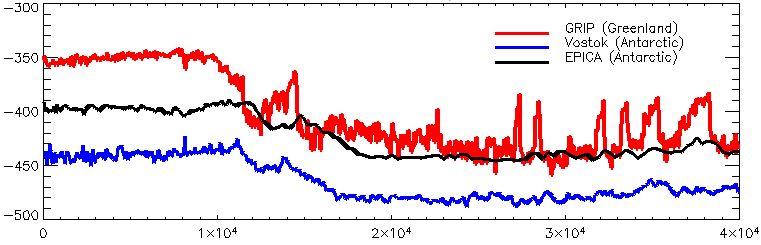
With this new paper, this may be one of those “case closed” moments in science showing that “climate change”/ice sheet collapse itself wasn’t to blame for the cold event, but the climate changed due to the impact event. This rather undoes the claims last year covered on WUWT in the story Sudden Clovis climate death by comet – “bogus”. I’d say it is pretty hard to argue with micro magnetic impact spherules dated to the time.
Evidence from central Mexico supporting the Younger Dryas extraterrestrial impact hypothesis

Abstract
We report the discovery in Lake Cuitzeo in central Mexico of a black, carbon-rich, lacustrine layer, containing nanodiamonds, microspherules, and other unusual materials that date to the early Younger Dryas and are interpreted to result from an extraterrestrial impact. These proxies were found in a 27-m-long core as part of an interdisciplinary effort to extract a paleoclimate record back through the previous interglacial.
Our attention focused early on an anomalous, 10-cm-thick, carbon-rich layer at a depth of 2.8 m that dates to 12.9 ka and coincides with a suite of anomalous coeval environmental and biotic changes independently recognized in other regional lake sequences.
Collectively, these changes have produced the most distinctive boundary layer in the late Quaternary record. This layer contains a diverse, abundant assemblage of impact-related markers, including nanodiamonds, carbon spherules, and magnetic spherules with rapid melting/quenching textures, all reaching synchronous peaks immediately beneath a layer containing the largest peak of charcoal in the core. Analyses by multiple methods demonstrate the presence of three allotropes of nanodiamond: n-diamond, i-carbon, and hexagonal nanodiamond (lonsdaleite), in order of estimated relative abundance.
This nanodiamond-rich layer is consistent with the Younger Dryas boundary layer found at numerous sites across North America, Greenland, and Western Europe. We have examined multiple hypotheses to account for these observations and find the evidence cannot be explained by any known terrestrial mechanism. It is, however, consistent with the Younger Dryas boundary impact hypothesis postulating a major extraterrestrial impact involving multiple airburst(s) and and/or ground impact(s) at 12.9 ka.
…

…
Summary
Synchronous peaks in multiple YDB markers dating to 12.9 ka were previously found at numerous sites across North and South America and in Western Europe. At Lake Cuitzeo, magnetic impact spherules, CSps, and NDs form abundance peaks within a 10 cm layer of sediment that dates to the early part of the YD, beginning at 12.9 ka. These peaks coincide with anomalous environmental, geochemical, and biotic changes evident at Lake Cuitzeo and in other regional records, consistent with the occurrence of an unusual event. Analyses of YDB acid-resistant extracts using STEM, EDS, HRTEM, SAD, FFT, EELS, and EFTEM indicate that Lake Cuitzeo nanoparticles are dominantly crystalline carbon and display d-spacings that match various ND allotropes, including lonsdaleite. These results are consistent with reports of abundant NDs in the YDB in North America and Western Europe.
Although the origin of these YDB markers remains speculative, any viable hypothesis must account for coeval abundance peaks in NDs, magnetic impact spherules, CSps, and charcoal in Lake Cuitzeo, along with apparently synchronous peaks at other sites, spanning a wide area of Earth’s surface. Multiple hypotheses have been proposed to explain these YDB peaks in markers, and all but one can be rejected. For example, the magnetic impact spherules and NDs cannot result from the influx of cosmic material or from any known regular terrestrial mechanism, including wildfires, volcanism, anthropogenesis, or alternatively, misidentification of proxies. Currently, only one known
event, a cosmic impact, can explain the diverse, widely distributed assemblage of proxies. In the entire geologic record, there are only two known continent-wide layers with abundance peaks in NDs, impact spherules, CSps, and aciniform soot, and those
are the KPg impact boundary at 65 Ma and the YDB boundary at 12.9 ka.
If you’re interested, the paper is published with unrestricted access on the PNAS website.
Or, you can read a full PDF copy that’s been mirrored on Dropbox.com at: http://dl.dropbox.com/u/2268163/Mexico%20YD%20Paper.pdf
h/t to reader Dennis Cox
@Matt G 2:18 pm :
Regarding ANYTHING to do with the overturning of the THC, I love quoting this from Carl Wunsch of MIT, one of the foremost oceanographers (I know, an appeal to authority, so shoot me…LOL):
I laughed out loud when I first heard of the overturning of the THC back in 2004. The stopping of the Gulf Stream is literally impossible, and I knew exactly what Wunsch was talking about. It is a mere fantasy – unless you stop the Earth rotating. The rotation drives the Coriolis-driven gyres. The heat comes OUT of the Gulf of Mexico with the current.
Do this: Look at any THC discussion, whether on video or in black and white – and then see if they talk about the Gulf of Mexico even once. Every map of it shows the current coming across the top end of South America and then straight up the American coast becoming the Gulf Stream. They have a Gulf Stream without the Gulf. Why do they do this? A. Because they think people are stupid. B. Because if they show the Gulf in the ‘oceanic conveyor’ system, then they have to explain what happens to the heat if the Gulf Stream doesn’t carry it northward. Then see if they mention ‘Coriolis’ even once. Nope, that’s not in there, either. They leave out the physics!
And who laughs loudest at it? An oceanographer. He says it is a ‘fairy-tale for grownups.”
The THC isn’t going to happen in the near future and it never happened in the past – not as long as the geography of the Earth is or has been like it currently is. And it didn’t happen during the YD.
Steve Garcia
feet2thefire says:
March 12, 2012 at 2:44 pm
Agreed.
The gulf stream always flows, it just helps contribute towards warmer water moving further North or further South. The THC has never been shown in past history to have stopped, only change direction and lattitude positioning.
,
Damn, looks like I’m going to have to rethink some things. Gard to remain skeptical of a Younger Dryas impact with evidence like this.
For a detailed analysis of the purported “flash freezing” of Mammoth, see “Mammoth”, Adrian iLister and Paul Bahn. Detailed analysis of those remains and when, where and how they ended up where they werer found is beyond the scope of a post here.
The Carolina Bays are not a product of the Holocene start impacts, as they were already being exploited by Clovis man prior to the HSI. They may have been produced by a far earlier impact, for which see the Perigee Zero website.
Assiniboine memories of the dischare of one western glacil lake, here:
http://www.mail-archive.com/meteorite-list@meteoritecentral.com/msg102257.html
@Alexandra Cairns 2:19 pm:
All good questions. Last year there was a paper Pinter et al 2011 “The Younger Dryas impact hypothesis: A requiem” [http://tiny.cc/55g2aw], in which they authors try to bury this hypothesis in toto, and the drag up stuff that has been refuted.
To whit [you]: “Some researchers have also accused firestone et al. of misidentifying nanodiamonds as a their replicate studies did not produce the same results.”
Not true. In the first place, the work done by Firestone’s lab people was done in 2003, the year before graphene was even discovered, yet they were taken to task for misidentifying graphene for nanodiamonds. In the second place, the original work was correct in all the time. Those were, in fact, nanodiamonds. But the incorrect refutation has never been rescinded.
At http://www.cosmictusk.com, there is a counter:
[You]: “Is it possible the researchers are just producing results that they want to see and making excuses for them?” Daulton and Pinter’s work “No evidence of nanodiamonds in Younger-Dryas sediments to support an impact event.” (your http://www.ncbi.nlm.nih.gov/pubmed/20805511 link) has already been rebutted. Daulton and Pinter were the guys who asserted nanodiamonds were graphene. They selected their samples incorrectly, too. Holliday’s “An independent evaluation of the Younger Dryas extraterrestrial impact hypothesis” (your http://www.ncbi.nlm.nih.gov/pmc/articles/PMC2775309/ link) has this list of papers in evidence against him: http://tiny.cc/s4v2aw
So far, the circle of skeptics is just that little circle. The YD impact hypothesis is having objective people come along and find corroborating evidence. It seems you are putting an undue amount of weight on Holliday, Pinter and Daulton, when their work has been superseded. It is they who are cherry picking.
Nanodiamonds are nanodiamonds. Over a dozen sites have produced them. You can’t make them by lighting a match. You have to have great pressure and great heat. Natural surface processes cannot produce them. It takes hypervelocity events (or human ingenuity) to make them on the surface. If you somehow have the impression that they can just be made normally, you are misreading the literature. If nanodiamonds are found, it is a clear indicator that an extraterrestrial impact has occurred at more than a few miles per second. Otherwise, Daulton would not claim that NOT finding them was a falsification of the YD impact hypothesis. It isn’t complicated.
As to why THIS site, the one in Mexico, has been touted as providing strong evidence while earlier ones didn’t – that was MY first question. Basically the others slipped past everyone unnoticed. Why I have NO idea You are correct on that. (Since I have actually been to Lake Cuitzeo, I feel proud of it, but am genuinely clueless why this one means more than the others.)
On the issue of gradual extinctions of N.A. megafauna, the link’s article is behind a paywall, and the Abstract gives no indications of what you assert, so I can’t address that.
As to your “If there was an impact, would it not wipe out a number of species pretty instantaneously?” But it did. See http://tiny.cc/y5w2aw Wikipedia – List of Extinct Animals North America, which lists 34 by my count that went extinct at 10,000 or 11,000 BCE. I did not count 9,000 or 12,000, of which there are a few. I choose to assume that the 10,000 and 11,000 are likely simultaneous.
Nothing I say here is the last word, but it is at least informed.
Steve Garcia
@E.P. Grondine 3:24 pm:
Hey, Ed. Nice to see you here.
Steve Garcia
So climate change isn’t our fault. It’s extraterrestrials!
We’re doomed.
E.P. Grondine and Steve Garcia, Thanks for the additional information – Fasinating!
People like you are the reason I come to WUWT.
Next year an asteroid will pass within about 16,000 miles of earth. That is closer than TV broadcast satellites:
http://rt.com/news/paint-asteroid-earth-nasa-767
About $100 billion has been wasted in the U.S. alone on the mythical catastrophic global warming scare, which has no supporting evidence [despite endless efforts to invent “evidence” for CAGW]. For much less than that amount a credible asteroid defense system can be set up to protect the planet. Otherwise, sooner or later there will be a major impact. It has happened many times before, and it will happen again and again, until there is a major impact, if we don’t begin to prepare.
The first step that should be taken is to immediately de-fund all “climate studies” since they have universally failed to produce worthwhile results, and re-direct the funds into an asteroid defense system — with the caveat that none of those individuals or entities that received government monies to “study climate change” should be permitted to take part in the planet’s defense. They are proven failures, incompetents, and self-serving charlatans, and they need to step out of the way so that honest, competent scientists can plan for the inevitable threat in order to avoid planetary catastrophe.
Thanks for the info it is very helpful! I had not seen the articles you have just provided about the nanodiamonds. I also had no idea the extinctions occurred on such a grand scale either. I will definitley have a sift through these articles. The hypothesis seems quite plausible given what you have told me.
@Doug Proctor, 7:36 AM.
I don’t see how a massive lake centered around Calgary could drain into the Pacific. The Rocky Mountain Range immediately to the west is way too high for such a path. The Rockies are bumpy, to be sure, but I don’t think there’s any pass low enough to accommodate your statement.
****
Bill Illis says:
March 12, 2012 at 7:35 am
There are 25 of these rapid cooling events in the record of the last ice age. We would need 25 meteorite strikes.
****
But not a single one of them produced a continental species extinction, or a distinct soot layer w/shock-formed nanodiamonds….
One may speculate that an impact delivering so much fresh water to the Arctic/N Atlantic may have “reset” ocean circulation patterns back to ice-age “mode” — failure of the N Atlantic Drift & subsequent freezing of the Barents Sea. Then ~1000 yrs to recover.
Re floods and dust: http://www.grahamkendall.net/Unsorted_files-2/A312-Frozen_Mammoths.txt
There’s a lot of muck in this. If what’s being said here about quick-frozen not cold-adapted mamoths and tropical forests is indicative of the conditions which prevailed at the onset of the Younger Dryas then the event was cataclysmic on a world greatly hotter than we are in now, that perhaps would still be this if the Younger Dryas hadn’t happened:
“Second, the well-preserved mammoths and rhinoceroses must have
been completely frozen soon after death or their soft, internal
parts would have quickly decomposed. Guthrie has observed that “an
unopened animal continues to decompose after a fresh kill, even at
very cold temperatures, because the thermal inertia of its body is
sufficient to sustain microbial and enzyme activity as long as the
carcass is completely covered with an insulating pelt and the
torso remains intact.”44 Since mammoths had such large reservoirs
of heat, the freezing temperatures must have been extremely low.
Finally, their bodies were buried and protected from predators,
including birds and insects. But burial could not have occurred if
the ground were frozen as it is today. Again, this implies a major
climate change, but now we can see that it must have changed
suddenly. How were these huge animals quickly frozen and
buriedãalmost exclusively in muck, a dark soil containing
decomposed animal and vegetable matter?
Muck. Muck is a major geological mystery. It covers one-seventh of
the earth’s land surfaceãall surrounding the Arctic Ocean. Muck
occupies treeless, generally flat terrain, with no surrounding
mountains from which the muck could have eroded. Russian
geologists have in some places drilled through 4,000 feet of muck
without hitting solid rock. Where did so much eroded material come
from?
Oil prospectors, drilling through Alaskan muck, have “brought up
an 18-inch long chunk of tree trunk from almost 1,000 feet below
the surface. It wasn’t petrifiedãjust frozen.”45 The nearest
forests are hundreds of miles away. Elsewhere, Williams describes
similar discoveries in Alaska:
Though the ground is frozen for 1,900 feet down from the surface
at Prudhoe Bay, everywhere the oil companies drilled around this
area they discovered an ancient tropical forest. It was in frozen
state, not in petrified state. It is between 1,100 and 1,700 feet
down. There are palm trees, pine trees, and tropical foliage in
great profusion. In fact, they found them lapped all over each
other, just as though they had fallen in that position.46
How were trees buried under a thousand feet of hard, frozen
ground? We are faced with the same series of questions that we
first saw with the frozen mammoths. Again, we are driven to the
conclusion that there was a sudden and dramatic change in climate
accompanied by rapid burial in muck, now frozen solid.”
Alexandra Cairns says:
March 12, 2012 at 2:19 pm
===========
It might help to start with an understanding of the last glacial maximum and work forward in time. Check the reference section id this study for a number of good sources.
High-resolution climate simulation of the last glacial maximum
http://caos.iisc.ernet.in/faculty/gbala/pdf_files/kim_etal_CD2008.pdf
Old is Getting Older
http://www.nps.gov/akso/nature/science/ak_park_science/PDF/2005Vol4-2/Old-Is-Getting-Older.pdf
“Sometime during the last glacial maximum between 21,000 and 17,000 years ago, archeological evidence suggests that groups of people from what is today the Russian far east, began their migration further eastward into North America [using the Bering land bridge].”
Swan Point [Alaska]
(Holmes and Potter 2002)
http://www.alaska.net/~taiga2/Swan_Point.html
“It is significant that Swan Point is not only the oldest site (radiocarbon dated between circa 15,000 and 14,200 cal. BP),…”
Note: oldest evidence of humans in Alaska and guess what they were hunting ; )
To Caleb: The old theory about how the mammoths died, standing up, with buttercups and other plants in their stomachs, was that a massive temperature inversion hit them. Temperature inversions, as I recall, are usually very cold air masses that for some reason drop through warmer air and literally engulf an area (and life) in a flash or quick freeze situation. Lungs would freeze almost instantly, thus accounting for mammoths found standing up, still eating.
They are also suggested as one reason for reports of strange, circular holes in cloud formations, or as UFOs.
I learned this over 50 years ago. However, I’m open to any rational speculation or explanation.
For those who may have missed it, here is aa asteroid impact calculator for various sized asteroids, and the damage they would cause.
Richards in Vancouver says:
March 12, 2012 at 4:36 pm
@Doug Proctor, 7:36 AM.
I don’t see how a massive lake centered around Calgary ….
________________________________________________
Try Lake Agassiz: http://wattsupwiththat.com/2011/10/05/evaporation-not-outflow-drained-ancient-lake-agassiz-during-the-younger-dryas/
@beng 4:39 pm:
“One may speculate that an impact delivering so much fresh water to the Arctic/N Atlantic may have “reset” ocean circulation patterns back to ice-age “mode” — failure of the N Atlantic Drift & subsequent freezing of the Barents Sea. Then ~1000 yrs to recover.”
Except that none of the scenarios work for getting the Lake Agassiz water to the N Atlantic, either visa the St Law3rence or the Arctic (Don’t forget the Arctic is even more frozen than further south). The Ice sheet did not recede enough by 12.9kya to use the St Lawrence, and the Mackensie River doesn’t work, either – not to the N Atlantic. As I said in another comment above, climatologist Rodney Chilton has a paper coming out pointing out the flaws in the fresh water and THC shutdown. And Oceanographer Carl Wunsch calls the THC shutdown “an adult fairy-tale” because the N Atlantic Gyre (the western part of which is the Gulf Stream) will not ever shut down as long as the Earth keeps rotating and winds keep blowing.
Steve Garcia
@John 4:45 pm:
By that time Solutreans had been on the Eastern Seaboard for between 1,000 and 8,000 years.
However, note that they used microblades, an entirely different technology from Solutrean/Clovis blades. And it is not microblades that are found at Clovis sites, but – of course – Clovis blades.
From 1st link: “Strong evidence supports the case that some people migrated from Siberia to Alaska via the Bering Strait.”
What the evidence does NOT do is show any Clovis points. This was swept under the carpet for a long time, until Monte Verde in Chile showed that others were here before the ‘ice-free corridor’ opened up.
Genetic data clearly show FIVE incursions. The MAIN one, the one that most American Indians came from – was over Beringia. However the Iroquois came from Europe. Up in Alaska they don’t care about Iroquois, I imagine. They want to show how important Beringia and Alaska were. But that route has had ALL the attention for several decades now, and it is time the other routes had some studies done on them. Clovis First is dead. Now we look at the Solutreans.
From the 2nd link: “Subsistence is assumed to have been based on big game, i.e., remnant Pleistocene megafauna.” Why is this assumed? Subsistence now is based on seals and fish. Per Uniformitarianism, what is seen now is also what happened in the past, unless counter evidence is provided. Assuming subsistence based on megafauna is illogical. A few mammoth bones with cut marks or other evidence of human butchering does not in any way imply that that was their main source of subsistence.
Steve Garcia
@Smokey 5:15 pm:
“For those who may have missed it, here is an asteroid impact calculator for various sized asteroids, and the damage they would cause.”
What does it say about comets? How about friable comets? What does it say about air bursts of comets?
All from out there isn’t asteroids or meteors.
Steve Garcia
Question, is it possible for an extraterristial source to deposit water into the upper atmosphere? If so how long would it remain? Longer then ash or dust?
Data:
nanodiamonds found at beginning YD, but no large dust cloud found in ice deposits
Earth cools at beginning YD
Possible large lakes in North America break ice dams around same time as beginning of YD
Animals die off (rapid cooling alone could effect this)
Incoming solar radiation lessons? Can this be accounted for by more water in upper atmosphere?
What is common among all cultures? A: Smile is sign of happiness and great flood mythology
Theory:
Cloud of mostly micro comets and some metal asterioids collide with earth, possible repeat collision similiar to current meteor showers. Injecting initial large amount of water into atmosphere. Water turns into rain. Lots of “great floods” world wide. Extra rain causes ice dams to break. Forms thick cloud cover reducing incoming solar radiation. Cooling earth. Rain turns to snow in many places, earth cools even more due to reflection of snow. Cooling earth locks water vapor into ice causing drying of NH, fires result produce carbon seen in lake deposits.
BS? Possible?
feet2thefire says:
March 12, 2012 at 6:15 pm
=====
I’m not fighting for any single approach to the NA migration and your comments are great about the Iroquois. I was just trying to give Alexandra a perspective and some references to follow.
Why big game? Because mammoth tusks were found at the various Alaska sites and were mined in vast quantity in the late 1800s from a small island in the East Siberian Sea. Unless herds of Siberian Mammoth decided it was the place to die, someone either herded them there or dragged the tusks to that location.
feet2thefire says:
March 12, 2012 at 6:15 pm
=====
There is another possible explanation for the occurrence of Mammoth on the Siberian Sea Island. As the ocean rose and reopened the Bering Strait, they may have migrated to higher ground and simply got trapped on the island. We would need some first hand account from the mining expedition to determine if only tusks were found and or if there was any evidence they had been hunted by humans.
Its hard to tell if a Russian expedition journal even exists.