 Reposted from Jo Nova’s site
Chinese 2485 year tree ring study shows shows sun or ocean controls climate, temps will cool til 2068
A blockbuster Chinese study of Tibetan Tree rings by Lui et al 2011 shows, with detail, that the modern era is a dog-standard normal climate when compared to the last 2500 years. The temperature, the rate of change: it’s all been seen before. Nothing about the current period is “abnormal”, indeed the current warming period in Tibet can be produced through calculation of cycles. Lui et al do a fourier analysis on the underlying cycles and do a brave predictions as well.
In Tibet, it was about the same temperature on at least 4 occasions — back in late Roman times — blame the chariots, then again in the dark ages — blame the collapse of industry; then in the middle ages — blame the vikings; in modern times — blame the rise of industry. Clearly, these climate cycles have nothing to with human civilization. Their team finds natural cycles of many different lengths are at work: 2-3 years, 100 years, 199 years, 800 years, and 1324 year. The cold periods are associated with sunspot cycles. What we are not used to seeing are brave scientists willing to publish exact predictions of future temperatures for 100 years that include rises and falls. Apparently, it will cool til 2068, then warm again, though not to the same warmth as 2006 levels.
On “tree-rings”
Now some will argue that skeptics scoff at tree rings, and we do — sometimes — especially ones based on the wrong kind of tree (like the bristlecone) or ones based on small samples (like Yamal), ones with abberant statistical tricks that produce the same curve regardless of the data, and especially ones that truncate data because it doesn’t agree with thermometers placed near airconditioner outlets and in carparks. Only time will tell if this analysis has nailed it, but, yes, it is worthy of our attention.
Some will also, rightly, point out this is just Tibet, not a global average. True. But the results agree reasonably well with hundreds of other studies from all around the world (from Midieval times, Roman times, the Greenland cores). Why can’t we do good tree-ring analysis like this from many locations?
Jo
Amplitudes, rates, periodicities and causes of temperature variations in the past 2485 years and future trends over the central-eastern Tibetan Plateau [Chinese Sci Bull,]
 Figure 5 Prediction of temperature trends on the central-eastern Tibetan Plateau for the next 120 years. Blue line, initial series; orange line, calibration series, 464 BC–834 AD; purple line, verification series, 835–1980 AD; red line, forecasting series, 1980–2134 AD. (Click to enlarge)
There are beautiful graphs. Have a look at the power spectrum analysis and the cycles below…
ABSTRACT:
Amplitudes, rates, periodicities and causes of temperature variations in the past 2485 years and future trends over the central-eastern Tibetan Plateau
Amplitudes, rates, periodicities, causes and future trends of temperature variations based on tree rings for the past 2485 years on the central-eastern Tibetan Plateau were analyzed. The results showed that extreme climatic events on the Plateau, such as the Medieval Warm Period Little Ice Age and 20th Century Warming appeared synchronously with those in other places worldwide. The largest amplitude and rate of temperature change occurred during the Eastern Jin Event (343–425 AD), and not in the late 20th century. There were significant cycles of 1324 a, 800 a, 199 a, 110 a and 2–3 a in the 2485-year temperature series. The 1324 a, 800 a, 199 a and 110 a cycles are associated with solar activity, which greatly affects the Earth surface temperature. The long-term trends (>1000 a) of temperature were controlled by the millennium-scale cycle, and amplitudes were dominated by multi-century cycles. Moreover, cold intervals corresponded to sunspot minimums. The prediction indicated that the temperature will decrease in the future until to 2068 AD and then increase again.
…
Figure 1 Tree-ring-based temperature reconstruction for the central-eastern Tibetan Plateau during the past 2485 years (gray line), the 40-year moving average (thick black line) and the 40-year running standard deviation (thin black line); the horizontal line is the mean temperature for the 2485 years. (Click to enlarge)
…
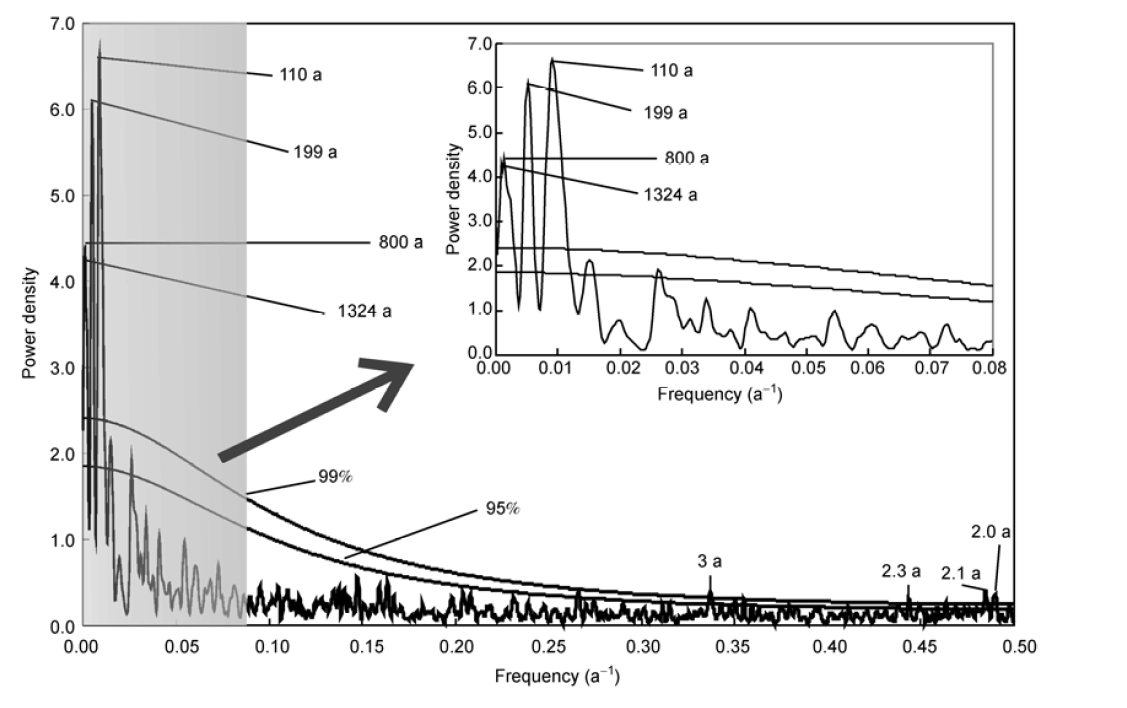 Figure 2 Power spectrum analysis of the 2485-year temperature series. (Click to enlarge)
…
 Figure 3 Millennium-scale cycle in the temperature variation during the last 2485 years. (Click to enlarge)
…
 Figure 4 Decomposition of the main cycles of the 2485-year temperature series on the Tibetan Plateau and periodic function simulation. Top: Gray line,original series; red line, 1324 a cycle; green line, 199 a cycle; blue line, 110 a cycle. Bottom: Three sine functions for different timescales. 1324 a, red dashed line (y = 0.848 sin(0.005 t + 0.23)); 199 a, green line (y = 1.40 sin(0.032 t – 0.369)); 110 a, blue line (y = 1.875 sin(0.057 t + 2.846)); time t is the year from 484 BC to 2000 AD. (Click to enlarge)
…
…
Conclusions
Climate events worldwide, such as the MWP and LIA, were seen in a 2485-year temperature series. The largest Figure 6 Temperature comparison between the forecast and observation data taken from seven stations on the central-eastern Tibetan Plateau (seven stations: Delingha, Dulan, Golmud, Lhasa, Nagqu, Dachaidan and Bange). amplitude and rate of temperature both occurred during the EJE, but not in the late 20th century. The millennium-scale cycle of solar activity determined the long-term temperature variation trends, while century-scale cycles controlled the amplitudes of temperature. Sunspot minimum events were associated with cold periods. The prediction results obtained using caterpillar-SSA showed that the temperature would increase until 2006 AD on the central-eastern Plateau, and then decrease until 2068 AD, and then increase again. The regularity of 600-year temperature increases and 600-year decreases (Figure 3) suggest that the temperature will continue to increase for another 200 years, since it has only been about 400 years since the LIA. However, a decrease in temperature for a short period controlled by century- scale cycles cannot be excluded. Obviously, solar activity has greatly affected temperature on the central-eastern Plateau. However, there are still uncertainties in our understanding of climate change, and the concentration of CO2 affects the climate. Further investigations are thus needed. –
————————–
REFERENCES
Liu Y, Cai Q F, Song H M, et al. Amplitudes, rates, periodicities and causes of temperature variations in the past 2485 years and future trends over the central-eastern Tibetan Plateau. Chinese Sci Bull, 2011, 56: 29862994, doi: 10.1007/s11434-011-4713-7 [ Climate Change over the Past Millennium in China.] … Hat Tip: Geoffrey Gold.
Lucy S: I had the same thought, as soon as I saw the name, and the comment.
It would not be surprising at all if this is the same Matt (alias “MattB” who haunts JoNova).
A research paper that comes up with a result that one would expect- natural cycles rule climate. It is the cycle lengths that are not well known neither is the number of cycles that go back into history, ie. the very long cycles that we are ignorant about.
Well done the Chinese.
Pete Miller~ Funny you should mention mann. Regarding what we have heard about just inputting Noise into his model, I have to wonder: would the Chinese data, plugged into mann’s model, generate a hockey stick?
I said this at BH too. I still don’t see what magic you use to turn tree rings into temperature proxies. Just because this study gives the “right” result doesn’t make it any more valid than other tree ring projects. Surely a tree ring is a blunt object, it will tell you whether the weather was nice ( in tree terms ) or not and that’s it.
BTW @Bushbunny
Your chronology is a little off. The 17thC appears ( for historians ) appear to be the years of real extremes, especially around the middle of the 17thC, when there used to be broiling summers and freezing winters.
It was interesting to see the dramatic trough at the begining of the 14thC which coincided with the start of the LIA in Europe, though.
Well it’s interesting; but I would quibble with their figure #3.
Their Stage IV straight line fit, seems reasonable, and it magically has the same magnitude slope as the three previous stages, but clearly the I, II, and III straight lines are really lousy fits to the data.
I do agree that the up down pattern is there, but they exaggerate the slopes in the first three to try and fool us into believing that the era since 1600 is just the same as earlier times, which it clearly isn’t.
But I agree with their general conclusion; the whole thing is a ho-hum so what ! And 2485 years of tree rings is a bit better than one yamal stunted weed tree.
“This is a brilliant paper. Yes, it goes a long way to rehabilitate treerings as temperature proxies.”
It does nothing of the sort. We need to see the methodology, especially sampling practices and numbers. I will keep repeating this until the physical scientists get a glimmer: every tree lives within its own unique ecosystem. Sample sizes need to be very large and very carefully cluster managed in order to ascertain any extrapolated trend. In any event, all you will measure is a local regional response, if you can even get the signal noise out. To do this with any meaning at all, you need stable isolated larg(very large) stands of trees not within range of historical and modern day harvest, industrial and agricultural practices. Good luck finding those.
Those who question the validity of this research because of the absence of a cause are missing the point. If one accepts that the data is real then the predictability of temperature fluctuations is startling irrespective of whether we know why it is happening.
They have taken a 1200 year period to identify the main frequencies and generate the Fourier coefficients. They have then applied these coefficients to generate a prediction for a completely different period spanning the years 835 to 1980. One only has to look at the correlation between actual and prediction to see that the match up is just astonishing.
My conclusion is that they are either right or they have manipulated the data in some way. I cannot really see that there is room for any other conclusion. My personal view is that they are right given that they have published the data necessary to allow other scientists to look for the same power spectrum and test their conclusions. They would not have done this unless they were confident. Mann et al please note.
These are non-cooperative trees. Under Mannian standard procedure, such trees are to be walked outside and shot.
No wonder the Chinese “ratf$%&ked” us accodering to ex Prime Minister Rudd after Cpenhagen. They are to much into realism on these things.
And thank god someone is doing a Fourier Analysis instead of this statistical drivel about principal components. Given we live of a rotating planet with a large orbiting satellite and are part of a spinning and orbiting solar system with all this evidence of cyclical effects from sun spots to whatever , the idea that one would not go to a Fourier Analysis FIRST is simply mad or utterly incompetent as far as I can see. Me, I am and engineer who chases vibration signals and ocean wave spectra but what would I know?
crosspatch says:
December 8, 2011 at 12:28 am
The chances of two completely different sorts of data from two completely different regions of the planet done independently by different groups of people present the same general result is beyond the realm of chance, in my opinion.
Unless they produce an hockey-stick?
Statistics isn’t my strong point, but in figure 1 the bottom SD curve doesn’t look right.
bill at 12:03 am above:
Bill,
The journal date for the publication of the Liu, et al 2011 , sumaary was
October 2011.
If I’m reading the material correctly at:
http://csb.scichina.com:8080/kxtbe/EN/abstract/abstract504775.shtmlt
[Please be patient, this was very slow downloading for me numerous times.
A traceroute showed the problem was with the servers at the far end (Asia)
of which several were running slow.]
the main study was originally submitted in March of 2011 and revised in August.
The study went through an unhurried peer review and editorial process
prior to publication in October.
This was published long before the COP17 delegates were gathering… and Jo Nova
brought it to our collective attention just now in December.
A NEW WORLD ORDER
Which societies usurp the aspirations of its citizens and are forcing them into penury with their industrial and energy policies, backed by government funded propaganda masquerading as scientific research and which society is striving to improve the lot of their masses with a healthy respect for industry and an even healthier respect for objectively conducted research, free from political dogma and control?
This question for Matt and Bill.
Great feeling for an author, who, with physics, for everybody transparent and understandable, calculated the 800 year (to be precise: the 790 year) cycle. Being validated with field reseach …great! See German Amazon.de : Book: ISBN 978-3-86805-604-4.
History proves the 800 year cycle wordwide, even in the most remote areas of the world (such asTibet etc) and with above quoted physical calculations, that they really exist…. well folks, sit back for a couple more years and the Hockey-stickers will be the laughing stock of history soon in this very decade…..
JS
Matt says: “…what about peer review?”
Peer review is worthless. That was understood before all the AGW-nonsense. The AGW-nonsense has in fact shown this statement to be, simply, true.
There have been those who warned of Technocracy: which is pretty much that politics-ideology CAN and WILL turn ‘science’ into an Authority with pre-determined Determinations (from which certain actions necessarily must follow), for carefully selected ‘Issues’. Those people were well aware how things work in the echelons of power and influence, and that ‘science’ was oh so very bendable: so here you all are, oh so very surprised that your holy cow has given birth to a plague-ridden turd.
Shall I mention Feynman? Go read his little speech again… and then dare try and tell me that ‘science’ will somehow magically end up perfecting itself AS AN INEVITABLE FACT. The practice of ‘science’ was, is, and will be subject to certain types of behavior and procedures (Feynman was EXPLICIT on this last point, AND the one before it) on the part of the ‘scientists’: since these have not been followed, AT ALL, surely this outcome, which is that Science Is Dead, was inevitable? Surely.
And then there are the hippies: most of you will not be aware of the pure, raw, corruptions that under-gird ‘Evolutionary Science’, but they too use ‘science’ as an iron hammer to bypass fact+logic+reason. ‘Settled science’ to blast pass the obvious need for such a thing as ‘proof’ in the face of incredible imPROBabilities – little mind-pictures of ‘POSSibilities’ are supposed to suffice – and do, to morons and uncaring dolts both. ‘Settled science’ to blast pass the obvious requirement for such a thing as falsifiability; how very unreasonable to expect ‘science’ to distinguish between ‘orderly patterns’ and ‘the Fact of Evolution’ – the outcome is, after all, settled. The very act of Interpretation itself is settled, and limited – all who disagree are Deniers: such people should be stripped of all credentials and cast out into the gutter… sound familiar?
You all (how very few are not part of this) have blindly allowed MASSIVE corruption to flower in regards to ‘defending’ the ‘science’ of Evolution from those who are ‘anti-science’… and now you reap the whirlwind – generations of hippie-type ‘scientists’, who LIE as it suits them. Thanks to your pathetic weakness, that once great tool for the advancement of mankind, science, has been turned into a whore that is rotting to death in a ditch.
‘Science’ had early on become, necessarily, the Prime Dogma of Humanism, atheism, etc. Also necessarily, its acceptance has become the Central Dogma for modern POLITICAL Humanism. (Ever met an Atheist who was not also a rabid ideologue? No? So what does that tell you?) And since peer-review as zero ability to Withstand political and ideological influences, it has served quite nicely in promoting-and-Justifying every single fluff-brained hippie dream-thought ever envisaged. Another (obvious) truism: hippies have no moral Standard (inherently, Excepting being utterly selfish and demoniac, of course), therefore they tend, on average, to be without morals or ethics. And yet you are all ever to surprised when this particular snake rises out of the grass and bites you on the ass.
I am not quite sure who is more worthy of contempt: the fools, or those who are surprised that fools do foolish (and consequently vile and murderous) things.
How many more people must die in abject misery at the altar of Political Humanism? DDT is just one example. Just one. 40 MILLION dead, mostly children. Yet I am the insane fanatic who hates science. Yes I do, with because ‘science’ IS worthless, because ‘peer-review’ IS utterly dominated by political-ideology. Because I am sick of its murders, and sick of its lies.
The first figure actually does show Mann’s hockey stick for the last 1000 years. Which is the time period over which he made his annalysis. It does not show a MWP but does show a LIA.
Doesnt answer the question – are trees good thermometers?
The Fourier analysis is very interesting and Iwould love to see links there to other cycles
I believe this could damage “the cause”
Bloke down the pub says:
December 8, 2011 at 3:34 am
“Statistics isn’t my strong point, but in figure 1 the bottom SD curve doesn’t look right.”
Mine either. And actually, both sides of the SD curve look wrong. Shouldn’t the SD curves be equidistant from the mean? Unless they did it from the mean of the whole series rather than each data point.(Though I’m not sure I’ve ever seen it done that way) Maybe this isn’t a statistical analysis?
I don’t know. My radar is still up on the validity of any tree ring study..and left wanting….? Maybe I’m being unfair…but it seems to me that producing a power spectrum analysis (one of many that might fit) is necessary I suppose – but not sufficient. I would have appreciated a causal justification for the cycles chosen – and would have started with those already known in nature (solar, ENSO, etc….)…..?
Liu Yu, Director of Earth Environment Institute of the Chinese Academy of Sciences, was interviewed about his paper by the South China Morning Post (Dec 4, 2011):
Where did you find trees more than 2,000 years old in a country with a long history of systematic logging? I need luck to find a tree more than 100 years old in the lowlands. But on some mountains of the Tibetan Plateau, where the altitude reaches up to 4,000 metres, I have run into forest after forest of Qilian junipers that have remained undisturbed for thousands of years.
How does a tree survive in that kind of harsh environment for so long? The Qilian juniper is one of the oldest surviving tree species on earth. In the high altitude of the eastern Tibetan Plateau, where poor soil, little rainfall and low temperatures make it impossible for other trees to survive, the juniper has perfectly adapted to the harsh environment by growing very slowly. We recently found one that is close to 2,000 years old, but less than 8 metres tall. In the study of tree rings, slow-growing trees provide information on variations in climate over a long period. Qilian junipers grow only in China.
Is the study of tree rings popular in China? Chinese researchers have studied tree rings for more than seven decades, and some scientists have produced original studies containing a trove of important data on the climate. But due to historical reasons, their research methods did not quite fit with international mainstream thinking, and therefore not widely recognised. Since the 1990s, as climate change has become a political and diplomatic issue, the study of tree rings has received increased government funding, allowing Chinese researchers to use the best tools and methods and produce well-received results.
Are the field trips fun? To collect samples, we sometimes need to dance with death. At altitudes of more than 3,500 metres above sea level, my research team has to combat low air pressure, a lack of oxygen, headaches and sometimes life-threatening illnesses. The best Qilian junipers for our purposes often stand alone on a cliff, where they can be fully exposed to the elements. We have to watch our step when approaching such trees. Some researchers from overseas have slipped and died in less-perilous situations. Most virgin forests of Qilian junipers are in areas inaccessible by road, and are barely, if ever, visited by humans. The remoteness turned each of my more than 20 data-collection trips over the past 10 years into unforgettable adventures. Standing so high up, with an ancient tree, one has the opportunity to enjoy some of the most breathtaking landscapes on earth.
Do you need to cut down a tree to take samples No, we do not cut down trees. Once a tree is selected, we use a long, fine tube similar to a chopstick to bore through the trunk and reach the core. It’s standard practice used by scientists for a long time and does not cause the tree any serious damage. In the laboratory, all the samples must be polished with sandpaper. The work is time-consuming because the samples cannot be used for measurement until they are smooth enough that, when put under a microscope, we can see a perfect outline of their cells.
What do you do with the data? Using a set of scientific techniques, we measure the width of the rings and convert the variations into changes in annual temperatures. We have published two papers in the English versions of Science in China – Series D: Earth Sciences and in the Chinese Science Bulletin.
What have tree rings told us about climate change over the last two millennia? Popular belief is that industrialisation has led to the fastest rate of warming witnessed by humans; that we are at the warmest time of the modern era; and that we are causing global warming by emitting carbon dioxide into the atmosphere. None of that fits the records in tree rings. In northern China, the warmest period occurred from AD401-413, which had an annual mean temperature 0.16 degrees Celsius higher than today’s. Other periods, including 604-609, 864-882 and 965-994 had temperatures higher than in recent decades. Our results are supported by historical documents from the period. Archaeological records in Loulan , Xinjiang , show that pomegranate, a fruit rich in vitamin C, was used as currency during the Eastern Jin dynasty (AD317-420). The fruit could not possibly have appeared in northern China without a climate much warmer than today’s. And we are not experiencing the most dramatic climate change in recent history, either. Over the past 2,485 years, the biggest climate change took place during the Eastern Jin dynasty. The period had two stages, with the temperature plummeting first and then soaring. In the warming period, the mean temperature [in the Tibetan Plateau region] increased suddenly from 1.66 degrees to 2.67 degrees in 30 years. In the cooling period, the mean temperature dropped to below that of the Little Ice Age [an abnormally cold period that lasted from about 1550 to 1850]. The coldest years, with a mean temperature of 1.38 degrees, occurred from 362-369, and the temperature was about 1.5 degrees lower than the mean temperature of the late 20th century.
So what causes climate change? We believe that the sun and atmospheric circulations play a vital, if not decisive, role in this. The millennial cycle of solar activity determines the long-term trends of temperature variations. Almost all sunspot minimums [periods of sometimes several decades when sunspots become rare] correspond with low-temperature intervals. Meanwhile, atmospheric circulations affect temperature changes from decade to decade. To quote Professor Zhu Kezhen , the father of climate change studies in China: “The big changes in the earth’s climate have been controlled by solar radiation, but the small changes by atmospheric circulation.”
Can tree-ring records tell us anything about the future? Our results show that the temperature continued to increase until 2006, and will now decrease until about 2068. After 2068, the temperature will increase again until 2088.
Do you think your research will help Beijing gain ground in climate negotiations? I am a scientist, and I know nothing about politics. But the climate- change debate, in my opinion, has more political significance than scientific. Diplomats can sit at negotiating tables talking about carbon caps while scientists have not reached an agreement on the role of carbon dioxide in global warming. But political decisions must be based on sound scientific foundation, or they will be useless, if not dangerous.
http://www.scmp.com/portal/site/SCMP/menuitem.2af62ecb329d3d7733492d9253a0a0a0/?vgnextoid=8ef931369d404310VgnVCM100000360a0a0aRCRD&ss=china&s=news
Gosh I wonder how some of the psuedo-scientists on the AGW team are going to deal with this? Can they afford to ignore it? If the do they will be accussed of either cherry picking or rank racial bigotry.
Good to see real science based upon real observations and not dodgy modelling of dodgy data.
Why aren’t Western scientists doing this rather than trying to extrapolate a few sightings of Polar bears doing what Polar bears do into some doom and gloom prediction of the future?
If that is the best that Western science can give us then maybe we deserve the decline in the West that is happening.
Good on the Chinese – sure.
How embarassed will we in `the free West’ be if it turns out that science in an authoritarian, communist state manages to turn out objective and correct analysis whilw efounder with politicised, agenda riddled rubbish.
Where is the self respect of our once great scientific establishment.For how long are natural scientists in the West going to sit on their asses and not speak out against this disgraceful stacked deck, that `climate science’ has become?
Disclosure: The Bear’s wife is Chinese. Guess that makes the Bear in the pay of evil sceptics, eh?
no hullaballo no hype just data and the ability for others to see and check it out, appears to me that may actually BE science at work for a change?
its probably spot on or closer than most,, I say that because NO msm has picked it up.
whereas they immediately pounce on every halfassed panick and die pronouncements by the goracle and his menn
this is one case where more research, would’nt be the usual cause for hilarity.
matt a~ I have looked at all of the graphs very carefully. I see massive ups and downs, where do you see a long, flat line?
Dare I ask what the ‘a’ stands for your name? I would guess it stands for [self-snipped]
John Barrett says:
December 8, 2011 at 3:08 am
I agree – all that tree rings thickness show is that it was a good growing season; this often bears no relation to temperature. There are too many other variables that affect tree growth – don’t ask someone with a PhD, talk to any gardener.
What these results show is that there are cycles in the climate between good growth conditions and poor growth conditions for that species of tree in Tibet.
If climate ‘scientists’ want to claim they can tell temperatures from tree rings it’s simple – do a double blind experiment with tree sections cut during the instrumented period. The type of tree would be known but the date of the tree sections and the location they were cut from would be unknown to the experimenters. They would be required to quantify the annual temperatures from the tree rings to an accuracy better than 1DegC. As this experiment is so extremely simple to set up one can only assume that it has not been done because the treemometer proponents realize that their hypothesis would be falsified.
Observer – thanks for that interview….. It had all sorts of wry comments re: ‘mainstream’ thought and ‘politics’ and importance of their own work. A Mann smackdown! Ha ha ha! ;-D