Guest post by Bob Fernley-Jones by Bob Fernley-Jones AKA Bob_FJ
CAUTION: This is written in Anglo-Oz English.
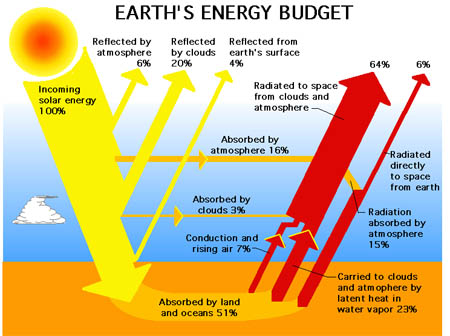
Here is the diagram as extracted from their 2009 paper, it being an update of that in the IPCC report of 2007 (& also 2001):


The unusual aspect of this diagram is that instead of directly showing radiative Heat Transfer from the surface, it gives their depiction of the greenhouse effect in terms of radiation flux or Electro-Magnetic Radiation, (AKA; EMR and a number of other descriptions of conflict between applied scientists and physicists). EMR is a form of energy that is sometimes confused with HEAT. It will be explained later, that the 396 W/m^2 surface radiation depicted above has very different behaviour to HEAT. Furthermore, temperature change in matter can only take place when there is a HEAT transfer, regardless of how much EMR is whizzing around in the atmosphere.
A more popular schematic from various divisions around NASA and Wikipedia etc, is next, and it avoids the issue above:
- Figure 2 NASA
Returning to the Trenberth et al paper, (link is in line 1 above), they give that the 396 W/m2 of EMR emitted from the surface in Fig.1 is calculated primarily by using the Stefan–Boltzmann law, and global year average conditions. Putting aside a few lesser but rather significant issues therein, it is useful to know that:
1) The Stefan-Boltzmann law (S-B) describes the total emission from a flat surface that is equally radiated in all directions, (is isotropic/hemispherical). Stefan found this via experimental measurement, and later his student Boltzmann derived it mathematically.
2) The validity of equally distributed hemispherical EMR is demonstrated quite well by observing the Sun. (with eye protection). It appears to be a flat disc of uniform brightness, but of course it is a sphere, and at its outer edge, the radiation towards Earth is tangential from its apparent surface, not vertical. It is not a perfect demonstration because of a phenomenon called limb darkening, due to the Sun not having a definable surface, but actually plasma with opacity effects. However, it is generally not apparent to the eye and the normally observed (shielded) eyeball observation is arguably adequate for purpose here.
3) Whilst reportedly the original Stefan lab test was for a small flat body radiating into a hemisphere, its conclusions can be extended to larger areas by simple addition of many small flat bodies of collectively flat configuration, because of the ability of EMR waves to pass through each other. This can be demonstrated by car driving at night, when approaching headlights do not change in brightness as a consequence of your own headlights opposing them. (not to be confused with any dazzling effects and fringe illumination)
4) My sketch below demonstrates how radiation is at its greatest concentration in the lateral directions. It applies to both the initial S-B hemispherical surface radiation and to subsequent spherical radiation from the atmosphere itself.

5) Expanding on the text in Figure 3: Air temperature decreases with altitude, (with lapse rate), but if we take any thin layer of air over a small region, and time interval, and with little turbulence, the temperature in the layer can be treated as constant. Yet, the most concentrated radiation within the layer is horizontal in all directions, but with a net heat transfer of zero. Where the radiation is not perfectly horizontal, adjacent layers will provide interception of it.
A more concise way of looking at it is with vectors, which put simply is a mathematical method for analysing parameters that  possess directional information. Figure 4, takes a random ray of EMR (C) at a modestly shallow angle, and analyses its vertical and horizontal vector components. The length of each vector is proportional to the power of the ray, in that direction, such that A + B = C. Of course this figure is only in 2D, and there are countless multi-directional rays in 3D, with the majority approaching the horizontal, through 360 planar degrees, where the vertical components also approach zero.
6) Trenberth’s figure 1 gives that 65% of the HEAT loss from the surface is via thermals and evapo-transpiration. What is not elaborated is that as a consequence of this upward HEAT transfer, additional infrared radiation takes place in the air column by virtue of it being warmed. This initially starts as spherical emission and absorption, but as the air progressively thins upwards, absorption slows, and that radiation ultimately escapes directly to space. Thus, the infrared radiation observable from space has complex sources from various altitudes, but has no labels to say where it came from, making some of the attributions “difficult”.
DISCUSSION; So what to make of this?
The initial isotropic S-B surface emission, (Trenberth’s global 396 W/m2), would largely be absorbed by the greenhouse gases instantaneously near the surface. (ignoring some escaping directly to space through the so-called “atmospheric window”). However, a large proportion of the initial S-B 396 surface emission would be continuously lateral, at the Trenberth imposed constant conditions, without any heat transfer, and its horizontal vectors CANNOT be part of the alleged 396 vertical flux, because they are outside of the vertical field of view.
After the initial atmospheric absorptions, the S-B law, which applied initially to the surface, no longer applies to the air above. (although some clouds are sometimes considered to be not far-off from a black body). Most of the air’s initial absorption/emission is close to the surface, but the vertical distribution range is large, because of considerable variation in the photon free path lengths. These vary with many factors, a big one being the regional and more powerful GHG water vapour level range which varies globally between around ~0 to ~4%. (compared with CO2 at a somewhat constant ~0.04%). The total complexities in attempting to model/calculate what may be happening are huge and beyond the scope of this here, but the point is that every layer of air at ascending altitudes continuously possesses a great deal of lateral radiation that is partly driven by the S-B hemispherical 396, but cannot therefore be part of the vertical 396 claimed in Figure 1.
CONCLUSIONS:
The vertical radiative flux portrayed by Trenberth et al of 396 W/m^2 ascending from the surface to a high cloud level is not supported by first principle considerations. The S-B 396 W/m^2 is by definition isotropic as also is its ascending progeny, with always prevailing horizontal vector components that are not in the field of view of the vertical. The remaining vertical components of EMR from that source are thus less than 396 W/m^2.
It is apparent that HEAT loss from the surface via convective/evaporative processes must add to the real vertical EMR loss from the surface, and as observed from space. It may be that there is a resultant of similar order to 396 W/m^2, but that is NOT the S-B radiative process described by Trenberth.
~~~~~~~~~~~~~~~~~~~~~~~~~~~~~~~~~~~~~~~~~~~~~~~~~~~~~~~~~~~~~
ADDENDUM FOR AFICIONADOS
I Seek your advice
In figure 5 below, note that the NIMBUS 4 satellite data on the left must be for ALL sources of radiation as seen from space, in this case, at some point over the tropical Pacific. The total emissions, amount to the integrated area under the curve, which unfortunately is not given. However, for comparison purposes, a MODTRAN calculator, looking down from 100 Km gives some interesting information for the figure, which is further elaborated in the tables below. Unfortunately the calculator does not give global data or average cloud/sky conditions, so we have apples and pears to compare, not only with Nimbus, but also with Trenberth. However, they all seem to be of somewhat similar order, and see the additional tabulations.

| Compare MODTRAN & “Trenberth”, looking down from 2 altitudes, plus Surface Temperature | ||||
| Location | Kelvin | 10 metres | 100 Km. | (Centigrade) |
| Tropical Atmosphere | 300K | 419 W/m^2 | 288 W/m^2 | (27C) |
| Mid-latitude Summer | 294K | 391 W/m^2 | 280 W/m^2 | (21C) |
| Mid-latitude Winter | 272K | 291 W/m^2 | 228 W/m^2 | (-1C) |
| Sub-Arctic Winter | 257K | 235 W/m^2 | 196 W/m^2 | (-16C) |
| Trenberth Global | 288K ? | 396 W/m^2 | 239 W/m^2 | (15C ?) |
| Compare MODTRAN & “Trenberth”, looking UP from 4 altitudes: W/m^2 | ||||
| Location | From 10 m | From 2 Km | From 4Km | From 6Km |
| Tropical Atmosphere | 348 | 252 | 181 | 125 |
| Mid-latitude Summer | 310 | 232 | 168 | 118 |
| Mid-latitude Winter | 206 | 161 | 115 | 75 |
| Sub-Arctic Winter | 162 | 132 | 94 | 58 |
| Trenberth Global | 333 Shown as coming from high cloud area (= BS according to MODTRAN) | |||
Discover more from Watts Up With That?
Subscribe to get the latest posts sent to your email.
Bob Fernley-Jones,
I should also add that of the 396 W/m^2 LW flux emitted from the surface, 70 W/m^2 goes straight space, which means 326 W/m^2 is the amount absorbed by the atmosphere (396 – 70 = 326). Of this, 169 W/m^2 is ultimately emitted up out to space and 157 W/m^2 is emitted down back to the surface. This is fairly close to a 50/50 split (52% to space and 48% back to the surface). If you read the paper, Trenberth’s 70 W/m^2 direct surface to space transmittance is not really referenced in the paper and only appears to be a rough estimate or guess. The fact that he has more than 50% going to space, suggests it’s low. Most estimates I’ve seen put this number more like 90 W/m^2. It should be virtually an exact 50/50 split because all the radiative emission in the atmosphere – be it directly from GHGs or from the heated gases of the atmosphere itself, is always isotropic. This means that half of what’s absorbed by the atmosphere from the surface LW flux ultimately goes to space and half goes back to the surface.
The non-radiative flux from the surface to the atmosphere, from the atmosphere to other parts of the atmosphere, and from the atmosphere back to the surface doesn’t affect or change this, as all of these fluxes are in between the surface and the TOA. The non-radiative fluxes are just moving energy around so the planet’s energy balance is what it is – about a 390 W/m^2 net energy flux into the surface.
Windchaser,
nice clear explanation. Hopefully others see it because it is wasted on Myrrh. He has a mind like a steel trap, with no hinge.
Bob Fernley-Jones,
You’re definitely correct that the diagram is highly misleading in many ways and really not an accurate depiction.
One of the most glaring examples is returning all the “Evapo-transpiration” back to the surface in the form of downward LW. What then is the source of the energy in the temperature component of precipitation? It’s no where to be found.
RW @ur momisugly November 1, at 7:26 pm
Thanks very much for that clarification RW, in which you wrote in part after Trenberth:
”…Downward LW received at the surface has three potential sources, and only a portion of it is ‘back radiation’ as defined as that which last originated from the surface LW flux of 396 W/m^2…”
My word, you are a brave fellow! I confess that I did not examine the body text of Trenberth et al 2009, with much thoroughness, partly because I was fearful of breaking out in hives. If you don’t know; let me explain that hives is a most fearful allergic/reactive rash, in which I’ve been prone in past years; and I’ve had times when I’ve contemplated chopping-off an arm having such angry welts.
The problem I have is that many sources claim that the Trenberth/IPCC diagram gives that there is massive HEAT loss from the surface greater than the energy received from the sun. I feel that this needs some clarification.
RW:
Bob Fernley-Jones:
If your still here:
Finally you guys are talking some real physics to me anyway! I have kept raising these points out there (not exactly the same but close, I tend to talk in NET transfers only) hoping someone would eventually get it and you two are on it. If you ever re-read my view, keep in mind those figures I stated are strictly net transfers and all of the figures on Kiehl-Trenberth’s graphic are also net but the two 333, the 356 and the 396. Miskolczi figures are a bit different as Trenberth’s 97 paper, all trying to nail it down. Those large IR figures are only true right at the surface, not ever 100 meters up on an averaged world, (and in my room, matter of fact, if you would pop the roof off and make it 16°C, not 23°C. so the upward component could escape (1/6th)). That is also why you see divide by 3 or divide by 6 in so many astrophysics papers when radiation is part of the equations, after all, this is a 3d universe. Way to go! You give me hope others might soon “get it”.
If you look at Mars this is not so. The atmosphere being about 1/100th of Earth’s even though nearly pure CO2 does not impede even horizontal radiation from escaping directly to space, not up but sideways. That is why the surface is 210K same as the theoretical black-body temperature of 210K (see NASA’s fact sheet on Mars). Venus’s is so incredibly thick there is no upward ‘window’ at all so the 17000 Wm-2 at the surface stays there by a tiny fraction and that moves upward strictly by SB layer by layer. IR radiation cannot move a millimeter without recapture in any direction. Try that, all figure tend to coalesce for all three bodies in that light.
Bob,
I admit that there are many shortcomings with the model, but we seem to be talking past each other a bit. I could embellish the analogy and shoot drops one at a time so they never hit each other. I could set up my warehouse in space where there is no gravity, I could set up little sponges that delay some of the water (or even shoot some of it back toward the ceiling).
But that is all secondary to the core of the analogy. The core point is that despite any of these shortcomings the angle that the water travels does affect the net flux. 1.0 grams of water heading at a 45 degree angle does not carry 0.707 grams of water left and 0.707 grams of water down. There are no vector components of the mass the way there are with momentum or force. Similarly, 1.0 J of photons heading at a 45 degree angle does not carry 0.707 J of energy left and 0.707 J down.
We would have to agree on this before moving deeper. I conclude that if 390 W/m^2 of photons are emitted at random angles from the surface of a large spherical planet with a transparent atmosphere, then we will still have 390 W/m^2 of photons heading up thru any concentric sphere slightly higher up (subject to corrections due the area of the upper sphere being slightly larger). Do you agree with this conclusion for this idealize though experiment?
Once was can agree on that, then we could try coming to agreement on the to decide what effect the atmosphere has when it absorbs and emits IR radiation itself.
———————————————-
As for the term “back radiation”, I can agree with RW’s semantics (and even more with his physics). I guess after a brief study of the figure, I simply thought about the physics and interpreted “back radiation” as meaning “in the general direction of the surface” or “back toward us from the sky”. I never equated “back radiation” specifically with “radiant energy that was heading one direction and came back” (which would exclude the downward radiation that might have originally gotten its energy from convection or evaporation or direct absorption of sunlight).
(As with the discussion of “heat” — the physics is can be crystal-clear even when the semantics is befuddled.)
Perhaps a better term would be “Surface-bound radiation”. (Although now I can imagine people equating “bound” with “tied to”. I guess you just can win.)
If you take a cubic meter of atmosphere, it will emit some small amount of total radiation. For the sake of argument, lets call it 10 W (but obviously it will depend on the temperature, the humidity, and the presence of water droplets). This should be isotropic.
* I could divide the total radiation into two sets of photons — those heading generally upward and those heading generally downward. That would be 5 W upward and 5 W downward.
* I could divide the total radiation into two sets of photons — those heading generally east and those heading generally west. That would be 5 W west and 5 W east.
* I could divide the total radiation into two sets of photons — those heading generally north and those heading generally south. That would be 5 W north and 5 W south.
You would divide the total radiation by TWO, not by SIX to get the amount going in any general direction.
Bob (or anyone else),
FYI, here is an excellent paper that illustrates the atmosphere is fundamentally limited to 50% opacity – meaning half of what’s absorbed from the surface LW flux goes to space as part of the total LW flux leaving at at the TOA and half is returned to the surface as part of the total energy flux entering the surface from the atmosphere:
http://www.palisad.com/co2/div2/div2.html
The model presented by the author is much more straightforward and is derived from the physics of black body/grey body emission and basic top level constraints dictated by Conservation of Energy, rather than the mostly assumptive methods and heuristics employed by Trenberth. It’s important to note though that the author’s model is not a model of the actual behavior but a model of the net result equivalent of the actual behavior at the boundaries of the surface and the TOA, where only radiation enters and leaves. It’s purpose is to show net energy flux in and out of the system, which is what really matters in the end, and as you can see, there is some doubling counting going on in regards to net effect of the 3.7 W/m^2 of ‘forcing’ from 2xCO2.
Tim Folkerts @ur momisugly November 2, at 3:23 am
Tim,
You cannot salvage your warehouse sprinkler analogy by making the changes you suggested. If you remove gravity, make the spray distribution isotropic, (hemispherically), magically arrange that the droplets do not collide with each other, remove the warehouse walls, and eliminate air drag and turbulence, then Newtonian mechanics would mean that the droplets would fly-off into space in all directions. The greatest number would be those approaching the horizontal; see item 4) in the article.
If you reinstate air drag, it gets a tad closer to an analogy of EMR in our absorptive atmosphere because the droplets would be quickly slowed to a virtual standstill, remaining on-course. (with no turbulence).
S-B surface emissions in our absorbent atmosphere are rather different in that the photons have a wide range of energy levels and frequency distribution a la Planck. A significant number are absorbed, (extinguished), by GHG molecules at various altitudes. They may or may not quickly emit a new photon but not necessarily of the same energy level, because meanwhile they have to thermalize a vastly greater number of O2 & N2 molecules etc, by transferring KE in collisions. (and of course that is two-way, and ignores some EMR that escapes directly to space)
wayne @ur momisugly November 1, at 10:49 pm
Wayne,
you wrote in part:
”…That is also why you see divide by 3 or divide by 6 in so many astrophysics papers when radiation is part of the equations, after all, this is a 3d universe…
That’s interesting; do you have any links handy?
If I eyeball, item 4) or Fig 3 in the article, it seems to me at a guess that the “conical” portion of the sphere described as crudely UP, might be about a sixth of the volume of the upper hemisphere. I went looking for it under “spherical geometry”, but couldn’t find a formula.
I’m not sure that I fully understood all that you wrote, but interesting.
Bob,
I think we are perhaps addressing slightly different issues, so maybe it is best to skip the analogy and go back directly to what you concluded
“The vertical radiative flux portrayed by Trenberth et al of 396 W/m^2 ascending from the surface to a high cloud level is not supported by first principle considerations.”
I agree that 396 W/m^2 does not reach high clouds. I disagree that this is what Trenberth portrayed. The diagram is intended only to show the radiation ascending to the atmosphere as a whole. Some goes to high clouds, some goes to low clouds, some goes to GHGs. (And some goes clean thru the atmosphere to outer space)
“The S-B 396 W/m^2 is by definition isotropic”
I agree with this.
“…as also is its ascending progeny, ”
I’m not quite sure what you mean here, so I am not quite sure what I think.
“with always prevailing horizontal vector components that are not in the field of view of the vertical.”
This is problematic IMHO. Any photon with any upward component will be in the “field of view” as I understand you to use it. Any photon with any downward component will NOT be in the “field of view”. So half will be visible, not some small amount as suggested by Figure 3.
“The remaining vertical components of EMR from that source are thus less than 396 W/m^2. ”
The vertical components do decrease, but I would attribute it to the lapse rate, not to “prevailing horizontal vector components.”
If the temperature was constant, then the upward radiation should be constant. Suppose a given layer of air emits 10 W/m^2 upward and 10 W/m^2 in a particular IR bad of the GHGs. The layer above and below would be the same (Again, assuming a constant temperature). So every layer absorbs and emits a total of 20 W/m^2 in the band.
Of course, the lapse rate will lower the temperature as you go up. The layer that absorbs and emits 20 W/m^2 would receive something like 10.1 from below and 9.9 from above (in that IR band). So as you go higher, the energy upward will taper off, much like you tried to draw.
If you play with MODTRAN looking down from varying heights up to ~ 1 km, this is confirmed. The upward energy flow is nearly constant. The higher you go, the more you can see that the energy up from the top layer is less than the energy up from the surface directly.
Again, this is NOT due to the layer absorbing 10 W/m^2 from below, then emitting only 1/6 upward = 1.67 W/m^2 so that the upward component is reduced by sending the radiation mostly to the sides instead.
Bob also says: “it seems to me at a guess that the “conical” portion of the sphere described as crudely UP, might be about a sixth of the volume of the upper hemisphere.”
What you were looking for is the AREA of that top surface relative to the entire surface (although as I think about it, the two answers will be proportional, so either will be the same). That fraction of the area would be
1/2 [ 1 – cos(phi) ]
where phi is the angle down from the top. So the surface of the “top” of the sphere is
1/2 [ 1 – cos(45) ] = 14.6%. Your intuition about 1/6 was only a couple percent off !
(But as I argued before, what you REALLY want is the photons with any upward component
= 1/2 [ 1 – cos(90) ] = 50%)
Bob Fernley-Jones says:
… do you have a link?
No Bob, that is merely from studying physics, especially astrophysics, for decades and thousands of papers read. Are you wanting to see the third and sixth factors? When I get some time I’ll dig. I’ll just start by going back to texts like Planck, Boltzmann, and Stefan’s, maybe Fourier’s on heat transfer written before modern ‘science’ has gotten a hold and re-written the equations into more modern symbolic mathematics with the dimensionality buried deep within. This is not necessarily bad but once spherical coordinates and solid angles (steradians) are used the dimensionality is not so apparent in the terms, but the equations are perfectly equivalent and the three dimensions are always there. It’s just an ‘old science’ – ‘new science’ thing. Both are actually identical.
I’ll dig but may be few days. (this kind of speak is a bit of pure poison to those studying modern climate science so you might have to not get sidetracked)
But you figure 3 is just partly completed. You drew red for top and bottom but you could have also painted red the right and left. The forward and backward would be rather hard to portray but they are there too. These four portions of 1/6 of the area of the sphere all point horizontally to a degree until they are pointing in one of the other 5 directions.
Put your sphere somewhere above the surface a couple of 100 meters high. Call this point A. Place another identical sphere 100 meters away horizontally, any direction, and call this B. A will radiate in all directions but a small portion of the four steradians of the sphere will pass right through sphere B. When A radiates it cools, and, a portion passing through B will be absorbed warming B. BUT, B is also radiating toward and through A and the same amount of it’s radiation is being absorbed by A. This cools B and warms A. On an averaged Earth, these would always be at the same temperature so these amounts are identical statistically.
What of the portion passing through B but not absorbed by B? There is some sphere C further or nearer that is in symmetry with A the same as B is, C and A passing radiation back and forth per SB and emissivity. Taking all possibilities and you get the point. This horizontal radiation that is constantly being passed back and forth horizontally does absolutely nothing.
Of course this example is exactly horizontally but even if A and B are not at the same altitude therefore different temperatures they have a portion per the cooler of the two that is in symmetry and the small variance becomes part of what we generally call up and down radiation energy transfer. Integrate this over all directions and you get the 1/6th up and the 1/6th down figures.
But one big questions is if this horizontal radiation is counted in any Stefan-Boltzmann calculation as the 396 or 333. Of course it is even though this portion is not cooling OR warming anything. The same thing is happening on the walls of your room. If you stick a pyrometer in the path of this radiation it is going to read it depending on the temperature and emissivity but you cannot claim this is warming or cooling anything for the temperatures are identical in such cases.
Is that clear enough for you to see my point. This 3d aspect is being totally ignored (or hidden, maybe just because of ignorance and bad training).
wayne @ur momisugly November 2, at 9:39 pm
Wayne,
Thank you for another interesting comment in which I have no disagreements! YES, it is the origin and logic of the third and sixth factors that have particularly caught my interest!
Hopefully, see later, a comment that I intend in part to make to Tim, concerning the “size” of an elemental parcel of air, and as to whether its surface area and/or its volume should be considered in relation to emissions from it, depending on its “size”, or if you like, its molecule count. (and absorptions into)
I doubt if I have time to do that today
Wayne,
Oh, but just one quick thing; you wrote in part, with my bold added:
“…But one big question is if this horizontal radiation is counted in any Stefan-Boltzmann calculation as the 396 or 333…”
I don’t understand how S-B can be applied to the general atmosphere because of widely varying photon free path lengths and the absence of any definable surface. The underside of substantial clouds, well, yes; I recognise them as likely being almost equivalent to black bodies.
Windchaser says:
November 1, 2011 at 8:21 pm
Myrrh: Via? You said blackbody was thermal. So you’re still saying what I’m saying, let’s leave out this blackbody silliness, is that thermal energy creates light. There are other ways of creating it, as we now have begun exploring and utilising, LED’s and such, but we’re talking about the Sun, the thermonuclear creator of it.
Okay.. one comment, and then I’m done.
You’re confusing thermal energy (i.e., kinetic energy of atoms and molecules) with thermal radiation (light that is given off as blackbody radiation, i.e., light that is produced from thermal energy). Thermal radiation for a body like the Sun (at, what, 7000 Kelvin?) is a mix of UV, visible, and IR light. Thermal radiation for the Earth is only IR, since the Earth is cooler.
I’m not confusing it, you are. I have given you a post, my link above, to some very good explanations about this. Until you read it and take on board what it is saying you are dismissing this world’s physics as it is traditionally taught, and which makes a coherent whole from the parts, i.e. is not full of illogical connections which come about from extrapolating from your fictional physics. Thermal radiation for a body like the sun is thermal infrared, it is not uv, visible or near ir which are not thermal.
Just because you have chosen to call them thermal, does not make them thermal. UV is not heat in the Sun, it is not the Sun’s thermal energy. It cannot therefore be the Sun’s thermal energy on the move to us. Ditto visible and near infrared. These are not hot, they are products of the Sun’s thermal energy. They do not heat matter. They are puny in size and work on an electronic transition level. The difference in size between near infrared which is not hot, we do not feel it any more than we can feel visible or uv, is that near infrared is microscopic compared with thermal infrared which is the size of a pinhead. It is this thermal infrared, heat, the thermal energy we receive from the Sun, which does have the power to move atoms and molecules into vibration which creates heat. Heat creates heat in matter because it does have the power to move atoms and molecules into vibration. Just as friction creates heat, rub your hands together, you are moving the atoms and molecules in your skin into vibration – visible light doesn’t do this, it can move electrons, but it doesn’t have the power necessary to move the whole atom or molecule into vibration. In water, visible light doesn’t even move the electrons, which it does of oxygen and nitrogen molecules in the atmosphere, it is transmitted through without being absorbed, that’s why water is transparent. That’s why they missed this massive amount of water vapour around Saturn, because water vapour is transparent to visible light.
“Thermal radiation” is just a tag we put on some light, to say how this light was created. It doesn’t say anything about the frequency of the light or about its spectra. “Thermal radiation” could be radio waves, IR, visible, UV, whatever, depending on how hot or cold the body emitting it is.
? All the different wavelengths of the electromagentic spectrum have unique properties, thermal radiation is not radio waves, you have absolutely so destroyed the known science which has already established that there are these differences, that you have utterly lost all sense of basic science perspective here. That’s why you generic now erroneously teach that ‘visible light is thermal; that the visible light we feel from the Sun is thermal, that the heat we feel from an incandescent lightbulb is visible light’. You’ve lost the plot completely. You’re no longer scientists in the line of scientists who’ve worked hard over the centuries to understand the differences between things. An incandescent lightbulb radiates 95% of it energy in heat, which is thermal infrared, and only 5% in visible light, which is not thermal, which is not heat. But because you have so twisted real world physics out of shape with this idiocy of calling all energy thermal, you can no longer tell the difference between heat and light.
But because you have so twisted real world physics out of shape with this fictional physics idiocy of calling all energy thermal, you can no longer tell the difference between heat and light.
I suggest that you get rid of the ‘blackbody meme’ and come back to basics.., if you want to understand how the world works on a physical level. All electromagnetic radiation is not the same, visible light is not thermal, it is not thermal infrared. And then you’ll have a better grasp of the use of words in context.
I showed you links (and there are plenty more to find, from respectable journals) showing that water does absorb visible light, although not so strongly that you’d see it from looking at a glass of water. These frequencies exist, and can be found on any chart of the absorbance of water.
You keep saying that water doesn’t absorb visible light. Would you mind providing a link to a scientific article showing zero absorbance in the visible range? I betcha you can’t. =p
Can you provide figures for the amount of heating of the oxygen and nitrogen in our atmosphere that visible light is creating by the electrons of these molecules absorbing visible light in reflection/scattering?
Your reference to exotic studies is again pure physics nonsense, irrelevant, in real world physics water is treated as 100% transparent to visible light, because its actual properties make it so to the actual properties of visible light.
You claim that Visible, shortwave, light is the primary heating mechanism of the world’s lands and oceans.
What you should be doing is giving me proof of this, instead of avoiding it by this over-emphasis on an insignificant number in the scale of things which is not well understood and irrelevant to the scale of what you are claiming – that visible light heats all the waters of the oceans, of the lakes and rivers, and all the land.
Water is a transparent medium to visible light is a basic physical fact about water, visible is therefore not absorbed, it’s energies are not absorbed, it cannot be heating it.
Discussion about what is happening in this insignificant ‘absorption’ does not alter the basic physical fact that water is transparent to visible because water’s molecules are ‘resistant’ to its wiles, visible is transmitted through water without being absorbed is basic standard physics. Water’s molecules do not let visible in to play with its electrons, visible isn’t powerful enough to move a molecule of water into vibration which is what creates heat. Do I have to put that in bold or even caps before you’ll think about it?
Enough of this bs avoidance to providing proof of your claim that shortwaves heat land and oceans. Damn well prove it, prove visible is capable of heating water and land. This is your energy budget, your claim, I don’t have to prove anything, you have to prove it is fact. I have already given you traditional physics on this which falsifies your claim. Do you understand what I’m saying here?
Even if you have a light+material combo that don’t interact thermally (in the range where, for that material, light can be directly converted to kinetic energy), light may still interact with the electrons of the material, and then be converted to heat. Look at phosphors, for example – the reason we have trouble getting high efficiencies using these as light sources is because the excited electrons (which are supposed to be giving off light) keep dissipating their energy as thermal energy instead. They relax in the wrong way. It’s caused by phonon scattering, mostly.
Who the f can tell what you’re saying here when you use the words heat and thermal energy.. 🙂
Do concentrate. I want you to prove that visible light heats water. Show and tell. This is the basic claim of the junk energy budget you keep promoting. Stop avoiding it.
Myrrh: Light is a form of electromagnetic radiation, such as radio waves are a form of electromagnetic radiation. So, you’ve just called all of these ‘light’?
Yep. That’s it. “Light” is just a shorthand way of saying “electromagnetic radiation”.
Well, I suggest if you really want to get a grip on the difference between heat and light, you stop saying that. A radio wave is not a gamma ray is not light is not heat, it’s a radio wave.
==================================
kuhnkat says:
November 1, 2011 at 9:36 pm
Windchaser,
nice clear explanation. Hopefully others see it because it is wasted on Myrrh. He has a mind like a steel trap, with no hinge.
As long as you think shortwaves can heat land and oceans and that you can feel heat from visible light you don’t know what you’re talking about.
That you agree with someone else saying this is irrelevant. Prove it, show and tell how.
Electronic transitions level do not create heat, because they don’t move whole atoms and molecules into vibration which is what creates heat. And until you get your mind out of the AGWSF meme trap and make at least some bloody effort to understand what I am saying you will continue to confuse yourselves and others by believing such utter stupid claims that visible light is thermal and you can feel it as heat.
In the real world, not your imaginary science fictional one, an incandescent light bulb radiates around 95% heat and around 5% light. Got that? There is a difference between these. 95% is heat, it is not light. 5% is light, it is not heat. The 5% visible light does not have the power to heat you, to move your molecules into vibrational states which is heat. The 95% which is heat, thermal infrared, does have the power to heat you, to move your molecules into vibrational states. That is the difference between light and heat. This is the traditional physics of my world, your physics is garbled nonsense in my world. In my world it is garbled nonsense.
The incandescent light bulb is proof that your world is fictional, because you can’t explain it with your claims that visible light from the Sun is thermal, your fictional science meme doesn’t make sense of the physical world we see around us. The parts don’t fit because you don’t understand words in context. You don’t understand words in context because you are regurgitating memes which have given the properties of one thing to another. Visible light is not thermal. If you can grasp that, the real physical difference between heat and light, you’ll know how you’ve been manipulated to the level of confusion you, generic, have achieved here, when in extrapolating from your science fiction memes you think ‘visible is thermal therefore the visible light from the incandescent lightbulb is what you feel as heat’. When you can see how ridiculous that is, you’re back in the real world.
Thermal infrared is heat. Visible light is not heat. Visible light is light it is not heat, it is not thermal infrared. Until you can tell the difference between visible light and thermal infrared you are not describing my world.
Do you understand what I’m saying? Your physics doesn’t work in my world.
Your physics is full of logical disjuncts, such as shown by your explanations of the incandescent light bulb and the claim that water is not transparent to visible light.
You are so much in your meme trap that you can’t understand what water transparent to visible light means because the word ‘absorb’ ties you in physical knots which produce garbled illogical claims as do the meme that get you confused about thermal and light because they use these out of context.
In my world that water is transparent to visible light is basic bog standard knowledge, as I gave example of the discovery of a huge mass of water around Saturn, which they couldn’t see before because water is transparent to visible light. They were looking straight through it. Something is transparent when the molecules do not absorb it, visible light is neither absorped on an electronic transition scale, as it is in the fluid gaseous atmosphere by the electrons of oxygen and nitrogen, nor is it powerful enough to move the whole molecule of water into vibration.
That’s in my world. Your world is fiction because it claims that water is heated by visible light. Go on, try heating water with visible light.
REPLY: Please consider making your comment longer next time /sarc – Anthony
Bob Fernley-Jones says:
November 3, 2011 at 12:01 am
I don’t understand how S-B can be applied to the general atmosphere because of widely varying photon free path lengths and the absence of any definable surface. The underside of substantial clouds, well, yes; I recognize them as likely being almost equivalent to black bodies.
Bob, my advice is DO NOT try to make the IR figures in Trenberth’s graphics real and make sense. You will find you cannot do that. That is what first queued me that this energy budget they laid out is so wrong, totally wrong. SB equation does not give you the amount of radiation always occurring. It gives you the absolute maximum of radiation POWER that could be spontaneously transferred from A to B, if and only if B is absolute zero and the emissivity of A is one. That is what SB gives you, a maximum.
First, this hypothetical world in the graphic has not latitudes, it doesn’t have a sense of spinning, it is evenly lit by average solar radiation at all points evenly and there is no day and night, you know this. So ask yourself, if part of the energy moving from the surface is due to evaporation (80 Wm-2) and part is carried upward from thermals (17 Wm-2) then can the surface ALSO radiate at 396 Wm-2 upward by radiation even if the emissivity is one? This is the first clue I had that this is all pseudo-science on the IR side of this graphic.
Many of the figures are real NET figures by good papers and are satellite analysis to our best ability. But those figures on the left 2/3rd are NET energy transfer figures and they give a NET amount of energy moving from the surface to space or from sun to our surface, averaged, not into the atmosphere to return to the surface. NET energy moves ONLY from warmer to cooler and because our atmosphere via lapse rate is layered warm to cool as you move each 100 meters higher (~0.65 K ) this NET energy can NEVER return to the surface. See the NETs highlighted above. Don’t mix NET figures with relative figures that are used on the far right side.
So back to your question. The 396 and 333, toss them. Change the 333 to zero for NET energy, never flows downward on an averaged Earth. The 396 is actually about 63 as you said in your article above. (We are converting these to NET transfer now). Of the ~63, ~40 Wm-2 is window frequencies that actually zip at the speed of light directly to space. So, that leaves us with a NET of ~23 Wm-2 instead of 356 that is attributed to IR radiation warming the atmosphere for this is NET absorbed from IR radiation from the surface above what it would be if it was never absorbed within the atmosphere.
That is my take after two years of deciphering this subject.
So, 161 Wm-2 absorbed = 80 + 17 + 63 + 1 (NET). Check!
And 239 Wm-2 at TOA = 78 + 80 + 17 + 63 + 1 (NET). Check!
Other papers show variances in these figures but all are closely clustered. It is 23 Wm-2 (63-40) we are talking about in relation to warming by GHGs, not 396 Wm-2.
On a more comical side, one thing a pyrometer or radiation thermometer never clues you into is there is also radiation hitting the back side that is hidden from you, never accounted for. You really need to tape two radiation thermometers together facing opposite directions and then let that instrument cast a shadow in the local radiative field… convert this temperature of both back by SB with emissivities accounted for and subtract the two which are actually cancelling each other as I showed above. Then and only then will you get the real story of what is occurring with radiation.
You are so close to seeing my thoughts clearly. No one else has ever commented back to me showing their insight. Keep digging, thinking, keep it in real physics.
Tim Folkerts @ur momisugly November 2, at 8:59 pm
Tim, you wrote in part:
As I’ve shown previously, the arrows and numbers are in the wrong place, and there is ZERO difficulty in drawing it to better show what may be happening. What makes things worse is that this misleading diagram is referred too without critique by others including its illustration by the IPCC
As a consequence of the initiating S-B 396 and its subsequent absorption and emission, there is an ascending progeny of absorption and emission which is isotropic. (spherical). “Its progeny” is a label used to distinguish it from additional EMR driven by thermals and evapotranspiration etc.
The surface integration that you have previously proposed, if that is what you are on about, has no relevance in an opaque atmosphere. Maybe at TOA, but that is not where we are at.
I’m referring to the fact that radiation is not straight-up-and-down. If you don’t want to believe in vectors, then just consider the significant portion of the purely horizontal components. By your own words, these are not up OR down, and because they are not, but are nevertheless part of the S-B 396, and its progeny, then the vertical stuff must be less than 396.
Anthony – Unless and until everyone using this junk energy budget as gospel in its basic premise that ‘shortwaves directly heat land and oceans and thermal infrared plays no part in this’ can show how this is physically possible then it remains science fiction. It is actually junk science fiction because real physics falsifies this claim, as I have shown traditional physics teaching on it.
Avoiding the import of this is not a substitute for producing the show and tell I have asked for. I only ask for it in the rapidly diminishing hope that some here in actually looking to provide me with real physical show and tell supporting their claim will come to see for themselves that it is junk science fiction and as such does not bear any relationship to the real world.
To simplify this request, I’m asking show and tell for only a part of that claim. I’m asking for proof that Visible light is actually capable of heating water, because if it can’t heat water then it can’t be heating the oceans. This then has to be taken out of the ‘energy budget’ to get nearer to what should be the energy budget of this real physical world around us.
Do have a go.
Tim,
Further to my November 3, at 5:06 pm
Concerning your belief that a photon stream cannot be analysed with component vectors, please see this brief summary of Lambert’s cosine law. It is written from the perspective of optics, and you may not like the semantics. However, if you look at the far right of figure 1, see how when the incoming light is at a shallow angle it is “reflected” less but still isotropically. This is because the vertical component is small, whereas the horizontal, which cannot be absorbed or reflected, is a large proportion of the light stream.
http://escience.anu.edu.au/lecture/cg/Illumination/lambertCosineLaw.en.html
CRX: 4π steradians, not 4 steradians. Just noticed that somewhere between MSWord to WordPress and back a couple of times the pi got lost. Hope that doesn’t negate the content.
Bob, Tom, and anyone else still here,
just to throw something else into the mix, photons have momentum. It is transferred when the photon is absorbed. This is not taken into account anywhere that I have seen this talked about. What would be the net effect of the surface irradiating the atmosphere knocking all those particles away from the point of emission? Wouldn’t it be a net upward force?
wayne @ur momisugly November 3, at 4:11 pm
Wayne,
You wrote in part:
Yes, I know what you mean, and this had me puzzled too for a long time. I think that the answer is that the surface temperature is a consequence of ALL of the various heat transfers. Thus it may be valid to do an S-B calculation from that resultant surface temperature. (even though we do not have good T data for the actual surface! BTW).
To elaborate; without an atmosphere, it seems perhaps non-intuitively, that without the alleged 65% “convective” cooling, the surface would be significantly hotter, with thus a different S-B result. Thus whilst at first sight there seems to be additional energy over the top of S-B, I don’t think that this is actually the case.
I’m not sure if I explained this well, so please ask if ye non comprendo.
“…photons have momentum”
kuhnkat, yes, your right but very, very tiny once you stop to think of the scale.
Think of this… energy increases with the velocity squared as momentum increase with just velocity. So with a velocity of the speed of light the scale of energy so dwarfs any momentum transfer by about 150 million times (1/2 c) using SI units. Does that simple explanation make some sense?
An order of magnitude estimate of the momentum of a typical IR photon:
p = h/(lambda) ~ 6E-34 J*s / 6E-6 m = ~ 1E-28 kg*m/s
Momentum of a typical molecule in the atmosphere:
p = mv = ~ 3E-26 kg * 300 m/s = ~ 1E-23 kg*m/s
So photons have a momentum ~ 100,000 times smaller than molecules. I suspect that for most purposes, this can be ignored. (You all are welcome to double check the numbers)
There are places where the photon momenta ARE important. These typically involve higher energy photons (eg x-rays and “Compton Scattering”) and/or brighter sources (eg “radiation pressure” from the sun).