Guest post by Bob Fernley-Jones by Bob Fernley-Jones AKA Bob_FJ
CAUTION: This is written in Anglo-Oz English.
Here is the diagram as extracted from their 2009 paper, it being an update of that in the IPCC report of 2007 (& also 2001):

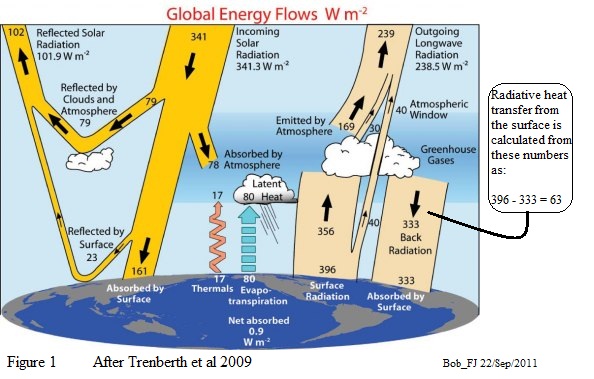
The unusual aspect of this diagram is that instead of directly showing radiative Heat Transfer from the surface, it gives their depiction of the greenhouse effect in terms of radiation flux or Electro-Magnetic Radiation, (AKA; EMR and a number of other descriptions of conflict between applied scientists and physicists). EMR is a form of energy that is sometimes confused with HEAT. It will be explained later, that the 396 W/m^2 surface radiation depicted above has very different behaviour to HEAT. Furthermore, temperature change in matter can only take place when there is a HEAT transfer, regardless of how much EMR is whizzing around in the atmosphere.
A more popular schematic from various divisions around NASA and Wikipedia etc, is next, and it avoids the issue above:
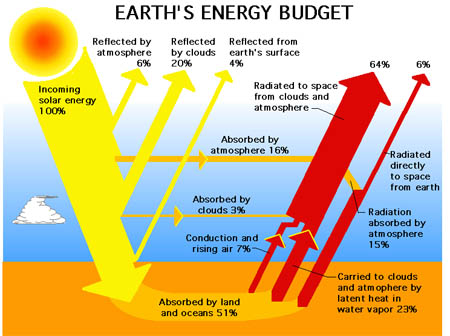
- Figure 2 NASA
Returning to the Trenberth et al paper, (link is in line 1 above), they give that the 396 W/m2 of EMR emitted from the surface in Fig.1 is calculated primarily by using the Stefan–Boltzmann law, and global year average conditions. Putting aside a few lesser but rather significant issues therein, it is useful to know that:
1) The Stefan-Boltzmann law (S-B) describes the total emission from a flat surface that is equally radiated in all directions, (is isotropic/hemispherical). Stefan found this via experimental measurement, and later his student Boltzmann derived it mathematically.
2) The validity of equally distributed hemispherical EMR is demonstrated quite well by observing the Sun. (with eye protection). It appears to be a flat disc of uniform brightness, but of course it is a sphere, and at its outer edge, the radiation towards Earth is tangential from its apparent surface, not vertical. It is not a perfect demonstration because of a phenomenon called limb darkening, due to the Sun not having a definable surface, but actually plasma with opacity effects. However, it is generally not apparent to the eye and the normally observed (shielded) eyeball observation is arguably adequate for purpose here.
3) Whilst reportedly the original Stefan lab test was for a small flat body radiating into a hemisphere, its conclusions can be extended to larger areas by simple addition of many small flat bodies of collectively flat configuration, because of the ability of EMR waves to pass through each other. This can be demonstrated by car driving at night, when approaching headlights do not change in brightness as a consequence of your own headlights opposing them. (not to be confused with any dazzling effects and fringe illumination)
4) My sketch below demonstrates how radiation is at its greatest concentration in the lateral directions. It applies to both the initial S-B hemispherical surface radiation and to subsequent spherical radiation from the atmosphere itself.

5) Expanding on the text in Figure 3: Air temperature decreases with altitude, (with lapse rate), but if we take any thin layer of air over a small region, and time interval, and with little turbulence, the temperature in the layer can be treated as constant. Yet, the most concentrated radiation within the layer is horizontal in all directions, but with a net heat transfer of zero. Where the radiation is not perfectly horizontal, adjacent layers will provide interception of it.
A more concise way of looking at it is with vectors, which put simply is a mathematical method for analysing parameters that  possess directional information. Figure 4, takes a random ray of EMR (C) at a modestly shallow angle, and analyses its vertical and horizontal vector components. The length of each vector is proportional to the power of the ray, in that direction, such that A + B = C. Of course this figure is only in 2D, and there are countless multi-directional rays in 3D, with the majority approaching the horizontal, through 360 planar degrees, where the vertical components also approach zero.
6) Trenberth’s figure 1 gives that 65% of the HEAT loss from the surface is via thermals and evapo-transpiration. What is not elaborated is that as a consequence of this upward HEAT transfer, additional infrared radiation takes place in the air column by virtue of it being warmed. This initially starts as spherical emission and absorption, but as the air progressively thins upwards, absorption slows, and that radiation ultimately escapes directly to space. Thus, the infrared radiation observable from space has complex sources from various altitudes, but has no labels to say where it came from, making some of the attributions “difficult”.
DISCUSSION; So what to make of this?
The initial isotropic S-B surface emission, (Trenberth’s global 396 W/m2), would largely be absorbed by the greenhouse gases instantaneously near the surface. (ignoring some escaping directly to space through the so-called “atmospheric window”). However, a large proportion of the initial S-B 396 surface emission would be continuously lateral, at the Trenberth imposed constant conditions, without any heat transfer, and its horizontal vectors CANNOT be part of the alleged 396 vertical flux, because they are outside of the vertical field of view.
After the initial atmospheric absorptions, the S-B law, which applied initially to the surface, no longer applies to the air above. (although some clouds are sometimes considered to be not far-off from a black body). Most of the air’s initial absorption/emission is close to the surface, but the vertical distribution range is large, because of considerable variation in the photon free path lengths. These vary with many factors, a big one being the regional and more powerful GHG water vapour level range which varies globally between around ~0 to ~4%. (compared with CO2 at a somewhat constant ~0.04%). The total complexities in attempting to model/calculate what may be happening are huge and beyond the scope of this here, but the point is that every layer of air at ascending altitudes continuously possesses a great deal of lateral radiation that is partly driven by the S-B hemispherical 396, but cannot therefore be part of the vertical 396 claimed in Figure 1.
CONCLUSIONS:
The vertical radiative flux portrayed by Trenberth et al of 396 W/m^2 ascending from the surface to a high cloud level is not supported by first principle considerations. The S-B 396 W/m^2 is by definition isotropic as also is its ascending progeny, with always prevailing horizontal vector components that are not in the field of view of the vertical. The remaining vertical components of EMR from that source are thus less than 396 W/m^2.
It is apparent that HEAT loss from the surface via convective/evaporative processes must add to the real vertical EMR loss from the surface, and as observed from space. It may be that there is a resultant of similar order to 396 W/m^2, but that is NOT the S-B radiative process described by Trenberth.
~~~~~~~~~~~~~~~~~~~~~~~~~~~~~~~~~~~~~~~~~~~~~~~~~~~~~~~~~~~~~
ADDENDUM FOR AFICIONADOS
I Seek your advice
In figure 5 below, note that the NIMBUS 4 satellite data on the left must be for ALL sources of radiation as seen from space, in this case, at some point over the tropical Pacific. The total emissions, amount to the integrated area under the curve, which unfortunately is not given. However, for comparison purposes, a MODTRAN calculator, looking down from 100 Km gives some interesting information for the figure, which is further elaborated in the tables below. Unfortunately the calculator does not give global data or average cloud/sky conditions, so we have apples and pears to compare, not only with Nimbus, but also with Trenberth. However, they all seem to be of somewhat similar order, and see the additional tabulations.

| Compare MODTRAN & “Trenberth”, looking down from 2 altitudes, plus Surface Temperature | ||||
| Location | Kelvin | 10 metres | 100 Km. | (Centigrade) |
| Tropical Atmosphere | 300K | 419 W/m^2 | 288 W/m^2 | (27C) |
| Mid-latitude Summer | 294K | 391 W/m^2 | 280 W/m^2 | (21C) |
| Mid-latitude Winter | 272K | 291 W/m^2 | 228 W/m^2 | (-1C) |
| Sub-Arctic Winter | 257K | 235 W/m^2 | 196 W/m^2 | (-16C) |
| Trenberth Global | 288K ? | 396 W/m^2 | 239 W/m^2 | (15C ?) |
| Compare MODTRAN & “Trenberth”, looking UP from 4 altitudes: W/m^2 | ||||
| Location | From 10 m | From 2 Km | From 4Km | From 6Km |
| Tropical Atmosphere | 348 | 252 | 181 | 125 |
| Mid-latitude Summer | 310 | 232 | 168 | 118 |
| Mid-latitude Winter | 206 | 161 | 115 | 75 |
| Sub-Arctic Winter | 162 | 132 | 94 | 58 |
| Trenberth Global | 333 Shown as coming from high cloud area (= BS according to MODTRAN) | |||
Bob,
“Furthermore I think if Trenberth tried to include every detail in his cartoon, it would be too complicated to follow.”
I agree. This is also the reason I really like the much more straightforward thermodynamic model derived from top level constraints dictated by Conservation of Energy in the paper I referenced. The author is stripping it down the net energy flux, which in the end is what really matters in the system (any system).
Bob,
“For instance, they show 80 leaving the surface and being released as latent heat, (the same value), in the clouds. However, this cannot be correct. The heat loss from the surface has an un-shown element known as evaporative cooling. In the process of evaporation, the higher energy water molecules are more readily able to escape and become gas, with the consequence that a higher proportion of lower energy molecules are left behind, resulting in cooling of the skin of water etc. I don’t know the relative scales of this, and probably no one does, but I’d rather drive a nail into the coffin with the S-B consideration, than with these lesser and controversial considerations.”
I’m not quite sure I understand what you’re saying here. Yes, I agree that the process of evaporation has a cooling effect on the surface or ‘skin’ of the water, but this would not be related to the S-B consideration, which is solely the result of the surface temperature and nothing else (assuming an emissivity of 1 or very close to 1). Any cooling effects like this are already embodied in the surface temperature and the resulting surface emitted LW flux derived from S-B (396 W/m^2 in the case of Trenberth’s diagram). Or am I misunderstanding you?
I am surprised that this paper:
http://www.biocab.org/Mean_Free_Path.pdf
hasn’t yet been thrown into the discussion. Could we be in the wrong building? GK
RW: (and Bob)
I’ve followed the last thirty or forty comments you and Bob have been tossing around and I still think you will never get the correct answers, for you keep mixing apples and oranges together, slicing and dicing them and then having trouble coming back with pure apples upward at the TOA. Don’t add (or subtract, or divide) relative numbers with NET numbers, otherwise you really need a proper, rather complex, program to track all changes IN THE ORANGES that are mixed into the apples (net) occurring simultaneously at all moments. Best to keep all numbers as net transfer of energy.
But, if you insist on keeping the “back-radiation” view, and you can do that, just remember those are relative figures, you need to listen to Bob about energy leaving the surface.
A moist averaged surface (see 80 Wm-2 evapo-transpiration) and a surface in contact with a gas that can conduct, warm, expand, and rise (17 Wm-2 thermals) cannot also radiate at 396 Wm-2 calculated from a 16°C perfectly dry and isolated (no air) surface by S-B and be correct in reality. The net radiation will be 97 Wm-2 less in reality. So the effective temperature radiating from that surface is ((396-97)/5.67)^0.25*100 or 296.5K (-3.6°C). So at least correct Kiehl-Trenberth’s IR figures to 396-97=299 and 356-97=259 and 333-97=236. If you do this you will notices that Bob’s figures at the top in the article’s text are still the same, the NET IR flux leaving the surface is still 63 Wm-2 but now you are one big step closer to reality. You will find this “shift-of-base” really affects nothing else in the graphic, it just corrects one wrong aspect.
BTW, that reduction of radiation happens at the molecular level in the top micro-meter of that averaged surface.
You will also notice that by reducing the 333 Wm-2 to 236 Wm-2 (-17 & -80) and getting the effective “back-radiation” happening right at the surface, √√(236/5.67×10^-8) = 254K or -19°C which is what most people get, on the average, when they point a radiative thermometer upward toward the empty sky. This is empirical evidence, and it’s real, that shows everything I’ve been trying to get you guys to understand is exactly correct. Re-read my comments above.
I can’t believe the peer reviewers let such a gapping mistake through. They were all, everyone of them, wrong. And to add insult the IPCC holds this up as high quality peer reviewed “science”, phooey!
RW @ur momisugly November 6, at 9:15 am
I meant that the evapotranspiration heat loss at the surface is shown as 80 at the surface, AND also 80 in the clouds, presumably in the form of latent heat loss in condensation. However, there is also evaporative cooling at the surface. What the relative proportions of these two processes are, I don’t know, but I was just pointing out another “simplification”.
The S-B consideration I mentioned is what my article discusses, that it is isotropic, and there are continuous horizontal components which cannot be part of the vertical 396 portrayed by Trenberth. (they are prevented from escaping directly to space because of the opacity of the atmosphere).
The surface temperature, and hence the S-B calculation is a consequence of ALL the processes
wayne,
“A moist averaged surface (see 80 Wm-2 evapo-transpiration) and a surface in contact with a gas that can conduct, warm, expand, and rise (17 Wm-2 thermals) cannot also radiate at 396 Wm-2 calculated from a 16°C perfectly dry and isolated (no air) surface by S-B and be correct in reality.”
I don’t see why not. The 80 W/m^2 of evapo-transpiration and 17 W/m^2 of thermals are in addition to the radiative flux at the surface. These values might be better expressed in equivalent joules rather than W/m^2.
G. Karst,
if you have actual data and science that disagrees with the IPCC meme you are ALWAYS in the wrong building!! 8>)
Thanks for the link.
wayne,
It might be easier to think of the atmosphere as acting as a ‘filter’ between the surface and space, where each ‘pass’ through the filter about 62% of the surface LW flux escapes to space and about 38% is ‘blocked’ and returned or recirculated back to the surface. Of the roughly 390 W/m^2 surface LW flux, only about 240 W/m^2 is allowed to leave at the TOA (240/390 = 0.62) and about 150 W/m^2 is returned to the surface (150/390 = 0.38) in addition to 240 W/m^2 arriving at the surface directly or indirectly from the Sun (240 + 150 = 390).
The physical mechanism for the 150 W/m^2 returned back to the surface is the downward re-emitted half of the surface LW flux absorbed by the atmosphere (either from the heated atmosphere itself or directly from GHGs). Of the 390 W/m^2 LW flux emitted at the surface, about 300 W/m^2 is absorbed or captured by the atmosphere and about 90 W/m^2 passes directly through to space as if the atmosphere wasn’t even there. Of the roughly 300 W/m^2 absorbed by the atmosphere, about 1/3rd is from the fixed or homogeneous GHG components like CO2 and about 2/3rds is from the highly dynamic components of water vapor and clouds, which are driven by evapo-transpiration moved non-radiatively from the surface into the atmosphere. The water is returned to the surface as precipitation and the non-radiative energy (latent heat) that isn’t returned as the temperature component of precipitation contributes the forces driving weather (storms, precipitation systems. wind, lightning, etc).
It’s important to realize also that at the TOA only radiation enters and leaves (i.e. all photons), so all the non-radiative flux from the surface to the atmosphere and from the atmosphere back to the surface all takes place in between the surface and the TOA. To the extent that non-radiative flux leaves the surface, non-radiative flux is also being returned to the surface somewhere else. While it’s entirely possible for some of the non-radiative flux moved from the surface into the atmosphere to radiate into the atmosphere and find its way radiated out to space as part of the 240 W/m^2 flux leaving, all that is happening in this case is non-radiative flux at the surface is being traded off for radiative flux at the surface, requiring the surface to emit less radiative flux to achieve equilibrium output power (240 W/m^2) at the TOA. Any trade off effects like this are already embodied in net energy flux entering the surface from the atmosphere, which also determines the LW flux from the surface into the atmosphere as well as the surface temperature (from S-B).
Bob,
“The S-B consideration I mentioned is what my article discusses, that it is isotropic, and there are continuous horizontal components which cannot be part of the vertical 396 portrayed by Trenberth. (they are prevented from escaping directly to space because of the opacity of the atmosphere).”
You mean that once the 396 W/m^2 surface LW flux is absorbed in the atmosphere it then gets re-emitted isotropically, much of which happens close to the surface and is not depicted in Trenberth’s picture?
“The surface temperature, and hence the S-B calculation is a consequence of ALL the processes.”
Agreed.
G. Karst @ur momisugly November 6, at 11:52 am, thank you for an interesting citation:
I’ve only read the body text excluding the maths, because I was hung-up on the following extract, and consequently did not want to grind through the mathematical model and so many references:
• Effective path length = 7000 m? Que?
• How can you have a path length of ANY dimension in a vacuum, unless there are annihilators of the photons?
• See also: Robert Stevenson @ur momisugly November 5, at 3:47 am and October 31, at 8:20 am above giving his calculation that appears to show the free path length, as not less than 2000m for CO2, and 120m for H2O.
• Other blog sources suggest annihilation of surface radiation mostly within 10 metres altitude.
• It seems more than counter-intuitive that a combination of CO2 & H20 could possibly reduce the number of photon intercepts.
OK, let’s argue that I’ve misunderstood, but now I come to some realities of the real world as I see them. Given that CO2 is known to have IR absorptive properties on its own, it seems counter-intuitive to suggest that it has a cooling effect when combined with other absorptive gases. I’m NOT claiming that this is untrue, but the point is that it seems extremely unlikely that this paper would be accepted by any of the iconic journals or the IPCC, or by rampant journalists and politicians.
Thus whilst it may be a matter of great interest, I doubt if it can further the cause of our scepticism. (sadly)
What is more, it is a tad off-topic, and so big that it really deserves a separate thread. Perhaps you could suggest it to Anthony in a few weeks after he has finished his new paper and the BEST circus!
kuhnkat @ur momisugly November 5, at 6:33 pm, you wrote in part:
“Here is a newer cartoon from NASA: http://mynasadata.larc.nasa.gov/Radiation_Explanation.html
Thanks K, I’ve added it to my library folder called “Funny Arrows”. I don’t know if I’m getting too senile but I couldn’t read all of the text, with the same result when I found two other sources and zoomed and whatnot. Ho hum!
Bob F-J,
I had to zoom to read it also. Fortunately I have a 17″ on the notebook and a 22″ on the desktop. Can’t imagine using a netbook for anything except possibly a phone!!
“G. Karst says:
November 6, 2011 at 11:52 am
I am surprised that this paper:
http://www.biocab.org/Mean_Free_Path.pdf
hasn’t yet been thrown into the discussion. Could we be in the wrong building? GK”
Could be/ 😉
Know if Nasif still frequences Jennifer Marohasy’s site? Haven’t had the time myself in the last few months to check.
>>
Bill Illis says:
October 27, 2011 at 5:47 pm
Modtran results looking up from the surface in the tropics (looking at the back-radiation, the red line) when it is Clear.
http://img171.imageshack.us/img171/4308/rad12081141.gif
Modtran results looking up from the surface in the tropics when there is low cloud cover. A perfect black-body radiating at 20C (and it is cloudy 65% of the time).
http://img171.imageshack.us/img171/7268/tropicalsurfacelookingu.gif
Where is this described in Trenberth’s diagram?
<<
and
>>
RW says:
November 5, 2011 at 10:22 am
One of the biggest problems with Trenberth is he does not clearly separate or distinguish the clear from the cloudy sky atmosphere, which only adds further to the confusion and ambiguity.
<<
In Kiehl and Trenberth 1997, the authors spend several paragraphs on cloud cover. They discuss a model of cloud cover where they take the percent of cloudiness from three levels: 49% low, 6% midlevel, and 20% high. They then use something called “random overlap” to calculate the total cloud cover of 62%. I have no idea what random overlap means, but I tried computing the same 62% using the Inclusion-Exclusion principle.
Now the Inclusion-Exclusion principle requires a specific order of terms and is rather error-prone to account for them properly. I prefer the mathematically equivalent technique of simply taking the complement of the product of the complements: 1 – (1-0.49)*(1-0.06)*(1-0.20) = 0.61648. This gives a similar answer to their 62%.
This supposedly, is the average Earth cloud cover. Their figure 7 should probably read “62% cloudiness assumed,” but it doesn’t. From this point on in their paper, the term “cloudy” is ambiguous. When KT 97 uses the term “cloudy,” do they mean 100% cloudy, 62% cloudy, or something else?
It appears that KT 97’s figure 7 represents 62% cloudiness, and most of the cloudy values that appear in figure 7 are referring to 62% cloudy. Then we have this little statement for computing the atmospheric window:
“The estimate of the amount leaving via the atmospheric window is somewhat ad hoc. In the clear sky case, the radiation in the window amounts to 99 W m−2, while in the cloudy case the amount decreases to 80 W m−2, showing that there is considerable absorption and re-emission at wavelengths in the so-called window by clouds. The value assigned in Fig. 7 of 40 W m−2 is simply 38% of the clear sky case, corresponding to the observed cloudiness of about 62%.”
That “cloudy case” 80 W/m² is a problem. If the 80 W/m² is the value at 62% cloudiness, then the window should be 80 W/m². If the 80 W/m² is the value at 100% cloudiness, then they should interpolate between 99 W/m² and 80 W/m² which gives us a window of 87 W/m². Instead they interpolate between 99 W/m² and 0 W/m², so that 80 W/m² must be a detractor and some other percentage of cloud cover (or it’s just wrong). The computation, 38% of 99 W/m², gives us 37.62 W/m². Why did they round to 40 W/m² instead of 38 W/m²?
There’s no mention of the 40 W/m² window value in their update paper. It just appears in their updated figure. It’s a puzzle.
Jim
Yes, here is another of Nasif’s posts, directly on topic:
http://jennifermarohasy.com/2011/03/recycling-of-heat-in-the-atmosphere-is-impossible/
I am not sure, how I am going to swing on these issues, as my paradigm has been undergoing subtle shifts lately. A lot of that, is directly due to reading WUWT and discussions like this. Old farts, like me, can experience difficulties with such shifting, as it must be downloaded throughout a life time of models and experience.
All I can say, is that, the present state of climate science is mostly a field of RED HERRING data. Fascinating, but we haven’t yet learned to frame the right question! Until we do, none of the “answers” will be very satisfying. GK
G. Karst @ur momisugly November 7, at 9:18 am and Wayne
I had a quick look at Nasif’s article, “Recycling of Heat in the atmosphere”, which included in part:
This kind of analyses shows a strange “multiplication” of the heat transferred from the surface to the atmosphere and from the atmosphere to the surface which is unexplainable from a scientific viewpoint. The authors of those diagrams adduce that such increase of energy in the atmosphere obeys to a “recycling” of the heat coming from the surface by the atmosphere …
As an old fart engineer myself, I found his reference to HEAT a bit inapproriate. Trenberth shows up-and-down EMR, which is a different form of energy to HEAT, in the classical sense, with quite different behaviour. Certain physicists and climatologists seem to have defined a new meaning for heat in recent times; that it is ONLY thermal energy IN TRANSIT. Not so in engineering, and even the IPCC, NOAA and others don’t seem to have caught-up with it. For example, see these links discussing heat content:
http://www.ipcc.ch/publications_and_data/ar4/wg1/en/ch5s5-2-2.html
http://www.sciencemag.org/content/284/5421/1735.1.full.pdf
http://www.nodc.noaa.gov/OC5/3M_HEAT_CONTENT/
http://journals.ametsoc.org/doi/abs/10.1175/2010MWR3189.1
http://www2.ucdsb.on.ca/tiss/stretton/database/Specific_Heat_Capacity_Table.html
Does anyone know how, why, or when, this wobbly new definition arose?
http://en.wikipedia.org/wiki/Heat
But see the section on semantics
Jim Masterson,
““The estimate of the amount leaving via the atmospheric window is somewhat ad hoc. In the clear sky case, the radiation in the window amounts to 99 W m−2, while in the cloudy case the amount decreases to 80 W m−2, showing that there is considerable absorption and re-emission at wavelengths in the so-called window by clouds. The value assigned in Fig. 7 of 40 W m−2 is simply 38% of the clear sky case, corresponding to the observed cloudiness of about 62%.”
That “cloudy case” 80 W/m² is a problem. If the 80 W/m² is the value at 62% cloudiness, then the window should be 80 W/m². If the 80 W/m² is the value at 100% cloudiness, then they should interpolate between 99 W/m² and 80 W/m² which gives us a window of 87 W/m². Instead they interpolate between 99 W/m² and 0 W/m², so that 80 W/m² must be a detractor and some other percentage of cloud cover (or it’s just wrong). The computation, 38% of 99 W/m², gives us 37.62 W/m². Why did they round to 40 W/m² instead of 38 W/m²?”
That’s interesting. What they should do is use the weighted cloud and clear sky averages. So 80*0.62 + 99*(1-0.62) = 88 W/m^2 (38 W/m^2 through the clear sky and 50 W/m^2 through the cloudy sky), which is much closer to the figures I’ve seen from other sources. It’s generally in the ball park of about 90 W/m^2, give or take a few watts.
The entire edifice of the atmospheric greenhouse effect paradigm, and these flat-earth models which try to depict it, are based on a paradox in the first place.
First, you have the fact that the “atmospheric greenhouse effect” functions nothing like a real, actual greenhouse.
Second, you have the admitted fact (admitted on Climate Etc., and in personal email exchanges with GHE supporters, which I can produce) that the models used to mathematically explain the atmospheric greenhouse effect, and to teach the effect to physics students, are meaningless pieces of fiction which have no basis in reality. This has been admitted and conceded. When asked to present the mathematics which explains the ACTUAL atmospheric greenhouse effect, nothing can be produced.
Third: This would be the first time, that I am aware of after having spent 12 years in learning and teaching astrophysics, that physicists used a piece of fiction, instead of the real thing, to teach what it claimed to be real. We do A LOT of advanced mathematics and physics in astrophysics, including deriving: the equations of General Relativity; Maxwell’s Equations; fundamental theorems of Quantum Mechanics; ALL of Classical Physics; Radiative Transfer in Stellar Atmospheres; Lifetimes of Stars, and much more. In none of these do we use a paradoxical fiction which no basis in reality to teach a concept – the concepts learned are all concepts which exist in real world. That we teach the atmospheric greenhouse effect with a model which has no basis in reality, which is admitted by the proponents of the atmospheric GHE, is a first for science.
We also undergo several years worth of laboratory training and learning exercises: there exists no laboratory demonstration in the world supporting the mathematical theory of the basic function of the atmospheric greenhouse effect, as it is depicted in these (fundamentally tautologous) flat-earth models. It would be one of the most insightful and fundamental physics labs to have ever existed, and it would give EVERY thread of support to the cause of catastrophic AGW. Yet it isn’t performed. The premise is simple: passively trap OLR in a box and make the box hotter than the insolation heating it. Given the insolation on a clear day is about 90C, we should be able to make the box WELL over 100C and boil water inside it by trapping its OLR inside.
Fourth: The flat Earth models depict the Earth as flat. The Earth is not flat.
Fifth: Water melts at 0C. Insolation of -18C could therefore never melt ice.
The physics of heat flow is simple: the Sun heats the Earth surface (and sunlight is HOT, over 120C, and +30C on average as it impinges), the earth surface heats the atmosphere. QED. The atmosphere is NOT a source of additional energy or heat.
For more info:
http://www.tech-know.eu/uploads/Copernicus_Meets_the_Greenhouse_Effect.pdf
http://www.tech-know.eu/uploads/The_Model_Atmosphere.pdf
http://www.tech-know.eu/uploads/Understanding_the_Atmosphere_Effect.pdf
The actually physically-realistic model presented in the “Model” paper has been converted into a proper 1-st order differential heat-flow equation. Such as equation creates no additional heat, but simply describes the flow of heat from hot to cold, in real time, for any location on a rotating, spherical Earth. There is no need for additional heat creation by the atmosphere, and the surface temperature is explained with ease.
The entire edifice of the atmospheric greenhouse effect paradigm, and these flat-earth models which try to depict it, are based on a paradox in the first place.
First, you have the fact that the “atmospheric greenhouse effect” functions nothing like a real, actual greenhouse.
Second, you have the admitted fact (admitted on Climate Etc., and in personal email exchanges with GHE supporters, which I can produce) that the models used to mathematically explain the atmospheric greenhouse effect, and to teach the effect to physics students, are meaningless pieces of fiction which have no basis in reality. This has been admitted and conceded. When asked to present the mathematics which explains the ACTUAL atmospheric greenhouse effect, nothing can be produced.
Third: This would be the first time, that I am aware of after having spent 12 years in learning and teaching astrophysics, that physicists used a piece of fiction, instead of the real thing, to teach what it claimed to be real. We do A LOT of advanced mathematics and physics in astrophysics, including deriving: the equations of General Relativity; Maxwell’s Equations; fundamental theorems of Quantum Mechanics; ALL of Classical Physics; Radiative Transfer in Stellar Atmospheres; Lifetimes of Stars, and much more. In none of these do we use a paradoxical fiction which no basis in reality to teach a concept – the concepts learned are all concepts which exist in real world. That we teach the atmospheric greenhouse effect with a model which has no basis in reality, which is admitted by the proponents of the atmospheric GHE, is a first for science.
We also undergo several years worth of laboratory training and learning exercises: there exists no laboratory demonstration in the world supporting the mathematical theory of the basic function of the atmospheric greenhouse effect, as it is depicted in these (fundamentally tautologous) flat-earth models. It would be one of the most insightful and fundamental physics labs to have ever existed, and it would give EVERY thread of support to the cause of catastrophic AGW. Yet it isn’t performed. The premise is simple: passively trap OLR in a box and make the box hotter than the insolation heating it. Given the insolation on a clear day is about 90C, we should be able to make the box WELL over 100C and boil water inside it by trapping its OLR inside.
Fourth: The flat Earth models depict the Earth as flat. The Earth is not flat.
Fifth: Water melts at 0C. Insolation of -18C could therefore never melt ice.
The physics of heat flow is simple: the Sun heats the Earth surface (and sunlight is HOT, over 120C, and +30C on average as it impinges), the earth surface heats the atmosphere. QED. The atmosphere is NOT a source of additional energy or heat.
For more info:
http://www.tech-know.eu/uploads/Copernicus_Meets_the_Greenhouse_Effect.pdf
http://www.tech-know.eu/uploads/The_Model_Atmosphere.pdf
http://www.tech-know.eu/uploads/Understanding_the_Atmosphere_Effect.pdf
The actually physically-realistic model presented in the “Model” paper has been converted into a proper 1-st order differential heat-flow equation. Such as equation creates no additional heat, but simply describes the flow of heat from hot to cold, in real time, for any location on a rotating, spherical Earth. There is no need for additional heat creation by the atmosphere, and the surface temperature is explained with ease.
Sure it is a caution flag… do you know of a climate paper without any?
I am not advocating Nasif’s hypothesis nor Nasif himself. Investigation i/p. GK
G. Karst @ur momisugly November 7, at 9:44 pm
I may have been a bit harsh on Nasif for him labelling EMR as HEAT. For instance he might just be going-along with the recent definition a la Wikipedia and various supporters of it such as Tim Folkerts and R. Gates on this thread. Trouble is, I get too grumpy sometimes when physicists and climatologists re-write the rule books.
But hey, I’ve just had one of those eureka moments. Remember how Trenberth wrote that infamous Email describing inability to find his missing heat as a travesty?
Well, since the elite definition is that heat is a transient thing, and not capable of residence in matter, then obviously, his heat is not missing, but still in transit!
“Bob Fernley-Jones says:
… then obviously, his heat is not missing, but still in transit!”
HAHAHAHA! There you go. Someone has left the trap door open to space wide open!
Off the top, one thing I see questionable in Dr. Nahle figures, and this does not invalidate his work, is simply where he converts the flux to ‘per steradian’. One I wonder why he is doing this for those units are generally not used in climate science and he is dividing by pi, not 4π if the four is already encapsulated in the previous terms. That I question. If that conversion is incorrect those figures listed as W/m^2/sr are really one fourth of his results but such an innocent slip is easily corrected.
This is playing right into my comment above of the total ‘real’ and net upward flux after removing the window portion is a mere 23-24 Wm-2 (63-40) per Trenberth et al’s figures, a fraction of what most people seem to think is happening as energy leaves the surface and is transferred to space, net-wise that is.
That is why it takes twelve hours for the air at night to cool a mere 8-12°C each night without further energy input. About the same energy as a small 24 watt CFL per meter squared.
RW, I might clarify, for you were speaking as if I was unaware that the thermal and evapo-transpiration figures listed in the graphic converts to IR. That’s not true. The problem is these figures are net figures which means there is 17 and 80 Wm-2 of energy per second that leaves the Earth system by these processes and that transfer ALREADY includes the conversion to IR outward, so, don’t remix this energy back into the atmosphere and then try to further move it around (“back-radiation”). Look in the papers listed as references at the bottom of Kiehl-Trenberth’s papers or Miskolczi’s papers where these figures were derived from other papers. For you are right, all energy lose from the Earth system is by IR in the end. Keep the net figures separated from the relative figures.
That incorrect mixing of net and relative figures IS the paradox in the cartoon. It will drive you mad!
Anyway, that’s the way I understand it.
I might add to:
“That is why it takes twelve hours for the air at night to cool a mere 8-12°C each night without further energy input. About the same energy as a small 24 watt CFL per meter squared.”
that this decrease in temperture also includes the window flux of course. Someone could read that dirrerently as if I didn’t understand the physics. I just assume people also realize that and I should not assume that, sorry.
wayne,
“RW, I might clarify, for you were speaking as if I was unaware that the thermal and evapo-transpiration figures listed in the graphic converts to IR. That’s not true. The problem is these figures are net figures which means there is 17 and 80 Wm-2 of energy per second that leaves the Earth system by these processes and that transfer ALREADY includes the conversion to IR outward, so, don’t remix this energy back into the atmosphere and then try to further move it around (“back-radiation”). Look in the papers listed as references at the bottom of Kiehl-Trenberth’s papers or Miskolczi’s papers where these figures were derived from other papers. For you are right, all energy lose from the Earth system is by IR in the end. Keep the net figures separated from the relative figures.
That incorrect mixing of net and relative figures IS the paradox in the cartoon. It will drive you mad!
Anyway, that’s the way I understand it.”
I’m not sure I understand exactly what you’re saying here, but perhaps you can clarify for me – do you know that the non-radiative flux at the surface is in addition to the radiative flux at the surface, and that the radiative flux at the surface is solely due to to the surface temperature and net energy flux entering the surface from the atmosphere?
RW @ur momisugly November 6, at 8:21 pm
Whoops RW, I overlooked this that you wrote:
You [Bob_FJ] mean that once the 396 W/m^2 surface LW flux is absorbed in the atmosphere it then gets re-emitted isotropically, much of which happens close to the surface and is not depicted in Trenberth’s picture?
Well yes, sort of, but the real point was that Trenberth shows the vertical flux as 396, but it can’t be when a significant part of the 396 is horizontal and therefore not vertical. (the horizontal stuff is constant under Trenberth’s uniform conditions)