The Berkeley Earth Surface Temperature project puts PR before peer review

UPDATE: see this new story

BEST: What I agree with and what I disagree with – plus a call for additional transparency to prevent “pal” review

=======================================================

Readers may recall this post last week where I complained about being put in a uncomfortable quandary by an author of a new paper. Despite that, I chose to honor the confidentiality request of the author Dr. Richard Muller, even though I knew that behind the scenes, they were planning a media blitz to MSM outlets. In the past few days I have been contacted by James Astill of the Economist, Ian Sample of the Guardian, and Leslie Kaufman of the New York Times. They have all contacted me regarding the release of papers from BEST today.

There’s only one problem: Not one of the BEST papers have completed peer review.

Nor has one has been published in a journal to my knowledge, nor is the one paper I’ve been asked to comment on in press at JGR, (where I was told it was submitted) yet BEST is making a “pre-peer review” media blitz.

One willing participant to this blitz, that I spent the last week corresponding with, is James Astill of The Economist, who presumably wrote the article below, but we can’t be sure since the Economist has not the integrity to put author names to articles:

The full article is here. Apparently, Astill has never heard of the UAH and RSS Global Temperature records, nor does he apparently know that all the surface temperature records come from one source, NCDC.

Now compare that headline and subtitle to this line in the article:

It will be interesting to see whether this makes it past the review process.

And, The Economist still doesn’t get it. The issue of “the world is warming” is not one that climate skeptics question, it is the magnitude and causes.

I was given a pre-release draft copy of one of the papers, related to my work as a courtesy. It contained several errors, some minor (such as getting the name of our paper wrong i.e. Fell et al in several places, plus a title that implied global rather than USA) some major enough to require revision (incorrect time period comparisons).

I made these errors known to all the players, including the journal editor, and the hapless Astill, who despite such concerns went ahead with BEST’s plan for a media blitz anyway. I was told by a BEST spokesperson that all of this was “coordinated to happen on October 20th”.

My response, penned days ago, went unheeded as far as I can tell, because I’ve received no response from Muller or the Journal author. Apparently, PR trumps the scientific process now, no need to do that pesky peer review, no need to address the errors with those you ask for comments prior to publication, just get it to press.

This is sad, because I had very high hopes for this project as the methodology is looked very promising to get a better handle on station discontinuity issues with their “scalpel” method. Now it looks just like another rush to judgement, peer review be damned.

Below is my response along with the draft paper from BEST, since the cat is publicly out of the bag now, I am not bound by any confidentiality requests. Readers should note I have not seen any other papers (there may be up to 4, I don’t know the BEST website is down right now) except the one that concerns me.

My response as sent to all media outlets who sent requests for comment to me:

===========================================================

In contradiction to normal scientific method and protocol, I have been asked to provide public commentary to a mass media outlet (The Economist) on this new paper. The lead author,  Dr. Richard Muller has released me from a previous request of confidentiality on the matter in a written communication on 10/14/2011. 10/15/2011 at 4:07PM PST in an email.  The paper in question is:

Earth Atmospheric Land Surface Temperature and  Station Quality [Tentative title, may have changed] by Muller et al 2011, submitted to the AGU JGR Atmospheres Journal, which apparently has neither completed peer review on the paper nor has it been accepted for publication by JGR.

Since the paper has not completed peer review yet, it would be inappropriate for me to publicly comment on the conclusions, especially in light of a basic procedural error that has been discovered in the methodology that will likely require a rework of the data and calculations, and thus the conclusions may also change. The methodology however does require comment.

The problem has to do with the time period of the data used, a time period which is inconsistent with two prior papers cited as this Muller et al paper being in agreement with. They are:

Fall et al (2011), Analysis of the impacts of station exposure on the U.S. Historical Climatology Network temperatures and temperature trends J. Geophys. Res.

http://pielkeclimatesci.files.wordpress.com/2011/07/r-367.pdf

and

Menne et al  (2010), On the reliability of the U.S. surface temperature record, J. Geophys. Res.

Both papers listed above (and cited by Muller et al) do an analysis over a thirty year time period while the Muller et al paper uses data for comparison from 1950 – 2010 as stated on lines 142-143:

“We calculated the mean temperature from 1950 to the present for each of these sites, and subtracted the mean of the poor sites from the OK sites.”

I see this as a basic failure in understanding the limitations of the siting survey we conducted on the USHCN, rendering the Muller et al paper conclusions highly uncertain, if not erroneous.

There is simply no way siting quality can be established as static for that long. The USHCN survey was based on photographs and site surveys starting in of 2007, plus historical metadata. Since the siting of COOP stations change as volunteers move, die, or discontinue their service, we know the record of siting stability to be tenuous over time. This is why we tracked only from 1979 and excluded stations whose locations were unknown prior to 2002. 1979 represented the practical limit of which we assumed we could reasonably ascertain siting conditions by our survey.

We felt that the further back the station siting changes occurred, the more uncertainty was introduced into the analysis, thus we limited meaningful comparisons of temperature data to siting quality to thirty years, starting in 1979.

Our ratings from surfacestations.org are assumed to be valid for the 1979 – 2008 period, but with Muller et all doing analysis from 1950, it renders the station survey data moot since neither Menne et al nor Fall et al made any claim of the station survey data being representative prior to 1979. The comparisons made in Muller et al are inappropriate because they are outside of the bounds of our station siting quality data set.

Also, by using a 60 year period, Muller et al spans two 30 year climate normals periods, thus further complicating the analysis. Both Menne et al and Fall et al spanned only one.

Because of the long time periods involved in Muller et al analysis, and because both Menne et al and Fall et al made no claims of knowing anything about siting quality prior to 1979, I consider the paper fatally flawed as it now stands, and thus I recommend it be removed from publication consideration by JGR until such time that it can be reworked.

For me to comment on the conclusions of Muller et al would be inappropriate until this time period error is corrected and the analysis reworked for time scale appropriate comparisons.

The Berkeley Earth Surface Temperature analysis methodology is new, and may yield some new and potentially important results on siting effects once the appropriate time period comparisons are made. I welcome the BEST effort provided that appropriate time periods are used that match our work. But, by using time period mismatched comparisons, it becomes clear that the Muller et al paper in its current form lost the opportunity for a meaningful comparison.

As I was invited by The Economist to comment publicly, I would recommend rejecting Muller et al in the current form and suggest that it be resubmitted with meaningful and appropriate 30 year comparisons for the same time periods used by the Menne et al and Fall et al cited papers. I would be happy to review the paper again at that time.

I also believe it would be premature and inappropriate to have a news article highlighting the conclusions of this paper until such time meaningful data comparisons are produced and the paper passes peer review. Given the new techniques from BEST, there may be much to gain from a rework of the analysis limited to identical thirty year periods used in Menne et al and Fall et al.

Thank you for your consideration, I hope that the information I have provided will be helpful in determining the best course of action on this paper.

Best Regards,

Anthony Watts

cc list: James Astill, The Economist, Dr. Joost DeGouw, JGR Atmospheres editor, Richard A. Muller, Leslie Kaufman, Ian Sample

===========================================================

Despite my concerns, The Economist author James Astill told me that “the issue is important” and decided to forge ahead, and presumably produced the article above.

Here is the copy of the paper I was provided by Richard Muller. I don’t know if they have addressed my concerns or not, since I was not given any follow up drafts of the paper.

BEST_Station_Quality (PDF 1.2 MB)

I assume the journalists that are part of the media blitz have the same copy.

I urge readers to read it in entirety and to comment on it, because as Dr. Muller wrote to me:

I know that is prior to acceptance, but in the tradition that I grew up in (under Nobel Laureate Luis Alvarez) we always widely distributed “preprints” of papers prior to their publication or even submission.  That guaranteed a much wider peer review than we obtained from mere referees.

Please keep it confidential until we post it ourselves.

They want it widely reviewed. Now that The Economist has published on it, it is public knowledge.

There might be useful and interesting work here done by BEST, but I find it troubling that they can’t wait for science to do its work and run the peer review process first. Is their work so important, so earth shattering, that they can’t be bothered to run the gauntlet like other scientists? This is post normal science at its absolute worst.

In my opinion, this is a very, very, bad move by BEST. I look forward to seeing what changes might be made in peer review should these papers be accepted and published.

==============================================================

UPDATE: Judith Curry, who was co-author to some of these papers, has a post on it here

Also I know that I’ll be critcized for my position on this, since I said back in March that I would accept their findings whatever they were, but that was when I expected them to do science per the scientific process.

When BEST approached me, I was told they were doing science by the regular process, and that would include peer review. Now it appears they have circumvented the scientific process in favor of PR.

For those wishing to criticize me on that point, please note this caveat in my response above:

The Berkeley Earth Surface Temperature analysis methodology is new, and may yield some new and potentially important results on siting effects once the appropriate time period comparisons are made. I welcome the BEST effort provided that appropriate time periods are used that match our work. But, by using time period mismatched comparisons, it becomes clear that the Muller et al paper in its current form lost the opportunity for a meaningful comparison.

Given the new techniques from BEST, there may be much to gain from a rework of the analysis limited to identical thirty year periods used in Menne et al and Fall et al.

My issue has to do with the lost opportunity of finding something new, the findings may agree, or they may be different if run on the same time periods. I think it is a fair question to ask since my peer reviewed paper (Fall et al) and NOAA’s (Menne et al) paper both used 30 year periods.

If BEST can run their comparison on the 30 year period for which our data is valid, instead of 60 years, as stated before, I’ll be happy to accept the results, whatever they are. I’m only asking for the correct time period to be used. Normally things like this are addressed in peer review, but BEST has blown that chance by taking it public first before such things can be addressed.

As for the other papers supposedly being released today, I have not seen them, so I can’t comment on them. There may be good and useful work here, but it is a pity they could not wait for the scientific process to decide that.

================================================================

UPDATE2: 12:08 PM BEST has sent out their press release, below:

The Berkeley Earth team has completed the preliminary analysis of the land surface temperature records, and our findings are now available on the Berkeley Earth website, together with the data and our code at

www.BerkeleyEarth.org/resources.php.

Four scientific papers have been submitted to peer reviewed journals, covering the following topics:

1. Berkeley Earth Temperature Averaging Process

2. Influence of Urban Heating on the Global Temperature Land Average

3. Earth Atmospheric Land Surface Temperature and Station Quality in the United States

4. Decadal Variations in the Global Atmospheric Land Temperatures

By making our work accessible and transparent to both professional and amateur exploration, we hope to encourage feedback and further analysis of the data and our findings.  We encourage every substantive question and challenge to our work in order to enrich our understanding of global land temperature change, and we will attempt to address as many inquiries as possible.

If you have questions or reflections on this phase of our work, please contact, info@berkeleyearth.org.  We look forward to hearing from you.

All the best,

Elizabeth

Elizabeth Muller

Founder and Executive Director

Berkeley Earth Surface Temperature

www.berkeleyearth.org

=========================================================

I’m still happy to accept the results, whatever they might be, all I’m asking for is an “apples to apples” comparison of data on the 30 year time period.

They have a new technique, why not try it out on the correct time period?

UPDATE4: Apparently BEST can’t be bothered to fix basic errors, even though I pointed them out, They can’t even get the name of our paper right:

http://berkeleyearth.org/Resources/Berkeley_Earth_Station_Quality

I sent an email over a week ago advising of the error in names, got a response, and they still have not fixed it, what sort of quality is this? Fell et all? right under figure 1

And repeated six times in the document they released today.

Sheesh. Why can’t they be troubled to fix basic errors? This is what peer review is for. Here’s my email from October 6th

—–Original Message—–
From: Anthony Watts- ItWorks
Date: Thursday, October 06, 2011 3:25 PM
To: Richard A Muller
Subject: Re: Our paper is attached
Dear Richard,
Thank you for the courtesy, correction:  Fell et al needs to be corrected to
Fall et al in several occurrences.
When we complete GHCN (which we are starting on now) we’ll have a greater
insight globally.
Best Regards,
Anthony Watts

Here is the reply I got from Dr. Muller

—–Original Message—–
From: Richard A Muller
Date: Friday, October 14, 2011 3:35 PM
To: Anthony Watts- ItWorks
Subject: Re: Our paper is attached
Anthony,
We sent a copy to only one media person, from The Economist, whom we trust to keep it confidential.  I sent a copy to you because I knew you would also keep it confidential.
I apologize for not having gotten back to you about your comments.  I particularly like your suggestion about the title; that is an improvement.
Rich
On Oct 14, 2011, at 3:04 PM, Anthony Watts- ItWorks wrote:
> Dear Richard,
>
> I sent a reply with some suggested corrections. But I have not heard back
> from you.
>
> Does the preprints peer review you speak of for this paper include sending
> copies to media?
>
> Best Regards,
>
>
> Anthony Watts

==========================================================

UPDATE 5: The Guardian writer Ian Samples writes in this article:

The Berkeley Earth project has been attacked by some climate bloggers, who point out that one of the funders is linked to Koch Industries, a company Greenpeace called a “financial kingpin of climate science denial“.

Reader AK writes at Judth Curry’s blog:

I’ve just taken a quick look at the funding information for the BEST team, which is:

Funded through Novim, a 501(c)(3) corporation, the Berkeley Earth Surface Temperature study has received a total of $623,087 in financial support.

Major Donors include:

– The Lee and Juliet Folger Fund ($20,000)

– William K. Bowes, Jr. Foundation ($100,000)

– Fund for Innovative Climate and Energy Research (created by Bill Gates) ($100,000)

– Charles G. Koch Charitable Foundation ($150,000)

– The Ann & Gordon Getty Foundation ($50,000)

We have also received funding from a number of private individuals, totaling $14,500 as of June 2011.

In addition to donations:

This work was supported in part by the Director, Office of Science, of the U.S. Department of Energy under Contract No. DE-AC02-05CH11231 ($188,587)

So now (pending peer-review and publication) we have the interesting situation of a Koch institution, a left-wing boogy-man, funding an unbiased study that confirms the previous temperature estimates, “consistent with global land-surface warming results previously reported, but with reduced uncertainty.

The identities of the people involved with these two organizations can be found on their websites. Let the smirching begin.

0 0 votes
Article Rating

Discover more from Watts Up With That?

Subscribe to get the latest posts sent to your email.

409 Comments
Inline Feedbacks
View all comments
Steve
October 21, 2011 7:40 am

The UHI paper claims that the UHI stations set has a lower warming trend than the set of those found in rural areas and that the difference is statistically significant (page 9 paragraph 2). This doesn’t sit right with me. I could accept if they found no difference, i.e. the UHI stations were not influenced by urban heat. But to find a lower rise in temperature? This result needs to be explained or understood. Are BEST really suggesting that if the whole surface of the earth was one giant city the global temperature rise would be lower?

Steve C
October 21, 2011 7:40 am

Phew! I’ve only read through these comments and found it exhausting. How Anthony manages to maintain a courteous manner in the face of some of the vilely personal attacks from poison dwarf trolls – who seem to be trying to lower the tone here to that of “Real Climate” – I really don’t know, but he’s earned a deal more respect from me for it.
Having said which, the title of the original post, about BEST putting PR before peer review, is plainly both an adequate summary of their modus operandi and a passing fair description of how the whole of modern climate alarmism is run. As someone noted above (sorry, I’m not going through that lot again to find out who), a lie is all round the world before truth has got its boots on, which of course is what propaganda relies on. It’s a pity that it had to be Muller who did it, as his comment on Climategate – about there being people “whose papers I will not now read” – remains imho far and away the best summing up of that affair.
Overall, Anthony +1 point; Muller -2.
And “science” “journalism”, minus several hundred (as usual).

Brian
October 21, 2011 7:53 am

Not surprising how quickly you’re moving the goalposts back. Anthony, once the papers are peer reviewed and accepted into scientific journals, will you still “accept whatever results they produce, even if it proves [your] premise wrong”? What specifically will it take for you to accept AGW? How much (more) warming? How much (more) scientific consensus? Right now, it seems like your approach is ‘global warming must be a lie. Now let’s find data that disproves it, and ignore data that proves it.’

JJ
October 21, 2011 8:07 am

Kevin McDonald –
“And yes, I’m aware these comments refer to the last decade,
Then you realize that those comments in no way support the point you were implicitly making.
“… but even then they are only true if you cherry pick your dataset, choose a time period too short to provide a statistically significant result and ignore the energy expended in ice melt, deep ocean warming, etc.”
Absolutely not true. Kevin Trenberth’s missing heat is nowhere to be found, let alone ignored. He looked at all of the things you refer to, and it just aint there.
And insofar as ocean heat is concerned, it is the warmist proselytizers that have ignored ocean heat. In fact they have ignored heat alltogether, sticking assidiously to temperature, as doing so opens enormous holes in the accounting into which they can drop their whole-cloth assertions about CO2. Their ‘just so’ story depends on ignoring heat and depth. The argument from ignorance that underpins ‘global warming’ (the models fit temps with our assumptions about CO2 effects, they dont without it, and golly, we just cant think of anything else it could be) hinges on that specific ignorance in particular. They are the ones who have been limiting the detection metric to surface temps rather than global heat, not us.

Jeff Grantham
Reply to  JJ
October 21, 2011 10:27 am

JJ commented
And insofar as ocean heat is concerned, it is the warmist proselytizers that have ignored ocean heat. In fact they have ignored heat alltogether, sticking assidiously to temperature, as doing so opens enormous holes in the accounting into which they can drop their whole-cloth assertions about CO2. Their ‘just so’ story depends on ignoring heat and depth.
Ignored? Really? Do you follow the literature? I do. These are just from the last few weeks:
Lee, Sang-Ki; Park, Wonsun; van Sebille, Erik; Baringer, Molly O.; Wang, Chunzai; Enfield, David B.; Yeager, Stephen G.; Kirtman, Ben P.
What caused the significant increase in Atlantic Ocean heat content since the mid-20th century?
Geophys. Res. Lett., Vol. 38, No. 17, L17607
http://dx.doi.org/10.1029/2011GL048856
08 September 2011
von Schuckmann and Le Traon, Ocean Sci Discuss., 2011:
http://www.ocean-sci-discuss.net/8/999/2011/osd-8-999-2011.pdf
Hamon et al, Ocean Sci Discuss., 2011:
http://www.ocean-sci-discuss.net/8/291/2011/osd-8-291-2011.pdf
Meehl, G., J. Arblaster, J. Fasullo, A. Hu, and K. Trenberth. “Model-based evidence of deep-ocean heat uptake during surface-temperature hiatus periods.” Nature Climate Change 1, no. 7 (2011): 360-364.
Zou, Liwei; Zhou, Tianjun
Sensitivity of a regional ocean-atmosphere coupled model to convection parameterization over western North Pacific
J. Geophys. Res., Vol. 116, No. D18, D18106
http://dx.doi.org/10.1029/2011JD015844
21 September 2011
Mohtadi, Mahyar; Oppo, Delia W.; Lückge, Andreas; DePol-Holz, Ricardo; Steinke, Stephan; Groeneveld, Jeroen; Hemme, Nils; Hebbeln, Dierk
Reconstructing the thermal structure of the upper ocean: Insights from planktic foraminifera shell chemistry and alkenones in modern sediments of the tropical eastern Indian Ocean
Paleoceanography, Vol. 26, No. 3, PA3219
http://dx.doi.org/10.1029/2011PA002132
10 September 2011
Jouanno, Julien; Marin, Frédéric; du Penhoat, Yves; Sheinbaum, Julio; Molines, Jean-Marc
Seasonal heat balance in the upper 100 m of the equatorial Atlantic Ocean
J. Geophys. Res., Vol. 116, No. C9, C09003
http://dx.doi.org/10.1029/2010JC006912
08 September 2011

isotopes
October 21, 2011 8:13 am

I call B.S.
“And, The Economist still doesn’t get it. The issue of “the world is warming” is not one that climate skeptics question, it is the magnitude and causes.”
Ummm, sadly, no. Your attempt to distance yourself from the Climategaters, hoaxers, and deniers is laughable. What about most of the repubs in congress? Most climate skeptics ABSOLUTELY question whether the world is warming, and any unpleasant hedging dance you perform is just embarrassing. History will treat you very, very unkindly, I’m afraid, as should your grandkids.

Jay
October 21, 2011 8:32 am

Mr Watts,
Perhaps you misunderstood my post above. When you criticized Astill for NOT citing UAH and RSS data records, you seemed to be implying that he deliberately missed some important, or even contradictory information. Otherwise I fail to see the importance of your k=making this criticism in the first place.
Fact is, his article dealt with surface records, the subject of the BEST studies. I was simply pointing out that when you include UAH and RSS data alongside Gistemp and HadCRUT records
http://tinyurl.com/439nzcz
the time series are all exceedingly well correlated.
As for the rest of you criticisms of BEST’s actions in releasing their study, we all must realize that this work received a lot of media hype at its inception. It is therefore not surprising that the media will be all over this like flies on honey. Not to mention the fact that scientists like Richard Muller and Bob Carter are showmen at heart. They love the limelight. It is good that the papers were pre-released before peer review. Now we’ll be able to see what changes due to the process.
I do concur that BEST should honor your request for analyzing the same 30 year period and comparing it to Fall, et al and Menne et al. That may not be required in the published article, since that work is really an assessment of the veracity of NASA, NOAA and Hadley. But you might request Muller, et al to do it for publication in your blog.

Jeff Alberts
October 21, 2011 8:36 am

“The world has warmed…” yada yada
Some places have warmed, some have cooled, some have remained relatively static. Taking a temperature reading from one place, averaging it with a temperature from a different place, and calling it meaningful is, well, I don’t know what to call that.

bob paglee
October 21, 2011 8:42 am

As a long term subscriber to “The Economist,” I find the weekly magazine interesting in many ways, but with regard to its reporting on issues regarding AGW, I believe it is as reliable as anything from Hadley CRU, or Phil Jones, or Al Gore, or many other apostles of similar anti-carbon religious conviction. So beware what you read in “The Economist” on the subject of “global wrming” and of any questions from a reporter for The Economist who is perhaps imbued with a strong anti-carbon conviction consistent with the editorial bias.

Rhys Jaggar
October 21, 2011 8:44 am

Do you not find it slightly coincidental that a group in Berkeley,CALIFORNIA spread this globally the very day that Cap N Trade gets passed?
I don’t……..

Dexter Hate
October 21, 2011 8:56 am

So, they didn’t process their data the way you wanted them to…
And they misspelled a name.
Those are exceedingly petty (and irrelevant) criticisms by someone who seems to think they are quite a bit more important than they are.

TTT
October 21, 2011 8:57 am

You really will never, ever admit you were wrong. You didn’t when your own study showed no station-based distortion of the temperature record, and now you’re not even when a study that you said you would accept likewise shows no station-based distortion of the temperature record. There is no station-based distortion of the temperature record, but at this point you’ve turned it into a religion and lack the integrity to be able to change your mind. By rights this ought to be the FINAL NAIL of any credibility any of you [SNIP: keep that up and your posts will simply be deleted -REP] ever had.

John
October 21, 2011 9:08 am

Anthony, I don’t know what you were expecting, but it seems to me that there are some things in the Berkeley report that are very interesting.
When I look at Fig. 1 in the report, available here:
http://www.berkeleyearth.org/Resources/Berkeley_Earth_Decadal_Variations
you will see that the 2010 temperature is considerably lower than in the other three records. In the El Nino year of 1998, three of the four records (including Berkeley) were at an anamoly of almost plus 1.0 degrees. At the end point, 2010, three of the records were between plus 0.85 and 0.95, but Berkeley was under 0.6. It is literally the last year where Berkeley breaks away, downward, from the pack. Could that possibly have to do with how Berkeley handled the dropping of so many surface stations? I’d look into that, ASAP.
Eyeballing the change from the beginning of the satellite temperature era, 1979, it seems to me that Berkeley’s trends through 2010 are the closest in temperature trends to the satellite records, which have lower trends than the land based records (0.140 degrees per decade for UAH, 0.148 for RSS, through Jan. 2011:
http://en.wikipedia.org/wiki/Satellite_temperature_measurements#Trends_from_the_record
If I were you, I’d concentrate really hard on the Berkeley 2010 temperature, which goes strongly in the opposite direction than the other three records.
The other thing that really stood out in the Berkeley work is that the land surface temperature record is much more closely related to the Atlantic Multidecadal Oscillation (AMO) than to ENSO. The PDO and AMO appear to be closely correlated, with PDO changes leading AMO changes by about 2.5 years (Fig. 5).
We’ve all read the articles by “mainstream” researchers suggesting that temperature might not rise for a couple of decades because the PDO is in its declining 25 to 30 year cycle. If this is true, then the AMO may not be far behind, and if Berkeley is correct that the AMO and surface temperatures are tightly linked, then we may indeed not see much warming for a while.

Rattus Norvegicus
October 21, 2011 9:48 am

When I read the caption for figure 1 it seems to say that it is not the full record, but rather a random selection of records from a subset. The (full?) analysis seems to be here:
http://www.berkeleyearth.org/images/Updated_Comparison_10.jpg
And there is no evidence of a sharp downward trend for 2010 there.

peter stone
October 21, 2011 10:05 am

It’s not plausible that the titans of the blog science realms are somehow continually being duped, out-witted, and persecuted by the IPCC overlords.
The physicist who did this study was sympathetic to sceptics.
Scientists associated with phony climategate scandal were exonerated by multiple, independent inquiries.
Dr. Spencer’s paper in some obsucre online journal was deemed to be
Many of us can remember when climate sceptics in the 1990s claimed the earth wasn’t really warming at all. That scientists were somehow mucking up the temperature records.
It doesn’t pass the laugh test anymore that web forum sceptics and blog scientists on some relatively obscure blogs are somehow unfairly and continuously being persecuted by mainstream science and the overwhelming majority of the global climate science community. Frankly, its starting to sound paranoid and kooky.
It is what it is. If blog scientists have more robust, and scientifically credible hypothoses that debunk human-induced climate change, feel free to publish it in a credible and internationally-recognized science journal.
REPLY: Oh, we will, be assured. – Anthony

October 21, 2011 10:29 am

The Norwegian Rat says:
“there is no evidence of a sharp downward trend for 2010”
Dishonestly using a specific temperature base line always shows rapidly rising temperatures. But it is just fooling the eye.
Contrary to the rat’s bogus chart, temperatures have been declining.
• • •
FleshNotMachine says:
“So Anthony, I have to ask: what evidence *would* convince you of AGW?”
Are you blind, or do you just have an inability to comprehend? I challenge you to cut and paste one comment of Anthony’s, stating that AGW is non-existent. You and the rest of the trolls infesting this thread are not only scientifically illiterate, you can’t even get simple facts right. Now run along to Skeptical Pseudo-Science and RealClimatePropaganda for some more talking points, like a good little climate alarmist.

Jeff Grantham
Reply to  dbstealey
October 21, 2011 10:49 am

@Smokey:
Anthony Watts: “I believe that our [man-made] contribution [to climate change] may be far less than has been postulated. Our measurement network has been compromised—not intentionally, but accidentally and through carelessness.”
http://www.newsreview.com/reno/watts-me-worry/content?oid=602867

October 21, 2011 10:38 am

Jeff Grantham,
Thanx so much for your citations of papers based primarily on computer models. However, looking at empirical [real world] evidence, it is obvious that OHC has stopped rising:
http://i55.tinypic.com/2i7qn9y.jpg [Tisdale chart]
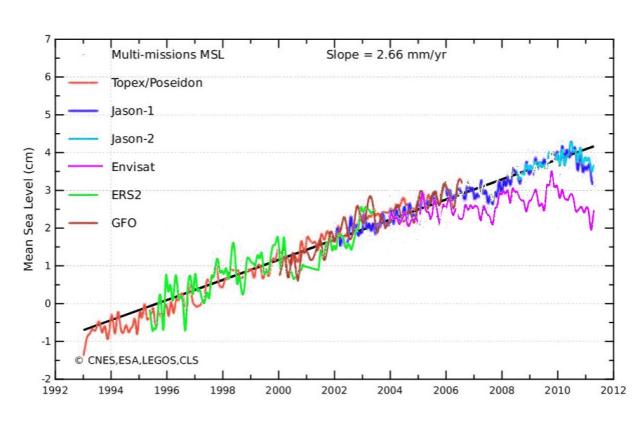
Furthermore, the rise in sea levels has moderated, clearly indicating that thermal expansion of the oceans is decelerating.
So who should we believe; grant-chasing alarmists? Or Planet Earth?
You can follow the rat to the nearest alarmist blog for more bogus talking points. The rest of us will listen to what the real world is telling us.

Jeff Grantham
Reply to  dbstealey
October 21, 2011 11:04 am

@Smokey:
1) JJ’s claim was that ocean heat isn’t considered. As I showed, clearly he is wrong.
2) The chart you linked to (http://i55.tinypic.com/2i7qn9y.jpg)n shows a plot past Jan 2011 but refers to a paper published in 2009! What kind of games are you playing here? The actual conclusion of Levitus 2009 is nothing like this chart; see Figure 1 in their paper: ftp://ftp.nodc.noaa.gov/pub/data.nodc/woa/PUBLICATIONS/grlheat08.pdf
2) Levitus et al 2009 only deals with the top 700 m of the oceans.
3) The paper says ” We acknowledge that ocean temperature data are sparse in the polar and subpolar regions of the world ocean…. there are locally important changes in OHC in these regions such as warming of the North Atlantic Water in the Arctic Ocean that may play an important role in climate change.”
4) The paper concludes “The linear trends (with 95% confidence intervals) of OHC700 are 0.40 x
10^22 ± 0.05 J yr^-1 for 1969 – 2008 and is 0.27  x 10^22 ± 0.04 J yr-1 for 1955 – 2008.”
You have a habit of picking small time intervals for your conclusions, which is invalid because natural cycles can be important over such short time periods.

tegirinenashi
October 21, 2011 10:55 am

I’m skeptic, but it is disappointing to see so many 2 cent comments here. Perhaps moderating yahoos here would be a good thing.

tegirinenashi
October 21, 2011 11:03 am

, can’t speak about the others, but I would accept GW theory when two thermometers:
http://www.nerc-bas.ac.uk/icd/gjma/amundsen-scott.ann.trend.pdf
http://www.nerc-bas.ac.uk/public/icd/gjma/vostok.ann.trend.pdf
would indicate anything but flat curve. Didn’t GW theory predicted that it is the poles that are expected to warm the most?

October 21, 2011 11:34 am

The Lackey for the alarmist crowd says: “…BEST may have also done this to try and hasten the final nails being put driven into the coffin of those that seek to perpetuate a completely artificial and unnecessary debate …” It takes two to tango, Lackey. If you don’t want to debate, no one is forcing you. Run along back to your fave alarmist blog, where you can get an “Amen!” from your fellow head nodders.
• • •
isodopes says:
“Most climate skeptics ABSOLUTELY question whether the world is warming…”
You are completely deluded.
• • •
Jeff Grantham,
Are you related to the financial wizard and CAGW crackpot Jeremy Grantham? Just wondering.
The chart I linked, as I clearly stated was by Bob Tisdale, who added more recent data showing that OHC is flat. The ARGO buoy system confirms that fact [despite a few mendacious nitpickers who try to challenge the ARGO real world data]. You also don’t seem to understand the concept of anomalies.
I stated: “I challenge you to cut and paste one comment of Anthony’s, stating that AGW is non-existent.” You failed. Anthony has never said that AGW is “non-existent.” Your lame response was to quote Anthony saying AGW “may be far less than has been postulated.” That statement is correct. The UN/IPCC’s 3°+ temperature rise per 2xCO2 is preposterous, and is contradicted by empirical evidence.
Finally, your comment: “You have a habit of picking small time intervals for your conclusions, which is invalid because natural cycles can be important over such short time periods.” That shows you know nothing about the CAGW conjectures I have consistently refuted, using charts that go back from months to billions of years, and everything in between.

Jeff Grantham
Reply to  dbstealey
October 21, 2011 3:12 pm

Smokey commented
The UN/IPCC’s 3°+ temperature rise per 2xCO2 is preposterous, and is contradicted by empirical evidence.
What’s preposterous is attributing false claims to the IPCC, and then blaming them for the claims they never made.
You do this repeatedly. Why?
In fact, the IPCC does not quote a single value for climate sensitivity, but a range:
http://www.ipcc.ch/publications_and_data/ar4/wg1/en/ch8s8-6-2-3.html
“The current generation of GCMs[5] covers a range of equilibrium climate sensitivity from 2.1°C to 4.4°C (with a mean value of 3.2°C; see Table 8.2 and Box 10.2).”
http://www.ipcc.ch/publications_and_data/ar4/wg1/en/ch8s8-6-2-2.html
In short, the IPCC presents a range of values and clearly discusses the limitations and uncertainties in the values (Chapter 8.6 of the first volume of the Fourth Assessment Report.)

Jeff Grantham
Reply to  dbstealey
October 21, 2011 3:20 pm

Smokey commented
The chart I linked, as I clearly stated was by Bob Tisdale, who added more recent data showing that OHC is flat. The ARGO buoy system confirms that fact [despite a few mendacious nitpickers who try to challenge the ARGO real world data]. You also don’t seem to understand the concept of anomalies.
Tisdale’s image presents results as if they’re from a scientific paper when they’re not. That’s fraud.
I understand anomalies quite well, thank you. Anomalies are differences from a *baseline*, and baselines are not a function of time. Differences from a trend line are not called “anomalies.”
This is a second reason why Tisdale’s plot is fraudulent.
He either doctored this image to give a certain result, or he is completely incompetent. And the same holds for you since you’re presenting it as evidence.
You’ve been caught red-handed. Ironic, since it’s in the same thread where your own claim of other’s fraud has been dissembled and disproved.
Q.E.D.

JJ
October 21, 2011 11:44 am

Jeff G,
“1) JJ’s claim was that ocean heat isn’t considered. As I showed, clearly he is wrong”
No, JJ’s claim is that heat, including ocean heat, is ignored in ‘global warming’ theology and the models that it is circularly based on. It is all about surface temperature. That is the detection metric and the model basis, and that is how they create the CO2 shaped hole.
LOL at your inclusion of such nonsense as:
Meehl, G., J. Arblaster, J. Fasullo, A. Hu, and K. Trenberth. “Model-based evidence of deep-ocean heat uptake during surface-temperature hiatus periods.” Nature Climate Change 1, no. 7 (2011): 360-364.
Model-based evidence that confirms our model based conclusions of our concept of the world, which drives the logic and parameterization of our models. Nice work, if you can get it. And stomach it.

Jeff Grantham
October 21, 2011 11:53 am

Smokey: In other words, Tisdale’s image is misleading — it attributes results to a paper that didn’t present them. That does not speak well for his integrity, and is usually criticized as “appeal to authority.” Nor is their any assurance Tisdale’s addition is correct, unless they were peer-reviewed somewhere.
But even worse, Tisdale’s plot clearly doesn’t even agree with Figure 1 (p. L07608) of Levitus 2009 where they overlap. Tisdale’s peaks in 2003, and Levitus et al in 2008.
Tisdale is trying to pull a fast one here, and you’re wrong to cite it as evidence when it has clearly been doctored. Sorry.

October 21, 2011 11:55 am

Jeff Grantham says:
“Your keep asserting this, but never provide any actual evidence. Assertions aren’t proof, no matter how many times you repeat them.”
The onus is on you, bud. Produce a verifiable statement from one of the “Team” claiming that the Harry_read_me file is fake. Wake me if you find one.

Jeff Grantham
Reply to  dbstealey
October 21, 2011 2:40 pm

Smokey says
The onus is on you, bud. Produce a verifiable statement from one of the “Team” claiming that the Harry_read_me file is fake. Wake me if you find one.
You’re the one making the claim — the onus is on you to prove claims you make.
Still, I see nothing approaching any actual evidence.

John
October 21, 2011 11:56 am

Smokey points out that the UAH temp record shows a big drop in temps from 2009 to the end of 2010:
http://img856.imageshack.us/img856/2403/dailyuahtempsmar92010.png
That is exactly what the Berkeley records shows, the opposite of what the other three records show.
Why is that? If the Berkeley record is accurate (as the UAH satellite record implies), then the Berkeley group has made an important contribution to the land based records.
So why did Berkeley make this 2010 finding?

isotopes
October 21, 2011 12:03 pm

@Smokey,
Your lack of critical thinking skills is overwhelming you…take a break or something and come back with a clear head.
In one single sentence, you give a shining example of the backward, anti-intellectual stance your crowd has against logic:
“Thanx so much for your citations of papers based primarily on computer models. However, looking at empirical [real world] evidence, it is obvious that OHC has stopped rising:”
So, you dismiss, with a dainty wave, every bit of science based on computer models, (pssssst: they process REAL data, my friend, but let’s just keep that between you and me, no need for others to know), but thrust your chest out at empirical evidence, the example of which you choose to provide is a decade of data (i.e., short term ‘weather’ data) in the subject of climate science (homework: look up definition).
When not chuckling at your logic, most will recognize that aeronautics, genetics, microbiology, cosmology, geologic sciences, finance analysis, chemical kinetics, engineering of all sorts, mathematics, etc, etc, would all grind to a halt to some degree or other if “computer models” (note scary quotes!) were pink slipped with the derision you gleefully apply. Welcome to the 15th century!!
In other words, picking and choosing which science you happen to want to believe is a slope lathered with stupid. Be careful where you tread, my friend.

Verified by MonsterInsights