
From the European Space Agency (ESA):
New ice thickness map of the Arctic unveiled
The first map of sea-ice thickness from ESA’s CryoSat mission was revealed today at the Paris Air and Space Show. This new information is set to change our understanding of the complex relationship between ice and climate.
From an altitude of just over 700 km and reaching unprecedented latitudes of 88º, CryoSat has spent the last seven months delivering precise measurements to study changes in the thickness of Earth’s ice.
Satellites have already shown that the extent of sea ice in the Arctic is diminishing. In fact, spring 2011 is the third lowest extent recorded by satellite.
However, to understand fully how climate change is affecting the fragile polar regions, there is a need to determine exactly how the thickness of the ice is changing.
To answer this question, a group of scientists together with Prof. Duncan Wingham from University College London proposed the CryoSat mission to ESA in 1998. The loss of the original CryoSat satellite in 2005 as a result of a launch failure has unfortunately made this a longer than normal wait.

Nevertheless, the launch of the replacement satellite in April 2010 has resulted in these first maps of ice thickness. They clearly demonstrate that CryoSat is a mission of excellence and will greatly advance polar science.

The results were presented at the Le Bourget air and space show by Volker Liebig, ESA’s Director of Earth Observation Programmes, Duncan Wingham and René Forsberg from the National Space Institute at the Technical University of Denmark.
Prof. Wingham said, “A new mission is always risky. There’s quite a long wait and then everyone gets to see if it really can deliver.
“What’s really nice about these results is that they show not only that the hardware is really excellent – which we already knew – but that it can deliver the geophysical information we need too.
“It’s a credit to the teams at ESA and UCL who have worked really hard and I’m very happy with these new results.”
CryoSat measures the height of the sea ice above the water line, known as the freeboard, to calculate the thickness. The measurements used to generate this first map of the Arctic were from January and February 2011, as the ice approaches its annual maximum.

Download: HI-RES JPEG (Size: 498 kb)
The data are exceptionally detailed and considerably better than the mission’s specification. They even show lineations in the central Arctic that reflect the ice’s response to wind stress.
Prof. Liebig said, “This major result comes just one year after launch. It is another important step towards achieving one of the primary objectives of the mission; namely, to determine how much the sea ice in the Arctic is thinning in response to a changing climate.”
A new map of Antarctica has also been created showing the height of the ice sheet. This is more preliminary because more data are needed here to see what CryoSat can do.
Even so, the extra coverage CryoSat offers near the poles can be demonstrated: parts of Antarctica can now be seen for the first time from space.

Download: HI-RES MP4 (Size: 5 779 kb)
In addition, detail of edges of the ice sheet where it meets the ocean can now closely monitored thanks to CryoSat’s sophisticated radar techniques. This is important because this is where changes are occuring.
“It is very satisfying to see these exciting results,” said ESA’s Richard Francis, who was the CryoSat-2 Project Manager during its development.
“It has taken about ten years to convert the initial proposal into a flying mission: ten years of hard work and dedication from a core team of less than a hundred people, ably assisted with crucial expertise from a few hundred more.”
ESA’s CryoSat Mission Manager, Tommaso Parrinello, added, “These first results are very exciting as we begin to see the mission’s potential realised.
“The coming months will be dedicated to completing the picture to gain better insight into how polar ice is changing.”
================================================================
Steve Goddard points out that there is good agreement with the Navy PIPS map:
For the past two years I have been getting constant flak from alarmists for using Navy PIPS2 maps. Turns out PIPS2 is very accurate. However, they seem to have been taken offline as of May 23.
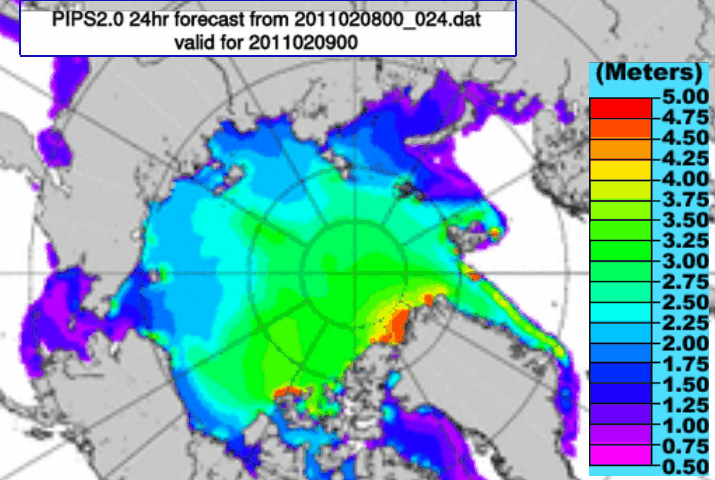
NSIDC’s Dr. Walt Meier wrote about PIPS in a guest post last year on WUWT
FergalR,
If you look at text on your link, you’ll find your question answered:
“SSM/I plots are mainly used to check the validity of the ice edge of the PIPS 2.0 forecasts. Thus, the central polar regions on the SSM/I plots generally have significant variations from actual conditions.”
Tom P,
There is ~100% ice in those areas according to JAXA and the U of Bremen.
Presumably, 1m ice at 60% on PIPS means that the other 40% is somewhat less than 1m – since it certainly isn’t open sea.
. . . outside of the blind spot at the pole, that is.
http://www.ijis.iarc.uaf.edu/seaice/data/200709/P1AME20070915IC0.png
After 53 responses, it may be too late to reduce excitement about ‘consistency’ between Cryophere’s first map and PIPS or consistentcy between both these reports and the real world.
To spoil the fun : It seems that both are heavily biased towards excessive ice volume.
For one, the Cryosphere map has been validated with only two measurements, both in multi-year ice, and they seemed to have interpreted snow cover as solid ice.
And PIPS was taken offline for a reason :
http://www7320.nrlssc.navy.mil/pips2/
Since late April/early May 2011, PIPS 2.0 has developed an unrealistic opening in the North Pole region. On 22 May 2011, PIPS 2.0 stopped running because of a numerical instability. Since that time, we have been carefully trying to diagnose this problem (checking for anomalous atmospheric forcing, initial fields, boundary conditions, assimilated satellite ice fields, etc). During this process, the system’s ocean model time step was reduced and the system is currently running again. The unobserved opening near the North Pole is still present and can be seen in the ice concentration and ice thickness fields. PLEASE USE THESE FIELDS WITH CAUTION! We have subsequently filled in the period from October 2010 to present with the hindcast using the reduced ocean model time step. Because PIPS 2.0 is a legacy system and will soon be replaced with a new ice nowcast/forecast system (see below), little additional effort will be expended to keep it running.
In short, PIPS will be replaced with a much more updated system. Most of us ice watchers are looking forward to the new system, which you can observe in action (with animations and all) here :
http://www7320.nrlssc.navy.mil/hycomARC/arctic.html
I hope that this new system (the Arctic Cap Nowcast/Forecast System (ACNFS)) will be more accurate than PIPS 2.0, considering that on multiple occasions it reported 4 meter ice where open ocean was clearly visible from MODIS pictures, and in general (despite it’s popularity here on WUWT) seemed to be out of touch with reality. For confirmation of this observation, consider that currently sea ice extent (both in the Actic as well as globally) is breaking all time record lows, and shows no slowdown in breaking the minimium extent record (of 2007).
If you want to see a picture of what really goes on in the Arctic right now, then check this out (latest picture taken at the North Pole) :
http://www.arctic.noaa.gov/latest/noaa2.jpg