
From the European Space Agency (ESA):
New ice thickness map of the Arctic unveiled
The first map of sea-ice thickness from ESA’s CryoSat mission was revealed today at the Paris Air and Space Show. This new information is set to change our understanding of the complex relationship between ice and climate.
From an altitude of just over 700 km and reaching unprecedented latitudes of 88º, CryoSat has spent the last seven months delivering precise measurements to study changes in the thickness of Earth’s ice.
Satellites have already shown that the extent of sea ice in the Arctic is diminishing. In fact, spring 2011 is the third lowest extent recorded by satellite.
However, to understand fully how climate change is affecting the fragile polar regions, there is a need to determine exactly how the thickness of the ice is changing.
To answer this question, a group of scientists together with Prof. Duncan Wingham from University College London proposed the CryoSat mission to ESA in 1998. The loss of the original CryoSat satellite in 2005 as a result of a launch failure has unfortunately made this a longer than normal wait.

Nevertheless, the launch of the replacement satellite in April 2010 has resulted in these first maps of ice thickness. They clearly demonstrate that CryoSat is a mission of excellence and will greatly advance polar science.

The results were presented at the Le Bourget air and space show by Volker Liebig, ESA’s Director of Earth Observation Programmes, Duncan Wingham and René Forsberg from the National Space Institute at the Technical University of Denmark.
Prof. Wingham said, “A new mission is always risky. There’s quite a long wait and then everyone gets to see if it really can deliver.
“What’s really nice about these results is that they show not only that the hardware is really excellent – which we already knew – but that it can deliver the geophysical information we need too.
“It’s a credit to the teams at ESA and UCL who have worked really hard and I’m very happy with these new results.”
CryoSat measures the height of the sea ice above the water line, known as the freeboard, to calculate the thickness. The measurements used to generate this first map of the Arctic were from January and February 2011, as the ice approaches its annual maximum.

Download: HI-RES JPEG (Size: 498 kb)
The data are exceptionally detailed and considerably better than the mission’s specification. They even show lineations in the central Arctic that reflect the ice’s response to wind stress.
Prof. Liebig said, “This major result comes just one year after launch. It is another important step towards achieving one of the primary objectives of the mission; namely, to determine how much the sea ice in the Arctic is thinning in response to a changing climate.”
A new map of Antarctica has also been created showing the height of the ice sheet. This is more preliminary because more data are needed here to see what CryoSat can do.
Even so, the extra coverage CryoSat offers near the poles can be demonstrated: parts of Antarctica can now be seen for the first time from space.

Download: HI-RES MP4 (Size: 5 779 kb)
In addition, detail of edges of the ice sheet where it meets the ocean can now closely monitored thanks to CryoSat’s sophisticated radar techniques. This is important because this is where changes are occuring.
“It is very satisfying to see these exciting results,” said ESA’s Richard Francis, who was the CryoSat-2 Project Manager during its development.
“It has taken about ten years to convert the initial proposal into a flying mission: ten years of hard work and dedication from a core team of less than a hundred people, ably assisted with crucial expertise from a few hundred more.”
ESA’s CryoSat Mission Manager, Tommaso Parrinello, added, “These first results are very exciting as we begin to see the mission’s potential realised.
“The coming months will be dedicated to completing the picture to gain better insight into how polar ice is changing.”
================================================================
Steve Goddard points out that there is good agreement with the Navy PIPS map:
For the past two years I have been getting constant flak from alarmists for using Navy PIPS2 maps. Turns out PIPS2 is very accurate. However, they seem to have been taken offline as of May 23.
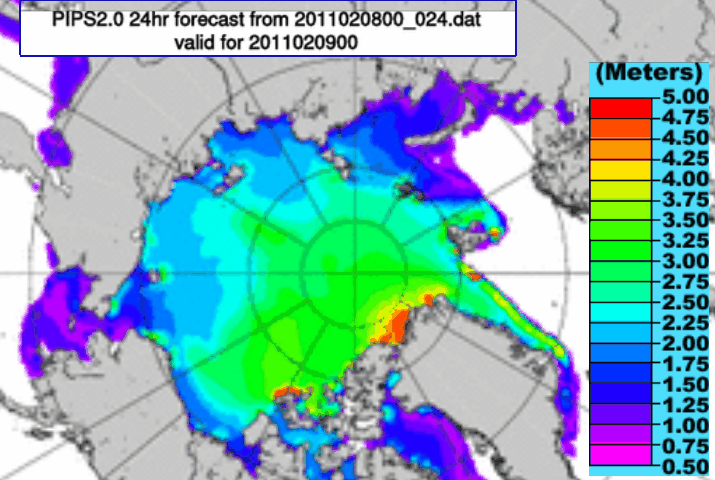
NSIDC’s Dr. Walt Meier wrote about PIPS in a guest post last year on WUWT
Ric Werme
Thanks for the info. Here’s the URLs
• 1881: http://query.nytimes.com/mem/archive-free/pdf?res=9B02E6DC133EE433A25752C2A9619C94609FD7CF “This past Winter, both inside and outside the Arctic circle, appears to have been unusually mild. The ice is very light and rapidly melting …”
• 1932: http://select.nytimes.com/gst/abstract.html?res=F30710F73E5A13738DDDAC0994DD405B828FF1D3&scp=314&sq=arctic%20melting&st=cse “NEXT GREAT DELUGE FORECAST BY SCIENCE; Melting Polar Ice Caps to Raise the Level of Seas and Flood the Continents”
• 1934: http://select.nytimes.com/gst/abstract.html?res=F00815F6395A107A93CAAB178AD85F408385F9&scp=308&sq=arctic%20melting&st=cse “New Evidence Supports Geology’s View That the Arctic Is Growing Warmer”
• 1937: http://query.nytimes.com/search/sitesearch?query=arctic+melting&more=date_all&n=10&prev=166&frow=176&page=18 “Continued warm weather at the Pole, melting snow and ice.”
Third lowest ice extent recorded “by satellite.” Ice extent margins vary with the weather of each year. Looking at the ice volume in the multiyear ice gives a much better idea of how much “persistent ice” there is and a better idea of how much excess there is. Simple 2-D thinking in terms of area is fraught with dangers as high and low pressure systems in Spring or Fall can change the sea ice extent quite drastically.
Few know that the Summer 2007 low ice extent was mainly due to the sea ice being blown to warmer latitudes—it did not melt in the Arctic—and a large bolus of warm water that was pumped into the Arctic basin by the NAO—those who admit to knowing basic science know that warm water not only melts ice faster than warm air (which really was not all that warm), but warm water also is less dense and would stay at the surface of the water column against the bottom of the ice. Summer 2007 was a perfect storm of melting, even ignoring the warm water produced by some sea floor hot vents and volcanic activity that summer.
Bob Kutz says:
June 21, 2011 at 10:55 am
“I guess I’m curious why the cryosat can’t or doesn’t measure ice thickness in that particular area. In fact, it seems to have trouble measuring ice thickness anywhere the sea is adjacent to land, except in the eastern hemisphere. Doesn’t seem to be as much of a problem along the Siberian coast.”
None of the satellites do an adequate job of capturing sea ice data in coastal areas. Data uncertainty is greatly increased in coastal areas. If you look at the video animation that I linked in my comment above you will note that in the 80s the residual sea ice at summer minimum was largely in the area of open ocean between the Pole and the Bering Strait, where coastal interference was not significant. After the current circulations changes that occurred in 1989 the residual ice was increasingly confined to the area along the Canadian archipelago where coastal interference is basically ubiquitous. At the IJIS sea ice graph site this note is included.
“In principle, SIC data could have errors of 10% at most, particularly for the area of thin sea ice seen around the edge of sea-ice cover and melted sea ice seen in summer. Also, SIC along coastal lines could also have errors due to sub-pixel contamination of land cover in an instantaneous field of view of AMSR-E data.”
SIC= Sea Ice Cover
Theoretically those preparing the data make allowance for the greatly increased data uncertainty that results from the much higher ratio of coastal concentrations of sea ice, but I’ve not found any positive declarations that that is actually the case.
Seems to me that another un-investigated issue with sea ice thickness is that the majority of the thin ice just happens to correspond with areas where active efforts are made to keep shipping lanes open with ice breakers as late as possible during the freezing cycle and then break the ice up as early as possible when the thaw starts.
You don’t suppose that a significant fraction of that thinning is due to the man made mechanical breaking of the ice and opening pathways for warmer water to be exposed both to the sun and to warm the air near the ice surface, rather than general warming due to CO2 or any other cause?
Larry
Something does not add up here.
PIOMAS shows average Arctic ice volume for Jan/Feb 2011 as 17,341km³. On the other hand ice thicker than 2 m in the Cryosat image above covers about 9 million km² and at least half of it is thicker than 3 m. That is, ice volume is more than 23,500 km³. It’s a huge relative error, some 35%! And that is for a lower bound.
Poor Peh Hugh – obsolete at such a young age.
There is a video of the Paris Airshow press conference. Enjoy!.
http://multimedia.esa.int/Videos/2011/06/CryoSat-Arctic-ice-map-unveiled
**Even so, the extra coverage CryoSat offers near the poles can be demonstrated: parts of Antarctica can now be seen for the first time from space.**
Really? They have “never” seen it?
All that melting ice from the arctic has ended up right here in the Big Horn Mountains which at last report have 500% of “normal” snow cover, whatever normal is. Folks who have lived here all their lives have never seen this much snow on the mountains. Have any of these “scientists” ever heard of local events? We have not had much if any glaciers in the Big Horns for many years but will have by this Fall. Since normal has been no snow cover by August, for many years now, I guess we will have infinite, or more precisely, undefined percent of snow by then as we are dividing by a 0 normal at that time of the year.
One other thought. Once you get up to 4 – 5 meters of thickness, the question really needs to be asked regarding the true origins of icebergs. Granted, larger bergs are due to calving off of continental glaciers. But the smaller ones? Are they all from calving? Or are some actually from very thick areas of sea ice? Consider currents in the Canadian Archipelago and through the Davis Strait.
Arctic ocean heat content appears to be a good proxy for arctic sea ice volume. From Bob Tisdale:
http://i53.tinypic.com/214s085.jpg
Note that the OHC reached a low in 1980 when sattelite monitoring sea ice extent began. Note the decline since 2008. The Piomasss model evidentlly uses positive NAO to model the sea ice volume. The NAO is now negative, OHC is declining and sea ice volume is building. I cant wait for next years cryosat data so we can claim the world will soon be covered in ice.
Doug says:
June 21, 2011 at 9:54 am
“Cryosat produces its first Arctic ice thickness map”
And it’s the thinnest it’s ever recorded…
HAHAHAHAHAHHAHAHAHAHAHA………………..top one!
It is good to see some results from Cryosat. While the spatial resolution appears good, there maybe two further data sets required to make a judgement as to the actual quality of the data. The first would be a high resolution map of the rills or open water used to measure freeboard (likely patchy to non existent toward the centre of the ice sheet much of the year). The second would be a barometric pressure map for 10km grid squares (empirical measurement only).
Has that Norwegian White Rat taken the weekend off on this topic ?
Jim G says:
June 21, 2011 at 1:29 pm
Same thing down here in the Sierra Nevada Jim. Snowpack is ‘undefined’ percent of normal. Still 15-20ft in the high country.
I was watching a guy ice fishing today…on the summer solstice. They have brought the horses and mules to the local pack stations but the uncleared snow is still higher than the fences of the pens…no one is going packing for awhile!
Ski lifts however are running…and not just on a few strips of snow, the entire mountain is still white.
I thought the Catlin survey determined the thickness of all that ice up there?
Why was all the money wasted on this satellite?
Considering the hulabaloo last year on here I am surprised at the lack of comments and debate, and follow up info. Is the initial data showing ice thickness as we thought?
“fragile polar regions”!
Of course, they are made of ice!
ESA should have enough money to have them built of iron!
Andres Valencia says:
“fragile polar regions”!
Of course, they are made of ice!
ESA should have enough money to have them built of iron!
The RMS Titanic sinking nearly a century ago would tend to imply the opposite.
Berényi Péter:
“Something doesn’t add up here.”
On the contrary, Cryosat gives results which look to be consistent with PIOMAS. PIOMAS only calculates volumes for the central portion of the Arctic Ocean: see for example fig. 6 at http://psc.apl.washington.edu/wordpress/wp-content/uploads/schweiger/pubs/IceVolume-2011-06-02-accepted-with-figures.pdf.
This amounts to a sea area of 6 million square kilometres, so the corresponding 17,000 cubic kilometres for PIOMAS would imply an average thickness of around 3 m. That looks a reasonable value from the Cryosat map.
PIOMAS values for the ice-volume minimum, when nearly all of the ice is within the area of its calculation, were also in reasonable agreement with the recently terminated PIPS 2.0 model results: http://img808.imageshack.us/img808/6980/pipsvspiomasvsicesat.png
This first Cryosat result seems to indicate that the models, both current PIOMAS and past PIPS 2.0, might have both been doing a reasonable job of estimating the ice volumes.
Tom P,
Figure 6 in that doesn’t show what you think it shows. The “P” in PIOMAS stand for “Pan-Arctic”.
PIPS 2 and PIOMAS are nowhere near in “reasonable agreement” with each other despite your unreferenced graph. How you think they could both be in reasonable agreement with something else is beyond me.
FergalR,
From the PIOMAS website itself:
“Comparison of winter total volumes with other volume estimates need to account for the fact that the PIOMAS domain currently does not extend southward far enough to cover all areas that can have winter time ice cover.”
I calculated the plot showing reasonable agreement between PIPS 2.0 and PIOMAS trends for the minimum volume extents: the code was posted on WUWT last year as to how to calculate ice volumes from PIOMAS. If you have some alternative analysis that demonstrates disagreement, why don’t you present it?
Tom P,
You can see exactly how far south PIOMAS extends on their website:
http://psc.apl.washington.edu/zhang/IDAO/seasonal_outlook.html
Seems like they miss out on the Baltic and Eastern China.
You’re welcome to extract stills from their animations and compare them for the same date according to PIPS. They bear only passing resemblance to each other.
Google has found where you posted your plot last year. There’s no sign of your elusive “code”.
FergalR,
Here’s a quick comparison of my PIPS-derived values to the recently released continuous PIOMAS dataset: http://imageshack.us/photo/my-images/29/pipsvspiomascont.png/
PIOMAS in black, PIPS in red. It shows quite clearly reasonable agreement between the trends for the minimum volume, and a clear discrepancy for the maxima. That’s just as expected given the more limited extent of PIOMAS, with a comparison only possible in the summer.
Here’s my MATLAB code for PIPS:
% Calculation of arctic volumes, thicknesses and extents from the PIPS2.0 data
% Change startdate and stopdate to define period
% TomP 20100601
format long g;
startdate=’20101101′;
stopdate=’20101130′;
calcdate=startdate;
calcdate=datestr(addtodate(datenum(calcdate,’yyyymmdd’),-1,’day’),’yyyymmdd’);
IceDate=zeros(0,4);
IceTime=zeros(0,4);
newplot
while strcmp(calcdate,stopdate)==0
DateValue=datenum(calcdate,’yyyymmdd’);
calcdate=datestr(addtodate(DateValue,1,’day’),’yyyymmdd’)
calcyear=datestr(datenum(calcdate,’yyyymmdd’),’yyyy’);
ThickURL=[‘http://www7320.nrlssc.navy.mil/pips2/archive/pips2_thick/’ calcyear ‘/pips2_thick.’ calcdate ’00.gif’];
AreaURL=[‘http://www7320.nrlssc.navy.mil/pips2/archive/pips2_area/’ calcyear ‘/pips2_area.’ calcdate ’00.gif’];
try
[ThickInd,ThickMap]=imread(ThickURL,’GIF’);
catch end;
try
[AreaInd,AreaMap]=imread(AreaURL,’GIF’);
catch end;
ThickRGB=ind2rgb(ThickInd,ThickMap);
image(ThickRGB)
drawnow
AreaRGB=ind2rgb(AreaInd,AreaMap);
ThickHSV=rgb2hsv(ThickRGB);
AreaHSV=rgb2hsv(AreaRGB);
ThickH=ThickHSV(:,:,1);%Extracts height array
ThickS=ThickHSV(:,:,2);%Makes mask for ice area
AreaH=AreaHSV(:,:,1);%Extracts concentration array
Thick=(ThickH*255)*(-.02)+4.86;%Fit to PIPS2.0 thickness colour scale
Conc=(AreaH*255)*(-0.353)+97.4;%Fit to PIPS2.0 concentration colour scale
VolValue=sum(sum(Thick.*Conc.*ThickS))*(31.2^2/(10^8));%in km^3. Each PIPS2.0 pixel is 0.28 degrees square
AreaValue=sum(sum(ThickS))*(31.2^2/(10^6));%in km^2.
HeightValue=sum(sum(Thick.*ThickS.*Conc))/sum(sum(ThickS.*Conc));%in m
IceDate=[DateValue,AreaValue,VolValue,HeightValue]
IceTime=[IceTime; IceDate];
image(ThickRGB)
end
IceTime
mean(IceTime)
Tom P,
Thank you.
Why do you choose to use the forecast concentration instead of the SSMI observations? The satellite sees mostly 100% concentration even at the height of the melt season in areas PIPS imagines 60%.
http://www7320.nrlssc.navy.mil/pips2/archive/retrievepic.html?filetype=Concentration&year=2007&month=9&day=15