UAH Temperature Update for May, 2011: +0.13 deg. C
By Dr. Roy Spencer
Little Change from Last Month
The global average lower tropospheric temperature anomaly for May, 2011 was just about the same as last month: up slightly to +0.13 deg. C (click on the image for a LARGE version):

Note the tropics continue to warm as La Nina fades:
YR MON GLOBAL NH SH TROPICS
2011 1 -0.010 -0.055 0.036 -0.372
2011 2 -0.020 -0.042 0.002 -0.348
2011 3 -0.101 -0.073 -0.128 -0.342
2011 4 0.117 0.195 0.039 -0.229
2011 5 0.131 0.143 0.120 -0.044
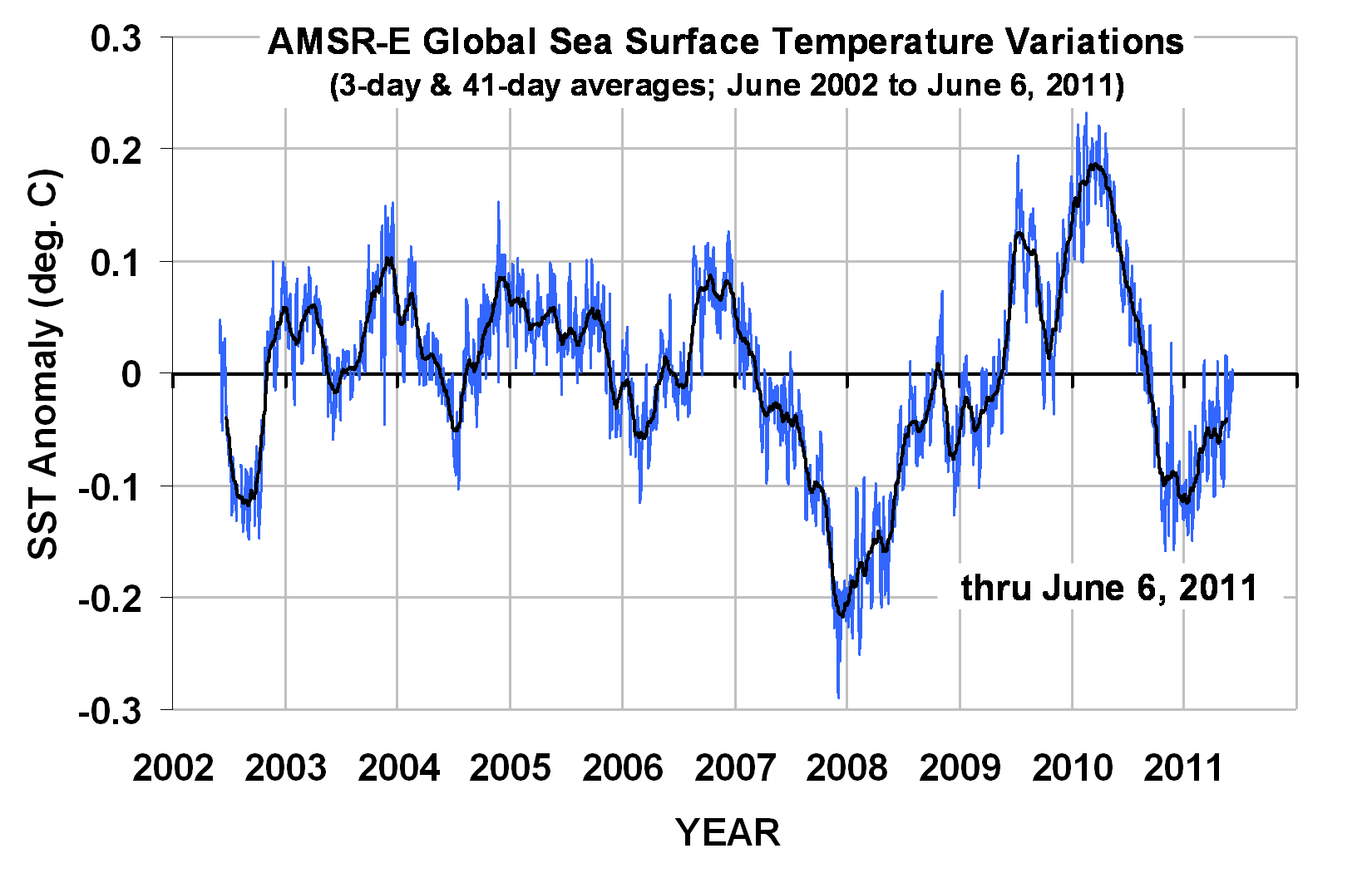
I have also updated the global sea surface temperature (SST) anomalies computed from AMSR-E through yesterday, June 8 6 (note that the base period is different, so the zero line is different than for the lower tropospheric temperature plot above):
@- richcar 1225 says:
June 8, 2011 at 8:36 am
“The increasing Northern Hemisphere winter snow cover as documented by the Rutgers lab may well be a negative feedback from GHG forcing by increasing albedo. http://climate.rutgers.edu/snowcover/chart_seasonal.php?ui_set=namgnld&ui_season=1”
The link you provide shows a small increase in winter snow cover in North America.
But the link also gives access to spring snow cover over the WHOLE of the Northern Hemisphere which shows a MUCH greater long-term trend downwards.
Note that this years increased snow cover in N America has been more than offset by much reduced snow cover over the much greater area of Eurasia.
This reduction in spring snow cover is one of the clearest examples of a positive feedback to the warming over the last few decades.
Izen wrote: “If the data are within the confines of ‘natural variability’ what is the CAUSE of that natural variability?”
Climate variation, decadally, if due much in part to simple chaos in the fluid dynamics of the oceans that dominate sea surface temperature, needn’t have any more predictable or modelable cause than that of a sailor taking a leak off the side of his boat.
And how does lack of alternative known causes of the current upswing from a downturn affirm CO2 as the cause when the exact same ignorance applies to the nearly identical variation that preceded it without CO2 being an issue?
http://oi45.tinypic.com/5obajo.jpg
Even if you have a hand waving explanation for the early variation, there is too little data prior to the space age to make an empirical case of it.
The Greenland ice core determines T via the O16/O18 isotope ratio which is determined by the T at which the snow forms and also by the T of the oceans from which the water evaporated from, worldwide. Here a nearby T reconstruction is added to bring it up to date.
http://oi53.tinypic.com/sg2wav.jpg
Now, again, if none of the identical spikes in the past were due to coal plants, and nobody can explain them away as due to conditions that fail to exist now, how can you expect an argument from ignorance (via the “exclusionary principle”) to even pass the laugh text?
Thirty years of satellite data plus a super computer is your offer? No thanks. Not when sea levels aren’t surging except due to corrections to actual sea level!
Well,
am I right then to say we just had the hottest La Nina on record?
NikFromNYC,
Excellent holocene graph. Mind if I add it to my collection?
Solar wind has been up a while so I’m not surprised.
I believe I would prefer that the anomaly be measured from 1979 to 2000, because it better answers the question, “Has the climate warmed over the satellite period?” For me, the issue is whether we are warming at a rate exceeding 0.1 deg C / decade, that is, has the natural trend following the LIA changed. So I would want to see a 0.3 anomaly as “normal”, I think.
But I suppose it’s all subjective.
@Steven Kopits
Why do you (and others) believe there is a continuing “natural trend” following LIA? LIA was probably due to low solar activity. Solar activity has recovered, but has been low in the late 20th C, while temperatures continued to rise. As Izen points out, “natural varibility” doesn’t explain anything. Ditto “natural trend”. Climate variations are caused by something, even if it is difficult to determine what.
John
John B,
Izen is wrong, natural variability fully explains the relatively minor changes in temperature over the past century and a half. Prof Richard Lindzen explains:
There is no difference between today’s climate and the climate during the Holocene. To preposterously claim that CO2 is the driver of the climate is unscientific in the extreme. It is a conjecture built entirely on computer models programmed by people paid with grants of public money. Don’t expect them to say that “carbon” isn’t a problem, because they find the slop in their troughs mighty tasty.
NULL is where a trace gas intercepts a trace amount of outgoing LIR.
They have no empirical data to support multiplicative forcing by 395 ppm.
Ah, izen
I’ve tried to point that out before, but to some here, Natural Variability is a thing, a force, a power — something they fiercely believe can have a causative effect and be an effective explanation of phenomena. Oh well.
@- NikFromNYC says:
June 8, 2011 at 9:16 am
“Climate variation, decadally, if due much in part to simple chaos in the fluid dynamics of the oceans that dominate sea surface temperature, needn’t have any more predictable or modelable cause than that of a sailor taking a leak off the side of his boat.”
You are quite correct that the pattern of variation is due to chaotic interactions between the oceans and the aurface/atmosphere; the butterlyfly wing and all that…
But while the pattern is detreministic but unpredictable (which makes a mockery of trying to find reqular cycles), the amount of change, or the envelope is narrowly constrained by the First Law of Thermodynamics. For warming or cooling to happen energy has to flow.
For warming you have to either increase the flow from somewhere hotter (Sun), or decrease the rate of loss to somewhere cooler (space).
You can move energy around the globe so that some regions get cooler while other warm. Water does this very efficiently by its phase changes. But to get a global warming or cooling requires a change in input or output (or both).
This is true for the last 700,000 years of glacial cycles – milankovitch triggers and subsequent albedo/CO2/ice cover feedbacks – and the LIA – reduced solar input and increased volcanic activity altering atmospheric albedo especially in the stratosphere.
The rise in sea level over the last century clearly indicates that extra energy has been added/retained at the surface to melt the land based ice and cause the expansion that has caused the rise. It takes a significant amount of energy to melt that much ice and expand that much water.
If the Earth climate was in equilibrium that energy would not be available to cause such a global change.
But as others have pointed out it never IS in perfect equilibrium, it is always moving towards a new equilibrium driven by a changing input or changing outputs. The chaotic patterns are driven by the energy flows responding to those changes.
“The Greenland ice core determines T via the O16/O18 isotope ratio which is determined by the T at which the snow forms and also by the T of the oceans from which the water evaporated from, worldwide.”
The result is a bias towards reflecting the local regional temperature rather than the global average. This is obvious from the anti-phase relationship with the South polar ice-core records, and the disparities with the Himalayan and Andes ice-core. Its that chaotic pattern again…
Just to be pedantic, the o16/o18 isotope ration is also altered by the amount of water in the form of ice, liquid and vapour. The ratio of the partitioning of water between its three states affects the dO16/O18.
@- Smokey says:
June 8, 2011 at 12:13 pm
“Izen is wrong, natural variability fully explains the relatively minor changes in temperature over the past century and a half. Prof Richard Lindzen explains:
…The earth is never exactly in equilibrium. The motions of the massive oceans where heat is moved between deep layers and the surface provides variability on time scales from years to centuries. Recent work suggests that this variability is enough to account for all climate change since the 19th Century.
There is no difference between today’s climate and the climate during the Holocene.”
It would be helpfull to know what this ‘recent work; is that Prof Lindzen refers to… especially as the “The motions of the massive oceans where heat is moved between deep layers and the surface ” are not considered by any authroity I am aware of to be sufficient explanation of the climate variations of similar magnitude in the past.
Certainly the LIA or Minoan warm period, or even the Holocene maximum are not explained by the movement of thermal energy in the oceans.
As far as I know all are attributed to changes in the input or output of energy, shifts in the equilibrium DRIVEN by changes in the amount of solar energy gained, or surface energy lost.
This because of the 1LoT, which as the Judge say “Its the LAW!” the oceans can move energy around, store and delay, or accelerate its release but it cannot create or remove energy – that remains a constant.
I agree there is no difference between todays cliamte and the rest of the Holocene. It is always driven by the changing rate of input and outputs which in turn drive the chaotic patterns of the weather. But invoking ‘Natural variations’ without an explanation of where the energy is coming from (or going to) is just reifying a description. You might just as weel say the variations are ‘explained’ by the Weather God…
Natural variability never EXPLAINS anything, it is merely a DESCRIPTION.
ditto.
Explanation always works by taking the more general and breaking it down into the more specific.
We see the temps go up and down daily. This is variation. We explain nothing by calling it natural. When we note that the rise and fall is explained by the earth turning toward and away from the sun, we have then explained the variation. And if its a good explanation it can predict the future. “natural variation” as an explanation explains nothing and predicts nothing. Its a description.
When are we going to get some serious solar cycle 24 global cooling to can the AGW nonsence ?
@- Smokey
You may not want a better graph of the disparities between the Greenland and Antarctic ice-cores, but here is a clearer set of graphs with comparisons over several timescales.
http://mclean.ch/climate/Ice_cores.htm
You might notice however that the source, while it refutes your earlier suggestion that the GISP cores provide a proxy for global temperatures, it is like you ‘skeptical’ of the AGW theory.
It seems you are a member of a broad church with diverse doctrines!
Ari says:
June 8, 2011 at 4:13 am
URKidding says:
June 8, 2011 at 3:13 am
And you forgot the El Chicon!
Uh Oh ……
=================================================================================
Hi Ari !!!
EM was referring to 1983.
It is generally accepted the effects of El Chichon on temps by March 1983 were negligible.
Double Uh Oh…………………………….
Cheers !!!!!!!!!
Why is a website that I have no connection with being forced upon me when I try to comment?
When a poorly-understood, complex dynamical system that exhibits chaotic behavior shows nothing beyond what little is known of its historical range of variablity, then no explanation is required. Under those circumstances, only the most physically naive would accept an explanation that involves a supposed “forcing” that consistently LAGS the “response.” Sadly, such desperate seekers of “the answer” are commonplace among true believers, who remain clueless about the foundations of sound science.
Izen,
It’s somewhat hard to see, but the warming episodes are visible in the charts you linked. I already have those charts, and dozens more in my MWP folder. I would post them, but this is a much handier reference showing that the MWP and LIA were in fact global events.
For a more thorough discussion, see here:
http://wattsupwiththat.com/2010/04/20/another-indication-of-mwp-and-lia-being-global
URKidding says:
June 8, 2011 at 3:59 pm
There are dozens of peer review studies showing the “insignificant” impact of -0.2 C to -0.5 C el Chichón. http://oceancolor.gsfc.nasa.gov/CZCS/czcs_elchichon.html
Ari says:
June 9, 2011 at 4:09 am
URKidding says:
June 8, 2011 at 3:59 pm
There are dozens of peer review studies showing the “insignificant” impact of -0.2 C to -0.5 C el Chichón. http://oceancolor.gsfc.nasa.gov/CZCS/czcs_elchichon.html
It might help if you actually cited one of these “dozens of peer review studies” then we could assess over what region and for how long the 0.5 deg drop in temperatures lasted. For example a 0.5 deg drop over 10% of the earth’s surface for ~3 months isn’t going to influence the annual global mean too much. The temperature response to the 1982/83 El Nino was pretty much in line with expectations, so it doesn’t appear as though 1983 LT temperatures were affected to any significant degree by El Chichon.
In any case, there was also a fairly intense El Nino in 1986/87 . The temperatures in 1987 are barely above those in the La Nina dominated 2011. That suggests the world is 0.4-0.5 degrees warmer than it was 25 years ago.
steven mosher says: June 8, 2011 at 1:41 pm
Natural variability never EXPLAINS anything, it is merely a DESCRIPTION.
ditto.
Explanation always works by taking the more general and breaking it down into the more specific.
We see the temps go up and down daily. This is variation. We explain nothing by calling it natural. When we note that the rise and fall is explained by the earth turning toward and away from the sun, we have then explained the variation. And if its a good explanation it can predict the future. “natural variation” as an explanation explains nothing and predicts nothing. Its a description.
Having an ‘explanation’ for a system for which we do not know all the variables is how much more valuable than simply saying we see nothing outside of the normal variation?
John Finn
I have a basic and serious question. Assuming that the atmospheric temperature last week is the same as it is today then doesn’t it mean the internal energy of the atmosphere is same today as it was last week. There may have been more hot days or cold days in between but the from today to last week there has been no warming/cooling. There may be a trend of warming or cooling but if the temperature today is the same as last week then can’t you say it is no warmer today than it was last week?
Smokey said “Izen is wrong, natural variability fully explains the relatively minor changes in temperature over the past century and a half. Prof Richard Lindzen explains:”
As a skeptic, have you ever considered that Lindzen might be wrong? I pointed out one place where he quoted Tsonis to substantiate his claim, but the paper he quoted actually said quite the opposite. What substantiates his claim here? (Please don’t link to his c.v., that doesn’t count)
John B says:
“As a skeptic, have you ever considered that Lindzen might be wrong?”
Aside from the fact that everyone is wrong on occasion, I accept Prof Lindzen’s view because he knows more about the climate than you or I, doubled and squared. Further, what Lindzen says makes eminent sense: “For small changes in climate associated with tenths of a degree, there is no need for any external cause. The earth is never exactly in equilibrium. The motions of the massive oceans where heat is moved between deep layers and the surface provides variability on time scales from years to centuries.”
Finally, the entire CO2=CAGW edifice is based on always-wrong computer models. Not one GCM predicted the flat to cooling global temperatures over the past decade. See, they were all wrong. You hang your hat on computer models that can’t predict their way out of a wet paper bag, and ignore the real world. No wonder your wild-eyed runaway global warming conjecture is going down in flames.
There’s a very significant uptick in the early June numbers. It is now warmer than the 2010 El Nino numbers. Something can’t be right. That’s the largest uptick in temperature that I can find in the records on the discover site.