While Krugman wails at the NYT, giant Elk die in print for all the wrong climatic reasons.
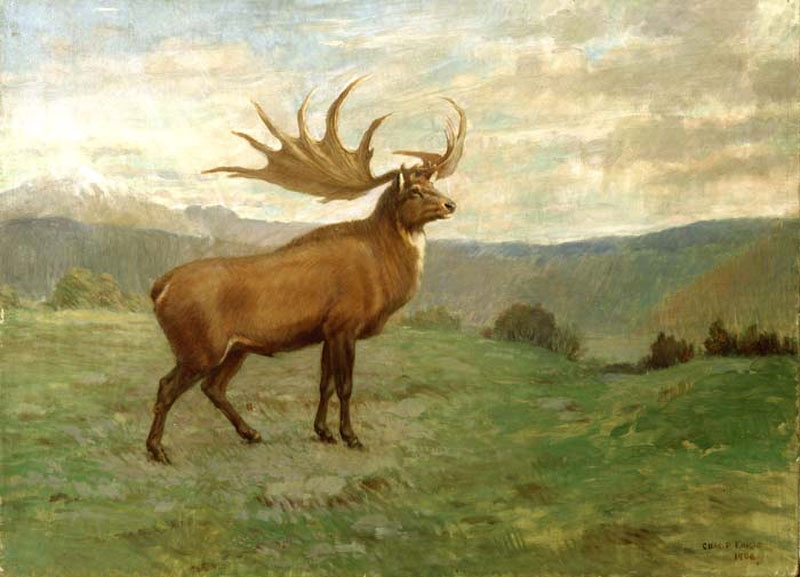
In Tips and Notes, P J Brennan says: All the news that’s fit to mis-report: From today’s NYT
When the planet warmed at the end of the ice age 11,000 years ago, for example, the change was too much for Irish elk, which became extinct. Moose, on the other hand, have survived. Some moose populations stayed put; other populations shifted to more suitable places.
But…there’s an inconvenient rub.
Here’s a link to the paper about the Irish Elk:
http://ib.berkeley.edu/labs/barnosky/BARNOSKY_QR_1986.pdf
Quote:
“It was not Holocene warming, but a brief cold spell just before warming, that eliminated M. giganteus from Ireland ”
There’s also a quote from a Dáithí Stone, a climate “scientist” at the University of Cape Town in South Africa.
I found a piece by Dáithí, titled “Whether the Weather” in which he explains to his South African audience that the blizzard that hit New York City just after Christmas last year was really caused by global warming: “It may seem odd to South Africans, but the blizzard actually involved unseasonably warm temperatures: in this region of the US it is usually well below freezing, so increasing the temperature a little allows the air to hold more moisture to then drop as snow.”
This comes as a surprise to this New Yorker – the average min/max in NYC in December is 30/41 – not exactly “usually well below freezing”.
Daithi is a nice Irish name – but methinks he has a bit too much of the Blarney in him – just like the whole AGW gang – pj
@ur momisugly George E. Smith
Definition of a species is – can they interbreed? If they can, they are the same species, if not, they have evolved far enough to be considered a different one. That’s more than just your normal intra-species variation. But see Wikipedia on “ring species” for ways that it can get complicated.
“”””” Veronica says:
April 6, 2011 at 8:22 am
@ur momisugly George E. Smith
Definition of a species is – can they interbreed? If they can, they are the same species, if not, they have evolved far enough to be considered a different one. That’s more than just your normal intra-species variation. But see Wikipedia on “ring species” for ways that it can get complicated. “””””
Veronica, I take it that you do mean “Can” they ? and NOT “do” they.
Any “Eastern Elk” living anywhere in the (presumably) Eastern North America, could (if they met) breed with at least the opposite sex, of any ordinary California, or west of the Rockies Elkus Commonus. The fact that the populations were geographically separated for some time; does not render them different species; just different populations of the same species.
Just take humans foir example; we surely have different populations that have never ever met let alone mingled. Wanna bet that they could interbreed if they ever met.
Now I’m not a biologist so I am not really up on all the rest of the sexes besides M and F, so I wouldn’t even attempt to assert whether any of those can interbreed or not. I have no idea whether hemaphrodites can interbreed with themself or not.
But yes I think I read somewhere that if they are the same species, they can interbreed; well I do believe that the offspring also have to be able to breed.
After all, horses and donkeys can interbreed but mules cannot.
Geo;
I think “interbreed” in the lingo is taken to mean implicitly, “and produce fertile offspring.” Otherwise that sub-branch of the species comes to a sudden halt. 😉
“”””” Brian H says:
April 7, 2011 at 4:18 am
Geo;
I think “interbreed” in the lingo is taken to mean implicitly, “and produce fertile offspring.” “””””
That sounds familiar; like something I might have said myself sometime.