While Krugman wails at the NYT, giant Elk die in print for all the wrong climatic reasons.
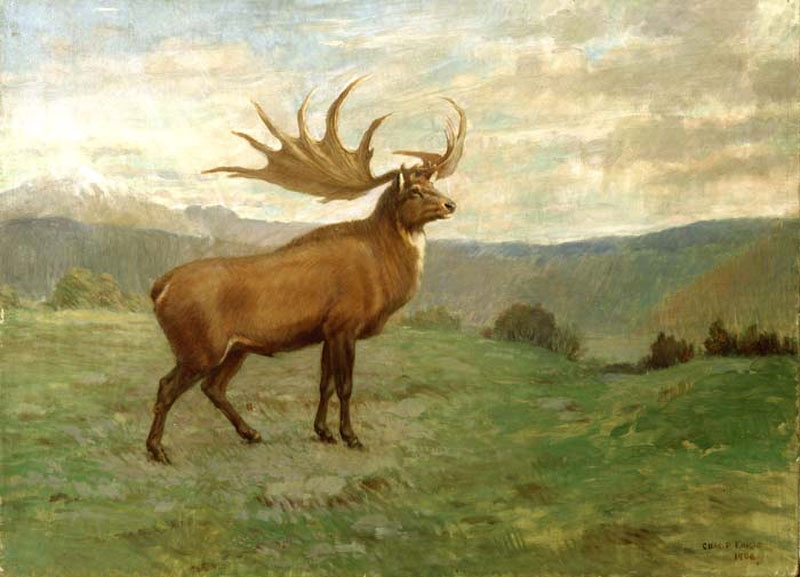
In Tips and Notes, P J Brennan says: All the news that’s fit to mis-report: From today’s NYT
When the planet warmed at the end of the ice age 11,000 years ago, for example, the change was too much for Irish elk, which became extinct. Moose, on the other hand, have survived. Some moose populations stayed put; other populations shifted to more suitable places.
But…there’s an inconvenient rub.
Here’s a link to the paper about the Irish Elk:
http://ib.berkeley.edu/labs/barnosky/BARNOSKY_QR_1986.pdf
Quote:
“It was not Holocene warming, but a brief cold spell just before warming, that eliminated M. giganteus from Ireland ”
There’s also a quote from a Dáithí Stone, a climate “scientist” at the University of Cape Town in South Africa.
I found a piece by Dáithí, titled “Whether the Weather” in which he explains to his South African audience that the blizzard that hit New York City just after Christmas last year was really caused by global warming: “It may seem odd to South Africans, but the blizzard actually involved unseasonably warm temperatures: in this region of the US it is usually well below freezing, so increasing the temperature a little allows the air to hold more moisture to then drop as snow.”
This comes as a surprise to this New Yorker – the average min/max in NYC in December is 30/41 – not exactly “usually well below freezing”.
Daithi is a nice Irish name – but methinks he has a bit too much of the Blarney in him – just like the whole AGW gang – pj
Not all Irish elks succumbed to climate change. Here’s one found a few miles from my home that was felled by local Mesolithic hunters circa 9,000BCE. When it’s remains were dug out of what was an old peat marsh arrowheads were discovered lodged in the skeleton.
I live in Western Quebec. It is always well below freezing here in the winter. We get lots and lots and lots of snow
Mmmm – elk & tatties! 😉
I live in the Pontiac region of western Quebec. it is always well below freezing in the winter here. We get a great amount of snow here. here is an image of teh wnow in teh area in March 2008
http://www.flickr.com/photos/tomgray/2350138235
A European “elk” is the same animal that Americans call a “moose”. What Americans refer to as an elk is actually a deer species. It would appear the European elk and moose being talked about in the OP are not different species but subspecies of the same species.
http://naturetravels.wordpress.com/2007/10/29/what%E2%80%99s-the-difference-between-a-moose-and-an-elk/
When the planet warmed at the end of the ice age 11,000 years ago, for example, the change was too much for Irish elk, which became extinct.
Maybe it’s just me, but with that statement they seem to give the impression that an ice age is GOOD.
Who knows? Maybe they really think it is.
Carl Zimmer responds to the question of whether it was warming or cooling that killed the the Irish Elk:
“The cooling you mention was the Younger Dryas, a period of lowered temperatures that’s most clearly documented in Northern Europe. It was brought on by earlier global warming: melting glaciers delivered fresh water to the Atlantic, rerouting the ocean currents so that Europe no longer received warm air. When the currents recovered, the temperature in Europe continued to rise… ”
http://blogs.discovermagazine.com/loom/2011/04/04/outlook-warm-grim-cloudy-my-story-on-global-warming-and-extinctions-in-tomorrows-ny-tiimes/comment-page-1/#comment-55489
Seems like he can blame warming for cooling in this case.
I thought early humans with Irish wolf hounds hunted them to extinction?
Actually, it was the climate…in an indirect way. Millions of years ago the climate was hot because there were a lot of dinosaurs exhaling a lot of CO2. Humans began evolving from tiny primates but they lost the “hairy gene” because air conditioning hadn’t been invented yet. The humans hunted all the dinosaurs to extinction because dino meat was delicious. Then the climate got very cold due to lack of CO2, but all the hairy animals like mastadons and sabre toothed cats were thriving due to their luxurious coats. The “hairy gene” never came back for the humans so they had to kill all the furry beasts to turn them into blankets. Luckily for humans, right around the time they were killing the last of the the large furry animals and they were setting their sites on the smaller ones, they learned how to burn coal and oil. So the planet started warming up and they could get rid of the huge mastadon blankets which by now were starting to smell pretty bad since dry cleaning hadn’t been invented yet.
It’s all true. Because I wrote it and I have a Ph.D. All I need is a movie and a Nobel Prize. See, isn’t it easy to make stuff up?
As George Banks said in Disney’s “Mary Poppins”: “Please do not attempt to cloud the issue with facts!”
Interesting to me, the comment about the University of Cape Town. As a lifelong Capetonian I have had to suffer the normal AGW nonsense which regularly grace the local MSM columns. Most of it originates from the University of Cape Town, which appears to sport its own complement of climate incompetents, who tediously toe the alarmist line in the worst possible fashion. In this they are, as everywhere else in the world, ably assisted by a core of slavishly compliant “climate” reporters and editors. Attempting to get a letter to a MSM editor published if the view expressed is contrary to the UCT line, is well-nigh impossible. Sigh…. I hope I live long enough to see reason prevail…
“H.R. says:
It’s bad enough hitting a white tail deer with your car. Imagine an Irish Elk jumping out into the road in front of you.”
Probably much like hitting a moose… if you want some data, google the MythBusters and hitting moose, they did an episode with that.
My hypothesis is that as the glaciers receded, an over abundance of tiny sharp pointy rock formations found themselves attached to long straight wooden shafts of narrow diameter. These objects were hurled through the air by some yet unknown force that probably resulted from the warming climate. This spelled the end of the majestic Irish Elk.
@UK Sceptic April 5, 2011 at 5:15 am:
It must have been Clovis Man: After he wiped out all the North American megafauna at the beginning of the Younger-Dryas, he must have gotten hungry enough to see if there were any mega-potatoes across the Big Water. /snarc
Good bit of info. Not snarc-ing you, but both AGW and the “Clovis Man done it” theory of the essentially instantaneous extinction of all the millions of large fauna in North America – by a (very) few thousand hunters. Both hypotheses are ludicrous.
The referenced post-glacial “cold shock” was probably a severe but short-lived 1,500-year rebound to Ice Time called the Younger Dryas. This spell is known to have been precipitated not by any terrestrial climate fluctuation, but by a bombardment of exo-solar debris from our system’s enveloping Oort Cloud. Disrupted by an onrushing object of some size –“Eversor,” as Sumerian portent astronomers would have it– cometary-meteorite fragments impacted Earth sufficiently to effect radical cooling for a millennium and a half.
Ancient Sumer’s classic “dark millennium,” a devastating cold-phase dominating Mesopotamian cultures from c. BC 4000 – 3000, is conventionally attributed to an episodic if not cyclical shift in deep-sea Atlantic Ocean currents, which affected Central Asian atmospheric patterns to a ruinous extent. This is not by any means uncommon… but blinkered academic researchers willfully ignorant of astronomy, geophysics, human history, seem incapable of factoring three-variable chaotic/fractal processes into their pathetically rudimentary calculations.
As for the Irish Elk, if a series of abruptly oscillating temperatures did not do in the herds, mayhap roving bands of neolithic hunter-gathers pursued ’em to extinction, unwilling to take their tribal Shamans’ word that human survival is in general a Bad Thing.
Dave Springer, the current European elk is NOT the same species as the extinct Irish elk. Please do not confuse the issue.
Dave Springer says:
April 5, 2011 at 7:31 am
“A European “elk” is the same animal that Americans call a “moose”. What Americans refer to as an elk is actually a deer species. It would appear the European elk and moose being talked about in the OP are not different species but subspecies of the same species.”
Just to follow up on what Mark Folkestad just posted… that confusion between ‘elk’ and ‘moose’ was mostly a historic phenomenon. The elk in Europe are actually called Red Deer and they are now recognized as the same species as our North American subspecies of elk – Rocky Mountain and Roosevelt (Pacific coast) and if you believe in junk classifications, the so called Merriam elk of the Southwest (now gone).
And both Red Deer (elk) and moose are members of the deer family.
And both are recent emigrants to southern North America.
AC says:
April 5, 2011 at 9:55 am
“[…] Probably much like hitting a moose… […]”
Well, with the typical rack having a 12-foot span and standing seven feet or better it kinda makes a moose look like a mouse. I wouldn’t want 6 feet of antlers coming through my windshield if I broadsided one of those things. ;o)
BTW, I couldn’t find a typical weight for the Irish Elk while looking for the size relative to a moose (only had time for a brief search). Based on what I did find, I’m thinking that the Irish Elk didn’t have that much more weight over a moose but that 12-foot rack is definitely a show-stopper.
Dave Springer – red deer are surely not the same as elk. Different size, different colour, non-palmate antlers.
I thought the Irish Elk died out because the Irish invented bows and arrows and Eated Dem (omnomnom).
I wonder if that 12 ft antler spread was a showstopper in terms of the giant elk’s existence. Note that it was some 5 ft wider than their taller surviving relative, the North American moose. If the giant elk were a grazing animal during the ice-age it wouldn’t have had much trouble with trees – even sequoia were small shrubs due to CO2 asphyxiation. However, once trees started lining the rives and surrounding the lakes, the paths to water would become more limited and perhaps also lined with waiting hunters and other predators.
Daily water treks were unnecessary for moose. They spend the summers feeding in rivers and lakes, even in water over their heads. Moose also browse on trees and shrubs. So I wonder if big antlers AND wild, CO2-induced tree growth might be an explanation for the extinction of the giant elk.
“”””” David Falkner says:
April 4, 2011 at 9:53 pm
Ok, who is PJ? Well I always thought it was “pajamas”, but then there is a PJ O’Rourke, and he sounds Irish, so maybe he kiled all the Irish elk.
Apparently in the USA, the Eastern Elk, is the only mammal species to have extincted since Columbus first discovered them; and they haven’t really extincted at all, they just couldn’t be bothered to climb over the Rocky Mountains to where all those Western Elk sheilas hang out; and if they had, then they wouldn’t be extinct; and they aren’t extinct since they are exactly the same animal. But hey, if you are seeking grant money you could do worse that so ask for money to do a census on the Eastern Elk. But we have plenty of them around the San Luis Reservoir, in Silicon Valley; well Santa Clara County anyhow; where I often go fishing.
Somebody should tell all these zoologists, that every single elk has different genes, from every other elk; so they aren’t all different species; just different samples of the same species. My kids, only look vaguely like me; and that’s understandable since they are not now, and never have been, and never will be the same age as me, so they will always look different; besides girls look different anyway. It’s how evolution occurs; kids aren’t the same as their parents; they’re intermediate missing links to whatever comes after homo sapiens sapiens.
“”””” H.R. says:
April 5, 2011 at 2:54 pm
AC says:
April 5, 2011 at 9:55 am
“[…] Probably much like hitting a moose… […]“
Well, with the typical rack having a 12-foot span and standing seven feet or better it kinda makes a moose look like a mouse. I wouldn’t want 6 feet of antlers coming through my windshield if I broadsided one of those things. ;o) “””””
Well as some Scotsman reportedly exclaimed:- “If that’s a moose; then I dinna want to meet a rat !”
The Berkeley paper made a convincing case that a short warming windlow let the elk into Ireland and then made an end of them. And if millions of hunters didn’t finish them off on the continent then millions of farmers did. What I find most annoying is the claim that their antlers did them in. In only a few centuries the great deer racks of England have disappeared due to hunters who went after big antlers–small antlers were bred through selective hunting. The same should easily have occurred among elk both in Ireland and Eurasia if foraging constraints outweighed any benefit of mating selection from big antlers–in very few generations. Sure, you can breed a dog that can’t survive in the wild but nature doesn’t breed animals that can’t survive the usual situation–it breeds those which can.
Island isolation often breeds gigantism or dwarfism–depending somewhat on whether the food source is external or internal. Kodiak bears grew large with an almost unlimited supply of fish, while pigmy hippos and elephants on Mediterranean islands grew small to better survive on a limited food supply. That sort of breeding probably takes longer than reducing antler size, but in any case becomes useless if the food supply disappears altogether.
The surviving deer they found were very, very old. A new sub-species: Methuselah deer! Actually, Double-Methusela!
;pP
Sorry, above was responding to Jimbo’s ref:
Geo. E.S.;
that Scotsman’s fear was nothing compared to the one who exclaimed, “Ach! There’s a moose loose in the hoose!”
;]
Extract from the book, Pre-Christian IRELAND – From the First Settlers to the Early Celts written by Peter Harbinson, well known authority on Irish archeology, Chairman of the National Monuments Advisory Commitee, Vice President of the Royal Irish Academy.
“…..the last cold period of the Ice Age which came to an end around 11000BC.
This cold period was quickly followed by an improvement in the climate which provided temperatures probably 1 or 2 degrees warmer than those prevailing today, and which allowed the Irish giant deer with its magnificent antlers to reach its maximum development.”
But he did not have a computer program, so what would he know.