
By Joseph D’Aleo, CCM, AMS Fellow
INTRODUCTION
The US congress sub-committee on Energy and Commerce Committee held hearings on whether to restrict in some way the EPA’s regulatory authority relative to greenhouse gas emissions.
There were 7 scientists invited to testify. Three of the four who argued not to restrict the EPA played a key role in the last IPCC report (and will also in the next one) and generally started with the position that IPCC science was sound and there was a consensus of all real scientists.
In the attached analysis we take a look at the IPCC based science. We are going to ignore all the many ‘gates’ that were uncovered like the Himalayan glaciers, Amazon rain forests, how many real scientists there were who authored the key summaries and all the issues as to whether the summaries truly reflected the scientific information in the chapters and despite claims to the contrary, how a significant percentage of citations were not peer reviewed.
We will not attempt to address the issues of sensitivity for CO2 or solar and cloud and water vapor feedbacks relative to the models. We will also ignore the many model shortcomings – like inability to forecast regional patterns, ocean oscillations, etc. Each of these alone discredit the consensus ‘settled science claim.
We will focus on how actual data compares to the consensus science, model based virtual world view of climate.
We will look at some of the major findings, assessments or model predictions from the IPCC and other national climate centers and NGOs, that we believe have failed and let you decide then whether or not the their science and model projections should be the bedrock onto which we build public policy.
The ten issues:
1. Warming is said to be unprecedented and accelerating. It is neither.
2. Global warming is not GLOBAL
3. Winters would grow increasingly warm
4. The entire Northern Hemisphere would experience less snow and snowcover
5. The arctic oscillation (AO) would become increasingly positive, aiding in the warming
6. Global warming would lead to a permanent or semi-permanent El Nino
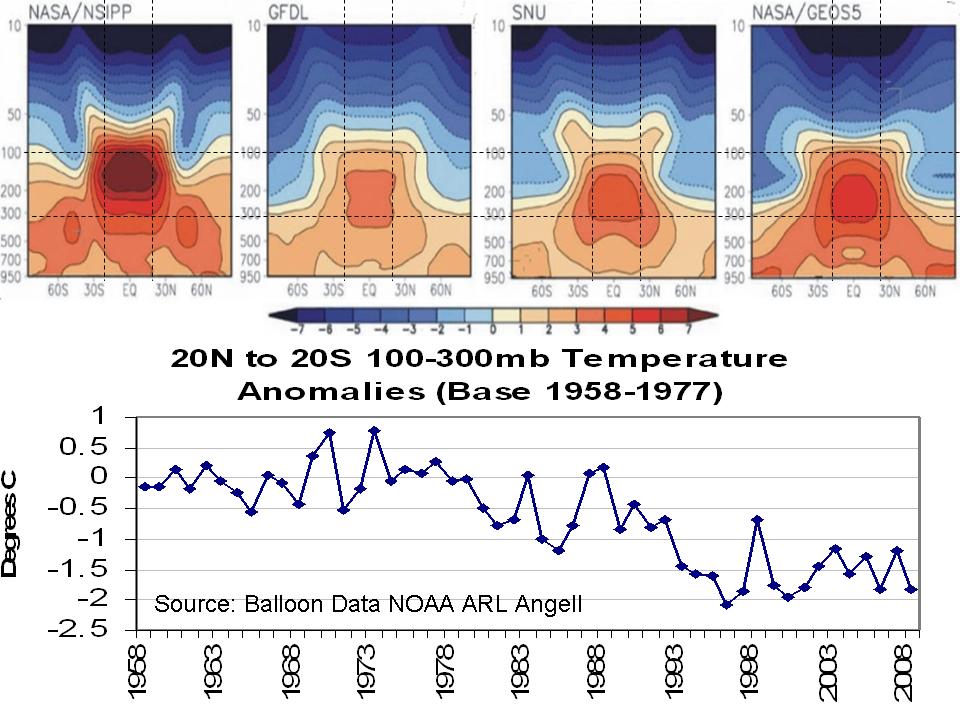
7. Atmosphere will warm faster than surface (because that is where the heat trapping gases are).

Enlarged. Balloon data for actual 100-300 mb from 20S-20N from NOAA ARL Angell (anomalies relative to base period 1968-1977) compared to models forecasts of warming 20S-20N 100-300mb. Note the cooling observed where models suggest most GHG warming. This is similar to depictions from Singer etal NIPCC 2007 and others.
8. Record highs and heat waves are increasing
9. Sea levels are rising at an increasing, alarming rate
10. Droughts and floods will worsen
We have actually made a list of 30 such ‘failures’ or ‘shortcomings’, but decided to focus on the first ten.
See the analysis part 1 and part 2.
Discover more from Watts Up With That?
Subscribe to get the latest posts sent to your email.
“Models show more heat, data doesn’t.”
…pretty much sums it up, doesn’t it? Thanks, Joe, great post & contribution!!
Most intersting– and some of the points you’ve raised are reasons why I am partially skeptical (25%) of the AGW theory. Never the less, I am 75% convinced in the reality of AGW (note: there is no “C” in front of that). It seems you’ve cherry picked your data rather nicely, and to be sure, the last decade has not seen the kind of increases we’d seen the previous two, though even still, overall, the decade of 2000-2010 was the warmest on instrument record AS A DECADE. And it is this decade to decade time scale that we’ll should see the effects of AGW. Even though the decade of 2000-2010 was the warmest on record, it really was the first half of this decade that we saw the most warming, with the second half flat to cooler. Could the very quiet sun and two rather intense La Nina’s have played a role? Certainly.
One thing that Joe also failed to mention for some reason were the many nightime record temps set in the U.S. and around the world in 2010. Joe also failed to mention that warmer night time temps were one of the GCM model predictions when factoring the additional CO2. Also of course, that the Arctic Sea ice continues a long-term decline, and was a one of the model predictions, and we’ll likely see a summer minimum this year approach 2007’s historic low, or it could even fall below that.
So the reality of what’s been happening this past decade (even though as a decade it was the warmest in record) is much more complicated than what some would like to paint it. There are of course natural variations in climate and the second-half of the last decade saw a combination of natural events (cool phase of the PDO, 2 large La Nina’s, deep and long solar minimum) etc. that caused some short-term cooling, but then in 2010, we get one EL Nino, and suddenly that year is challenging 2005 as the warmest on instrument record. Wow, just from one El Nino? I think this chart:
http://www.giss.nasa.gov/research/news/20110113/509983main_adjusted_annual_temperature_anomalies_final.gif
It is well worth looking at for anyone who (like me) isn’t 100% committed one way or another to the AGW issue. AGW skeptics will use a variety of techniques to explain away the last 100 years of warming, but I find none of them fits completely until CO2 is factor in, and this is precisely what the GCM’s show. And after looking at that chart, have a look at this one:
http://arctic.atmos.uiuc.edu/cryosphere/IMAGES/seaice.anomaly.arctic.png
How could the Arctic not continue down as we have the warmest water in 2,000 years entering the Arctic Ocean:
http://www.nature.com/news/2011/110127/full/news.2011.52.html
and this one:
http://climate.rutgers.edu/snowcover/chart_seasonal.php?ui_set=nhland&ui_season=2
This graph of spring NH snow cover (not the winter snow cover!) tells you more about the direction of NH warming. The trend is down down down, just as forecast by GCM’s.
My honest gut feeling (while I admit to being a partial skeptic) is that the current natural variations in the short-term (cool phase of the PDO, strong La Nina’s a few years apart, long and deep solar minimum, etc.) are somewhat masking the effects of AGW and make it easy for certain skeptics to attempt to make a case that AGW simply not happening, but an honest appraisal of all the data and a look at the bigger picture still seems to show that it is.
If 2010-2019 is cooler as a decade than 2000-2009 I could change my mind to become more skeptical of AGW, or if, as Joe Bastardi keeps insisting, that the Arctic sea ice begins to show a serious rebound in this time frame, I could also begin to change my mind.
Mike Hulme (University of East Anglia) – “only a few dozen experts,”
http://www.probeinternational.org/Hulme-Mahony-PiPG%5B1%5D.pdf
75 scientists is not a consensus
http://fullcomment.nationalpost.com/2010/12/30/lawrence-solomon-75-climate-scientists-think-humans-contribute-to-global-warming/
R.Gates, I appreciate your comments about supporting evidence for AGW, but I can’t get past one point – it only takes one failed prediction to falsify a theory.
If the models are predicting things that aren’t happening, then the models are wrong. It doesn’t matter if they are predicting things that are happening – the fact that at least one of their predictions is wrong means that the models are wrong. That is, the underlying assumptions they are using to make those predictions must be wrong in at least some respects.
It’s possible that some parts of the model are right (for example, that CO2 is warming the planet – I’m not agreeing, just hypothesizing that the models have that correct)), but other parts are incorrect (such as feedbacks). Since their conclusions, including the push for drastic measures to prevent catastrophic temperature rises, and the consequences of those rises, are based on the total sum of all the parts, invalidating parts is sufficient to invalidate the conclusions.
>>
7. Atmosphere will warm faster than surface (because that is where the heat trapping gases are).
. . .
However, greenhouse theory and IPCC models predict the lower troposphere should be warming 1.2 times faster than surface, not slower. This data suggests that either greenhouse theory is incorrect and/or that NOAA’s surface temperature data has been contaminated – e.g. by its treatment of factors like land use changes or urbanization.
We believe both are true.
<<
This is the primary fingerprint of GHGs. If the atmosphere isn’t warming faster than the surface, then any surface warming is NOT due to GHGs. (Notice I’m not saying that the atmosphere must be warmer than the surface.) This is simple physics of the GHG model. You can’t hide the warming either. Lack of warming in the atmosphere means there can be no corresponding warming of the surface due to GHGs.
Hansen and company are shooting themselves in their collective feet. By trying to show more surface warming via a doctored surface record, they are actually removing any connection to GHGs.
Jim
Smokey
“That is a point I continually try to make. A ≈40% increase in CO2 is a very significant rise. If CO2 would lead to runaway global warming as predicted, we would have certainly seen very significant warming by now, and the temperature would be closely tracking the rise in CO2. But it doesn’t. ”
You cannot merely look at C02.
1. you got the units wrong. if you want to look at at C02 and temps you have to turn
C02 into a FORCING. since the relationship between ppm and FORCING is
not linear, you are really making a fundamental mistake. the forcing values
are available, simply pull the data that is fed into any GCM.
2. there are MORE FORCINGS than C02. so you really need to look at all the other positive and negative forcings. Again, I can point you to the sources that will help you understand this.
3. Because of the lag between the forcing and the response ( think about hitting the gas pedal down to the floor when you are at a stop light) you also need to take care about the temporal dimension.
Lions and tiger and bears, oh my!
Graeme W says:
March 21, 2011 at 7:21 pm
R.Gates, I appreciate your comments about supporting evidence for AGW, but I can’t get past one point – it only takes one failed prediction to falsify a theory.
If the models are predicting things that aren’t happening, then the models are wrong. It doesn’t matter if they are predicting things that are happening – the fact that at least one of their predictions is wrong means that the models are wrong. That is, the underlying assumptions they are using to make those predictions must be wrong in at least some respects.
It’s possible that some parts of the model are right (for example, that CO2 is warming the planet – I’m not agreeing, just hypothesizing that the models have that correct)), but other parts are incorrect (such as feedbacks). Since their conclusions, including the push for drastic measures to prevent catastrophic temperature rises, and the consequences of those rises, are based on the total sum of all the parts, invalidating parts is sufficient to invalidate the conclusions.
_____
I personally believe that the GCM’s are simply not good at trying to get every little detail correct in a chaotic system– we’ve simply no way to really do it. Those who would like to pick a year, or even 5 years out of a longer term trend a say “see, we’ve falsified your theory of AGW” are simply cherry-picking and really doing themselves a great disservice.
In no way has the AGW been “falsified” simply because it hasn’t predicted every little detail. It’s like trying to predict it will rain and then tell me when and where the first raindrop will stike the sidewalk in front of my house. If you’re pretty sure it will rain (i.e. the GCM’s generally have it correct that the 40% increase in CO2 since the 1700’s will cause warming) then it is the long-term trends I would expect them to get correct. Joe say they’ve missed the mark (over the short term) but I feel he’s cherry picking to the extreme to prove his point.
But I’m at least being honest after looking at all the data over the longest term (i.e. the past century) and saying, yep, it’s been warming, and yep, 2000-2009 was the warmest decade on instrument record, and yep, 2010 was close to or tied for the warmest year on instrument record, and yep, Arctic Sea ice continues to decline, and yep, the water moving in the Arctic is the warmest in 2,000 years, and yep, Greenland is losing ice mass. To not acknowledge these longer-term trends and to try and look at a period in time over just a few years when we’ve had a few really good La Nina’s and a solar minimum that was the deepest and longest in a century and cool phase of the PDO is a tad bit myopic in the least…again, if the Arctic Sea ice begins a true longer term reversal and starts to show a sustained period of year-to-year growth, and the decade of 2010-2019 is not warmer than 2000-2009, I’ll be the first person adjusting my 75% conviction in AGW downward…
I am still wondering how there can be a consensus when many (maybe most) have doubt or just disagree. When did “consensus” get defined as “those that agree with me”?
Since Anthro-Global Warming is actually more like a religion, I guess it doesn’t surprise me how wrong its predictions are. Predicting something useful is actually hard, and is the hallmark of a sound theory. AGW has more in common with Astrology (I am not meaning to be sarcastic, I am serious). Predict enough things in enough ambigous ways and something is gonna stick. That’s how fortune cookies work! I wonder if there is “consensus” on fortune cookies?
Just after I heard of the terrible Japan earthquake I thought to myself, “I wonder how long until someone ties that to AGW”? The answer was the next day. Why does ANYONE take this serious anymore?
R. Gates says:
March 21, 2011 at 5:37 pm
The Earth has warmed out of Ice Ages and Little Ice Ages, then cooled into Ice Ages and Little Ice Ages innumerable times, and CO2 has risen and fallen like a dog running ahead/behind/beside in all cases.
http://www.robertb.darkhorizons.org/TempGr/Vostok.JPG
The CO2 multiplicative forcing GCMs cannot handle predicting climate nor weather, therefore they are of little value. They are certainly not a basis to trash whole economies.
But look at this graph’s red line:
http://www.robertb.darkhorizons.org/TempGr/HADcrut3gl.JPG
The Anomaly plus the average global temp added on (which gives you the correct perspective of how much warming since 1850. Easily accounted for by taking into consideration the urban heat islands, where most lnad temperature data now comes from.
The bottom line is that it is warmer in our cities, but not outside of them.
If the present .7C warming over the last 100 years worries you, go live in the country.
“Graeme W says:
March 21, 2011 at 7:21 pm
R.Gates, I appreciate your comments about supporting evidence for AGW, but I can’t get past one point – it only takes one failed prediction to falsify a theory.”
R.Gates, Graeme is right, what you call cherry picking is actually the scientific method. You really should check this out and contrast the scientific method with, say, democracy. The warmists would have you believe that the new scientic method is consensus so are trying to destroy not just our economic well-being but also the scientific basis of society that has been building for a few hundred years. You seem capable of seeing through that. Try harder.
steven mosher says:
“You cannot merely look at C02.”
Ah, but CO2 is the explicit basis for the entire “carbon” scam.
The AGW conjecture claims that “carbon” [by which the illiterati mean carbon dioxide, a trace gas] will cause runaway global warming and climate catastrophe. However, there is no evidence for that belief. None at all.
If you have real world evidence of global damage specifically attributable to CO2, I’d love to see it. No one else seems to be able to provide any such evidence. But as a scientific skeptic, I’ll keep an open mind.
R.Gates, I understand what you’re saying, but I can’t find documentation that defines what is climate. Therefore, what is the ‘correct’ timeframe over which to evaluate climate theory?
You’ve implied a century is appropriate, and I can accept that, but that means that we’ll have to wait until late this century to see if the models are accurate (you can’t judge on the past century because the models are not predicting the last century – they are using the past century as input into their predictions). The models have made some short term (less than twenty year) predictions, some of which are true and some of which are not. Is that enough to judge their effectiveness? From what you’ve said, the answer is no, so the ‘successes’ are no more a judge on their accuracy than their ‘failures’.
I can appreciate your view that another nine years will be enough to determine if they are accurate, but you’ve given yourself some wriggle room. Would you be interested in refining that? From my understand of AGW theory, as CO2 levels rise, the CO2 forcing should dominate the climate and result in an upward trend in temperatures. If the rate of increase slows down, while CO2 increases at around the same rate, would that not also invalidate AGW theory?
To put numbers on it, if the rate of temperature increase over a twenty year period is more than 20% lower than more than rate for previous 20 years, would that invalidate AGW? Or, if you like, if the rate of increase over the most recent 20 year period is more than 20% lower than the maximum 20 year increase rate over the last 60 years, would that invalidate AGW?
The rate of increase over the last 10-15 years has been well below the maximum rate observed in the instrument history. How much longer would a lowered rate of increase need to run for before AGW is invalidated?
did anyone read and check I just spend a few minutes on number 1
“1. Warming is said to be unprecedented and accelerating. It is neither.
Satellite and surface data shows no warming for 15 years despite CO2 increases ..”
There are several problem with this.
A. there are no citations for the claim.
B. the evidence produced doesnt address the issue. they show two graphs
1.UAH Monthly from 1995 (15 years) with NO TREND calculation
2 hadcrut from 2002 with a trend. thats not 15 years.
So, lets take a look at the actual evidence for the past 15 years.
first, the claim:
“Satellite and surface data shows no warming for 15 years despite CO2 increases ..”
Now, the data. Satellite
http://www.woodfortrees.org/plot/rss/from:1995/to:2010/plot/rss/from:1995/to:2010/trend/plot/none
http://www.woodfortrees.org/plot/uah/from:1995/to:2010/plot/uah/from:1995/to:2010/trend/plot/none
In this paper, the writer neglected to plot the trend line. which shows a warming trend of course.
Now the surface: for the last 15 years
http://www.woodfortrees.org/plot/hadcrut3vgl/from:1995/to:2010/plot/hadcrut3vgl/from:1995/to:2010/trend/plot/none
As you can see the claim of the text, that there is no warming for the past 15 years, really isnt supported by the data. the chart of UHA that they include in the report, doesnt show the trend. the trend is positive. the chart of the surface is not for 15 years.
More serious, however, is the failure to understand or properly quote the actual claims of AGW theory. Look, you cannot prove a theory wrong when you start by mis stating it’s positions:
1. Warming is said to be unprecedented and accelerating. It is neither.
the writer needed to SOURCE THESE CLAIMS. that means find the piece of science which says this and then FAIRLY represent the claim. Then and only then can you start the job of deconstructing it. and when you deconstruct it, make sure your charts are better than those you criticize.
Further on my last post, I’ve been thinking on a couple of the items that R.Gates gave as why he considers AGW as a probability (75% likely, if I’ve understood his use of percentages correctly).
Arctic ice loss. The problem here is that this is not really a prediction of AGW. The ice loss has been documented as starting around the 1950s… which is well before the models were written. All they’ve done is report a continuing trend. Any model that simply continues current trends without assuming anything about CO2 would report the same thing. As we don’t know what started the trend down in the 50s, we can’t say it was CO2 that was causing it, or even that CO2 is continuing it. The trend has been going on too long for CO2 to be the culprit. It could be argued that CO2 is allowing the trend to continue, but that’s conjecture until we identify the cause for the trend’s start in the 50s.
Global temperatures. Yes, the temperatures have risen over the last century, but that trend started well before CO2 levels started to rise. Models that predict rising temperatures are reporting trends that started well before CO2 levels started to rise significantly. CO2 clearly didn’t start the temperature trend rising, so models did not predict this – they are just predicting that the trend would continue to rise. We don’t know why the temperature started to rise in the first place, so we don’t know if CO2 is the reason the trend has continued. Without an explanation of what started the rise in the first place, we can’t say what is maintaining the rise.
So, on these two points the models are simply predicting that pre-existing trends would continue. In neither case (arctic loss or temperature increases) is there any positive acceleration detectable from rates that started prior to significant CO2 increases. Indeed, it’s quite possible (probably even, at say 75% likelihood if I had to pick a figure) that the temperature increase rate has been decreasing in recent times (last twenty years).
“You cannot merely look at C02.”
Smokey you are wrong. When you try to understand what drives the temperature there are about 10 forcings that you have to look at. C02 is JUST ONE. To be sure it is argued that it is one of the most important. it gets all the press. but DO NOT confuse that with the math. When you want to explain all the ups and downs in the temperature you need to look at all the forcings. thats WHY you cant simply draw a chart of temperature and overlay the WRONG chart of C02 ( you used ppm for gods sake, that is so wrong its laughable )
###########
I don’t think you will find a good quote in the science that claims a runaway global warming. we dont become venus. So, you have a strawman here.
The effect of tyndall gases is fundamental physics. we know that more GHGs lead to warmer surface temps, not colder temps. Lindzen knows this, spencer knows this, christy knows this, Willis agrees, Anthony agrees, and Monckton agrees. GHGs cause warming not cooling. They do this by raising the effective radating height of the atmosphere, thus delaying the release of energy back to space.
The question of global DAMAGE is vastly different from the question of what happens when we double the IR opaque gases in the atmosphere. When we increase the gases in the atmosphere that are opaque to Ir transmission the effective result is a delay in the release of energy back to space. otherwise known as warming.
You’ve used a space blanket. that super thin blanket covered with a trace amount of reflective coating. How does such a thin little blanket keep you warm? Well, that silvery stuff doesnt hold heat… so its not that.. it slows down the heat lost via radiation. Now that’s a simple metaphor of sorts for you, but the atmosphere is full of gases which collectively retard the return of radiation back to space. The ‘thicker” the screen, smaller the windows, the more slowly the radiation returns to space. So think of it this way, it doesnt hold heat, it doesnt transfer heat back to the surface, it slows the release of energy back to space. More GHGs means a more opaque screen. that means a slower release of energy back to space. that means a slightly warmer surface.
the question is HOW MUCH warmer. Put your skepticism on THAT LEVEL and you will join the skeptics (like lindzen) who understand physics.
John F. Hultquist says:
March 21, 2011 at 1:59 pm
10!
That’s a nice round number and a rather large one in the context of hypothesis testing.
My 9th grade science teacher told me 1 was enough.
Politicised pseudoscience has the properties of the undead. AGW will need to be,
[1] Stabbed through the heart with a stake made of Aspen,
[2] Doused with holy water,
[3] Have it’s head cut of with a silver shovel that has been used to dig graves on consecrated land.
[4] Be dismembered, with the body parts placed in sacred urns.
[5] Take a head shot from a shotgun at close range.
[6] Be buried at midnight, during the full moon at a lonely crossroads, while a breeze swirls dead leaves nearby.
[7] Be forgotten and never spoken of again.
G
It’s like shooting fish in a barrel. Global Warming is based on a whole lot of nothing.
steven mosher says:
March 21, 2011 at 10:19 pm
Steve I think Smokeys point is that co2 is getting all the blame for any perceived warming and thereby being taxed by our respective governments. And on both counts very wrong.
Graeme says:
March 22, 2011 at 12:03 am
or [7] international AGW remembrance day. Lest we forget.
I have found Jo Nova’s ‘Sceptics’ Handbook’ the most practical information resource for dealing with silly ‘consensus’ arguments. It’s available on her website, Jo Nova (see blogroll on WUWT sidebar) and it comes in a number of languages. Easy to download and wonderfully down-to-earth.
RBates: “Most intersting– and some of the points you’ve raised are reasons why I am partially skeptical (25%) of the AGW theory. Never the less, I am 75% convinced in the reality of AGW (note: there is no “C” in front of that).”
Well if you’re partially sceptical about the AGW theory you are probably alone on these threads. There isn’t the slightest doubt that increasing GHG will increase temperature, the doubt is to what extent, and how catastrophic it will be. If you believe totally in the AGW hypothesis that says there will be positive feedbacks giving 1-5C to 4-5C increase in GATA but you don’t believe it’s going to be catastropic, then you haven’t got a dog in this fight. And you certainly haven’t read the IPCC FAR, which is replete with stories of upcoming catastrophe.
“The question of global DAMAGE is vastly different from the question of what happens when we double the IR opaque gases in the atmosphere.”
Smokey appears to have gotten under your skin Steve, of course the question of damage is different from the increase in GHGs, that’s a given. But the increase in temperature arising form the increase in CO2 (why was his/her use of ppm laughable, that’s what is normally quoted as tipping points etc. Don’t understand) is forecast to have severe and dire affects on the environment according to the IPCC so that’s damage isn’t it? If there’s no damage there’s no argument and the forcings that produce our climate/temperature become an academic interest rather than a politicial one.
Surely it is clear to all reasonably unbiased scientists that this analysis falsifies most, if not all the currently operating AGW models. It brings together much data, many that have been published separately over the years. This is just the treatment that our politicians should be forced to read. Even if not scientifically educated, they should find it reasonably easy to understand. Unfortunately I fear that their scientific advisers will never recommend they take the trouble to do so, as it is they who have advised their masters to accept the consensus view for so long.
Steven Mosher,
You have forgotten one thing is that IF the process works one way, it can also work the other of reflecting more solar radiation than what would penetrate into the atmosphere.