New SDO images show CMEs exploding from the Sun ripples like clouds do on Earth. It looks a lot like this photo, showing the well known Kelvin-Helmholtz instability.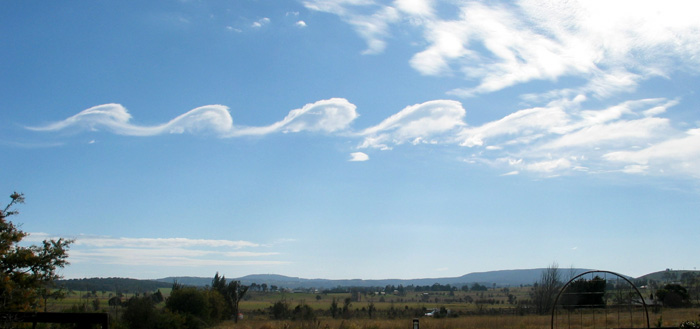
===============================================================
 From the University of Warwick:
Physicists, led by a researcher at the University of Warwick, studying new images of clouds of material exploding from the Sun have spotted instabilities forming in that exploding cloud that are similar to those seen in clouds in Earth’s atmosphere.
These results could greatly assist physicists trying to understand and predict our Solar System’s “weather”.
The researchers, led by of the Centre for Fusion Space and Astrophysics, at the University of Warwick’s Department of Physics, made their discovery when examining new images of clouds of material exploding from the Sun known as coronal mass ejections (CMEs). These images were provided by the Atmospheric Imaging Assembly (AIA) experiment on NASA’s Solar Dynamics Observatory (SDO). SDO was been launched last year and provides unprecedented views of the Sun in multiple temperatures.
The new SDO/AIA observations provided images of coronal mass ejections in the extreme ultra violet at a temperature that was not possible to observe in previous instruments – 11 million Kelvin. On examining these images the Warwick researchers spotted a familiar pattern of instability on one flank of an exploding cloud of solar material that closely paralleled instabilities seen in Earth’s clouds and waves on the surfaces of seas.

When observed these Kelvin-Helmholtz (or KH) instabilities appear to roll up into growing whirls at boundaries between things moving at different speeds, for instance the transition between air and water or cloud. The difference in speeds produces the boundary instabilities.
Similar conditions can occur when one looks at the magnetic environment of the path of these coronal mass ejections as they travel through the solar corona. The difference in speed and energies between the two creates the very similar KH instabilities that we can observe in clouds.
While KH instabilities have been predicted or inferred from observations as happening within the solar system’s weather this is the very first time they have been directly observed in the corona. What makes this observation even more interesting is that the instabilities appear to form and build on one flank of the CME. This may explain why CMEs appear to bend and twist as these instabilities build, and cause drag, on one side of the cloud. This effect will be the next focus for the University of Warwick led research team.
University of Warwick researcher Dr Claire Foullon said:
“The fact that we now know that these KH instabilities in CMEs are so far only observable in the extreme ultra violet, at a temperature of 11 million Kelvin, will also help us in modelling CME behaviour”
“This new observation may give us a novel insight into why these CMEs appear to both rotate, and be deflected away from following a simple straight path from the surface of the Sun. If the instabilities form on just one flank they may increase drag one side of the CME causing it to move slower than the rest of the CME.”
Dr Foullon and her co-researchers have outlined their observations and detailed modelling of how they believe this phenomenon occurs in a paper just published in Astrophysical Journal Letters entitled Magnetic Kelvin-Helmholtz Instability at the Sun by Dr Claire Foullon, Erwin Verwichte, Valery M. Nakariakov Centre for Fusion, Space and Astrophysics, Department of Physics, University of Warwick; Katariina Nykyri, Department of Physical Sciences, Embry-Riddle Aeronautical University, Daytona Beach, Florida; and Charles J. Farrugia, Space Science Center and Department of Physics, University of New Hampshire, Durham, New Hampshire.
The preprint is available at:
http://www.warwick.ac.uk/go/foullon/publications/foullon_preprint_apjl_2011.pdf
George E. Smith says:
February 7, 2011 at 8:43 am
……………..
Hi George
On MS IE (and some other browsers) next to the Back- Forward arrows, there is a smaller triangular arrow pointing downwards. Click on it and you will see further down WUWT link that will take you to your last WUWT page and location on it.
George E. Smith,
With Firefox and IE, the back button has a small history viewer next to it to select other than the last page; you could open in another window or another tab, as well . A lot of the links already take you to a new tab but, unfortunately, not all. You’d think it would be the default.
If you fly down the Pacific Coast of the Baja, you will sea the sandy coast line scalloped into those whorly patterns, that simply move the sand around according to some sort of turbulence theory I suspect.
“”””” vukcevic says:
February 7, 2011 at 11:15 am
George E. Smith says:
February 7, 2011 at 8:43 am
……………..
Hi George “””””
Yeah we do use Firefox, and Google Mail, and I hate both of them. With M$ despite all its bugs, I could copy all my e-mails off the servers or wherever they are sorted, and stick them on my local hard drive, and then get rid of what I didn’t need or want to keep.
All I can keep now on my hard drive is the Google mail address of wherrever the hell they have it stored.
I used to have a Telephone that I could actually dial a phone number, and talk to somebody on the phone. Nowadays, I would have to sort through a bunch of cookie recipes, and sewing patterns on a sellphone, in order to get to a dial tone. AT&T wants to fiber cable to me, and give me my phone, and internet, and a T&V in every room so I could watch 400 channels of shop at home, and walk from one room to the other, and have the TV magically follow me from room to room. I really don’t even want to watch that much TV; I’d rather be out some place fishing.
Leif Svalgaard says:
February 7, 2011 at 7:38 am
Geoff Sharp says:
February 7, 2011 at 4:37 am
“You can clearly see that 2010-2011 are not special in any way. The mean for 1988-2011 is 34% unipolar.”
The ratio is much higher today.
For 2010 it was 38%
For 2011 it is 37%
Not different from 1915-1955 or from 1988-2011 means.
What is the percentage from July 1 2010 to now, that is the period in question.
I truly learned about many of this, but however, I still assumed it had been helpful. Fine post!
Thanks Leif.
It has occurred to me I ought to consider the data in relation to some strong linkage co-incidences between datasets, one of which is asymmetry in the nasa/greenwich data. Does L&P have any connection.
What to do with the L&P data is a tricky problem. It would be useful to have the latitude of each measured datapoint. Is going to be a slow think about it and experiment.
Geoff Sharp says:
February 7, 2011 at 2:20 pm
What is the percentage from July 1 2010 to now, that is the period in question.
46%, same as it was during the strong solar maximum in 1990. Beware of the effect of making the period too short [the noise goes up]. E.g. for 2011 alone the ratio was 37%, perhaps the Grand Minimum is already over, now that the ratio has returned to normal…
Tim Channon says:
February 7, 2011 at 4:41 pm
It would be useful to have the latitude of each measured datapoint. Is going to be a slow think about it and experiment.
That data is available, but takes some work to format. I don’t think it is worth the effort as the L&P data is an unbiased sample of the whole thing.
Leif Svalgaard says:
February 7, 2011 at 4:59 pm
Geoff Sharp says:
February 7, 2011 at 2:20 pm
What is the percentage from July 1 2010 to now, that is the period in question.
———————–
46%, same as it was during the strong solar maximum in 1990. Beware of the effect of making the period too short [the noise goes up]. E.g. for 2011 alone the ratio was 37%, perhaps the Grand Minimum is already over, now that the ratio has returned to normal…
Ok, we are starting to get somewhere. Now lets dig a little deeper.
My results returned 47% for the same period. The first half of the year shows 0.04%, there is no doubt about a regime change. There are different types of unipolar groups, I am concentrating on the large circular spots with a dark umbra as they behave very differently to normal beta type groups.
Once again by isolating the tiny speck regions a true picture emerges. SC24 really began around the middle of Dec 2009, from Jan 2010 to June 2010 there were 24 regions recorded by the Layman’s count. Only one of these regions was a large unipolar. Then from July to now we have had 34 regions with 16 being large unipolar, considering how many different types of regions are possible I would say these groups are dominating and represents a certain regime change.
I have plotted all the regions since Jan 2010 to now to show this regime change clearly. The implications are large if this trend continues, we are seeing a very low EUV count now along with the F10.7 flux trending below the sunspot number. Your analysis of F10.7 moving above the sunspot number is wrong. I am surprised that this issue is not being talked about.
Geoff Sharp says:
February 7, 2011 at 6:24 pm
My results returned 47% for the same period. The first half of the year shows 0.04%, there is no doubt about a regime change.
No, just the result of picking too short a period. The 0.o4% is clearly nonsense [think about it – the smallest number of groups is 1 and it takes 1/0.0004 = 2500 groups for 1 group to be 0.04%, but let that slide]
these groups are dominating and represents a certain regime change.
To make statistics with 16 groups is not very meaningful.
with the F10.7 flux trending below the sunspot number.
They have different units so comparing them is as meaningful as to say that 5 degree C is trending below 33 degrees F. You have to bring the series onto the same scale by a formula, e.g. F10.7 = 60 + 1.1*SSN or something like that. What is your scaling formula? and derived how?
Your analysis of F10.7 moving above the sunspot number is wrong. I am surprised that this issue is not being talked about.
The data shows that there is more F10.7per spot lately than before cycle 23. You cannot argue with the data [you can quibble about a 1-2% percent, but that is all and makes no difference]. And the issue is being talked about [Hudson et al., Tapping, Hathaway] and it is clear than there are too few spots [of any size] compared with the coronal F10.7 emission [if you use the Layman’s count, even fewer 🙂 ]: http://lasp.colorado.edu/sorce/news/2010ScienceMeeting/doc/Session6/6.03_Tapping_F10.7.pdf
he states
Conclusions:
1: During the late cycle 23, the relationship between photospheric activity changed with more coronal activity [i.e. F10.7] than one might expect on the basis of the level of photospheric activity. Since photospheric activity drives coronal activity there is an issue here that needs some serious consideration.
2: Indications are that in Cycle 24 so far the deviation from “standard behaviour” is continuing or perhaps increasing.
3: There are indications in earlier cycles of a trend towards changing solar behaviour.
Geoff Sharp says:
February 7, 2011 at 6:24 pm
Your analysis of F10.7 moving above the sunspot number is wrong.
Show that you are up to it by doing the following:
1) compute monthly means of F10.7 and of SSN
2) plot a scatter graph of those monthly means with F10.7 as the X-axis and SSN as the Y-axis. Use different symbols or colors for data before 1996 and after 1996.
3) show the plot here
Leif Svalgaard says:
February 7, 2011 at 8:22 pm
Show that you are up to it by doing the following:
I think I am the one playing the teacher role in this case. I hope you can learn from a layman? The only useful time frame we have for analysis on SC24 is from Dec2009 till now. Agreed it is not a large sample but we have seen two extremes in sunspot formation that should be noteworthy…this is the area I was describing as not being talked about.
There is no need to perform your exercise, we only need to follow the monthly trend lines of both indexes which show F10.7 completely flat for 12 months against the sunspot number with a small rising trend. Going back to 1996 is also pointless, I am talking about SC24 only where we are seeing a change from around July 2010.
Geoff Sharp says:
February 7, 2011 at 9:00 pm
“Show that you are up to it by doing the following:”
There is no need to perform your exercise
So you are not up to it.