Guest post by E.M.Smith
Temperature Inversion
The Event
We’ve recently had some very cold days in International Falls.
This posting:
http://wattsupwiththat.com/2011/01/21/new-record-cold-tempertures-in-minnesota/
has a nice write up of the -46 F new record cold. ( That’s -43.33 C – still damn cold.) This is not just another “oh a record” posting. I’m asking “what does this mean about the magnitude and time scale of CO2 action?” and finding it means “not much” and “very short term”. But first, the data:
RECORD EVENT REPORT
NATIONAL WEATHER SERVICE DULUTH MN
518 PM CST FRI JAN 21 2011
…RECORD LOW TEMPERATURE SET AT INTERNATIONAL FALLS MN…
A RECORD LOW TEMPERATURE OF -46 DEGREES WAS SET AT INTERNATIONAL
FALLS MN TODAY. THIS BREAKS THE OLD RECORD OF -41 SET IN 1954.
Last night set a “daily record” too, but not a new “all time record”.
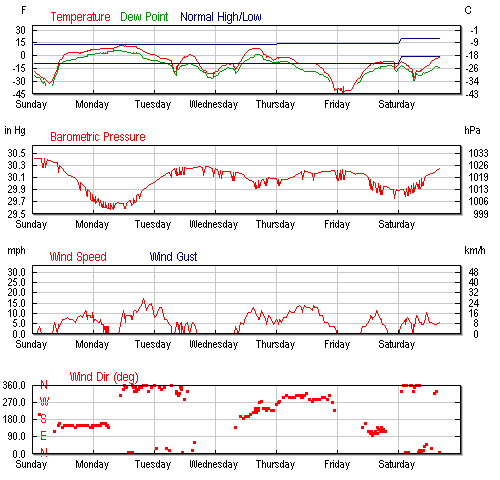
Here is a monthly chart so you can see if anything “interesting” happens on that scale:
And here is a ‘close up’ on that week in particular:
International Falls week ending 22 January 2011
The Meaning
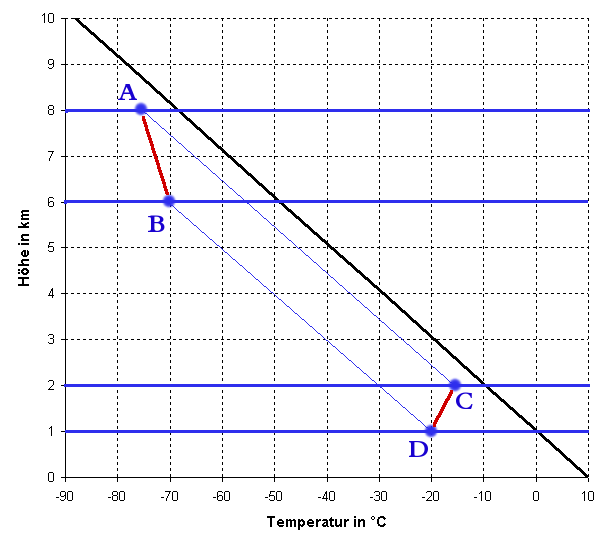
OK, so what does this mean? Typically it means that there was a temperature inversion on a cold clear night. (I was watching The Weather Channel when they reminded me of this with a brief coverage of how this particular cold record happened). Normally, temperature decreases with altitude, during an inversion the temperature is coldest at the surface and warmer at altitude. (The “D-C” segment in the diagram up top. It is showing how air from the ‘normal’ “A-B” segment, if descended, would result in an inversion).
Under certain conditions, the normal vertical temperature gradient is inverted such that the air is colder near the surface of the Earth. This can occur when, for example, a warmer, less dense air mass moves over a cooler, denser air mass. This type of inversion occurs in the vicinity of warm fronts, and also in areas of oceanic upwelling such as along the California coast. With sufficient humidity in the cooler layer, fog is typically present below the inversion cap. An inversion is also produced whenever radiation from the surface of the earth exceeds the amount of radiation received from the sun, which commonly occurs at night, or during the winter when the angle of the sun is very low in the sky. This effect is virtually confined to land regions as the ocean retains heat far longer. In the polar regions during winter, inversions are nearly always present over land.
That bit about relative IR rates is the key bit, from my point of view.
The Weather Channel also pointed out that the conditions needed were:
1) Clear sky. (i.e. no cloud layer blocking IR).
2) Still air. (i.e. no turbulent processes mixing the air and a lack of convective processes).
3) Dry air. (i.e. the water vapor content had to be taken out of the air for the IR to be free to leave).
So what does that LEAVE in the air? CO2.
Now think about this for a minute. If you have ANY of: Convection, barometric driven mixing, clouds, water vapor, water droplets; then IR does not dominate. With them all removed, and with the CO2 left in place, we have the full “CO2 Forcing” in effect (but unobscured by other drivers).
And what did we get? A New All Time Record Low.
I’d like to turn this into a whole lot more, but to me it’s clear and done at this point and any “more” is “less” clear.
CO2 is completely swamped by ANY of [ convection, wind, water vapor, clouds / water drops ] and when seen acting on its own can do nothing to prevent record lows from IR radiation from the surface.
There are sidebars and sidelights, but the crux of it is just that. CO2 is a wimp, and can be ignored. Water kicks sand in its face and clouds pee in its beer while the wind gives it a wedgie.
Sidebar on timing:
Look at the daily cycles. The IR cooling process happens in less than a day. From the 20th to the 21st things plunge. Why did it not happen on the 12th to 13th? Because IR was busy being beat up by the other processes. And when they are out of the way? Overnight a plunge to “way cold” that leaves CO2 “speechless”.
This means that the IR process is measured in HOURS, not days, weeks, months, and certainly not “30 year trends”. It’s over and done in HOURS. Trying to measure it with an annual average is folly of the worst sort. Trying to do so when there is clear evidence that it is irrelevant in the context of water and wind is lunacy. Doing it while completely ignoring clouds, humidity, and winds, as the “Annual Global Average Temperature” does is a bastard cross of folly with lunacy. “Just say no.”
Sidebar on Water and Wind
The Weather Channel put up two graphics. I don’t know if they were “typical” or actual data from the location, and I can only describe them here (i.e. I don’t have links… yet…)
One showed ‘normal conditions’ with it -40 F at altitude and something like -8 F at the surface, the other showed the inversion with it being -43 F at the surface (last night) and something like -15 F at 5000 feet. They then went into the above referenced discussion of the importance of ‘still air’ and low humidity to allow radiative cooling of the surface.
This made one thing very clear to me: Much of the “surface temperature” we measure is in fact measuring how much “vertical mixing” has happened (or not). We can get 30 F range based on how much vertical mix is going on? And nobody is taking that into account in the “Global Average Temperature”?
Where are the data on vertical mixing rates globally? Do we even have a clue how they change over time? Over 60 year PDO cycles? We’ve got 3 orders of magnitude “more there there” in the vertical mixing range than in the 1/100 C variations they are panicked over in “Global Warming” and it is being ignored?
Now look at that daily data again. Yes, there is wind moving things down from Canada, but it’s not the lateral displacement that is dominant here, it’s the vertical displacement. The lateral is taking several days to work, the vertical is much faster. There are “microbursts” that can down an airliner (over 2000 fpm downdrafts) and the distance we are talking about is 5000 feet. I make that 2.5 minutes time scale.
I’ve noted for a couple of years now that ever since the sun went quiet, the vertical atmospheric ‘thickness’ got compressed to thinner, and the PDO flipped: that the winds were more “bursty” and with more “vertical component” (in comments on various threads, many at WUWT). Now I think we have “why it matters”. Just ask the folks in Frostbite Falls…
Now, as that thinner colder layer gets colder (as has happened up North) we get more water vapor turned into ice crystals (all that snow on the ground as well as the ice in noctilucent clouds) and with more GCR (cosmic rays) making more condensation, if it’s more COLD condensation as ice, we get that “clear cold dry” air.
Conclusion
So, in the end, it’s all about what happens to the water, what happens to the wind, and what drives the clouds.
And even just ONE clear, dry, cold night with CO2 doing all it can but resulting in a record low EVER for that location pretty much says there is not a thing of importance being done by CO2. That even just one day away is drastically different says that the CO2 is not the “driver” here, it isn’t even in the passenger seat…
I thought you might find those interesting. I bet some interesting experiments could be developed with a proper black body radiator of low heat capacity or IR heat sensor, measuring the hemispherical radiant temperature of the sky under different humidity conditions. If we can characterize the changes due to humidity changes we might be able to show in real experimental behavior exactly how the heat budget to the sky varies with humidity. Subtract that contribution from the “theoretical” CO2 contribution and see if the sums add up right.
When I get home I will see if I can find the notes I made shortly after I got that IR thermometer. I spent a couple nights going outside every hour or so, measuring the IR surface temperature of all sorts of surfaces. You could actually measure the IR cooling of the windshields of cars compared to other surfaces. They were often several degrees F cooler than the ambient temperature.
I work a swing shift so will not be able to respond in until much later this evening.
Bottom line, is I think the issue people need to get their heads around, is that from the view point of the ground the night sky is a very cold surface and it suffers a significant IR energy transfer to the sky, regardless of the air temperature, and unless winds and advection actively warm surfaces by passing warmer air over them, they will chill over night much colder than the still outside air temperature. This is where the heat budget should be calculated not based on air temperature but the actual IR imbalance of surfaces that radiate to the sky.
This radiant cooling is well studied by solar energy folks, as they actively use it to chill water for some purposes (sustainable air conditioning systems using solar cooling etc.) and also because they discovered that their flat plate solar collectors become pretty good heat radiators to the sky at night, and would freeze water in the water loop collectors even though outside air temps were several degrees above freezing.
This radiant cooling of the land surface (which was heated by the suns energy during the day) raises the question about how useful tropospheric air temps are when calculating the heat balance at IR frequencies. Near surface air temperature might not be too useful to calculate the radiant heat balance, if the actual energy loss is occurring by IR energy transfer from surfaces directly to the cold sky.
Larry
Here is another interesting link that basically says as a first approximation, the equilibrium temperature of a thin metal plate exposed to the sky in low wind conditions will tend to reach a value about half way between the local air temperature and the local dew point temperature. This is based on 2 years of testing in a real world experiment to characterize so called “white plate” temperatures using IR cooling by radiation to the night sky.
http://www.plumbingengineer.com/jan_09/solar.php
same info in pdf
http://www.solarlogicllc.com/Articles/pe01_2009%20extracted.pdf
Here we have a very highly correlated relationship between surface temperatures and humidity (local dew point) and cloudiness, that I think shows quite well that IR heat loss to the sky is entirely dominated by humidity levels.
We also in the previous links I posted have test results for radiant temperatures of the sky from the view point of the ground decades ago which might be a large enough time interval to characterize what if any change recent increasing CO2 levels has made in the apparent radiant temperature of the sky at night.
This is a good place for the AGW advocates to actually do some experimental observations that could either prove or falsify their assertion that CO2 is the primary driver to earths thermal equilibrium temperature.
Let them validate their model assumptions by running their model calculations to predict what the equilibrium temperature of a surface exposed to the night sky should be based on local air temperature and local dew point for our current CO2 levels then go out an actually measure the same results and see if their “prediction” matches the real world. Better yet do it double blind and two different groups perform the experiments, with the experimental group not knowing anything about the models projections for their experiments.
Repeat every 10 years and see if changes track with the CO2 changes or remain coupled closely to the humidity.
Larry
>> John Day says:
January 24, 2011 at 3:22 pm
The more energetic vibration states still represent kinetic energy and thus mean higher temperatures. That’s how microwave ovens work: microwaves cause molecules with large dipole moments (“water”) to vibrate faster. Result: your food gets hotter. Same thing is supposed to happen to the CO2 molecules (but on Mars it can’t be detected at all. Also hard to detect on Earth in the dry deserts. That’s the issue.) <> How is a “pressure broadening” collision different from a “transfer of energy” collision? <<
In Wayne's reverse thermalization, the entire energy of the transition is transferred from N2 to CO2. Pressure broadening only makes a small change in the energy of a photon absorbed or radiated.
I do agree that it has been overblown as an excuse as to why Mars shows no greenhouse effect. From what I've read of pressure broadening, it's more significant the shorter the wavelength.
>> John Day says:
January 24, 2011 at 3:22 pm
The more energetic vibration states still represent kinetic energy and thus mean higher temperatures. That’s how microwave ovens work: microwaves cause molecules with large dipole moments (“water”) to vibrate faster. Result: your food gets hotter. Same thing is supposed to happen to the CO2 molecules (but on Mars it can’t be detected at all. Also hard to detect on Earth in the dry deserts. That’s the issue.) <<
Oops, the first part of my response got lost in the last comment.
You're right. I was thinking more in terms of atomic absorption (electron energy levels) rather than molecular absorption. According to your reference of equpartition of energy, the vibrational states add to the total kinetic energy of the system, and thus ARE part of the temperature.
Brass monkeys in Boston right now.
scott says:
January 24, 2011 at 7:32 am
_________________________________________
When Columbus first step foot on an island in the Western Hemisphere, there was less forestation in NA and SA than now. Between the Mississipi and the Appalachian mountain ranges, there was a very large agrarian society of Native Americans that had deforested a considerable amount of what we see today. Disease had traveled faster than the western movement of Anglo-Europeans and when pioneers had finally arrived, they were greeted by vast mature forests after the collapse of said native agrarian society.
The same is true for the Amazon basin. The estimate of how extensive the deforestation of the societies, and re-forestation after the collapse of this agrarian society is staggering.
The White Pine acreage of the upper midwest is nothing compared to the re-forestation of said areas, not to mention that the white pine’s natural habitat isn’t deforested as we speak.
Basically the same thing is well documented for Central America.
The Northeast of America also had a fairly large agrarian society.
It is estimated that there are more trees in the Americas than prior to Anglo-European’s arrival.
Yes, I’m formerly from Minnesoooooota, and the White Pines are beautiful, and I wish there were thousands of acres of these giants, but let’s not confuse a love for a monarch of the forest with eco-hyperism and faux Egalitarianism between man and nature.
The God created earth is not so fragile.
Tom_R:
Hey, Tom. Didn’t even get to participate today in the discussion I started last night. Before I read all of these comments and possibly have my thoughts sidetracked I should clarify my thoughts in this area.
Having spent over a year now trying to decipher the science behind AGW, I agree with many that there is much being ignored and not considered in the science of the atmosphere. This is not a test in a lab bottle.
I thing that has influenced me is Dr. Miskolczi’s paper. He makes no claims as to the cause or to the which effects his discover might apply but you can’t ignore one parameter that his paper did hone down: the LW opacity (optical thickness) of the total atmosphere over all latitudes and seasons and over a sixty-one year period as a whole is a constant.
What would that imply for he says little? Only that evidently just co2 concentrations seem to have absolutely no effect and that is on the atmosphere as a whole, all latitudes and altitudes across seasons, considered only as a complete system. To me that means that the stratosphere may cool below normal and therefore the troposphere must increase, or vice versa, but that imbalance vertically would have a limit to maintain the constant optical thickness. I think we are seeing that right now with the UV collapse.
That brings me to the thermalization occurring within the atmosphere. I have yet to pin down it’s role into this interplay of the layers but sure seems it has *some* role. That was my queue to try to get more information on this subject another might hold.
I keep looking. It’s there somewhere but most hides behind pay-walls and that is frustrating having to go to blogs to get current science.
Anyway, now I’ll read all of this and will probably comment back if warranted.
E.M. Smith says:
So, IMHO, if you are looking at any scale less than millenial, you ARE looking at weather, and “the 30 year average of weather” is ’30 year weather averages’ and the “climate scientists” are just being very poor weathermen. They ought to leave it to the professional Meteorologists who have a much better handle on things.
—
How so true! The redefinition of ‘climate’ is the true travesty. That was a great comment, all of it.
Every blog as yours and wuwt should have a tab called “Deemed True” and put your comments about climate under that tab.
No, I’m real serious about that tab. Every now and then things are posted or commented on that are so fundamental and held by the vast majority to be a true statement and these jewels should be cataloged. Blogs would then have a way for some very critical core information to be permanent and quickly reviewed or referenced and not just lost in the flow of the hundreds of posts after posts after posts.
WOW!
This post certainly generated a lot of interest.
On the issue of IR guns, I have done the same as hotrod Larry – I purchased the gun to check for “hot spots” on horses to detect injuries but have used it to check for heat loss in houses, and to check surface temperatures as Larry has – and detect what does and does not store heat. Most informative.
But the most important thing in Mr Smith’s article that resonated with me was the differentiation between horizontal and vertical distances. The International space station orbits at 208 to 285 miles above the earth. The distance from International Falls to Minneapolis is 294 miles. It’s a five hour drive. You can look up and see the space station go by. But you can’t see Minneapolis from International Falls. From 30,000 feet you can see pollution plumes that extend hundreds of miles, from the space station you can see smoke from forest fires or sand from sand storms that span thousands of miles. Looking up from a point on the earth, you just see stars or you don’t, you have no understanding of the scope.
“Dave Springer says:
January 23, 2011 at 10:39 pm (Edit)
I don’t see how this changes the debate at all.”
Dave – as a pilot, you have to know that if you compare vertical sensitivity to horizontal sensitivity, there is a huge difference and you must see it on your instruments when you fly. And this is why all those two dimensional climate models don’t work so well as the problem is multi-dimensional and we don’t even know how to quantify all the variables … which is what I see in the posts in response to Mr Smith’s post … and many other posts on WUWT lately. It is becoming clear that as we learn more and more about climate that we actually “know” less and less.
And that is as it should be. The more we know, the more we know that we know less.
John Day,
You seem to understand my question. Somehow broadening got into the discussion but don’t think either Doppler or pressure would fundamentally affect this effect other than the broadening itself. I think I need to go to the library to ferret out some of this info. For instance, since it is also quantized, broadening always present of course, at what temperatures do you get a certain level of energy flux with co2 at a certain temperature (energy/area) much as thermal conductivity is only on the radiative side. I can find nothing on this deeper level. Not sure if it has every really been measured in an experiment.
Dr. Vonk …. are you there? He seems to know more on this particular subject than any other physicist I have come across. I was accolading his last two posts on WUWT on thermalization while most others were absolutely tearing them apart. Some people have such short insight and the ability to overlook (temporarily) minor misstatements to still get the fine essence from the words.
Ok I am home and can devote some time to digging up old info.
This topic first came to my attention 40 years ago when I took a winter survival course. Our instructor had us spend a night out in the mountains near Evergreen Colorado wearing only street cloths a light jacket and the survival gear we could fit in a very small fanny pack. One of his lessons was get under shelter and out of the view of the open sky.
Believe me at 3:00 in the morning with temperatures in the high 20’s F you can tell the difference in the radiant temperature of the clear sky and the radiant temperature of a pine tree that blocks most of your view of the sky.
Now years later, I bought an IR thermometer for automotive purposes (checking tire temperatures) looking for cold header pipes to find a cylinder not firing etc.
It is a Master Cool model 52224-b, rated as having a useful range on the IR sensor from -76 deg F to 1200 deg F (-60 C to 648 C).
It has a viewing angle of 15:1 (3.8 degrees).
I decided to verify the radiant cooling from the clear sky by taking some temperatures and got the following results:
(Note there is a dependence on emissivity of the surface and the IR reading so I have included the generic setting of E=.95 I used for most of these measurements, unless I had a reliable value for some other emissivity for the surface)
===================
weather conditions
outside temp per Rocky Mountain Metro airport (BJC) weather report :
39.2 deg F (dewpoint 15.8 deg F)
I live about 2 miles from the airport, in an apartment complex on the 3rd floor which has an open breeze way through the building, in this breezeway my thermometer read
(hallway) = 42.6 deg F (E=0.95)
Breezeway floor (concrete open to the air on both sides) 37.1 deg F (E=0.95)
pavement north side of building = 20.6 deg F (E=0.95)
snow near swimming pool = 15.1 deg F (E=0.95) <– open view of sky of about 170 degrees .
surface of snow on grass = 10.4 deg F (E=0.95)
sidewalk surface in the open space = 10.9 deg F to 6.6 deg F (E=0.95)
hood of parked car (cold soaked had not run in days) 12.8 deg F (E=0.95)
windshield of cars
2.6 deg F (E=0.95), -3.4 deg F (E=0.84)
Early in the morning I remeasured some of the following temperatures:
0:750
Temperature 39.2 deg F
Pavement north side of building 16.8 to 14.6 deg F
When the IR thermometer was pointed at the clear northern night sky it instantly showed off scale low which for this thermometer is -76 deg F.
I had expected the sky to be cold but not that cold, so I contacted a friend who is a thermal control engineer for an aerospace company, and they use an empirical formula to estimate the effective temperature of the sky for their calculations of heat load on the pad.
It is:
Tsky = 0.04114 x ( Tair deg R) ^1.5
Tsky = effective absolute temperature of the sky
Tair = absolute temperature of the air in Rankin (this formula is not in Metric units)
I have not done a carefully controlled series of measurements, these were just dash out and take some readings temps, as at the time it was simply a curiosity question.
Using the above rule of thumb calculation, you come up with the following approximate values for the effective sky temperature under various conditions.
Effective sky temperature vs air temperature
(calculated radiant temperature of the sky in typical conditions)
air temperature sky radiant temperature
120 deg F 114 deg F
100 deg F 85 deg F
80 deg F 56 deg F
60 deg F 28 deg F
40 deg F 0 deg F
20 deg F -27 deg F
0 deg F -54 deg F
-20 deg F -80 deg F
I will leave it to the math wizards to convert this relationship to Kelvin temperatures.
I also found another paper that gives another relation for sky temperature/emissivity.
http://www.sciencedirect.com/science?_ob=ArticleURL&_udi=B6V50-497T2FY-GY&_user=10&_coverDate=12%2F31%2F1982&_rdoc=1&_fmt=high&_orig=search&_origin=search&_sort=d&_docanchor=&view=c&_searchStrId=1618705469&_rerunOrigin=google&_acct=C000050221&_version=1&_urlVersion=0&_userid=10&md5=bbcef1e0ac613a3af09999a7f76744a6&searchtype=a
The current outside temp is 29.3 F
Pavement temperature in IR (E=95) on the north side of the building is 4.3 deg F.
North sky is off scale low (clear sky no haze or clouds)
The face of the building across the parking lot is 10.7 deg F
The grass surface is at -7.5 deg F.
And some wonder why we think site conditions are important for weather enclosures!
Larry
Larry
http://books.google.com/books?id=LlSWiyJBaRsC&pg=PA72&lpg=PA72&dq=global+thermal+sky+radiance&source=bl&ots=iYtJF6Z1TW&sig=pXMyaV8X3E7IxSXTTRgTIequEPg&hl=en&ei=NWs-TaGGJoSmsQPi5ejOBQ&sa=X&oi=book_result&ct=result&resnum=3&sqi=2&ved=0CCYQ6AEwAg#v=onepage&q&f=false
see page 76 chart of sky irradiance
Larry
The IPCC report is a political document not a science paper, hence the political recognition by the Nobel panel. It is important that CO2 is the main climate problem because water vapour, convection and wind cannot be controlled and cannot be taxed. CO2 emissions, on the other hand, can be used to tax us back to the stone age and prevent us from doing all those things we like doing. I am beginning to think that climate science belongs to the same group as those other robust sciences like astrology, psychology and Scientology.
http://www.urbanclimate.net/matzarakis/papers/IziomonMayerMatzarakisJASTP2003.pdf
Seems to be a fair amount of study data out there if you know the key words to google for.
Larry
phlogiston says:
Brass monkeys in Boston right now.
Um, I think you meant “neutered brass monkeys” 😉
@Hotrod Larry:
I have to get one of those… love the way you can demonstrate that “air temperature” is at best a polite fiction and at worst highly misleading for what is happening to IR from actual surfaces.
I’ve taken more ice off more windshields than I care to think about (often with no ice elsewhere around) and propose the “Windshield Ice” metric for measuring the effect. One could calibrate the number of ‘windshield increments” lower any serface was… so a really cold surface would be 2 WS while a modest cooling might only get 1/2 WS 😉
hotrod ( Larry L ) says: January 24, 2011 at 11:15 pm
Ok I am home and can devote some time to digging up old info.
Amazed… thank you very much.
@wayne
> Somehow broadening got into the discussion …
Broadening is crucial because it allows the warmists to mitigate the negative finding of CO2 warming on Mars.
AFAIK, there is no compelling proof that “pressure broadening”, by itself, would explain why it would “enable” CO2 warming. For example, the NASA GISS folks (Lacis et al.) recently acknowledged in their “CO2 is the control knob” that CO2 warming is surprisingly absent in the CO2-rich Martian atmosphere (where it is 30x more abundant per unit area than Earth). All they could say was that this was due to the absence of “pressure broadening” on Mars, as if it were some kind of conjecture yet to be proved.
> since it is also quantized, broadening always present of course, ..
A small amount of quantization noise may be present, but it is probably not the main artifact here. I think there are two major components to this broadening effect:
1) Some of it, dependent on the quality of the instrument, is internally generated by the response function of the spectrometer. This produces a “point spread” (convolution of response function with signal) which makes lines look thicker than they really are. For example, stars are zero-width points, yet they seem to have a measurable “disk” to the the Airy response of the scope. Or why an unmodulated CW carrier signal seems to have a measurable band-width on most radio receivers, when actually its true bandwidth is virtually zero (disregarding any tiny bit of AC hum and other noise modulating the signal slightly)
2) The other part of it is external, related to the uncertainty of precisely determining the frequency of the spectral lines (which in reality are zero-width points, like stars). This is caused by Doppler shift and also truncated spectra caused by re-absorption (analogous to changing FFT length in Fourier analysis).
> Dr. Vonk …. are you there? He seems to know more on this
> particular subject than any other physicist I have come across.
Yes, I would love to hear his take on all of this, from a real subject-matter expert.
😐
Yes I was surprised by how many surfaces cool to significantly lower temperatures than the air does after sundown. Glass is a high emissivity surface in the IR band with an emissivity of about 0.92 which explains why it cools so much below ambient temperature. Concrete is also a high emissivity surface at IR, (E=0.92-0.97) as is asphalt (E=0.95). This explains why bridges get a film of water/ice on a cold night even though air temps are above freezing.
Now what is more interesting, is that ice has an emissivity of 0.97. It is almost a perfect black body radiator of IR. Even a very thin coat of ice or snow (E=0.80) will radiate large amounts of IR to a clear open sky at night, water is slightly higher in emissivity emissivity (E=0.98) (cough arctic cough).
Seems to me that having ice cover in the arctic during the winter season is probably irrelevant to radiant cooling. With the low atmospheric humidity levels at arctic temperatures, the relatively warm water surface or ice cover is radiating to an apparent sky temperature of something like -100 deg F in the heart of the winter if there are no clouds.
It also comes in handy for cooking. Want perfect pop corn, heat the oil to 410 deg F then drop in the corn, want your oat meal to be just hot enough to eat right out of the microwave? Heat until its IR temp is about 150 deg F, and it is ready to eat without scalding your mouth. 😉
One more study to ponder that I found this morning:
http://langley.atmos.colostate.edu/courses/at652/2010/Stephens_Jackson_Wittmeyer_JClim_1996.pdf
Larry
@John Day
AFAIK, there is no compelling proof that “pressure broadening”, by itself, would explain why it would “enable” CO2 warming. For example, the NASA GISS folks (Lacis et al.) recently acknowledged in their “CO2 is the control knob” that CO2 warming is surprisingly absent in the CO2-rich Martian atmosphere (where it is 30x more abundant per unit area than Earth). All they could say was that this was due to the absence of “pressure broadening” on Mars, as if it were some kind of conjecture yet to be proved.
Yes, I agree. The warmists keep trying to prove that co2 warms by trapping thermal heat on one side of the argument but I personally have moved on past that to absolutely no effect at all when the climate system is studied from afar, from space. My major was chemistry up to the last year and you study endothermic reactions that truly trap heat thermally into the bonds. That energy is gone forever without a reverse reaction occurring and will never express itself as heat again. But in physics all of the laws and relationships mainly are symmetrical. The warmist side have so brainwashed most people that everyone is now discussing on one-sided processes without nary a mention of the opposite side of the relationship. Warms yes but it also equally cools.
There are effects from co2 locally and that was my point. co2 in a couple of band groups does absorb IR well but that also means co2 in these bands also, and equally, emit radiation the these bands. If the atmosphere were viewed as blood then co2 is like a blood thinner on the radiative side in those spectral bands. That is why International Falls is setting low records. E.M. is correct to bring up inversions and did a good job on the subject but there have always been inversions in winter, so why the new lows? Just natural variation?
We seem to have two effects both who have their signatures overlaid in the temperature records. One is UHI and the removal of higher altitude and rural station. This shows mainly the low temperatures to be elevated across the decades. But I feel this is masking the effect I mentioned (the radiative thinning so to speak) that would show the atmosphere temperatures having higher highs and lower lows. We can only see this lower lows signature in a small percentage of the stations because they keep removing all but those with high UHI signatures also. And the thermalization between co2 and the other gases, both ways mind you, is the only explanation I’ve been able to find.
But I keep looking. To me co2 has NO effect, OVERALL, on this globes temperature. Just locally redistribution and most of it vertically, again, both ways.
Wish I could write more fluidly but you should still see my point.
I spent a very cold winter in Duluth, MN back in 1974/5 and I do not miss the very cold temperatures that ON AVERAGE occur during most of the winter- nor the super cold nights that occur occasionally when the conditions are just right (a -3 to -6 sigma event- the lack of wind, moisture and clouds, etc. that Anthony discussed in this post). The Jesuits at the college I was attending in Duluth tried their best to train my brain to look at any question with an open mind. I have found “Watts Up With That” is a GREAT site to gain some insight into the assumptions of the models used to estimate the effects of various inputs (CO2, IR, wind, etc. etc.) on the outputs (AVG Temp, etc.). I have to admit it has been close to 35 years since I have spent any time looking into our attempts to understand short term weather events let alone the complexities of the climate system. I was thrilled to see Anthony’s post as it covered a specific weather event for me (and it reminded me why I prefer to live in the foothills of CA- it’s been in the upper 60’s recently with loads of sun which was great for my 6.12 Kw PV system) and how that relates to the significance of the different inputs to a weather event. I would be interested in knowing what a climate model(s) would predict the low temperature to have been with CO2 levels at what they were in the late 1800’s and double what they are today (in MN) that way I could get a better understanding of the significance of CO2 vs their other factors that effect temperature (it is OK with me if the estimates are done on the high temperature for that day too).
It has been a long time since I first read “The Environmental Handbook Prepared For the First National Environmental Teach-In, edited by Garret De Bell- http://www.amazon.com/Environmental-Handbook-Prepared-First-National/dp/B000RUO3R4 which touched on the role that CO2 has on our climate system and the dangers of increasing it’s concentration in the atmosphere. I am a bit surprised that our measurement capabilities haven’t progressed as much as I would of expected over the last 40 years. I would of thought that our measurement systems would of progressed to the point that we could have accurate data for temperature, wind, CO2 (as that’s what the we were concerned about) at a majority of the stations throughout the globe. Specifically Veronica’s “….In fact we rely on temperature readings from all over the place (in weather stations of varying quality) but a single point reading of CO2 at Mauna Loa in Hawaii. I wonder how relevant that is, especially when it is considered alongside global average temperature, which is a derived measurement obtained with lots and lots of errors.” point comes to mind.
Mark Miller,
It’s probably a good thing on balance that everyone relies on MLO’s CO2 record.
Can you imagine what would happen if CO2 sensors were scattered all over?
NEWS FLASH …Dateline Los Angeles…
LAX has just reported a CO2 spike of 1,760 ppm! Commenting on this alarming poisonous gas reading is NASA/GISS climate expert Dr Gavin Schmidt…
Just to add a little data to what I have already reported.
Current temp 31.9 deg F dew point 27 deg F
Overcast with light snow.
Pavement north side of building (22:30 local time) 29.4 deg F
sky temp ranges from 0.0 deg F to 2.2 deg F
So even with overcast and snow, the sky temp is about 32 deg F colder than the air temp.
Larry
“Dave in Delaware says:
January 24, 2011 at 6:06 am
They find that – “Water vapor contributes approximately two thirds of the LDFclear regardless of season while CO2 contributes about one-third. The actual ratio of H2O/ CO2 LDFclear is in the range 2.1–2.3 throughout the year. This constancy is surprising because precipitable water vapor (PWV) decreases significantly from summer to winter, but atmospheric CO2 concentration remains constant as the atmospheric temperatures drop dramatically.”
As we know, radiation depends on the fourth power of the absolute temperature. And 300 K to the 4th power is about 3 times as much as 230 K to the 4th power. So while the “atmospheric CO2 concentration remains constant as the atmospheric temperatures drop dramatically”, is it possible that at very low temperatures, there are way fewer photons at the 15 micron wavelength to allow CO2 to act as effectively act as a greenhouse gas?
Here is another data point in the IR temperature of the sky issue.
Last night we had a cold front slide into the Denver Metro area. Temperatures were in the low 30’s early in the morning then started falling like a rock around 6:00 am local time. Currently it is 8.2 deg F here just west of the Denver Metro area, with light snow and solid overcast.
I took my IR thermometer out and the north sky (cloud covered) is showing an IR temperature of -19 deg F, with snow temps on the ground at -3 deg F. It is still day light (3:40 pm local), it will be interesting to watch how the sky temp changes as the sun sets.
Forecast is for lows well below zero F. in the -4 to -9 deg F range.
NCAR foot hills lab is showing a temperature of 8.6 deg F dew point of 3.6 deg F at this time. They are very near the same altitude I live at and usually are very consistent with my local readings.
Larry