Guest post by E.M.Smith
Temperature Inversion
The Event
We’ve recently had some very cold days in International Falls.
This posting:
http://wattsupwiththat.com/2011/01/21/new-record-cold-tempertures-in-minnesota/
has a nice write up of the -46 F new record cold. ( That’s -43.33 C – still damn cold.) This is not just another “oh a record” posting. I’m asking “what does this mean about the magnitude and time scale of CO2 action?” and finding it means “not much” and “very short term”. But first, the data:
RECORD EVENT REPORT
NATIONAL WEATHER SERVICE DULUTH MN
518 PM CST FRI JAN 21 2011
…RECORD LOW TEMPERATURE SET AT INTERNATIONAL FALLS MN…
A RECORD LOW TEMPERATURE OF -46 DEGREES WAS SET AT INTERNATIONAL
FALLS MN TODAY. THIS BREAKS THE OLD RECORD OF -41 SET IN 1954.
Last night set a “daily record” too, but not a new “all time record”.
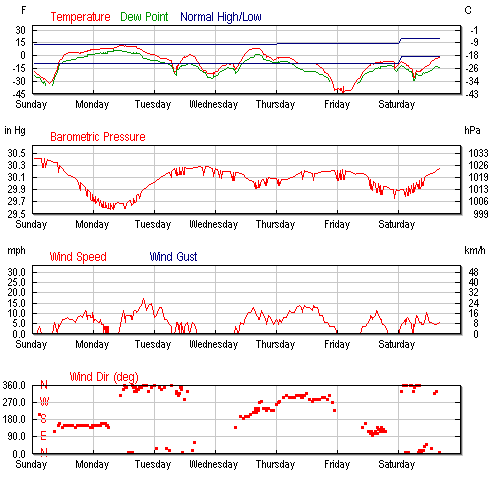
Here is a monthly chart so you can see if anything “interesting” happens on that scale:
And here is a ‘close up’ on that week in particular:
International Falls week ending 22 January 2011
The Meaning
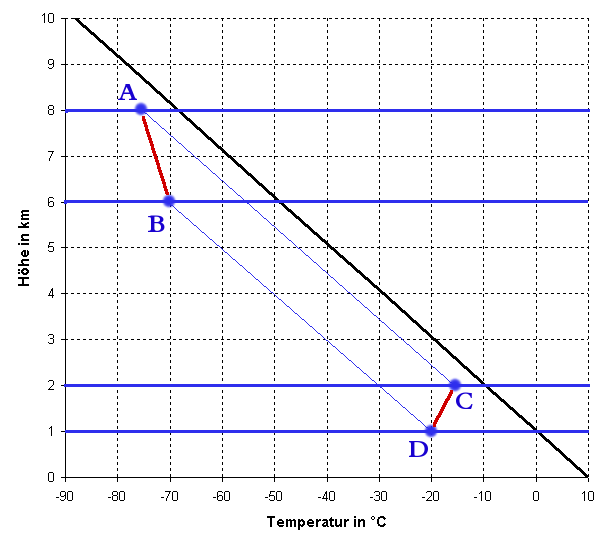
OK, so what does this mean? Typically it means that there was a temperature inversion on a cold clear night. (I was watching The Weather Channel when they reminded me of this with a brief coverage of how this particular cold record happened). Normally, temperature decreases with altitude, during an inversion the temperature is coldest at the surface and warmer at altitude. (The “D-C” segment in the diagram up top. It is showing how air from the ‘normal’ “A-B” segment, if descended, would result in an inversion).
Under certain conditions, the normal vertical temperature gradient is inverted such that the air is colder near the surface of the Earth. This can occur when, for example, a warmer, less dense air mass moves over a cooler, denser air mass. This type of inversion occurs in the vicinity of warm fronts, and also in areas of oceanic upwelling such as along the California coast. With sufficient humidity in the cooler layer, fog is typically present below the inversion cap. An inversion is also produced whenever radiation from the surface of the earth exceeds the amount of radiation received from the sun, which commonly occurs at night, or during the winter when the angle of the sun is very low in the sky. This effect is virtually confined to land regions as the ocean retains heat far longer. In the polar regions during winter, inversions are nearly always present over land.
That bit about relative IR rates is the key bit, from my point of view.
The Weather Channel also pointed out that the conditions needed were:
1) Clear sky. (i.e. no cloud layer blocking IR).
2) Still air. (i.e. no turbulent processes mixing the air and a lack of convective processes).
3) Dry air. (i.e. the water vapor content had to be taken out of the air for the IR to be free to leave).
So what does that LEAVE in the air? CO2.
Now think about this for a minute. If you have ANY of: Convection, barometric driven mixing, clouds, water vapor, water droplets; then IR does not dominate. With them all removed, and with the CO2 left in place, we have the full “CO2 Forcing” in effect (but unobscured by other drivers).
And what did we get? A New All Time Record Low.
I’d like to turn this into a whole lot more, but to me it’s clear and done at this point and any “more” is “less” clear.
CO2 is completely swamped by ANY of [ convection, wind, water vapor, clouds / water drops ] and when seen acting on its own can do nothing to prevent record lows from IR radiation from the surface.
There are sidebars and sidelights, but the crux of it is just that. CO2 is a wimp, and can be ignored. Water kicks sand in its face and clouds pee in its beer while the wind gives it a wedgie.
Sidebar on timing:
Look at the daily cycles. The IR cooling process happens in less than a day. From the 20th to the 21st things plunge. Why did it not happen on the 12th to 13th? Because IR was busy being beat up by the other processes. And when they are out of the way? Overnight a plunge to “way cold” that leaves CO2 “speechless”.
This means that the IR process is measured in HOURS, not days, weeks, months, and certainly not “30 year trends”. It’s over and done in HOURS. Trying to measure it with an annual average is folly of the worst sort. Trying to do so when there is clear evidence that it is irrelevant in the context of water and wind is lunacy. Doing it while completely ignoring clouds, humidity, and winds, as the “Annual Global Average Temperature” does is a bastard cross of folly with lunacy. “Just say no.”
Sidebar on Water and Wind
The Weather Channel put up two graphics. I don’t know if they were “typical” or actual data from the location, and I can only describe them here (i.e. I don’t have links… yet…)
One showed ‘normal conditions’ with it -40 F at altitude and something like -8 F at the surface, the other showed the inversion with it being -43 F at the surface (last night) and something like -15 F at 5000 feet. They then went into the above referenced discussion of the importance of ‘still air’ and low humidity to allow radiative cooling of the surface.
This made one thing very clear to me: Much of the “surface temperature” we measure is in fact measuring how much “vertical mixing” has happened (or not). We can get 30 F range based on how much vertical mix is going on? And nobody is taking that into account in the “Global Average Temperature”?
Where are the data on vertical mixing rates globally? Do we even have a clue how they change over time? Over 60 year PDO cycles? We’ve got 3 orders of magnitude “more there there” in the vertical mixing range than in the 1/100 C variations they are panicked over in “Global Warming” and it is being ignored?
Now look at that daily data again. Yes, there is wind moving things down from Canada, but it’s not the lateral displacement that is dominant here, it’s the vertical displacement. The lateral is taking several days to work, the vertical is much faster. There are “microbursts” that can down an airliner (over 2000 fpm downdrafts) and the distance we are talking about is 5000 feet. I make that 2.5 minutes time scale.
I’ve noted for a couple of years now that ever since the sun went quiet, the vertical atmospheric ‘thickness’ got compressed to thinner, and the PDO flipped: that the winds were more “bursty” and with more “vertical component” (in comments on various threads, many at WUWT). Now I think we have “why it matters”. Just ask the folks in Frostbite Falls…
Now, as that thinner colder layer gets colder (as has happened up North) we get more water vapor turned into ice crystals (all that snow on the ground as well as the ice in noctilucent clouds) and with more GCR (cosmic rays) making more condensation, if it’s more COLD condensation as ice, we get that “clear cold dry” air.
Conclusion
So, in the end, it’s all about what happens to the water, what happens to the wind, and what drives the clouds.
And even just ONE clear, dry, cold night with CO2 doing all it can but resulting in a record low EVER for that location pretty much says there is not a thing of importance being done by CO2. That even just one day away is drastically different says that the CO2 is not the “driver” here, it isn’t even in the passenger seat…
This is science.
Observe the system with variables held constant to observe the effect of the variable in question. Result? Other variables dominate. Simple and elegant.
An experimental result that leads to other questions, observations, and experiments.
Well done EM!
Hey E.M. Smith… great article! You really opened up some minds.
Weather isn’t Climate
I keep hearing (& reading) this, but I don’t quite understand – what, exactly, IS “Climate” if not Weather over Time? They ARE related, aren’t they? If the weather in a particular location is almost always warm and dry, then wouldn’t the climate of that location be “warm and dry”?
Just trying to get a handle on this…
————
@kwik:
The feminists at the University of Oslo wanted to ban logic. Logic was too troublesome.
Sadly, in today’s world, it’s hard to tell if you’re joking when you say something like that. If the moderators will indulge me – if this is, indeed, true, (as opposed to hyperbole or sarcasm) I would love a link to a reference!
Sorry, but I don’t find this article very convincing. Simply replace the words CO2 and temperature with sealevel and waves/tides and one can make a similar story to “prove” that there is no sea level rise…
Of course the effect of CO2 is probably (very) small, but with short term fluctuations caused by other more important variables, one can’t prove or disprove the effect of CO2.
James F. Evans says:
January 23, 2011 at 10:48 pm
The warmists will come out of the box, again, with some explanation — they always do. But everytime AGW’s do, it gets harder to rationalize their previous erroneous prognostications.
James F. Evans says:
January 23, 2011 at 10:48 pm
The warmists will come out of the box, again, with some explanation — they always do. But everytime AGW’s do, it gets harder to rationalize their previous erroneous prognostications.
This sounds so much like the old Communist Party of the Soviet Union. They would do a 180° turn on some aspect of doctrine and the fellow travelers in fellow Parties would obediently make the same abrupt turn and act as if nothing had changed.
IanM
Tony says: January 24, 2011 at 10:23 am
Totally agree with the concept: Weather is Climate
Do not be fooled into thinking otherwise…
The Team need to separate Climate from reality… then the The Team can peddle their AGW Belief System based upon bogus metrics like the Global Average Temperature, Global Temperature Anomaly and Global Average Energy Budget… these metrics cannot in reality actually be measured… but more importantly these average metrics cannot be challenged by mere mortals because there is no single point on this earth where you can validate these metrics… you either believe them or you are in denial.
My personal view is that the word Climate can only be used to describe typical patterns of weather… for example: Mediterranean Climate defines land areas that typically experience warm, wet Winters and hot, dry Summers… that’s it… it’s not rocket science… in fact it’s not science at all… it’s just describing typical weather patterns…. so don’t be fooled – just remember: Weather is Climate and Climate Science is an oxymoron.
A temperature inversion is the only occasion when ‘back-radiation’ from GHG gases could possibly operate because radiation or any other form of heat transfer can only move from a warmer body to a colder body, despite what Science of Doom claims. (I am not disputing that humid air can reduce heat loss.) And yet EM Smith’s article appears to show that even in these circumstances CO2 has a minuscule effect.
Berényi Péter says:
>I am sure soot is a major player on sunlit snow.
It used to be even more important. NH is much less sooty than it was, in my view.
>Also, if soot forcing (and of course UHI) is taken into account (its efficacy is high), there’s not much room left for CO2 sensitivity.
Concur completely.
>And there’s an even more serious problem with soot: it is completely removed from the atmosphere in a week or two by precipitation, so as soon as soot emissions are stopped, nothing is left in the “pipeline”.
E-eh, well, not so fast. Advances in measurement technology show that PM 0.01-0.02 range particles are very plentiful and do last for a long time – they just weren’t measurable before. And they heat phenomenally efficiently per kg. Many times more than large particles. They are produced by combustion processes that appear very clean when rating their PM2.5 output measuring using light scattering (which has a lower detection limit of 0.1 micrometers).
>Also, it is not prohibitively expensive to decrease soot emissions, one just needs more perfect combustion & proper filters.
Agreed, and often filters are not necessary, just better combustion. Particles are not the natural emissions of the fuel (inherent), they are a product of the combustor. There is much confusion between PM emitted from stacks that is the result of the fans blowing ash up the pipe and PM from actual combustion. Natural draft stoves and furnaces are not a major (proportionate) source of particles above PM1.0 (i.e. from the combustion). It is when fans get involved that the PM starts to be larger, and it is not Black Carbon (BC) it is largely OC and ash.
This don’t agree with the advice: “…stop burning biomass, especially dung for cooking, use natural gas instead. Burn coal in power plants (with proper handling of smoke), not at home.”
The latest generation of biomass stoves are extremely clean. Also check what Austria is researchgin on biomass pellet furnaces. Amazing. The cleanest coal burning devices on the planet are domestic stoves (i.e. GTZ 7.5 brown coal burner in Mongolia) and emit less PM and CO than domestic natural gas burners. Strange, eh? Advances in combustion technology are not all on the large end of the spectrum.
>…Do not use small diesel engines, install filters on large ones.
Clean diesel engines are now shown to produce huge quantities of tiny BC PM unless catalytic converters are added. New technologies (like the aethalometers from Clarkson Univ) are able rate these emissions now. Very interesting and high tech field.
>There’s also a collateral advantage in decreasing soot emissions. Soot in air (unlike carbon dioxide) is dangerous to human health.
Agreed again. Hillary’s clean cooking stove initiative and its closely associated UN Global Alliance for clean cooking is putting $100m on the line to dramatically improve the lot of the (mostly) women who are affected by cooking stove emissions (1.6m die per year from such emissions). However make no bets on which fuel and technologies will turn out to be cleanest. There is a lot emerging from intensive investigations into clean burning stoves. See http://www.bioenergylists.org/ for updates and discussions.
Thanks for bring domestic BC to the WUWT table.
Agw will latch onto the “inversion” thing and say this is due to co2 warming. Actually, I don’t believe inv is the mechanism in terms of vertical movement. The cold air mass from the north wedges like a plow under the lighter warm air at the line of the front and the latter rises up the wedge sliding on the interface. The relative motion of the two air masses has a larger horizontal component than the verical. The rest of your analysis re co2 effect seems sound.
E.M. is completely right. Every record cold, or just cold, proves that the heat made off into space. It’s gone. CO2 didn’t hold it back. It doesn’t accumulate. The only place where heat could accumulate is the oceans; never the atmosphere. So it all boils down to OHC. And ARGO shows no heat is building up there at the moment; so i wonder, why doesn’t the increased CO2 concentrations have an effect?
The only explanation is that the AGW theory is bunkum (not the radiative properties of CO2, but AGW as a Global Warming theory).
There is a debate about AGW, you guys should consider joining it.
Steven Mosher says:
January 24, 2011 at 12:18 pm
There is a debate about AGW, you guys should consider joining it.
That is the type of argument used by various vicars and priests when they were trying to indoctrinate me at school… their arguments didn’t make past my first principles filter… neither does the AGW belief system.
Steven Mosher says:
January 24, 2011 at 12:18 pm
There is a debate about AGW, you guys should consider joining it.
Not so much a debate… more like a sermon… and unfortunately the flock isn’t hanging round to hear the rest of the sermon… they have flocked off… or are they flocked off… they might even want to say it…
What is funny is that this effect of water vapor on the radiant temperature of the sky is well known and documented by the solar energy folks.
The effective radiant temperature of the sky as seen from ground level is dominated by the local dew point temperature. Low dew point very low radiant temperature of the sky, high dew point or haze and clouds and the sky appears much warmer in the infrared.
http://www.ceen.unomaha.edu/solar/documents/SOL_29.pdf
http://www.aceee.org/proceedings-paper/ss06/panel03/paper12
http://books.google.com/books?id=Lx1BclFf7QIC&pg=PA157&lpg=PA157&dq=radiant+temperature+of+the+sky&source=bl&ots=194pTaSahm&sig=8HNCGpwumDWDRYwi9xKEfz_akw4&hl=en&ei=TvA9TbztB4KC8gaDndj4Cg&sa=X&oi=book_result&ct=result&resnum=3&ved=0CCMQ6AEwAg#v=onepage&q=radiant%20temperature%20of%20the%20sky&f=false
http://www.sciencedirect.com/science?_ob=ArticleURL&_udi=B6X3W-46T39FM-G&_user=10&_coverDate=05%2F31%2F1989&_rdoc=1&_fmt=high&_orig=search&_origin=search&_sort=d&_docanchor=&view=c&_searchStrId=1618367121&_rerunOrigin=google&_acct=C000050221&_version=1&_urlVersion=0&_userid=10&md5=0dc7ff690b6e2849b6137c4f78ffa557&searchtype=a
http://books.google.com/books?id=oaS-OpEjPtUC&pg=PA62&lpg=PA62&dq=radiant+temperature+of+the+sky&source=bl&ots=N7oUfTWN_E&sig=lyc5M6t4CMNHiJr-x65iwF8I-ns&hl=en&ei=TvA9TbztB4KC8gaDndj4Cg&sa=X&oi=book_result&ct=result&resnum=7&ved=0CD0Q6AEwBg#v=onepage&q=radiant%20temperature%20of%20the%20sky&f=false
I have an IR thermometer that is capable of reading well below zero in the IR and on a clear night with no haze the IR temperature of the sky is off scale low. If there is any haze (halo around the moon) and the thermometer will give an on scale reading of the sky temperature. If there is any detectable clouds their radiant temperature approximates the dew point temperature at the cloud base altitude.
Taking a long walk on a clear sky low humidity night and measuring radiant temperatures of surfaces with an IR thermometer is an eye opening experience.
Even outdoors survival experts know that the clear open sky is very cold and you are much warmer in a survival situation if you can place any physical surface between you and most of the sky.
Larry
@richard verney:
Thank you! You have rephrased the point eloquently. It is a joy to see that the idea has been grasped so well.
@TimC:
If you want to broaden this out to a millenium time scale, as your comment seems to indicate, then we leave this example and move to a very different paradigm. On that time scale, we see what looks like 2 stable limit points. One, the depths of an Ice Age Glacial. The other, the peak of an Interglacial. BOTH have remarkably consistent “limit temperatures” for their peaks when compared to”peer events” in history. (All warming stops at a similar peak to now. All cooling stops at a similar very cold temperature.) Note, too, that these happen with little respect for CO2. Prior ice age glacials have happened at much higher CO2 levels and interglacials have happened with much lower. The “fit” of CO2 to glacial / interglacial is nearly none, and it is trailing by several hundred years when it does track, not leading.
At that point, things move to speculation. I would speculate that during the interglacial side of things we reach a moisture upper limit in the air. It’s as humid and tropical / rainy as it can get. (Vis Queensland, Sri Lanka, Colombia, et. al.) In the depths of a glacial, the air is as dry as it can get (don’t have a pointer to hand, but there is clear correlation of glacials with higher levels of desertification).
We also have a gigantic quantity of water doing 2 phase changes (steam on one end, ice on the other) right at those hysteresis end points of the cycle.
So the problem for your position is that “all in balance” assumption. It isn’t. It wasn’t. It never has been. It is a water driven system with high hysteresis between two limiting end points. With an orbital “kicker” flicking the light switch. That the switch has just been flicked from “interglacial” to “glacial” is not in doubt (we know where we are in the Milankovitch cycle and we know it’s been ‘down hill’ for 6000 years or so). What isn’t known is when the polar ice STOPS melting in the summer and we plunge into that long cold phase. (Our interglacial only happens when summer melt of the arctic ice happens.)
So there IS a ‘tipping point’, but only to the downside from here. We’ve already bounced off the upper limit. AND there is a tipping point to the upside, but only when at the bottom of an Ice Age Glacial. And they are both ‘water driven’ not CO2 driven.
So, take that bucket example again. In our present condition, the water cycle is limiting the dump of heat to space. So much so that we melt the north polar ice sheet (or Chicago would be under a mile of ice). It doesn’t matter of you open that a bit more, or not. We’ve hit the limit. (I’d even go so far as to suggest that we might be able to get back to where we were during the Roman Optimum if we were very very lucky. Ralize that DOES include higher ocean levels and Ostia Antica being a coastal city again… so you can still play “disaster games 101” with it 😉 but that scenario has to deal with our present status of 6000 years past orbital mechanics “best ice melt” position…. So the “leak” (CO2 part) is not tipping a balance, it is fighting a giant spigot being slowly turned in the opposite direction…
And note that the log effect of CO2 is in the direction such that “more is less”. It’s pretty much got all the mojo it’s going to get and another doubling will do darned near squat in additional effect. Now, take that water spigot and turn it just a smidge and you’ve erased it all…
@Dave in Delaware:
Thanks, I needed that! 😉
@Smokey:
Nice observation… very nice.
@Charles Higley:
Dad grew up in Iowa. We’ve visited in winter. The “homestead” was a farm near Boone. No electricity when he was a kid. No oil either. “We talked”… Why I live in California (The Land Of Fruits & Nuts 😉 now “Warm is good” …
@Scott:
The impact of the biosphere changes are very large, and ignored. Trees and other plants also “self regulate” to cooler in the summer (evaporation from the leaves). So removal of them causes all sorts of temperature grief. We than assume that we can compensate for this by putting the thermometer in a Stevenson Screen over the airport tarmac and that ought to be comparable to “in the forest”…
>> John Day says:
January 24, 2011 at 9:09 am
If the absorption of an IR photon by a CO2 molecule somehow increases the “temperature”of that molecule, then thermodynamically that means the molecule is moving faster (i.e has higher momentum and kinetic energy) and its new speed can be calculated from the temperature alone: <<
The absorption of an IR photon doesn't increase the temperature of the CO2 molecule. It changes the molecule to a more energetic vibration state. Wayne's suggestion was that the CO2 molecules could transfer the vibrational energy to N2 and O2 molecules as translational linetic energy and thus heat the air, and that this process would also work in reverse, taking kinetic energy out of the air.
Broadening is different. An isolated CO2 molecule will only absorb at specific wavelengths, with a small range around each wavelength created due to the uncertainty principal. Pressure broadening changes the wavelength each CO2 molecule would absorb if it were in isolation, and the aggregate collection of molecules presents a broader, shallower absorption profile.
@Wayne:
I’d not looked at the “how” (why I call it an observation rather than a thesis). The “reverse thermalization” looks like it addresses the ‘how” part.
One bit I hesitate to mention (as it’s a bit of a wander into speculation) is the fact that the surface gets way cold, yet up at 5000 – 10,000 feet it’s stays warm. Somehow the IR is just booking it out of town from surfaces. Is that “CO2” doing the radiating? Or do we need to think about the radiative spectra of every single object on the surface? Is THAT in the models?
So I could see a case where IR is leaving the surface, and then gets stopped up at the 5000 – 20,000 foot kind of ranges (only to go where? When?). But this leaves us with 2 problems.
1) The Satellites are looking at that part of the air. Could the discrepancy between satellites and ground temps be a proxy for ‘change in average clear dry nights’? Or “surace vs at altitude IR flux”?
2) The surface record is not a suitable proxy for total air mass heat content as we would have an example of a load of heat leaving the surface but not the air mass. Whoops. How do we then use any surface temperatures for a heat proxy when we’ve got the heat not leaving with record low surface temps?
Your ‘reverse thermalization’ is important to both processes, but is ignored.
Basically, this speculation leads to “we don’t really know at all what’s happening” and that is disquieting…
@pbjosh:
See that paper in the comment above about daily cycling of the tropospheric heat into the stratosphere. It has the method all layed out (even if not exactly the study you are looking to find). They look at what happens over time when the water composition is more stable. You could also look at what happens as the composition changes just by choosing different days. Don’t know if there is enough data in the paper to make that analysis… (maybe I need to re-read it too ;=_
@Flask:
You are most welcome! Like the elephant methaphore… I’m fond of elephants… have to find a way to work that into a methaphorical posting some day 😉
@Dave in Canmore & Wayne:
Thanks, glad you liked it. I was always trained to observe first, speculate second, then test test test. (Then return to observe…) Never really “got it” on the New Post Normal of “Speculate First, put it in a computer model, vary the model, pronounce ‘Truth’ in our time.”
Or, put more bluntly: To me, a model is a great thing to ‘inform our ignorance’ but rather useless for saying what is really happening.
I’d make that process: Observe. Speculate. Make a model. Compare model to observations. Say “Oh Shiooot”, model is wrong here, must have that speculation wrong. Tweek model. Observe more, run new model. Say “Oh Shiooot”…
But along the way it give you new ideas about things you have missed that could be subject to more observation, speculation, and testing.
But the model never, ever, ever tells you the “Truth” nor does it let you “test” anything but the model. At best it can tell you to suspect something and send you back to more observation and speculation and testing in the real world.
(So if your model says “Tropospheric hot spot” it is fine to look for one. Find it or not, that does not mean your model is right and certainly does not mean that the speculation embodied in the model is “Truth”. It only tells you that you have found a physical thing of interest that MAY be the product of the model / speculated process… so back to testing…)
For the inevitable folks who will take this to be evidence of computer illiteracy or some such other muddle headed leap: I say this after having managed a Cray Supercomputer center who’s major purpose was to do computer simulations and modeling. We used a variet of codes to model fluid flow under variations of temperature, pressure, etc. They help a great deal in designing plastic injection dies that are ‘right first time’, but their biggest value was in training the insight of the Engineers as to what could be modeled and what could not. We still had some ‘blown moulds’ where the dies in the real world did things the model didn’t predict, but after a few the engineers learned what to avoid. We had “informed our ignorance”…
Or: It’s fine that the model said 300 F injection temp, but we still got a weld line. Try 320 … (or a different injection point or…)
This was ONE fluid in ONE phase in a highly well characterized environment.
I shudder at what it would take to correctly model snow, rain, air, IR, transpiration, GCRs, clouds, lighting, etc…. and ever hope to get anything right. But it could certainly ‘inform a lot of ignorance’…
Tony says:
Weather isn’t Climate
I keep hearing (& reading) this, but I don’t quite understand – what, exactly, IS “Climate” if not Weather over Time? They ARE related, aren’t they? If the weather in a particular location is almost always warm and dry, then wouldn’t the climate of that location be “warm and dry”?
Just trying to get a handle on this…
Well, this is one of my great complaints about “Climate Science” and a large part of why I put it in quotes. Climate as I learned it was a geologic scale process. It was defined by things like latitude, altitude, distance from water, landforms (i.e. rain shadow behind a mountain range). Things that don’t change until the land changes. Things with a time scale of thousands to millions of years.
Along come Hansen and friends and they define it as “30 year average of weather”. Why? Because they had 30 years of weather data with enough spatial coverage to be of interest.
Now, to me, that’s, er, “an issue”.
Why?
Because the Sahara has been a “desert climate” for thousands of years (though not always!) and the Mediterranean has been a Mediterranean climate for 10s of thousands of years and Brazil has been Tropical and Canada Arboreal for millions of years in the first case and about 10,000 in the second.
Things in Canada and the Sahara change with the position of the planet (our old friend Milankovich). Brazil is full of frost sensitive species that would be extinct if it froze even once. It hasn’t.
So “what is climate?” is one of those key little ignored assumptions that I think the “climate scientists” have got very wrong. There are 60 year known weather cycles (PDO for example). There are 180 (ish) year known solar cycles that MAY have significant impact on weather for decades. There is even a 1500 year cycle of weather (Bond Events in the interglacials, D-O events during the glacials) that are unexplained… but do not turn the Mojave into a swamp nor British Columbia into a giant sand trap.
So, IMHO, if you are looking at any scale less than millenial, you ARE looking at weather, and “the 30 year average of weather” is ’30 year weather averages’ and the “climate scientists” are just being very poor weathermen. They ought to leave it to the professional Meteorologists who have a much better handle on things.
http://en.wikipedia.org/wiki/Köppen_climate_classification
is a reasonable place to start (though you have to watch out for the AGW PC Bias in all things wiki).
@Malaga View:
Your case also is reasonable, at least as used in the ‘less than 1000s of years’ scale.
@hotrod (Larry L):
Wonderful links, and observations. Now I’ve got another day going into the past… 😉
Thought experiment:
In the complete absence of greenhouse gases, how would the atmosphere lose heat?
It cannot radiate, except for tiny amounts in the UV region, so it wouldn’t lose much to space.
It cannot lose much to the surface through conduction, as dry air is a good insulator, and convection causes heat to tend to rise rather than fall.
It gets gradually heated by the surface at the times and places that the surface is warmer.
Therefore what’s to stop the atmosphere from gradually warming towards the highest surface temperature?
Steven Mosher says:
January 24, 2011 at 2:35 am
“I take it to be a major conclusion of Lindzen that there are serious attribution issues for CO2 increases causing so called (my words) ‘observed heating at the earth surface’.”
Actually No. Lindzen, Christy, Spencer, Monckton, Willis, would ALL say that
all other things being equal more c02 means more warming. That’s just first
order physics.
Actually yes. One of the many attribution problems that CAGW has is that the palaeoclimate evidence refutes, flatly and finally, and hypothesis of CO2 being a dominant – or even significant minor – driver of global temperatures. See the CO2 / temperature plots below:
(1)
http://img801.imageshack.us/img801/289/logwarmingpaleoclimate.png
(2)
http://img404.imageshack.us/i/tempandco2geologictime.png
And before you phone a friend (e.g. Granny Foster, Eli Rabbet etc.) to prepare a special pleading response “its the dim sun” or “everything was different – including physics – all those years ago” or “God created the earth in 4004 BC I dont believe all this palaeontology”, these arguments are weak excuses; most of the data above come from the Phanerozoic, only a percent or less solar increase. Has the solar output fluctuated in a complex way such as to exactly convert the apparently chaotic relationship between CO2 and temperature, into a coincidentally linear one showing – hey presto! CAGW? Hardly Occam’s razor.
The plot (1) shows a flat horizontal regression between measured CO2 and palaeo temp. The only thing it suggests is the possibility that about 200 ppm CO2 represents the lower limit of a wide range of CO2 concentration compatible with a temperature-stable climate. This is BTW consistent with the saturation hypothesis for CO2 absorption saturation by Miskolczi and others. The logical conclusion is that it is a good thing that we are pushing CO2 levels higher, away from this dangerously low threshold.
hotrod (Larry L) says: January 24, 2011 at 1:44 pm
Taking a long walk on a clear sky low humidity night and measuring radiant temperatures of surfaces with an IR thermometer is an eye opening experience.
I would like to read more about this eye opening experience. PLEASE! 🙂
@Tom_R
> The absorption of an IR photon doesn’t increase the temperature
> of the CO2 molecule. It changes the molecule to a more energetic vibration state.
The more energetic vibration states still represent kinetic energy and thus mean higher temperatures. That’s how microwave ovens work: microwaves cause molecules with large dipole moments (“water”) to vibrate faster. Result: your food gets hotter. Same thing is supposed to happen to the CO2 molecules (but on Mars it can’t be detected at all. Also hard to detect on Earth in the dry deserts. That’s the issue.)
> Wayne’s suggestion was that the CO2 molecules could transfer the vibrational
> energy to N2 and O2 molecules as translational linetic energy and thus heat
> the air, and that this process would also work in reverse, taking kinetic
> energy out of the air.
I think the Equipartition Theorem is applicable to that situation:
http://wapedia.mobi/en/Equipartition_theorem
> Broadening is different. An isolated CO2 molecule will only absorb at specific
> wavelengths, with a small range around each wavelength created due to the
> uncertainty principal. Pressure broadening changes the wavelength each CO2
> molecule would absorb if it were in isolation…
How is a “pressure broadening” collision different from a “transfer of energy” collision?
I claim they are one and the same (from the “point of view” of the molecule). They are not different because molecules have no concept of “pressure”. That’s a “macro” concept.
What you are suggesting is that molecules are somehow aware of pressure and shift their wavelengths in response. (Perhaps they keep tiny barometers in their pockets?)
That may be how it looks through a spectrometer, but at the molecular level the only thing molecules are “aware of” are collisions with other molecules. That causes the velocity distribution to spread out and makes the lines look thicker.
Doppler shift spreads the lines too and can be detected because the molecules are moving in different directions with respect to the spectrometer. But the molecules themselves are not aware of this motion. (I.e. you can’t hear the Doppler shift of a train whistle if you’re riding on the train).
@EM: I don’t need to move to a new paradigm, thank you. I need only point to the system remaining stable and convergent (albeit oscillating between the different limit points) through the regular ~100ky cycles of recent glaciations in the quaternary. If it wasn’t stable none of us would be here today to worry over it.
Your argument was that CO2 is “completely swamped” by convection, wind, water vapor, clouds water drops (all daily phenomena – essentially weather – at separate locations); CO2 “is a wimp and can be ignored”. I say that this is just too simplistic: on a decadal or centennial timeframe CO2 is having measurable effect. But within a century or so I expect mankind will have the technology to sequester CO2, so be able to set atmospheric CO2 levels to whatever level within reason the politicians can agree on. (I wouldn’t be surprised to see this as 600-800 ppm, for the earth really to blossom….)
“CO2 is a wimp, and can be ignored. Water kicks sand in its face and clouds pee in its beer while the wind gives it a wedgie.”
Thank you for giving me my laugh of the day.
Priceless.