Guest post by E.M.Smith
Temperature Inversion
The Event
We’ve recently had some very cold days in International Falls.
This posting:
http://wattsupwiththat.com/2011/01/21/new-record-cold-tempertures-in-minnesota/
has a nice write up of the -46 F new record cold. ( That’s -43.33 C – still damn cold.) This is not just another “oh a record” posting. I’m asking “what does this mean about the magnitude and time scale of CO2 action?” and finding it means “not much” and “very short term”. But first, the data:
RECORD EVENT REPORT
NATIONAL WEATHER SERVICE DULUTH MN
518 PM CST FRI JAN 21 2011
…RECORD LOW TEMPERATURE SET AT INTERNATIONAL FALLS MN…
A RECORD LOW TEMPERATURE OF -46 DEGREES WAS SET AT INTERNATIONAL
FALLS MN TODAY. THIS BREAKS THE OLD RECORD OF -41 SET IN 1954.
Last night set a “daily record” too, but not a new “all time record”.
Here is a monthly chart so you can see if anything “interesting” happens on that scale:
And here is a ‘close up’ on that week in particular:
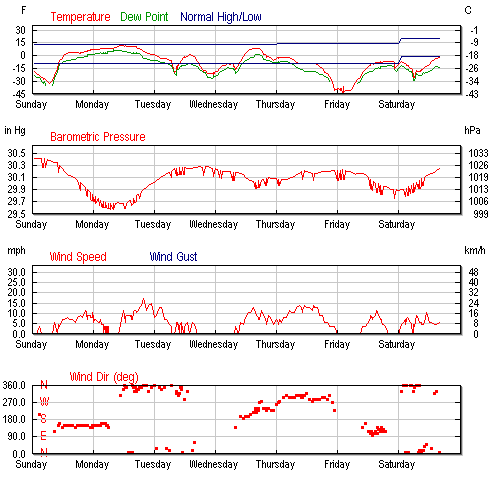
International Falls week ending 22 January 2011
The Meaning
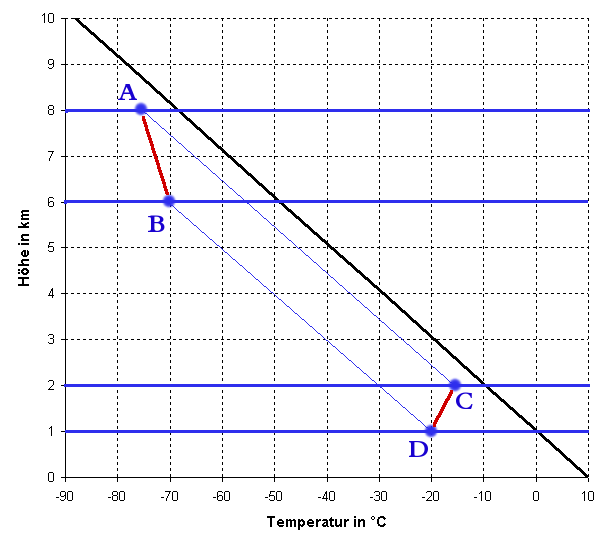
OK, so what does this mean? Typically it means that there was a temperature inversion on a cold clear night. (I was watching The Weather Channel when they reminded me of this with a brief coverage of how this particular cold record happened). Normally, temperature decreases with altitude, during an inversion the temperature is coldest at the surface and warmer at altitude. (The “D-C” segment in the diagram up top. It is showing how air from the ‘normal’ “A-B” segment, if descended, would result in an inversion).
Under certain conditions, the normal vertical temperature gradient is inverted such that the air is colder near the surface of the Earth. This can occur when, for example, a warmer, less dense air mass moves over a cooler, denser air mass. This type of inversion occurs in the vicinity of warm fronts, and also in areas of oceanic upwelling such as along the California coast. With sufficient humidity in the cooler layer, fog is typically present below the inversion cap. An inversion is also produced whenever radiation from the surface of the earth exceeds the amount of radiation received from the sun, which commonly occurs at night, or during the winter when the angle of the sun is very low in the sky. This effect is virtually confined to land regions as the ocean retains heat far longer. In the polar regions during winter, inversions are nearly always present over land.
That bit about relative IR rates is the key bit, from my point of view.
The Weather Channel also pointed out that the conditions needed were:
1) Clear sky. (i.e. no cloud layer blocking IR).
2) Still air. (i.e. no turbulent processes mixing the air and a lack of convective processes).
3) Dry air. (i.e. the water vapor content had to be taken out of the air for the IR to be free to leave).
So what does that LEAVE in the air? CO2.
Now think about this for a minute. If you have ANY of: Convection, barometric driven mixing, clouds, water vapor, water droplets; then IR does not dominate. With them all removed, and with the CO2 left in place, we have the full “CO2 Forcing” in effect (but unobscured by other drivers).
And what did we get? A New All Time Record Low.
I’d like to turn this into a whole lot more, but to me it’s clear and done at this point and any “more” is “less” clear.
CO2 is completely swamped by ANY of [ convection, wind, water vapor, clouds / water drops ] and when seen acting on its own can do nothing to prevent record lows from IR radiation from the surface.
There are sidebars and sidelights, but the crux of it is just that. CO2 is a wimp, and can be ignored. Water kicks sand in its face and clouds pee in its beer while the wind gives it a wedgie.
Sidebar on timing:
Look at the daily cycles. The IR cooling process happens in less than a day. From the 20th to the 21st things plunge. Why did it not happen on the 12th to 13th? Because IR was busy being beat up by the other processes. And when they are out of the way? Overnight a plunge to “way cold” that leaves CO2 “speechless”.
This means that the IR process is measured in HOURS, not days, weeks, months, and certainly not “30 year trends”. It’s over and done in HOURS. Trying to measure it with an annual average is folly of the worst sort. Trying to do so when there is clear evidence that it is irrelevant in the context of water and wind is lunacy. Doing it while completely ignoring clouds, humidity, and winds, as the “Annual Global Average Temperature” does is a bastard cross of folly with lunacy. “Just say no.”
Sidebar on Water and Wind
The Weather Channel put up two graphics. I don’t know if they were “typical” or actual data from the location, and I can only describe them here (i.e. I don’t have links… yet…)
One showed ‘normal conditions’ with it -40 F at altitude and something like -8 F at the surface, the other showed the inversion with it being -43 F at the surface (last night) and something like -15 F at 5000 feet. They then went into the above referenced discussion of the importance of ‘still air’ and low humidity to allow radiative cooling of the surface.
This made one thing very clear to me: Much of the “surface temperature” we measure is in fact measuring how much “vertical mixing” has happened (or not). We can get 30 F range based on how much vertical mix is going on? And nobody is taking that into account in the “Global Average Temperature”?
Where are the data on vertical mixing rates globally? Do we even have a clue how they change over time? Over 60 year PDO cycles? We’ve got 3 orders of magnitude “more there there” in the vertical mixing range than in the 1/100 C variations they are panicked over in “Global Warming” and it is being ignored?
Now look at that daily data again. Yes, there is wind moving things down from Canada, but it’s not the lateral displacement that is dominant here, it’s the vertical displacement. The lateral is taking several days to work, the vertical is much faster. There are “microbursts” that can down an airliner (over 2000 fpm downdrafts) and the distance we are talking about is 5000 feet. I make that 2.5 minutes time scale.
I’ve noted for a couple of years now that ever since the sun went quiet, the vertical atmospheric ‘thickness’ got compressed to thinner, and the PDO flipped: that the winds were more “bursty” and with more “vertical component” (in comments on various threads, many at WUWT). Now I think we have “why it matters”. Just ask the folks in Frostbite Falls…
Now, as that thinner colder layer gets colder (as has happened up North) we get more water vapor turned into ice crystals (all that snow on the ground as well as the ice in noctilucent clouds) and with more GCR (cosmic rays) making more condensation, if it’s more COLD condensation as ice, we get that “clear cold dry” air.
Conclusion
So, in the end, it’s all about what happens to the water, what happens to the wind, and what drives the clouds.
And even just ONE clear, dry, cold night with CO2 doing all it can but resulting in a record low EVER for that location pretty much says there is not a thing of importance being done by CO2. That even just one day away is drastically different says that the CO2 is not the “driver” here, it isn’t even in the passenger seat…
The white pine forests of Minnesota were wiped out from 1850 to 1910 and had about 3.5 million acres (5000 square miles) or about 100 Minneapolis heat-islands worth of heat trapping giant pine trees. Deer like to winter-yard in large pine stands because they are warmer. The winter-warming effect of these pine forests probably far exceeded any warming effect of CO2.
Has anyone ever looked at how removal of these white pine forests affected the historical temperature record? The white pine forest range covered a very large area, Northeast US to Minnesota and quite a distance south. Not many trees remain … perhaps 1%. Turn-of-the-century winter temps look awfully cold, was that because so many trees were removed leaving a blank white landscape (some of the old pictures of cutover forests are unbelievable)? Logging went far beyond run of the mill land-use issue, it was a wholesale reordering of the environment imo. How much warmer would winter temperatures in many areas of the country been a century ago if the forests were not cut?
@Tom_R
That’s the so-called “line broadening” effect that I mentioned in my post about Mars above: http://wattsupwiththat.com/2011/01/23/frostbite-falls/#comment-581784
The AGW camp uses that argument to mitigate the observed lack of CO2 warming on Mars. They say it’s the collisions with non-GHG gas molecules that explains why Earth is warmed by CO2, but not on Mars.
But as you pointed out, that argument works both ways. I’m inclined to believe that CO2, in effect, acts as a “thermal conductor” from the ground to upper atmosphere.
In the case of Mars, this belief is reinforced by actual observation (i.e., not the output of some modeling experiment). That’s why Mars is important as a “greenhouse gas laboratory”.
Joe Bastardi tweets:
Did you know International falls has 6 record lows in the past 3 jans? The station history is over a hundred yrs old. Next tweet,the math….. They should have a record every 3 winters. 6 in 3 winters is 6 times normal frequency. Unheard of: it happening in 3 winters in a row!…… 1909 though had 5 records, so for a single year, that is the benchmark
http://twitter.com/BigJoeBastardi
There are two statements in the thread essay that look similar but have different meanings. First :-
“If you have ANY of: Convection, barometric driven mixing, clouds, water vapor, water droplets; then IR does not dominate.”
And then :-
“CO2 is a wimp, and can be ignored. Water kicks sand in its face and clouds pee in its beer while the wind gives it a wedgie.”
The first statement is true, the second false.
Just because other factors dominate the CO2 effect does not mean it is ignorable.
Its effect may be small compared with the influence of water vapour, convection and clouds, but compare the rate and depth of the temperature drop on the Moon and the Earth.
When ther is REALLY nothing to provide back-radiation and the surface thermal energy drops as fast as possible the temperature fall far faster and further.
The statement CO2 is not in the passenger seat, it is not even in the car! Correct me if i am wrong but since CO2 needs IR to heat up goes on to when the sun goes down, CO2 loses its IR so no more heating of the air. No SUN = No WARM. I get so tired of reading that CO2 is a heat trapping gas, it can not trap heat only radiate it. Cloud cover at night keeps the warm in no clouds warm radiates to space. IMO
Tim Folkerts says:
January 23, 2011 at 9:58 pm
Obviously you do not understand the relationship between interest paid at the bank and the measure of CO2 in our atmosphere. There is none. Interest rate is a RATE, a change per time period. The measure of CO2 in our atmosphere is a static measure of the content of CO2.
You missed the whole point of the posting. The effect of CO2 on heat retention is so small, it might as well not be there.
Yes, CO2 has ‘some’ effect on the climate. So does my spitting on the sidewalk. But it doesn’t mean anything.
Izen,
The only reason CO2 is not ignored is the enormous amount of money perpetuating the “carbon” scare.
Steve Mosher says
‘It get’s much more complicated when you look at “all other things” but first
order physics says more c02 = warmer than less C02.’
Steve, I have great respect for your views on these matters . But I think that there is a basic fallacy here that permeates so many of these discussions. That is the (invalid) global averaging of chaotic, non-linear phenomena. Just because Co2 absorbs radiation does not necessarily mean that its effect is to raise the temperature. Co2 is much more uniformly distributed than water. Its effect may not be (probably is not) ‘first order’. So first order physics may not give the right answer.
EM is right!
The time constant is in hours not 30 year periods.
When you’re hot you’re hot and when you’re not you’re not.
(apologies to the late Jerry Reed)
@-Tom_R says:
“Can CO2 molecules also be pushed to a higher energy state via collisions with N2 and O2 molecules and then radiate that energy, some of which would go upwards? If so, wouldn’t adding CO2 drain additional heat from the atmosphere via this process?”
But it is the CO2 absorbing IR that then warms the N2 and O2. The CO2 converts photon energy into thermal energy and transfers that thermal energy to the bulk of the atmosphere. Any thermal energy that N2 or O2 transfer back to CO2 is then much more likely to be radiated as a photon, in a random direction, but the source of that thermal energy is the CO2 in the first place.
>> John Day says:
January 24, 2011 at 7:34 am
That’s the so-called “line broadening” effect that I mentioned in my post about Mars above: http://wattsupwiththat.com/2011/01/23/frostbite-falls/#comment-581784 <<
I think they are two different effects.
The pressure broadening is caused by a change in the central wavelength of the absorption/reradiation band due to collisions. Thermal doppler broadening would have a similar effect, and the two are possible conflated.
What Wayne described was a transfer of energy from a collision with an O2 or N2 molecule which would put the CO2 molecule into an excited state, just as if it had absorbed an IR photon.
Tom_R says:
January 24, 2011 at 7:10 am
——
Thanks for being a little curious Tom_R, that makes you a mind of science no matter what anyone tells you!
Maybe doom to Steven. That was given for the true science of the matter, notice how Steven’s quickly squelched the conversation away from science, be wary. Certain true science is blasphemy of the church to some, even here at wuwt.
That’s a real effect and you can find a bit more on infrared spectroscopy and it is also quantized, so gets a bit in quantum mechanics. I just can’t seem to remember how much energy therefore specific temperature is required and how prevalent it’s effect, and there is an equilibrium meaning the process can go both ways, give energy or take it.
I’ll see if I can look back up more info on it later and will post it back here tonight.
A starters to learn more might be here:
CO2 heats the atmosphere…a counter view
at http://wattsupwiththat.com/2010/08/05/co2-heats-the-atmosphere-a-counter-view/
Right there at the last statement is what I termed reverse thermalization.
Some people don’t even want this science information to see the light of day!
I for one want a discussion and to learn more for this is seems key to E.M. Smith’s article. That is why I posted the comment in the first place!
>> TimC says:
January 24, 2011 at 6:51 am
Then you open the *new* 1/1000 GPM leak – CO2, entirely man-made as from the industrial revolution (this was your analogy!). 1 gallon will be lost every 1.44 days; 1 ton every 323 days and so on. Slowly it will all drain away unless you also argue that natural fluctuations somehow also compensate for the leak. <<
You're missing his primary point. Based on the observation, the metaphorical bucket emptied in a matter of hours. The CO2 'hole' did not affect the final result, it only makes the heat loss take a few seconds longer each night.
My only awareness of International Falls is when I have been making my annual pilgrimage to Orlando – usually in the spring or autumn (that’s ‘fall’ to you, Anthony). Slightly obsessed with The Weather Channel, as I’m basking in 75-85F heat, I’m amazed to see the temperature in International Falls as -20, -30F or some such. I point this out to my wife, with the comment: ‘Who on earth would LIVE in International Falls..?’
Now I know..!!
Big respect….
This is exactly what I have been theorizing for a while:
That the effect of the total Global Warming factor could be assesed in watching the daily heat loss over the course of a day in different areas that have different CO2 concentrations and also different water concentrations, and that by looking at these minute data points we can dial in the effect of, say, 300ppm of CO2 vs 400ppm of CO2, since there are areas that have that difference currently.
We hear of long term testing, we hear of some seasonal, but I haven’t heard of various daily testing of points that progress through a day where there is a high CO2 concentration and a low CO2 concentration. It seems to me to be a logical way to figure out the differences between the GHE due to various factors.
This post makes a similar comment. I am curious if anybody here has seen any studies to that affect?
(On a side note, in Alaska I went to school in -44 weather in shorts, just to say I did it. -44 is cold…)
@Tom_R
How do you distinguish a “line broadening” collision from a “transfer of energy” collision?
If the absorption of an IR photon by a CO2 molecule somehow increases the “temperature”of that molecule, then thermodynamically that means the molecule is moving faster (i.e has higher momentum and kinetic energy) and its new speed can be calculated from the temperature alone:
v=sqrt(2kT/m), where m=mass k=Boltzmann const T=temperature
If this speedy CO2 molecule then bumps into another molecule, it transfers some of its momentum and energy to that molecule. Doesn’t make any difference whether it is another CO2 or N2/O2. Does it?
These collisions tend to redistribute the speeds and cause line thickening too.
What I don’t see is how this necessarily enables the CO2 warming on Earth, but disables it on Mars. I’m not denying the possibility. I would just like to see a conclusive experiment (not a model) that proves this.
What do you mean? It should have been -51F at International Falls that night instead of -46F, since CO2 warms the polar regions more than tropics.
Great post E.M.
Practical observation of a natures testing laboratory trumps a “synthetic” model world any day.
I watch this sort of relationship on a daily basis and it is a trivially obvious conclusion to those of us who live in high altitude arid regions were water vapor levels frequently drop to very low levels.
Winds and water vapor are the 600 lb gorillas in the room, CO2 is the infant squalling in the corner.
For those that want to watch this happen in real time just watch this web link on a low humidity night with no winds. (there is also a metric version of the page for those who prefer metric measurements)
http://www.eol.ucar.edu/cgi-bin/weather.cgi?site=fl&period=5-minute&fields=tdry&fields=rh&fields=cpres0&fields=wspd&fields=wdir&fields=raina&units=english
Larry
Tom_R says: January 24, 2011 at 7:10 am
A CO2 molecule absorbs at certain wavelengths to reach a higher energy state and then reradiates. Among the numerous CO2 absorptions and reradiations, some of the energy goes downward, – hence the ‘greenhouse’ effect. Can CO2 molecules also be pushed to a higher energy state via collisions with N2 and O2 molecules and then radiate that energy, some of which would go upwards? If so, wouldn’t adding CO2 drain additional heat from the atmosphere via this process?
My perspective is that Radiated Heat is a doubled edge sword i.e. it can cut both ways… and it is an issue most of us are very familiar with if we have a car… when a car is absorbing strong sunlight the temperature inside the car becomes higher than the air outside… this is the greenhouse effect as the hot air cannot escape from the car unless we open the windows. However, even with the windows closed the car is still radiating heat away… you will know this if you have even jumped into your leather drivers seat in your shorts… the leather seat is even hotter than the air in the car… so my guess is that all the plastic trim inside the car would start melting unless the car was radiating heat away on those lovely sunny days.
So far this car analogy is pretty much standard AGW greenhouse climate science… and lets image walking through a very large open field on this bright sunny cloudless day… it feels warm in the sunshine… now lets image walking through this field with 300 cars parked in it… we can probably feel some of that extra radiated heat as we pass by one of those parked cars… but overall the parked cars have very little effect on the average temperature of this large field… and increasing the number of parked cars to 400 doesn’t really do much either… especially as our field is so big it can hold up to 1,000,000 parked cars.
OK so far?
Now lets think about what can happen on a clear, cloudless night… those 400 parked cars start cooling down when the sun goes down… they keep on radiating heat during the night… and the air inside those becomes cooler… and the temperature inside the car is cooler than the outside air temperature before dawn… this is why you end up scrapping ice off your windshield even when there hasn’t been a frost. Now imagine walking through that field just before dawn sing your flashlight… perhaps you can feel the colder air you walk close by one of the parked cars… you might even see those frosted windshields… but overall the average temperature of the field isn’t cooled that much by those 400 parked cars.
Conclusion.
Heat Radiation is a double edged sword in AGW climate terms… CO2 could cause heating during the day… CO2 could cause cooling at night… these effects might even balance out… who knows… but either way the impact of CO2 is trivial because it is only 0.039% of the atmosphere CO2… it you think otherwise try getting drunk on beer that only contains 0.039% alcohol 🙂
One more thing, Tom, read very carefully:
If thermalization and it’s reverse, being a process under time reversal and equipartition, is such a very weak effect… then also CO2 heating the atmosphere is also an equally very weak effect and proven by the science! But if it is as I have read a very strong effect, 90+% of energy transfer being by this effect and radiation a mere 10% or so, what does that mean to you? If it’s strong, the Co2 cools just as strongly also.
To me, there is no hidden amount of warming by co2 underneath every temperature reading as Steven Mosher has stated above. If it’s minus 46 ºF now then it would have been minus 48 ºF if that poisonous CO2 was not present, I don’t buy that, by the real science. In fact, it seems it is exactly the opposite and CO2 does not “TRAP” heat, in fact it really makes it flow better, faster.
Oh, I’ve done it now! Shut the doors and turn off the lights… the creatures from the cellars of the Church of AGW will soon be upon us all reading this!
( Getting real tired of the games with the words, hiding the truth, and the whole truth never really being spoken. Especially here at wuwt this is supposed to be a science site, the truth of the science involved being open and all of it. This is one exact subject seems to be particularly sensitive to some. )
@ur momisugly Tim C
E M Smith actually said “There is a heat bucket into which we pour heat from the sun each day. The clouds, water vapor, and winds keep a 10 Gallon Per Minute hole plugged. We are also plugging a 1/1000 GPM hole with CO2. It’s a 100 gallon bucket. So one night the 10 GPM hole is left open and the darned thing drains dry in 10 hours. That 1/1000 GPM hole just doesn’t matter. (As every year has a few nights with the big holes opened).”
The 1/1000 GPM leak is plugged by the CO2, the CO2 isn’t represented by leaking, like you suggest. (What he forgot to add is every night an elephant drinks the water that doesn’t leak out, but on those nights the 10GPM leak is unplugged, the elephant gets cold as well as thirsty!)
@ur momisugly E.M.Smith
I like your post, a great example of the relative value in warming of CO2, H2O in all it’s forms, and convection. Thanks for that, chiefio.
Here is the Skew T chart for International Falls for the morning of the 21th taken at 6:00 AM local time. It shows the temperature increasing from surface to 700 mb (Approx 10,000 feet). The temperature stayed relatively steady at -8 to -10 from there to near the 250 mb level, which is likely the thermopause.
Note: For readers unfamilar with these charts the right line is the air temperature and the left is the dew point temperature
Ottawa, ON Canada broke a 41 year record for a Jan 24th low temperature. And the weather was clear and calm.
Sorry for … I double checked this story (http://www.ottawacitizen.com/news/Cold+snap+shatters+year+record/4156017/story.html) and it’s false. The record low for Jan 24th is from 1976…. when it was also clear and calm.
Pbjosh,
“We hear of long term testing, we hear of some seasonal, but I haven’t heard of various daily testing of points that progress through a day where there is a high CO2 concentration and a low CO2 concentration.”
Good point. I don’t think there is a big enough difference in co2 levels from place to place, although there is the annual cycle, but even that doesn’t amount to much. My suggestion is to construct three transparent tubes that go from the surface to the stratosphere. One contains normal air, the second contains air with co2 at pre-industrial levels, and the third contains air with double the pre-industrial level. The downwelling radiation can be measured and that would at least give a good approximation to the forcing.