Guest post by E.M.Smith
Temperature Inversion
The Event
We’ve recently had some very cold days in International Falls.
This posting:
http://wattsupwiththat.com/2011/01/21/new-record-cold-tempertures-in-minnesota/
has a nice write up of the -46 F new record cold. ( That’s -43.33 C – still damn cold.) This is not just another “oh a record” posting. I’m asking “what does this mean about the magnitude and time scale of CO2 action?” and finding it means “not much” and “very short term”. But first, the data:
RECORD EVENT REPORT
NATIONAL WEATHER SERVICE DULUTH MN
518 PM CST FRI JAN 21 2011
…RECORD LOW TEMPERATURE SET AT INTERNATIONAL FALLS MN…
A RECORD LOW TEMPERATURE OF -46 DEGREES WAS SET AT INTERNATIONAL
FALLS MN TODAY. THIS BREAKS THE OLD RECORD OF -41 SET IN 1954.
Last night set a “daily record” too, but not a new “all time record”.
Here is a monthly chart so you can see if anything “interesting” happens on that scale:
And here is a ‘close up’ on that week in particular:
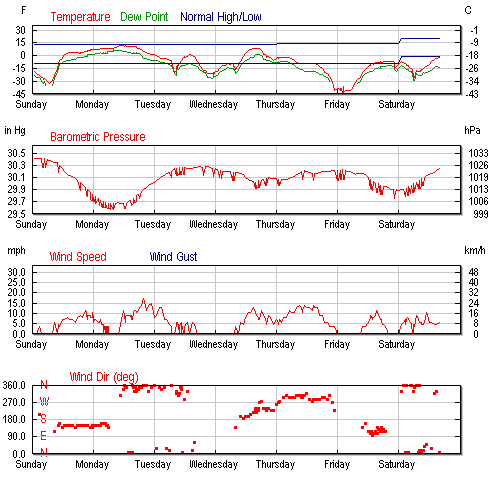
International Falls week ending 22 January 2011
The Meaning
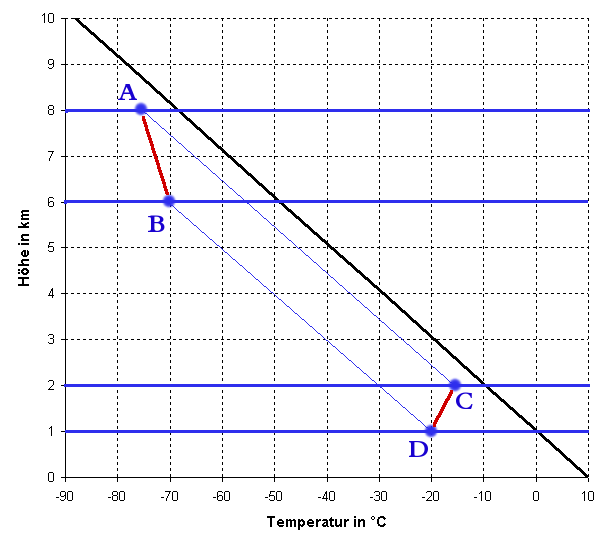
OK, so what does this mean? Typically it means that there was a temperature inversion on a cold clear night. (I was watching The Weather Channel when they reminded me of this with a brief coverage of how this particular cold record happened). Normally, temperature decreases with altitude, during an inversion the temperature is coldest at the surface and warmer at altitude. (The “D-C” segment in the diagram up top. It is showing how air from the ‘normal’ “A-B” segment, if descended, would result in an inversion).
Under certain conditions, the normal vertical temperature gradient is inverted such that the air is colder near the surface of the Earth. This can occur when, for example, a warmer, less dense air mass moves over a cooler, denser air mass. This type of inversion occurs in the vicinity of warm fronts, and also in areas of oceanic upwelling such as along the California coast. With sufficient humidity in the cooler layer, fog is typically present below the inversion cap. An inversion is also produced whenever radiation from the surface of the earth exceeds the amount of radiation received from the sun, which commonly occurs at night, or during the winter when the angle of the sun is very low in the sky. This effect is virtually confined to land regions as the ocean retains heat far longer. In the polar regions during winter, inversions are nearly always present over land.
That bit about relative IR rates is the key bit, from my point of view.
The Weather Channel also pointed out that the conditions needed were:
1) Clear sky. (i.e. no cloud layer blocking IR).
2) Still air. (i.e. no turbulent processes mixing the air and a lack of convective processes).
3) Dry air. (i.e. the water vapor content had to be taken out of the air for the IR to be free to leave).
So what does that LEAVE in the air? CO2.
Now think about this for a minute. If you have ANY of: Convection, barometric driven mixing, clouds, water vapor, water droplets; then IR does not dominate. With them all removed, and with the CO2 left in place, we have the full “CO2 Forcing” in effect (but unobscured by other drivers).
And what did we get? A New All Time Record Low.
I’d like to turn this into a whole lot more, but to me it’s clear and done at this point and any “more” is “less” clear.
CO2 is completely swamped by ANY of [ convection, wind, water vapor, clouds / water drops ] and when seen acting on its own can do nothing to prevent record lows from IR radiation from the surface.
There are sidebars and sidelights, but the crux of it is just that. CO2 is a wimp, and can be ignored. Water kicks sand in its face and clouds pee in its beer while the wind gives it a wedgie.
Sidebar on timing:
Look at the daily cycles. The IR cooling process happens in less than a day. From the 20th to the 21st things plunge. Why did it not happen on the 12th to 13th? Because IR was busy being beat up by the other processes. And when they are out of the way? Overnight a plunge to “way cold” that leaves CO2 “speechless”.
This means that the IR process is measured in HOURS, not days, weeks, months, and certainly not “30 year trends”. It’s over and done in HOURS. Trying to measure it with an annual average is folly of the worst sort. Trying to do so when there is clear evidence that it is irrelevant in the context of water and wind is lunacy. Doing it while completely ignoring clouds, humidity, and winds, as the “Annual Global Average Temperature” does is a bastard cross of folly with lunacy. “Just say no.”
Sidebar on Water and Wind
The Weather Channel put up two graphics. I don’t know if they were “typical” or actual data from the location, and I can only describe them here (i.e. I don’t have links… yet…)
One showed ‘normal conditions’ with it -40 F at altitude and something like -8 F at the surface, the other showed the inversion with it being -43 F at the surface (last night) and something like -15 F at 5000 feet. They then went into the above referenced discussion of the importance of ‘still air’ and low humidity to allow radiative cooling of the surface.
This made one thing very clear to me: Much of the “surface temperature” we measure is in fact measuring how much “vertical mixing” has happened (or not). We can get 30 F range based on how much vertical mix is going on? And nobody is taking that into account in the “Global Average Temperature”?
Where are the data on vertical mixing rates globally? Do we even have a clue how they change over time? Over 60 year PDO cycles? We’ve got 3 orders of magnitude “more there there” in the vertical mixing range than in the 1/100 C variations they are panicked over in “Global Warming” and it is being ignored?
Now look at that daily data again. Yes, there is wind moving things down from Canada, but it’s not the lateral displacement that is dominant here, it’s the vertical displacement. The lateral is taking several days to work, the vertical is much faster. There are “microbursts” that can down an airliner (over 2000 fpm downdrafts) and the distance we are talking about is 5000 feet. I make that 2.5 minutes time scale.
I’ve noted for a couple of years now that ever since the sun went quiet, the vertical atmospheric ‘thickness’ got compressed to thinner, and the PDO flipped: that the winds were more “bursty” and with more “vertical component” (in comments on various threads, many at WUWT). Now I think we have “why it matters”. Just ask the folks in Frostbite Falls…
Now, as that thinner colder layer gets colder (as has happened up North) we get more water vapor turned into ice crystals (all that snow on the ground as well as the ice in noctilucent clouds) and with more GCR (cosmic rays) making more condensation, if it’s more COLD condensation as ice, we get that “clear cold dry” air.
Conclusion
So, in the end, it’s all about what happens to the water, what happens to the wind, and what drives the clouds.
And even just ONE clear, dry, cold night with CO2 doing all it can but resulting in a record low EVER for that location pretty much says there is not a thing of importance being done by CO2. That even just one day away is drastically different says that the CO2 is not the “driver” here, it isn’t even in the passenger seat…
In one fell swoop E.M.Smith demonstrates with an observed, documented event from real life – as opposed to computer models – that it is nonsense to fixate on just CO2 as the main and only culprit of GW, never mind if its AGW or cAGW.
My gut reaction, for a good long time now, has been: ‘wot – no clouds?’ when reading about the dire consequences of adding CO2.
Thanks to this post by E.M.Smith, and those by Willis, shouldn’t it be clear that leaving clouds, H2O, winds, out of the equation will not describe what is really going on?
LazyTeenager says:
I became suspicious and decided to check because EM claimed, without providing evidence, that a thermal inversion based on radiation imbalance was involved,
Perhaps you missed the part where I stated that this was based on The Weather Channel reporting the conditions and mechanism?
“I was watching The Weather Channel when they reminded me of this with a brief coverage of how this particular cold record happened.”
and
“The Weather Channel put up two graphics. I don’t know if they were ‘typical’ or actual data from the location, and I can only describe them here (i.e. I don’t have links… yet…)”
“One showed ‘normal conditions’ with it -40 F at altitude and something like -8 F at the surface, the other showed the inversion with it being -43 F at the surface (last night) and something like -15 F at 5000 feet. They then went into the above referenced discussion of the importance of ‘still air’ and low humidity to allow radiative cooling of the surface.”
So please read a bit more carefully before asserting I’ve said something without citation when it is right in front of you.
It also appears that Yahoo is attributing this particular cold snap to cold winds blowing out if Canada.
Don’t know what winds you are getting out of Yahoo, but look at the daily chart up top on the night when we hit -46 F. Look at the “windspeed” line. Notice that it reads ZERO over the word “Friday” when the record is set. That is the time when the air is still and the process happens. So good luck with that whole “winds blowing it in” thing with a measured ZERO at the time…
I suspect that the error you are embracing is the usual CAGW one of extending your time horizon further than justified and dragging in exogenous events / time / places. So could this overall “cold snap” (usually measured over many days) be drifting down from Canada? Sure. Was it being driven in by winds at the time I’m talking about? Nope. Documented.
Per your question on snow, I’ll leave that for others. There is a 24 hour average in any one day, and the cold period of inversion did not last the entire 24, so unless we’ve got some ‘by the hour’ data on snowfall, I’m just not seeing anything worth discussing. My best estimate would be that you are dragging in events from later in the day when the winds picked up (and the temperatures too… also looks like the barometric pressure dropped. must have been that Canadian air being blown in to warm things up by 30 degrees F 😉
For serious cold at these latitudes, you also need snow cover. That blanket keeps ground heat in and offers up very little thermal mass to radiate/conduct at night.
Altitude and thin air helps too.
Dry air is important two ways – less water vapor to block IR, and less latent heat released by frost formation. By the time the dewpoint gets down to -20 or so there’s not enough frost forming to slow things down much.
My low temp here in New Hampshire this AM was -10°F, I think that’s the second lowest I’ve recorded. See http://home.comcast.net/~ewerme/wx/current.htm , and that was recorded without calm winds. Pretty amazing. The NWS forecast had called for -23°F and that was achieved NW of here, e.g. KLEB (Lebanon).
Sure would like one of them Rossi devices right about now!
Is there any study, comparing the tmin with tmax? Because per GH theory, tmin at night should be affected most. Of course, one has to pick a proper rural station, since tmin is affected by UHI as well.
Re “CO2 as insulating blanket”
Using descriptions at complete odds with what is actual amount is AGWScience in a nutshell here, just how many holes are there in that blanket which are not CO2?
I appreciate articles such as these that explain the issues down to a layman’s understanding. Thanks Willis!
@Viv Evans:
Glad I could be of some assistance. IMHO, it’s very easy to get all wound up in a hypothetical toy world, even festoon it with a lot of mathematical analysis, and forget that sometimes you must simply look at what is happening and ask questions.
PhilJourdan says: I appreciate articles such as these that explain the issues down to a layman’s understanding. Thanks Willis!
I’ll take that as a very high complement indeed. Someone tell Willis he’s got competition 😉
Juraj V. says:
January 24, 2011 at 5:14 am
I happened to have this study handy after reading E Ms article at Chiefios. You can have it 🙂
http://www.john-daly.com/barker/index.htm
Baa Humbug,
Another gem from the late, great John Daly’s website! Thanks for posting.
The last sentence in the Conclusion: “It is interesting to note that a 0.6% increase in the solar output would correspond to about 0.6°C increase in global temperatures using the Stefan-Boltzmann law and a solar radiance of 1,390 W/m2.”
The increase in solar irradiance correlates well with the *mild* 0.7° warming over the past century.
Today is the anniversary of the record cold drop in the U.S. during 24 hours. At Browning Montana in 1916 the temp. dropped 100 degrees from +44 to -56.
thank Adonai for the UHI effect. It only got down to -4F in Newton MA last night according to my Vantage VUE.
I find myself very much in agreement with what E M Smith has said in this post and in his subsequent comments.
Dave Springer says:
January 23, 2011 at 10:39 pm
“CO2 is completely swamped by ANY of [ convection, wind, water vapor, clouds / water drops ] and when seen acting on its own can do nothing to prevent record lows from IR radiation from the surface.”
I’d be surprised if there are there any climate boffins who would contend that convection et al do not have the potential to effect local/regional weather to a much greater degree than CO2. That seems like a given in any informed discussion of the subject that should go without saying.
The problem is we’re still left with the fact CO2 is still there and it still adds a surface forcing. So the record cold would have been a bit colder had anthropogenic CO2 been absent. That also should go without saying.
I don’t see how this changes the debate at all.
////////////////////////////////////////////////////
Had there been less CO2 in the atmosphere, it would not have been colder that night. It would merely have taken slightly less time (and this may be measured in seconds, if not minutes) for the record cold to have been reached.
I think that some people fail to appreciate that occasionally nature allows us a rare glimpse to see what real and practical effect CO2 has when acting in isolation, ie., when “convection, wind, water vapor, clouds / water drops” etc are not masking what effect CO2 really has. When these other factors are removed, one can see that the real effect of CO2 is in fact inconsequential. I am not saying that it has no effect at all, merely that in isolation its effect is insignificant and for all practical purposes one can say that it is so ineffective that it can be ignored.
I also consider that people fail to realize that the effect observed in the example cited by E M Smith (ie., the extent to which CO2 is hindering heat loss) is happening every night at every location of the planet but the only reason we do not see this rapid heat loss is that almost always the other factors (ie., “convection, wind, water vapor, clouds / water drops”) are in play such that these other factors (and not the presence of CO2) prevent the remarkable heat loss. If it were not for these other factors, almost always being in play, we would be freezing no matter whether CO2 levels were doubled or tripled or quadrupled since the real effect of CO2 is negligible and is dwarfed by other processes.
None of this should be that surprising since back radiation does not heat, it merely slows down heat loss, and it does not, in practical terms, matter whether a photon takes a direct route to space involving a distance of say 20 to 30 km or whether it collides with CO2 molecules on its way such that it gets bounced around and ends up having to do a trip of a 100,000 km or 1,000,000 km. Given the speed at which photons travel and given the low concentration of CO2, there is ample time at night for all the heat energy to escape back to space (if it were not for the other factors that almost always are in play). As E M Smith observes, it does not matter whether CO2 in the atmosphere delays the time taken for the heat to be lost by 1 second, 1 minute, 10 minutes or 1 hour, The bottom line is that irrespective of the levels of CO2 in the atmosphere, during the night, there is sufficient time for all the heat to find its way back out into space and would do so but for the other factors in play.
I would like to thank E M Smith for this very good and important post.
But without the CO2 driven global warming, the temperature at Ind. Falls would have been -57F. That’s 5 degrees celsius of warming!!!! SUFFER YOU MINNESOTANS… SUFFER GLOBAL WARMING!!
/sarc off (number picked for easy math… it’s early, give me a break)
Actual measurements of downwelling ‘backradiation’ would seem to support E M Smith in regards to the importance of CO2 versus H2O.
Canada
Evans and Puckring 2005, measured at Trent University in Peterborough, Ontario (44oN, 78oW) – [note-geographically similar to northern Minnesota]. From their Table 3a:
Winter
H20 94 to 125 W m-2
CO2 31 to 35 W m-2
Note that in Winter, with lower atmospheric moisture, the H2O contribution is about 3x that of CO2.
Summer
H20 178 to 256 W m-2
CO2 10.5 W m-2
In Summer, with higher atmospheric moisture, the H20 value went up and the CO2 backradiation went DOWN SIGNIFICANTLY.
Antarctica
But the current E M Smith article is for very low temperatures and very low moisture. So lets look at similar downwelling backradiation measurements in Antarctica, as reported by Spectral and Broadband Longwave Downwelling Radiative Fluxes, Cloud Radiative Forcing and Fractional Cloud Cover over the South Pole_TownEtAl_2005.pdf
They find that – “Water vapor contributes approximately two thirds of the LDFclear regardless of season while CO2 contributes about one-third. The actual ratio of H2O/ CO2 LDFclear is in the range 2.1–2.3 throughout the year. This constancy is surprising because precipitable water vapor (PWV) decreases significantly from summer to winter, but atmospheric CO2 concentration remains constant as the atmospheric temperatures drop dramatically.”
From their Table 7 (units are W m-2)
Winter
H2O 48
CO2 23
Summer
H2O 83
CO2 35
In both papers, the measured backradiation from ‘all other GHG’ was significantly less than the CO2 values, so CO2 plus H2O accounted for 90 to 95% of the totals.
And lastly in relation to the Kiehl and Trenberth 1997 diagram that shows 324 W m-2 ‘backradiation’ from Greenhouse gasses. The measured values listed above for CO2 are only about 30 W -m2 (no more than about 10% of K&T). To get from 30 up to 320 takes a heck of a lot of water. Or as noted by E M Smith –
“CO2 is a wimp, and can be ignored. Water kicks sand in its face and clouds pee in its beer while the wind gives it a wedgie.”
Good post – it makes reasonable logic sense to me.
If others want to shoot it down (and show ‘it was CO2 wot dun it, Guv!’) then I suggest they provide a detailed explanation of the actual Observations given – without computer models (;))- and preferably in as astute manner as performed by the venerable E M Smith.
I’m sure myself and others here will be happy to read such explanation(s) and thereafter decide which theory fits the OBSERVED data best!
Steven Mosher says: (January 24, 2011 at 2:35 am)
“Another simple way to look at it is this.
C02 can never cause warming.
C02 causes warming, but the effect is too small to measure, yet.
C02 causes some of the warming we have seen and so does internal variability
C02 causes most of the warming we have seen, more than internal variability has.”
The bottom line is are we willing to accept the redistribution of trillions of dollars by self appointed guardians of humanity just in case #4 may be correct.
Now, as Milankovitch cycles return us to a long period of glaciation (and they will), I am hoping that #4 is correct and advocate a policy that we should do nothing to stop it. After all, warmer is truly better for humanity and we should do everything (or nothing in this case) to make it so.
*****
Now think about this for a minute. If you have ANY of: Convection, barometric driven mixing, clouds, water vapor, water droplets; then IR does not dominate. With them all removed, and with the CO2 left in place, we have the full “CO2 Forcing” in effect (but unobscured by other drivers).
*****
That’s true, but most areas under this bitter cold seem to have ice-fog forming near the surface, so there’s some latent-heat release due to condensation & freezing of water vapor.
It seems that the Minnesota cold has reached the east: -25 F this morning in western New Hampshire, predicted high today of 5 F. The good news is that my car started this morning (left outside all night)…
To EM: thanks for your go-around but I’m sorry that I still believe your actual argument/observation is fallacious.
On your bucket example, don’t forget that for eons before you opened the new 1/1000 GPM leak the bucket (perhaps we should better say reservoir) was effectively in balance – the effect of all natural variations, however large in themselves, had always cancelled out to zero. (Of course were long-term fluctuations such as the ice ages during the quaternary, but the system remained stable and convergent overall, during all of these).
Then you open the *new* 1/1000 GPM leak – CO2, entirely man-made as from the industrial revolution (this was your analogy!). 1 gallon will be lost every 1.44 days; 1 ton every 323 days and so on. Slowly it will all drain away unless you also argue that natural fluctuations somehow also compensate for the leak. I don’t think that was your argument (although I personally think it is likely that the system has a regulator – it has proved very stable otherwise none of us would be here to worry about it); your argument/observation was that the leak was so trivial compared with natural phenomena that it could just be ignored.
I didn’t actually suggest that excess heat would just build up – I said the forcing (the lessening in IR reflected radiation suggested as produced by the extra CO2) would produce “a small averaged temperature increase”. That is because its effect on temperature is logarithmic, for which a fourth power is just a walk in the park: the log of even the exponential function produces only a straight line slope.
“So the record cold would have been a bit colder had anthropogenic CO2 been absent. ”
I doubt this is a proveable statement.
Warm is good. Cold kills.
>> Steven Mosher says:
January 24, 2011 at 2:39 am
sorry wayne. I’ve seen no published physics that establishes that. No experiments that establish it and its totally at odds with the observational record. It makes the past less understandable no more understandable. It makes a hash of our understanding of how other planets operate.
Back to Science of doom class for you. <<
Wayne brings up an interesting point which I don't remember hearing before.
A CO2 molecule absorbs at certain wavelengths to reach a higher energy state and then reradiates. Among the numerous CO2 absorptions and reradiations, some of the energy goes downward, – hence the 'greenhouse' effect.
Can CO2 molecules also be pushed to a higher energy state via collisions with N2 and O2 molecules and then radiate that energy, some of which would go upwards? If so, wouldn't adding CO2 drain additional heat from the atmosphere via this process?
When you live in Iowa, those perfectly clear night when the stars are gorgeous and bright is when you need to pull your thermal underwear tight. Then, put extra wood on the fire, plug in the oil pan heater on the car, set all of the faucets to drip, and make sure all unused flues are closed. Dogs do their business in record time and the cats don’t move all night while sleeping on the registers. Yep, those clear winter nights are killers. School gets cancelled on account of cold, not snow.
CO2 is a wimp, and can be ignored. Water kicks sand in its face and clouds pee in its beer while the wind gives it a wedgie.
Wonderful posting…. relished your responses… anyone who wants a realistic perspective should also take a look at the glorious Ignore The Day At Your Peril posting by E. M. Smith
http://chiefio.wordpress.com/2010/12/28/ignore-the-day-at-your-peril/
[Anthony: That is meant to be a BIG HINT :-)]
THANK YOU E. M. SMITH
Tim Folkerts says: “Similarly, CO2 provides only a small part of the total back radiation. But a small change in that 300+W/m^2 IR would lead to noticeable changes in climate.”
Tim, I have a question for you, or for anyone who knows the answer. I have seen the number 300 W/m^2 IR in many publications. I have asked, and been told, that it is the average amount of heat hitting the surface of the earth, taking into account that the earth is a sphere. Since it is an average, and hopefully not just a number pulled out of a hat, it is probably based on some sort of averaging formula. My question is: What is the plus/minus error on the 300 W/m^2? What is the standard deviation on this number?
Tim Folkerts says: “Clearly CO2 has SOME effect on climate. And even 1 or 2 W/m^2 has a noticeable effect on global temperature”
My concern is that the number 300 is a nice big round number. It isn’t 293 or 307, it is just 300. Yet even a 1 or 2 W/m^2 has a noticeable effect on global temperature. Now, it could be that the carefully calculated number actually is 300, but in that case wouldn’t it be written as 300.0 to show that a calculation was done with a standard deviation down in the tenth’s of W/m^2? Written as 300, I could easily be forgiven for asking if the standard deviation is 100, though 50 would actually be reasonable also.