One of the more common visual tactics used by AGW proponents to scare people into thinking that AGW induced sea level rise is a big threat is to show altered photographs and GIS models of a city near the ocean (take your pick, New York, London, San Francisco etc.). These futuristic images demonstrate what the city might look like once global warming kicks in and kicks our butt, apparently without anyone noticing the advance of the sea. Take for example, lower Manhattan, one of the more common targets. The top image is a future shock rendition from the History Channel “Armageddon Week” and the bottom image is a photo of present day reality from Wikimedia.


Scary huh? And it’s not just photos, now that most anyone with a PC can run Google Earth, there’s a veritable cottage industry of people who make sea level inundation KML files using the 3D buildings feature for major cities. It works very well to get people’s attention. But how much of a looming threat is it when compared to the reality of measured sea level rise? Let’s find out.

Will Manhattan really look like that in the future? You can even interactively freak yourself out here, at Climate Atlas, and see what it looks like in NYC when the entire Greenland Ice Sheet melts:

Gosh.
Well, I can see how people must be terrified. Just look at this plot of sea level rise at the Battery Park tide gauge from NOAA:

Yeah, it’s headed up, wayyyy up. 2.77 millimeters per year. So, to get the levels in the photo and 3D GE model shown above, we’d need to do some simple calcs.
The Google Earth 3D model is easy. It specifies a 3-5 meter sea level rise, so we’ll call it 4 meters.
For calculation purposes, we’ll assume sea level rise to be linear, and round up the Battery Park tide gauge rate to 3.0 mm per year, which puts it closer to the 3.1 mm per year measured by satellite and published at Colorado State University’s Global Sea Level Page.
4 meters = 4000 millimeters
4000 millimeters /3.0 millimeters per year = 1333 years

Now, how about the doctored image from the History Channel? There’s no reference given on the height of sea level rise on the web page, but fortunately, we have built-in yardsticks in the image. The story height of buildings in the photo can easily be estimated from the before and after photos shown at the top of this post.
I’ve selected the white building on the northeast side of Battery Park, along South St. I counted 18 stories of that building as being underwater using the hi-res image here , and I’ll estimate from other objects in the photo (like the water to pier to street height) that it is an additional 2 stories from street level there to the present day sea level (PDSL).
So what is the height of a story? The Council on Tall Buildings and Urban Habitat gives a handy guide on story height for office buildings like that one. They say that an office building like that one has a story height of 3.9 meters , so we’ll use that.
History Channel photo submersion = 20 stories
Story height = 3.9 meters
Sea Level Rise in the photo 20 x 3.9 meters = 78 meters
78 meters = 78,000 millimeters
78,000 millimeters / 3 millimeters per year = 26,000 years


26,000 years to get that? Would those buildings still be standing then? And even more important, wouldn’t we be in a new ice age by then? If we did enter another ice age, sea level would be lower, as demonstrated in this graph below. Note the level 24,000 years ago.

This demonstrates the folly of assuming that climate change, and hence sea level rise, is linear. As we all know, it isn’t, yet that doesn’t stop many AGW proponents from using present day measurements to project linearly into the future and then generate scary scenarios and visuals from it.
Even on the short-term, such predictions fail miserably. Take for example Dr. James Hansen of NASA GISS. Read his prediction 20 years ago about sea level rise in New York City, which I previously covered on WUWT in A little known 20 year old climate change prediction by Dr. James Hansen – that failed badly.
He said that [in 20 years]:
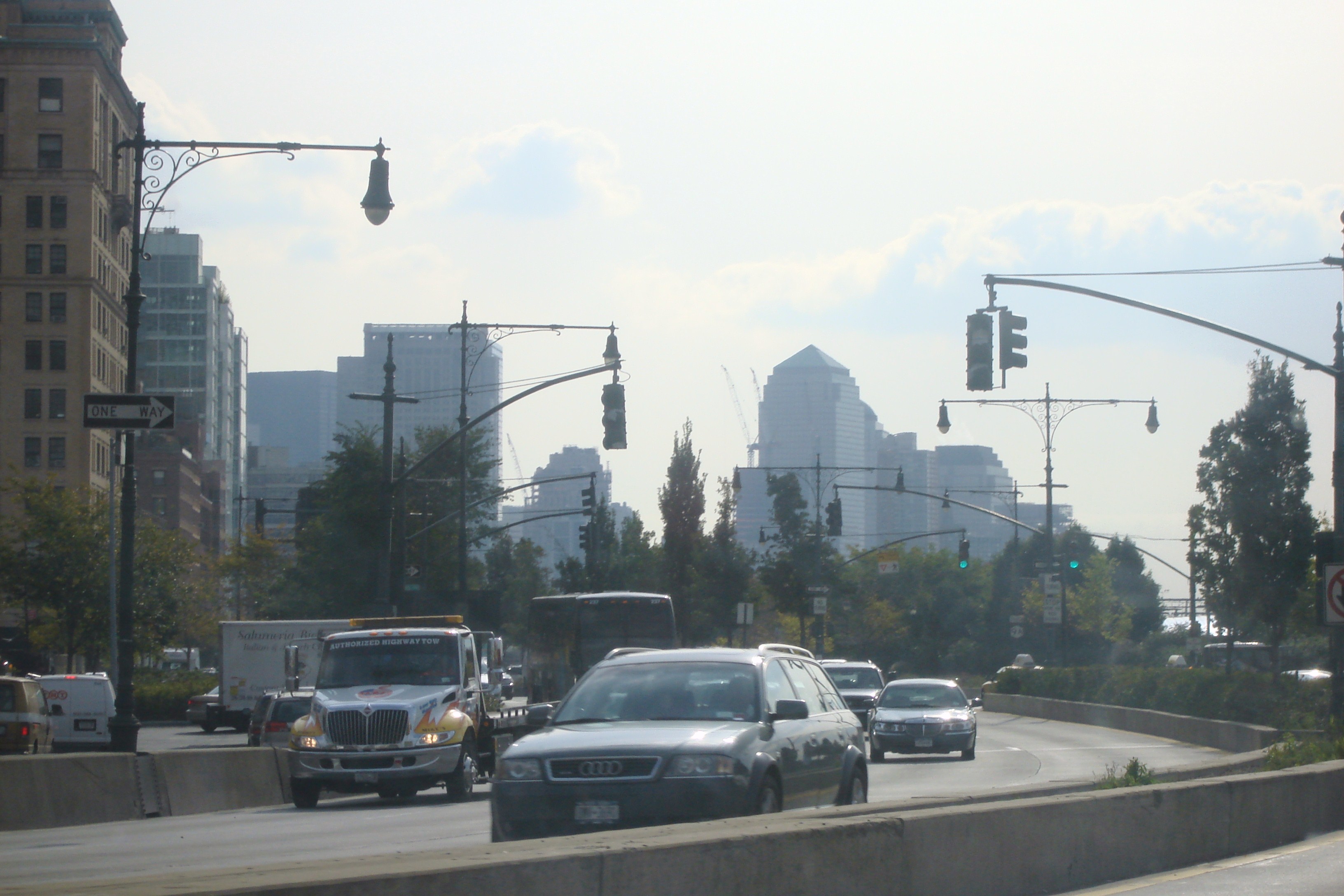
“The West Side Highway [which runs along the Hudson River] will be under water.
Problem is, here it is 20 years later, and people still drive that highway today without the use of Jet-Skis.
What got me started on this post was a comment left on WUWT by “Rascal”
Submitted on 2010/11/26 at 7:46 pmCopy the following address in to your browser, and observe the expansion of lower Manhattan since 1660.
http://www.racontours.com/archive/coastline_anim.php
Note that the West Side Highway (West Street) over half of the World Trade Center site, and the South Street Seaport were “under water” in 1660!
He’s right. And one thing many AGW proponents don’t consider (in addition to the non-linearity of climate) is the adaptability of humans. For readers here, I’ve taken that Flash animation at Racontours.com and made it into an animated GIF below:

They write about this historical account of lower Manhattan:
Based on our study of historical maps of Manhattan, Racontours has been able to create this simulation of the expansion of the island’s coastline. This topic is covered in both our South St. Seaport and Lower Manhattan tours, and most people are amazed at the transformation that’s taken place. Pearl St, named for the seashells that washed up there, once ran along the river. (Click here for a view of Captain Kidd’s house at the corner of Pearl & Wall Streets)
The first land reclamation was undertaken by Peter Stuyvesant upon taking over as the colony’s governor in 1646. Hoping to facilitate waste disposal and transportation, he organized the excavation of the canal along what is now Broad St. Back then, this was still called New Amsterdam, and the Dutch were great believers in canals.
By the American Revolution, the city’s population had grown to 30,000, and land had become scarce and cramped in the city center. That’s when the city began to sell ‘water lots’, wherein entrepreneurs would seek to use landfill to create additional lots for use.
The most recent landfilled area led to the creation of Battery Park City, built in the 70’s on the earth excavated from the World Trade Center’s foundation.
Based on the 2.77 millimeters per year (call it 3 mm) of current sea level rise as shown by that Battery Tide gauge, in the 344 years (1660-2004) the sea level would have risen by:
344 years x 3 millimeters/year = 1032 millimeters or 1.032 meters.
Clearly, New Yorkers have been able to stay well ahead of that 1 meter rise since the city was founded.
The next time your friends get freaked out about sea level rise, or “high water”, show them this.
Discover more from Watts Up With That?
Subscribe to get the latest posts sent to your email.
Well I’ve looked at a number of these high rise water pictures and they all have one thing in common. All of the sea level rise takes place inside a bathtub; they just show the water going up the vertical walls.
How about showing all of the new beach front property that will be created; which will slow the rise rate down.
In fact my analysis suggests that the actual rise is consistent with it being a logarithmic function of the total ice melt rate; so all these disaster predictions; excuse me; projections; are highly exaggerated. There’s a fairly good chance that the sea level will stop rising; certainly by the time all the land is covered; or if not then shortly thereafter.
We have plenty of time to build boats, since my analysis shows that the time to inundation grows exponentially with the ice melt amount; so even though the sea level rise will evntually stop; we will never get to total inundation anyway; so that means we don’t need to build so many boats.
Mike says –
” And how do we convince the plankton to adapt? ”
Speak politely, just like Prince Charles does to his flora.
My wife has an aunt that will turn 100 next month. She still has all her marbles and has a very good memory. She can remember going to the train station to see off her dad as a soldier to France in WW. She still has the little Canadian flag she waved on that day.
I asked her what else she could remember from her early years, specifically mentioning New York City. Not a word came up about the water level in the harbor.
From the early years the only things that mattered was WW1, the depression and WW2. I figured I might as well ask someone who was around in those early years to see what mattered.
The ENSO and sea data page show that the apparent step down in sea level rate of rise which occurred around 2006, is continuing, as Juraj V also noted.
Also, the persistent warm pool in the west Pacific is finally shrinking.
I can’t help but feel that so much of AGW has come down to some sick version of Pascal’s wager (religious philosophy). Pascal basically said that belief in God was a good idea logically because when the options were broken down into equal probabilities, only one choice allowed access to heaven and had no equivalent positive on the lack of belief side (Either there is a God, you believe and go to heaven or disbelieve and go to hell. Or there is no God and your belief gained you or lossed you nothing.) Problem being with Pascal’s wager is the same as with AGW today.
The greenies scream at you about Mitigation, because their calculations don’t take into account the same things that Pascal didn’t.
1) Is the belief you speak about even the right one? Pascal’s wager states that belief in God is the best bet, but how do you choose the RIGHT religion? His answer was based in his own biased worldview where Christianity was inherently right, but if the correct answer was the Mayan beliefs, then we’re all screwed today.
Similarly, the idea of mitigation only works if you pick the RIGHT future scenario of doom and gloom and mitigate appropriately. Presuppose that AGW is wrong, and in 20 years glaciation will already be advancing into inhabited areas of Russia and Canada, all your attempts to decrease carbon to offset warming was wasted and you’re now going to go desperately in the other direction to stave off as much damage as possible.
2) The wager ignores the damages done inherently by accepting that belief over disbelief/uncertainty. Assuming Christianity is wrong, you haven’t *only* made the wrong choice by believing, but you’ve spent numerous hours devoted to that cause. While with religion, many of the actions made in the name of your belief will be (hopefully) altruistic, what about the people who shoot abortion doctors over their belief in God? Did these people’s actions, assuming a world without God, make the world a better place for people? Were their actions, in the name of their religion, inherently good? Misdeeds performed, time/money wasted, and active suppression of REAL ideas in the name of the dogmatic laws of the belief structure can serve to stifle appropriate debate in the name of beliefs. Without AGW, maybe we’d have a better idea of what was really going on on this planet, climate-wise, and maybe the environmental movement would be involved stopping something people actually would care about appropriately.
Just like with religion, the unintentional attempting to resurrect Pascal’s wager as a AGW-belief cry (do it because not doing it isn’t logical since if I’m right we’re all screwed and if you’re right, nothing will happen and you didn’t waste anything) is wasting manpower, money, and credibility of the enviros. Mitigation for the sake of uncertainty, coupled with the economic suicide it brings is enough reason to send the AGW crowd back to the drawing board until they can actually produce some DECENT research.
Also, in relation to the Cumbre Vieja “mega-tsunami” concept. Believing in that is utter idiocy. First off, these rock formations, as a general rule, do not abruptly fall off, they generally slide in slowly. But assuming a catastrophic falling in like that, the simple physics of the situation doesn’t lend over to the propogation of tsunamis around the Atlantic basin. It’s a simple matter of not enough energy, due to not enough displacement. Tsunamis are usually not caused by large splashes made by big rocks falling into the ocean, but by suboceanic plate tectonics. While landslides can cause tsunamis, the waves don’t propogate as far or as dangerously, and there has never been an incidence of it.
Quite frankly, I can’t say that I really have the geological knowledge to determine the amount of potential energy that would be stored in that chunk of rock, but I have a feeling that given the kind of earthquakes that spawned the local Indonesian tsunamis, versus their overall ability to drown out shorelines thousands of miles away (effectively none, outside of the local areas, there was almost no tsunami damages), I’m guessing that the effect will very rapidly be dissipated, causing only minor disturbances to the US East Coast, and maybe only slightly catastrophic flooding along the African and European coasts.
peter_dtm says @ur momisugly November 28, 2010 at 10:32 am: “One thing we badly need is resource showing all the predictions made regarding the effects of climate change.”
Although I cannot find some of the better lists that I have seen, here are three references that might interest you:
http://oneutah.org/2010/01/02/2010-predicted-to-be-a-banner-year-for-global-warming/
http://www.c3headlines.com/predictionsforecasts/
http://blogs.news.com.au/heraldsun/andrewbolt/index.php/heraldsun/comments/column_the_10_worst_warming_predictions/
Re: Quote from Hansen.
“REPLY: Oh puhleeze. Alleged quote? It’s in salon.com and a book:
http://dir.salon.com/books/int/2001/10/23/weather/index.html”
It is in a book! It is on line! Well then it must be true!! Please remember your Freshman English classes and relearn how to assess the reliability of sources. The quote was not from a recorded interview. The quote was something Suzy Hansen (no relation) remembered from a conversation that occurred a decade before. (She claims to have checked with him, but it is not clear which remarks she verified.) I have no idea if Jim Hansen said this and neither do you. I suggest you check with him before reproducing it again. Is there anything in Jim Hansen’s publications similar to these claims? And, yes I would level the same criticism at Salon.com.
@ur momisugly Murray Grainger says: November 29, 2010 at 12:24 am: “Well that clearly didn’t work as expected.”
That’s OK. We all make mistakes. 😉
Clear and sharp. Rien à demander de plus. A+
“The next time your friends get freaked out about sea level rise, or “high water”, show them this.” Don!