UPDATE: 8AM PST 9/13/10 JAXA has updated with their final Sept 12th data, up for the second straight day there’s been a gain:
The latest value : The latest value : 5,005,000 km2 (September 12, 2010 final data)
While the vagaries of wind and weather can still produce an about-face, indications are that the 2010 Arctic sea ice melt season may have turned the corner, earlier than last year.

In the JAXA data, there was a gain of 33,593 km2 in a single day on 9/11/10 and another gain of 18, 594 km2 on 09/12/10 (final data):
09,08,2010,4989375

09,09,2010,4972656

09,10,2010,4952813

09,11,2010,4986406

09,12,2010,5005000
Last year, when I correctly called the turn, it was September 14th:
Arctic sea ice melt appears to have turned the corner for 2009
I wrote:
That is a gain of almost 26,719 km2 from the Sept 13th value of 5, 249, 844 km2 which may very well turn out to be the minimum extent for 2009.
And it is not just the JAXA plot that indicates a turn the corner bump for 2010. The DMI 30% extent graph is showing a very sharp uptick.

Here is the relevant area zoomed and annotated:

ADDENDUM: Last year’s DMI graph about this time had similarly abrupt uptick:

Temperatures at 80°N and above are now dropping quickly, after some delay:

The annotations are mine, the current temperature is approximately -5.5° C. I say approximately, as DMI doesn’t make the data available here, only the graphical output, so I’ve had to draw a line and estimate based on the coarse scale they provide. Seawater freezes at a temperature of -1.9° C (source here) but varies with salinity. Call it -2° C, but clearly now air temperatures are cold enough above 80°N to expect some refreezing.
The NSIDC Arctic extent plot shows the beginning of a flattening, but since their smoothing algorithm adds a reporting delay, we won’t see the turn (if it holds) until about two days from now.
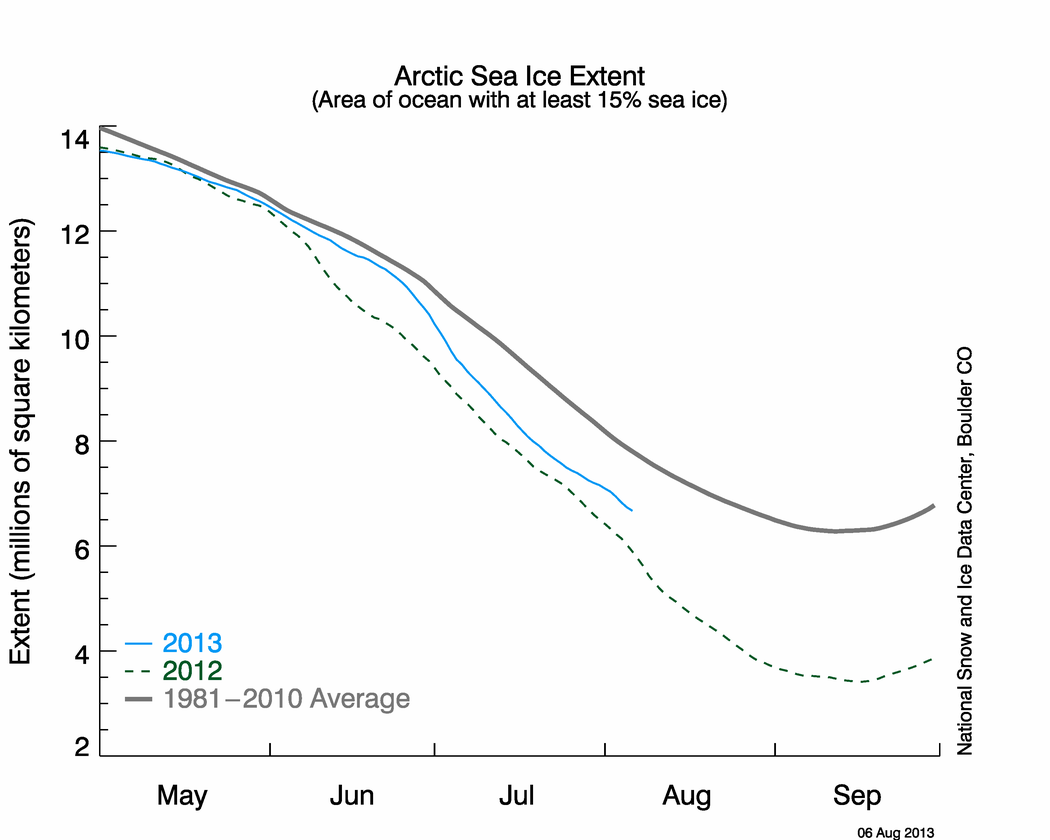 NSIDC Arctic Sea Ice Extent – 15% or greater – click to enlarge
If it is indeed the turn, then Arctic Sea Ice minimum for 2010 will end up at 4,952,813 km2
I may make a follow up post and have a look at all the forecast players mid to late week if the turn is confirmed. Of course my forecast has been proven incorrect already, but then, so have others.
Polar weather forecasts suggest colder weather ahead, and historically, the timing is right for a turn.
One such indicator is the Arctic Oscillation, shown below:

Source, NOAA Climate Prediction Center:
http://www.cpc.noaa.gov/products/precip/CWlink/daily_ao_index/ao.sprd2.gif

The forecast shows a deepening AO in the next few days, which traditionally means colder temperatures and a refreeze.
So, we’ll watch and wait, and I’ll update if the turn is confirmed.
Jakers, you have failed the test and given me an off topic question to my comment. You present averaged data. That data hides the drivers. I am talking about day to day deary, not averages. Today’s sea ice extent uptick is due to entirely natural processes (axial tilt causing decreased Sun exposure, pressure systems correlated with cold temps, and poleward but very mild winds). If tomorrow there is a down turn, please study the weather charts and tell me why there is a down turn. You will find your answer for tomorrow’s ice condition in tomorrow’s weather (and in this case I lump atmospheric and oceanic conditions under the term weather).
I am assuming you believe that the chart you linked to is showing anthropogenic drivers. If my assumption is correct, it’s your belief, so you get to explain it.
However, Jakers, for the argument’s sake, the noaa synopsis of ice-related conditions is quite good at explaining why the ice ended up here or there on a monthly basis. They have a great archive of past conditions. Makes for educational reading.
Yes, but Seth Borenstein still isn’t giving up, with gratuitous quotes from Serreze
http://news.yahoo.com/s/ap/20100913/ap_on_sc/us_sci_walruses_ashore
jakers says:
September 13, 2010 at 12:54 pm
Pamela Gray says:
September 13, 2010 at 10:15 am
…
Great! What, then, are the conditions which explain this? I know I would love to have the answers. http://arctic.atmos.uiuc.edu/cryosphere/IMAGES/seasonal.extent.1900-2007.jpg
The conditions explaining these thrilling curves are the conditions inside a silicon computer processor. The graphic you showed is the result of GCM computer runs. For some of us, this is not the same as data.
Skeptical? Look at slide 2 in this powerpoint.
http://soa.arcus.org/sites/soa.arcus.org/files/sessions/1-1-advances-understanding-arctic-system-components/pdf/1-1-7-maslowski-wieslaw.pdf
Pamela Gray says:
September 13, 2010 at 12:49 pm
Once again RGates, you resort to CO2 as the unmentioned cause but fail to explain how CO2 has become involved with the day to day and year end Arctic ice data. I visit Arctic weather, jet stream, and oceanic current conditions regularly from which I can make an educated guess as to what the sea ice will do that day under those conditions. Not once have I had to say, golly, CO2 must have been “wut dun it”. If day to day conditions are entirely related to natural processes, how can you say that this minimum or that minimum is related to anthropogenic conditions, much less make predictions? Each and every minimum has naturally occurring conditions over the melt and freeze up season that explains it.
If you believe that CO2 is the driver of the trend, kindly explain how, with equations and measurements of CO2 either causing incoming oceanic temps to rise and/or air temps to rise over the Arctic outside the average range to the extent that it is the overriding driver, and not natural variations.
If you ask me what I think happened or what the driver was this year, I will give you a synopsis of the natural conditions that occurred this summer and you will also easily see my point.
______
I would always love to hear your explanation. I think the 2008-2009 deep and entended solar mimum to a large extent simply bought some time, and help to push temps down and increase cloudiness just enough in the Arctic during this period to flatten the record low drop seen in 2007. The La Nina during this time also played a lessor role.
In regards to CO2 (and the general increase in CO2 we’ve seen since the 1700’s), one would never expect to see a linear trend from the tiny year-to-year increase in CO2. The effects would both gradual and also show up as sudden jumps or changes in the overall system. 2007’s dramatic decline (on top of the longer term decline) may be one such example. As the loss this year shows (with more overall ice loss from the March high to the September low than 2007) we’ve hardly recovered from that drop, so it appears that was a change in the summer Arctic ice loss that is here to stay.
The effects of increasing CO2 appear to be showing up now after several centuries of gradual increase. Only a few parts per million a year but now up 40% since the 1700’s. Like adding grains of sand to a sandpile, chaos theory would tell us that eventually just one addtional grain of sand will cause a little landslide in that pile, and exactly when the landslide will occur (like the dramatic decline in 2007) is unpredictable. We’ve not yet recovered from that landslide, and new grains of sand continue to pile up– perhaps indicating more landslides ahead.
R Gates,
CO2 has been much higher in the past without causing runaway global warming. Further, there is no correlation between rises in CO2 and subsequent rises in temperature.
On all time scales rises in CO2 follow temperature rises, therefore they are not the cause. CO2 is the effect. But thank you for your speculation. The ‘landslide’ comment was a nice touch, even though it’s falsified by the fact that when CO2 was almost twenty times higher, the planet’s temperature remained within its long term parameters and never went into catastrophic runaway global warming. In fact, planetary warm periods are few and far between.
Pamela Gray says:
September 13, 2010 at 1:05 pm
Of course they’re pure fiction…and I wouldn’t call them models. All I did was do what Jeff P asked here:
And I even put in a few details how to improve it a bit (which I’ll probably make some estimates on when I get some time later today). If you have a problem with performing this estimation this way, please address those comments to Jeff P.
-Scott
RGates, please provide mechanism for both the Sun and CO2. Unless you have none and are just hoping there is a mechanism. If you are saying the deep minimum increased cloud cover, does that mean that when we are at maximum we should have decreased cloud cover? What does the long term observation say about that?
I know how pressure changes (IE weather conditions) bring about an increase or decrease in cloud cover, both the low thin kind, the high thin kind, the low thick kind, and the deep and high thick kind.
This synopsis of mechanisms is quite good and demonstrates natural drivers well:
http://nsidc.org/arcticseaicenews/
Tell me how, not whether, CO2 drives this or that, increases this or that, decreases this or that, whatever. And by the way, oceans have a way of letting go of warm water.
You seem to believe that CO2 is warming the oceans. By how much do you think that is per year, given that CO2 can only warm the surface and with much of that immediately evaporated off. You do understand that my back of the envelope amount is an infinitesimally small amount with a rather large standard deviation. Most people make the mistake of taking CO2 increased temperatures as being applicable to SST’s. It is not. That warming is based on several assumptions and is related to air temps, not ocean temps.
Phil. says:
September 13, 2010 at 12:44 pm
Hi Phil, can you give a quick explanation why CT is best for area and JAXA for extent? If you’re short on time, a reference is fine. I was just curious as to why this is (I don’t know the histories of these databases/satellites.)
-Scott
Scott says:
September 13, 2010 at 12:19 pm
Wow! That was awesome. Clearly at 38 times the potential energy needed to melt the arctic the potential energy is there it’s just a matter of where the energy goes.
I have a couple of follow up questions.
For this calc: “Final calculated extra energy from addition of CO2 = 9.49 e22 J” Is that the total for the 20 year period that you were working with?
Are there satellite measurements of long wave radiation to confirm that the energy is not leaving the earth?
Thanks again that was great.
I think before anyone can claim sea ice is recovering they need to show where all the extra energy is going instead.
As an example of CO2 affects coming with a large standard deviation over land, Wallowa County has been experiencing average to high daytime temps but with below average night time temps. Why? Strong radiative cooling sending the day time warm air up, up, and away at night. We don’t have enough water vapor at night to hold in that heat. The affect of water vapor at night can completely obliterate any CO2 warming affect. It is highly likely that the CO2 effect is well within the standard deviation of water vapor variation alone.
Pamela Gray says:
September 13, 2010 at 1:05 pm
Assumptions make for very poor models. Scott, your calculations can easily be substantiated as pure fiction. Why? Your model does not even come close to observations of air, land and SST in the Arctic.
————–
Pam,
I wasn’t looking for a model. I was asking is there sufficient energy from c02 absorbing long wave radiation to melt all of the sea ice in the arctic. Scott’s calculation was rough and that was all I was looking for. It is illuminating that even if the numbers are off by an order of magnitude there is still the enough extra energy to possibly melt the arctic. At 38 times the energy required it looks quite possible for the arctic to completely melt and not the impossibility by 2013 that some would like to claim.
Pamela Gray says:
September 13, 2010 at 2:16 pm
It is highly likely that the CO2 effect is well within the standard deviation of water vapor variation alone.
———
So what?
The question is how much extra energy is in the system due to c02 absorbing long wave radiation all other factors being equal. Is that energy enough to melt all the arctic sea ice if it only went to that purpose? The answers looks like a rough 38 times over. Is that what is going to happen? Who knows. Is it possible? Yes, definitely.
Jeff P says:
September 13, 2010 at 2:13 pm
That’s a very good question and one I don’t have an answer to. All I did was calculate the change in radiative forcing factor (delta_F, W/m^2) using the equation 5.35*ln(C/C0) where C (ppm) is the current concentration of CO2 and C0 (ppm) is the original concentration of CO2. I’m not even sure how appropriate this approach is since I haven’t really worked with these sorts of numbers before.
That’s the next part of my calculation. If you have some numbers on that for me to start with, that’d be great. Otherwise I’ll just do estimates again. 🙂 I wouldn’t be surprised if the vast majority of the energy I calculated goes into things other than the ice. :-O
-Scott
The vagaries of predicting temperature. Even if CO2 increases temps under ideal conditions, we rarely have ideal conditions. The vagaries of longwave radiation cooling or noncooling simply outdoes CO2. Especially at night, but this can happen in the daytime as well.
http://www.theweatherprediction.com/habyhints2/423/
Yes, and I could possibly go through a growth spurt at age 54. I eat enough, so why am I not taller? Is it possible for that to happen? In rare cases yes. But real conditions tells us it is not probable. Shouldn’t we be talking about what is probable? Going on these fantasy trips only cheapens your argument, not mine.
Pamela Gray says:
September 13, 2010 at 2:37 pm
We’re not talking about local weather predictions, we’re talking about total energy held in the system by c02. This number: Final calculated extra energy from addition of CO2 = 9.49 e22 J
Not sure why you continue with local weather predictions.
It’s not “fantasy.” That extra energy has got to go somewhere. And if it is going to the arctic there’s plenty of it to melt all the sea ice.
Pamela Gray says:
September 13, 2010 at 2:40 pm
Yes, and I could possibly go through a growth spurt at age 54. I eat enough, so why am I not taller? Is it possible for that to happen? In rare cases yes. But real conditions tells us it is not probable.
——–
Interesting analogy but flawed. It is more like if your current food intake keeps you at a steady weight and you then add 1000 calories a day to your diet and change nothing else then it is possible that over time you are going to get fat.
Jeff P says:
September 13, 2010 at 2:52 pm
It’s not “fantasy.” That extra energy has got to go somewhere. And if it is going to the arctic there’s plenty of it to melt all the sea ice.
On the subject of energy, Arctic and space – some things that happened this year:
(1) Near 30-year minimum ice extent
(2) Therefore large area of open water in the Arctic over summer
(3) Exceptionally cold Arctic air over summer
(4) Warmer than normal Arctic sea water (eddys from El Nino)
Put this all together and what do you get?
Exceptionally high loss of heat energy from the Arctic open sea to space.
Periodic low Arctic ice extent is the global equivalent of a dog lolling out its tongue and panting – a way of losing excess heat.
Lots of yapping here & 0 F-casting…Miss gray talks up a big Game so I am going to hope she can analyze all those pressure systems & compute all the sucking in & out of heat & cold..factor in the SST & give us the Ice Forecast for next week…or is there a charge for that?..I’m thinking that there will be a very small increase when we get the new #’s & i’m also looking for a good increase in snowcover in the next couple of weeks to fuel the cold factory..think positive (gains)..!
[bridge too far George ~ ctm]
Jeff said, “…We’re not talking about local weather predictions, we’re talking about total energy held in the system by c02. This number: Final calculated extra energy from addition of CO2 = 9.49 e22 J.”
Jeff, that is a modeled (or calculated, whichever) number based on improbable assumptions. However, I remember a few months back the science community was worried over the observation that they could not find the store of heat energy they had calculated should be in the system. Maybe our Earth’s systems didn’t capture and hold onto all of it.
There must be a hole in the bucket dear Liza.
As for short term forecasting, the Arctic system is large enough to have a fairly predictable ice response on a day to day basis (see noaa’s recap). And to not belabor the point, the trend is a statistical average of day to day ice response to local/regional weather. Nothing more. The global temperature models that factor in CO2 warming do not match the averaged global trend, so there is even less reason to explain ice loss by considering CO2. Which is why I think the data is inappropriately scrubbed of vital cause and effect information when it is smoothed. So don’t ask me to tell you about the smoothed trend. There is no information in it as to cause. Only the day to day wriggles have that information at hand.
Here is an example of a forecast based on local weather and oceanic conditions. It is not talking a big Game. It is straightforward meteorology. And if you give it serious study on a daily basis, you will learn to see the trees that make up the forest.
http://www.arcus.org/search/siwo
5 to 10 Day outlook: June 25 to July 5
A high pressure ridge will build over the central Bering Sea today (Friday, June 25) and persist through Monday, June 28. Southerly winds will dominate the region and with little or no sea ice present, seas will build to 6-7 feet through Monday, June 28. These southerly winds should help move the remnants of shorefast ice northward. A low system will move into the central Bering Sea from the west on Tuesday, June 29, and persist but weaken through Monday, July 5 as high pressure builds to the north of Chukchi Sea.
Alexej Buergin says:
September 12, 2010 at 2:08 pm
The longer term:
Forecast for 2011 by R. Gates: 2.5 Million sq km
Forecast 2012 by A. Gore: …when the Northpole is EXPECTED to be ice-free (his words).
About the ice-free NP by Phil.: … 2013 will be interesting.
_____
I never forecast 2.5 million sq. km for 2011. Please stop this nonsense.
Smokey says:
September 13, 2010 at 2:07 pm
R Gates,
CO2 has been much higher in the past without causing runaway global warming.
__________
When have I ever mentioned runaway global warming?
Yes, CO2 has been higher, but not in at least the past 800,000 years. The last time it was this high, the Arctic was ice free.