This week was a true roller coaster ride with Arctic Sea Ice. It is best summed up by looking at the JAXA graph for extent, shown below:

Below, see the area of interest magnified.

I’ve added the 5 million square kilometer line for reference.
The roller coaster ride actually looked for a day like it might cross the 2009 line, but soon turned down again, ending this week at 5,142,813. Here’s the recent JAXA data
08,28,2010,5342656

08,29,2010,5352500

08,30,2010,5348281

08,31,2010,5329375

09,01,2010,5332344

09,02,2010,5304219

09,03,2010,5245625

09,04,2010,5192188

09,05,2010,5142813
Source: http://www.ijis.iarc.uaf.edu/seaice/extent/plot.csv
JAXA sea ice area has dropped to 2008 levels:

JAXA AMSR-E Sea Ice Area – click to enlarge
Sea ice concentration from JAXA:

While JAXA shows extent now lower than 2009, DMI and NANSEN plots show it to be about even. The differences in observing sensor/platform AMSRE -vs-SSMI and methodologies at agencies are in play.

Above: Danish Meteorological Institute Arctic Sea Ice Extent – 30% or greater. Note that while this graph shows 30% concentration at the cutoff point, it is valuable to compare.

Above: NANSEN Artic ROOS- Sea ice extent 15% or greater – click for larger image
The differences appear to be in the low end of concentration, the 15% to 30% range. It suggests that the brief gains we saw may be wind related, blowing floating ice around, compacting it when winds are strong versus allowing expansion when winds are weak.
Temperature, after holding near freezing, now appears headed sharply downward.
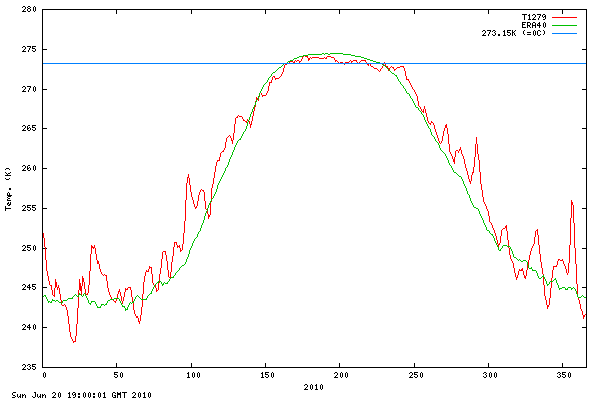 Above: Danish Meteorological Institute – Mean Temperature above 80°N
Some light refreezing may take place before the end of September, which could minimize the ability of wind to sharply change extent like we saw recently.
With all these variables in play, choosing a winner will be as much a game of luck as of skill. Based on what we’ve seen, it seems probable that it will come from the middle of the pack between 2008 and 2009.

From SEARCH:
The estimates from the scientific community range from 4.0 to 5.6 million square kilometers, with 8 of the contributors suggesting a September minimum below 5.0 million square kilometers, 3 contributors suggesting a minimum of 5.0 million square kilometers, and 5 contributors suggesting a September minimum above 5.0 million square kilometers. Two contributors forecast a September minimum below that of 2007 at 4.0 million square kilometers and 3 contributors suggest a return to the long term downward linear trend for September sea ice loss (5.5 to 5.6 million square kilometers). None of the contributors indicate a return to the climatological sea ice extent of 6.7 million square kilometers.
Including all 18 contributions gives a September ice extent minimum of 4.8 +/- 0.77 million square kilometers, with a range of 2.5 to 5.6 million square kilometers.
Individual responses were based on a range of methods: statistical, numerical models, comparison with previous observations and rates of ice loss, or composites of several approaches.
savethesharks,
I was responding to a particular idea regarding the middle of the seasons.
The two poles are two very different regions. One is water surrounded (with gaps) by land; the other is land surrounded by water. It should not be surprising that there are differences in their responses to changes in the global climate. However, whether these differences are consistent with what was expected I am not certain – it is something that I will look into.
latitude,
Using the JAXA data from the graph posted, the trend is downwards for December by 62,000 a year, with an R^2 value of .496. Too few data points to get to statistical significance, but not really that different from the NSIDC data.
For May, this result supports your hypothesis, with a positive slope of 25,000 per year. This is not statistically significant, however, with an R^2 value of .078.
savethesharks says:
September 6, 2010 at 7:21 pm
2010 Global Sea Ice Area is within 1M km^2 of where it was in 1979 on the Cyrosphere Today chart, when one considers where global sea ice spends most of it’s time between the extremes of ranges.
http://arctic.atmos.uiuc.edu/cryosphere/IMAGES/global.daily.ice.area.withtrend.jpg
If you look closely at the upper plot in the graph, you’ll notice the ‘landings’ where sea ice spends most of it’s global area time.
From 1979 to 1985, it spent most of it’s area time between 20 and 21 M km^2.
After that, it dropped to 19-20 M km^2. It has wavered up & down ever since.
Last year, it was at 19-20 M km^2. This year, it has already spent considerable time at that level.
The phenomenon of record melts seems to be an exaggerated “V” on these area landings.
Truth be told, global sea ice area is all over the place, suggesting 31 years worth of data is woefully short.
Now for those extremes:
Global Sea Ice Area falls to it’s extreme low point in January. It then rises quickly to it’s first pea, the height of which is random. It then falls, spending time at the elevated landing area, finally shooting up to it’s extreme max for the year (another crapshoot) before returning to next January’s low.
Spend some time with the Global Sea Ice Area, it’s the only Global Sea Ice Area we got (plagiaried from Joe Cool Meteorologist), even if it is a total crapshoot.
David Gould says:
September 6, 2010 at 7:36 pm
Mechanism: CO2 warms and warmer conditions melt more ice than cooler conditions.
==================================
Huh? You have not identified a mechanism, at all.
And CO2 is a trace gas in the atmosphere.
So you have a double wall to break through.
Chris
Norfolk, VA, USA
Walt Meier says:
September 6, 2010 at 7:35 pm
There are statistically significant declines of Arctic sea ice extent in all months and the annual average.
Walt Meier
NSIDC
===========================
OK. Following your reasoning, how do you reconcile with the SH which has been increasing over those same 30 years?
Are those SH increases….”statistically significant” too?
And if that is the case…..then don’t the two signals basically cancel themselves out??
Chris
Norfolk, VA, USA
David Gould says:
September 6, 2010 at 7:36 pm
I take it that those UAH figures are anomalies.
What values of Degrees C or F do I add to those anomalies to get the observed values?
No idea, rbateman, but I will investigate.
The trend is independent of the observed values, however.
savethesharks,
The mechanism is the poorly named greenhouse effect. I would have thought that if you have been following the global warming issue for any length of time you would have been aware of this mechanism, whether or not you accept its existence or not.
[youtube=http://www.youtube.com/watch?v=r0dsENsufPo]
I have not been able to find the absolute temperatures that are the monthly means used in the UAH dataset. It is in degrees C, though.
David Gould says:
September 6, 2010 at 8:46 pm
The mechanism is the poorly named greenhouse effect. I would have thought that if you have been following the global warming issue for any length of time you would have been aware of this mechanism, whether or not you accept its existence or not.
=================================
Ah….poorly named it is.
Since most of the greenhouse panels are missing from the greenhouse….
Again….it becomes difficult to describe a “mechanism” when there is no infrastructure to support the mechanism in the first place.
Chris
Norfolk, VA, USA
stevengoddard says:
September 6, 2010 at 9:01 pm
=====================
Bravo.
Damn sure miss your posts on here.
Chris
Norfolk, VA, USA
Brad said:
September 6, 2010 at 7:01 am
NeilT-
Huh? Arctic ice conditions alone will not kill you, relax. Also, remember there is an Antarctic where we are at or near record highs for ice. meaning the global sea ice extent has varied little since 1979. Why don’t you read that in the papers?
____________________________________________________
Because it is not true, looking at extent and area it seems to be close to the mean in the Antarctic curently
http://www.iup.physik.uni-bremen.de:8084/amsr/ice_ext_s.png
http://arctic.atmos.uiuc.edu/cryosphere/IMAGES/seaice.recent.antarctic.png
Andy
David Gould says:
September 6, 2010 at 9:06 pm
I would venture it’s critical that those observed temps, by satellite, should be out in the open, there being no such instrument as an anomalymometer.
But, as long as the raw data is out-of-sight, it’s basically out-of-mind for serious consideration.
Have you enquired about the raw data?
savethesharks said:
September 6, 2010 at 8:31 pm
===========================
OK. Following your reasoning, how do you reconcile with the SH which has been increasing over those same 30 years?
Are those SH increases….”statistically significant” too?
And if that is the case…..then don’t the two signals basically cancel themselves out??
Chris
______________________________________________________
No, because as a percentage of the total amount of ice in those regions the loss in the Arctic is a lot more than the gain in the Antarctic.
Andy
Mr. Watts: Obviously you did not read the Sea Ice Outlooks.
My 2.5 — the Low — was because I believe this to be a “freak” year.
“None of the contributors indicates a return to the” [‘average] ??
“the 60-year PDO says we will be getting twice the number of La Nina as El Nino — plus: stronger — for the next 27 more years. But … another 2010 would finish the job. Easily. HALF a 2010”. — Wilson, August Update.
IF we survive the first few upcoming El Ninos, the Cold half of the 60-year Cycle will build us up to Above average – – of course, by 2060, the “up” half puts us back to risking a CATASTROPHIC MELT-OFF every year.
As long as we listen to JUST 2 sides & IGNORE THE SCIENCE,. We will be vulnerable to a Combination of:
1) Greens get $ to stop the Warming. Naturally they do not want to end the Joyride. So:
2) They try to make it WORSE. —
3) The “Opposition” put out this Ignoramus “we cannot possibly affect Mother Nature”. So they DO NOT STOP IT.
— Now Industrial Pollution is fundamentally RANDOM. But:
>> KILL the “Great Global Cooler” = Sulfur, and
>> enhance BIG warmers like SOOT – – NOW You can Change things BIG TIME.
SOOT comes from “forgiving” things because they “Cap” the “little warmer” — CO2: Sure, make the formerly bright reflective Ice absorb SUN & melt ! – – by: 1) sending Industry to China (where there are no Scrubbers at all), 2) “forgive” Diesels their Soot — did you see the way the Ice Melted back from Europe this Year ! – – 3). Italy, especially, is trying to reduce dependance on Nukes with — you guessed it: COAL.
.. A lack of Sulfur — and for years FISHING has reduced Natural Sulfur by tilting the BALANCE against bony fish (bones decay & release sulfur Dimethyls) …and Tilting Nature, is easy: just watch the Deer Plague — because we killed the Wolves
– – Low Sulfur =.a brighter SUN (not to mention reducing Crop Yields).
– – Soot makes formerly bright white reflective things like Snow & Ice into polka-dots.
The fact is, had this year been LESS strong an El Nino, the CLOUDS would have dissipated sooner, & revived the Ice / reflectance FEEDBACK effect (once Ice melts — Sea replaces it, & absorbs about 4 times the Sun (because it is DARK), heats, & the hot water melts more Ice, etc.).
And we might be dead:
… If 2010 had been a regular, not a “Modoki” which fades slower (putting the “transition” in July, not May).
… Or, even so, if the “Ice that Always stays attatched to Greenland” hadn’t spread out (in a big Crescent that shielded the rest & when a hole burned through, the collapse of the thin remnant inside the ring, resulted in that Odd Shape you see).
And: >>> Next Time, it won’t be there.
But, as this is the 30 years of — well, we normally just say “Cooling” – – but actually it is just that there are twice the Cold (Nina) years as HOT (El Nino) instead of the reverse. So until ice builds up, there is always the danger of a “freak” like 2007.
[PS most of the changes seem to be “freak”s like 2007 — COLD Freaks, need EL Ninos too — a NINO PLUS A VOLCANO = MOISTURE from the El Nino, results in a Mega-Freeze].
But as long as the Ice is Low, I will fear – – oh, NOT the “big Wave” of that Disaster Movie. No. They CENSORED the 300 mph wind that follows, out of the Movie. Remember: the Wave was the Storm Surge in Front of the Giga-Cane ? NO buildings survive the Wind, ANYWHERE in the USA, & that means 99% of this Country will STARVE TO DEATH. There’d have been NO RESCUE, no Love Story – – Cannibalism instead.
… I kind of preferred not having to watch the Cannibalism.
Now the Last time, I said a 1-in-4 to 1-in-8 chance. Hard to geet excited about something that Probably won’t happen.
Next Time — & we’ll likely have 2 Nina years before another Nino – – Because we now know Rules the Clouds follow:
It’ll be 1-in-2.
You prepared to risk your kids at those Odds ?
Yet, again, even a Nino has to be just right. 1-in-2 is ONLY – – IF – – I call the Alarm – – which is ? 1 in 5 or less.
But we cannot keep Playing Russian Roulette again and again, like Lousiana did, cancelling Hurricane alerts because they averaged 1-in-4.
Sooner or later: BLOOWIE !
(ps: i have run numbers on other Warming Dangers & none is a Thousandth the threat this is. Also, none other has a cost-to-stop-it of just $20 million ).
savethesharks,
CO2 is at around 400 ppm at present.
If – for instance – the level of arsenic in your body was at 400 ppm, you would be, well, in a lot of trouble to say the least.
Trace elements can have very large effects, so by itself the argument that CO2 is a trace gas is irrelevant.
Michael Schaefer says:
September 6, 2010 at 3:54 am
And in that, the arctic ice extend seems to be quite well on it’s way back to normal
I’d say it always was normal. What happened in 2007 I am certain has happened before.
mrjohn says:
September 6, 2010 at 5:28 am
Hold on, wasn’t the North Pole supposed to be ice free this summer ?
Funny how we are being told it’s the hottest weather ever since time began but the North Pole isn’t cooperating.
Neither is the South Pole 🙂
Alexej Buergin says:
September 6, 2010 at 6:48 am
Carneval cruise to the Northpole for that year.
It’s the Love Boat and Captain Stubing.
NeilT says:
September 6, 2010 at 1:43 pm
Those of you who are insulted at being called unfeeling, uncaring people who don’t care about the misery and deaths of millions
Do you care about the people that starve to death from food shortages caused by biofuels?
Charles Wilson says:
September 6, 2010 at 10:31 pm
Mr. Watts: Obviously you did not read the Sea Ice Outlooks.
My 2.5 — the Low — was because I believe this to be a “freak” year.
.
.
.
(ps: i have run numbers on other Warming Dangers & none is a Thousandth the threat this is. Also, none other has a cost-to-stop-it of just $20 million ).
________________________________________________________
Just a suggestion, as I’m sure you do have important points to make.
Your posts have the appearance of random noise, formatting-wise.
It would benefit you (but mostly us) a great deal if you at lease tried to clean up your post a bit.
Also, your Arctic sea ice estimates of 1E6 km^2 and most recently 2.5E6 km^2 for 2010 are way out of line with the modern historical record, not by a factor of O(0.1) but between O(1) and O(10), 1E6 km^2 is clearly off by a factor of 4-5 (300% to 400%), 2.5E6 km^2 (made at the end of August of this year mind you) is off by a factor of 2 (100%).
Even the 2007 record low, is only O(0.1) different with respect to all other recent recorded lows (2002-2010 JAXA, for example).
David Gould says:
September 6, 2010 at 6:03 pm
So measuring in the middle of the seasons shows a consistently downward trend in sea ice since 1979.,/i>
A warming trend began in 1976. Satellite measurements started at 1972 but for some reason are only used since 1979. There was a warming trend in most of the years you used in your comment, 1979 until around now. But now the earth is cooling. Let’s talk in 2030 about the growing trend in Arctic ice that began in 2007 and is still lasting until then.
Anu: Actually, satellite measurements began in 1972:
http://iup.physik.uni-bremen.de:8084/amsr/ice_ext_n.png
Nothing in the 1972 to 1979 data showed an “increasing trend in Arctic sea ice” for that “crucial” pre-1979 period. Perhaps you can find some scientific papers that show differently.
Your graph proves nothing and is difficult to compare with other graphs since it uses a different endpoint (2008) than NANSEN (2006) or NSIDC (2000). It shows a lower summer minimum than both those, though. Do you have any data that actually supports your claim? (And anyway, we’re talking about only 7 years)
Jeff P says:
September 6, 2010 at 5:12 pm
Today 2010 has 2009 beat leaving the Goddard Minimum way far behind.
Let’s look at the standings.
2003 Min.: 6,041,250: Busted 8/14/10
2004 Min.: 5,784,688: Busted 8/19/10
2006 Min.: 5,781,719: Busted 8/19/10
2002 Min: 5,646,875: Busted 8/22/10
Goddard Min: 5,500,000: Busted 8/26/10
2005 Min: 5,315,156: Busted 9/2/10
2009 Min:5,249,844: Busted 9/2/10
2008 Min:4,707,813: ???
This puts 2010 in the top three lowest sea ice extents in the JAXA record and there is still time on the clock.
FYI, Steve,
Maybe you shouldn’t brag about being accurate until the last bullet is shot.
_____________________________________________________________
SG didn’t post this latest sea ice article, Anthony did.
But I liked your list, so here’s an updated version after gazing at my JAXA crystal ball;
2003 Min.: 6,041,250: Busted 8/14/10
2004 Min.: 5,784,688: Busted 8/19/10
2006 Min.: 5,781,719: Busted 8/19/10
2002 Min: 5,646,875: Busted 8/22/10
Goddard Minimum: 5,500,000: Busted 8/26/10
2005 Min: 5,315,156: Busted 9/2/10
2009 Min:5,249,844: Busted 9/3/10
Goddard Mulligan: 5,100,000: Busted 9/6/10 (JAXA provisional, NSIDC and Bremen are already lower)
NOAA Mulligan: 5,000,000: Busted 9/13/10 (p ~ 1)
100K Delta Min: 4,900,000: Busted 9/17/10 (p ~ 0.5)
200K Delta Min: 4,800,000: Busted 9/21/10 (p ~ 0.15)
2008 Min: 4,707,813: Busted 9/26/2010 (p ~ 0)
NOTE: Last four estimates are the most conservative dates possible given the current JAXA database (2003-2010 inclusive) and analysis thereof, these dates will change or disappear entirely based entirely on future weather conditions.