Guest Post by Thomas Fuller
This is a great time to talk about energy use worldwide. Not because it’s topical, or politically important, or anything like that. It’s a great time because the math is easier now than ever before, and easier than it ever will be again.
It’s similar to a time a few years ago when there were almost exactly 100 million households in the United States. It made a lot of calculations really easy to do. And this year, the United States Department of Energy calculates that the world used 500 quads of energy. Ah, the symmetry.
Even more conveniently, the United States and China will each use roughly 100 quads. Comparisons, contrasts–you don’t even need a calculator! A quad is a quadrillion British Thermal Units, and is roughly equivalent to the energy liberated from 36 million tons of coal. It’s a lot of energy, and 500 of those quads is really a mind stretcher. (For those of you who are counting, about 52 of those quads came from renewable energy. Of those 52 quads, about 50 came from hydroelectric power… urkk…)
In 2035, the DOE figures the world will consume about 683 quads, give or take. The UN, more ambitiously, thinks it’ll come in at about 703 quads. Either way, they anticipate a 40% growth in energy requirements. Is it okay if I say I think they’re both wrong?
Here’s why: The UN (and pretty much everybody else) believes that the world’s population will be at or around 8 billion in 2035. The UN (and pretty much everybody else) believes that world GDP will grow by about 3% per year between now and then–which is pretty much what it has been doing for quite a while. But most of that growth is projected to occur in the developing world. And most of that growth will be very energy intensive.
Here in the U.S., our energy consumption per person has been declining for a while, now. We’re down from 337 million btu’s per person to 323 mbtu’s per capita. But it’s going in the other direction in the developing world. They need the energy to actually, well, develop. And then they want the energy to enjoy the fruits of their development. Makes sense–that’s exactly what we did here.
Price Waterhouse Coopers has projected GDP growth to 2050 for major economies. For the U.S., they predict per capita growth in GDP from $40,339 in 2005 to $88,443 in 2050. Most of the very well developed countries show the same level of growth–a bit better than doubling.
The Department of Energy has energy use per person for many of the same countries. So let’s look at China. Before I start, remember that China has doubled its energy use since 2000. And they’re not done yet.
Their 2005 GDP per capita was $1,664 and their energy usage per capita was 58.8 mbtu’s. Their 2050 GDP per capita is projected to be $23,534, similar to Spain’s present GDP per person. Spain’s energy use is 164 mbtu’s. So who wants to predict China’s energy use per person in 2050? In 2035?
We’re always picking on China, and we don’t need to. The scary part is we can do the exact same thing for Indonesia, Brazil, Mexico, Turkey and India. The developing world is developing. They are going to be energy-sucking monsters for the next 80 years–just like we were.
My calculations show that, if we succeed in persuading the developing world to use energy efficient technologies wherever possible, switching from coal to natural gas, adopting wind and solar, buying best of breed turbines, etc., the world’s energy consumption in 2035 will be about 1,100 quads. However, if they proceed as they are (mostly) doing now, throwing up dirty coal to avoid blackouts and brownouts, cobbling together solutions however they can, world energy use in 2035 might well approach 2,000 quads–or even surpass it.
Imagine a world of 8.1 billion people, 7 billion of whom are using energy at the same rate as we do here in America–323 million btu’s per head. (3.23 x 7, for Joe Romm). That’s over 2,100 quads. It is at this point that some ugly questions appear. If we burn coal to obtain this energy, that’s 2,100 x 36 million tons of coal. If we withhold energy from these people, we condemn them to lives of starvation and poverty. If we subsidize clean energy solutions for them, we are spending our hard earned tax money on the poorest of the poor, many of whom live in countries that are not friendly to us. Oh, wait… we’re already doing that, aren’t we?
I favor the third solution. Using your and my tax dollars to help the poor afford electricity that comes from natural gas, nuclear and other cleaner solutions, so they can afford to buy our video games and see our movies (and, well, pay for them…). I do not expect my idea of the best solution to be very popular. Not with climate alarmists, who already don’t like natural gas or nuclear, and want to limit energy consumption by everybody except for themselves. Probably not with many readers here, who have seen taxpayer money go up in smoke on so many poorly-designed projects. But I think it’s our duty to ourselves, as well as the poorest of the poor.
Adam R. says:
September 1, 2010 at 6:29 am
The WUWT crowd’s dismissal of GHG emissions as a factor in the world energy picture is not surprising. One needn’t be concerned with the elephant’s destructive potential if one denies it’s in the room.
Alas for the group here, even their darling Bjørn Lomborg has at last admitted to the presence of the climate change pachyderm:
It’s certainly not surprising that a Warmist troll will take any opportunity to make an elephant out of a mere flea, which is all C02 amounts to.
Nice try on the “news” about Lomborg. He was always a believer in the fairy tale of manmade C02-produced warming/climate change/climate chaos (gee, what do they call it now?), just not on board with the spending part. Lomborg is nothing more than an opportunist, and saw a way to make some money on the S.S. Climatanic, which has raised up in the water in preparation for its final descent into the history books and total ignominy.
Mr Lynn says:
September 1, 2010 at 6:15 am
Re GM:
I just love hitting the ‘Peak Oil’ (and ‘Peak Whatever’) doomsayers with these two posts by E.M. Smith:
http://chiefio.wordpress.com/2009/05/08/there-is-no-shortage-of-stuff/
http://chiefio.wordpress.com/2009/03/20/there-is-no-energy-shortage/
Thanks, and worth reposting.
Still no response.
@ur momisugly Tim
Oh brother. Why not post the DOE numbers for dollars per kWh for wind/solar. Put things into perspective.
http://www.eia.doe.gov/oiaf/servicerpt/subsidy2/pdf/chap5.pdf
Refined coal is a high subsidy, but it at least produces a net increase in electricity output. Neither wind or solar can do that. If the playing field were leveled as you suggest, “renewables” (wind/solar in this case) would go belly up in a week.
Apparently you are totally unaware of the fact that our socioeconomical system requires perpetual growth or it collapses otherwise. This means that an ever increasing energy supply is required too.
.
Yes, there are numerous source. What you leave out is that they aren’t all the same.
EROEI if shale oil is 3, EROEI of Ghawar was probably 100 some 50 years ago. Big difference, but it requires some thought to appreciate, and thought is the thing that’s in shortest supply in the world right now
It couldn’t have been 2%, it is between 500,000 and 1,000,000 km2 currently. Sahara is less than 10,000,000 km2. It looks very easy on paper, but the reality is that we simply don’t have the resources to cover 500,000 km2 with solar panels
Enneagram says:
September 1, 2010 at 8:23 am
“Is that CDM really working? I mean “really” with real cash payments or it is just another “model” ”
The UN CDM issues ‘purchasable carbon credits’. The value of those credits is determined by the European Carbon Markets.
The Chinese aren’t stupid, the Carbon Credits aren’t working out to be as valuable as originally anticipated and becoming dependent on coal imports when you are already dependent on Oil and Natural Gas imports doesn’t make for ‘energy security’.
As a result they are building nuclear power plants without UN subsidy as fast as the Japanese can make the critical reactor forgings. Unfortunately that is slower then their rising energy demand.
India doesn’t have much in the way of Uranium deposits and is doing some research work on thorium. They had loads of thorium deposits. I expect as soon as they get a ‘commercially viable’ thorium reactor worked out they’ll abandon coal but it’s not going to be tomorrow morning at 9.
The world has an enormous supply of coal. Unfortunately the vast majority of it is not ‘economically recoverable’ or is too far from markets. It costs 2-3 cents/ton mile to transport coal by rail. Then $20-$30 for ton if it needs a boat ride. The $12/ton coal in Wyoming isn’t ‘cheap’ once it has to be transported 1,000 miles by rail to a seaport.
Hence, while electricity from coal is still cheap in the US Midwest it’s not cheap anymore in the US Southeast. Not surprisingly the electric utilities in the US Southeast are trying to build nuclear power plants.
harrywr2 says: September 1, 2010 at 7:46 am
“….. A 1,000 megawatt coal fired plant burns in about 4 million tons of coal per year.
If China or India builds a coal fired plant they are dooming themselves to spending more then $400 million per year on coal.
A Westinghouse AP1000 1,000 megawatt nuclear reactor can be built in China for $2-$3 billion. So the Chinese can build a nuclear reactor for the price of 5-7 years of coal imports for one coal fired electricity plant. Sounds like the economics is beyond brainless.”
The Chinese are definitely NOT brainless. They are currently building 24 nuclear power plants, with 33 more on order and 120 additional planned.
http://www.world-nuclear.org/info/reactors.html
How many new starts in the US in the past 30 years? None, zero. Chinese nukes cost about half as much as US plants (same plant) because Chinese projects don’t get held up in court for 5 years while the lawyers get rich. And yes, harry, some of those Chinese plants under construction are Westinghouse AP1000 models.
Humankind has a long history of those that “have”, “fixing” things for those that “have not”. Usually to the detriment of those being helped, and enriching the helper.
Make the technologies available and let then decide for themselves.
Oh, and by the way, while you are at it let us decide for ourselves too.
A new way to produce electricity!:
REPLY: snip – oh puhleeze, none of that pyramid stuff here. – Anthony
Peak Oil is a myth,
Myth: The World is Running Out of Oil (Peak Oil)
Peak Uranium is a myth,
Uranium resources sufficient to meet projected nuclear energy requirements long into the future (Nuclear Energy Administration)
I am so tired of the fantasy (renewable) energy source delusional types. All forms of renewable are NOT economically viable. If they were we would be using them. Over 88% of the world’s energy comes from hydrocarbons the remainder is nuclear (5%) and hydroelectric (6%). That is right less than 1% from everything else.
Fine remove all subsidies (I am all for it). Renewables will NOT be economically viable because they are low in power and energy density. People pushing fantasy energy solutions don’t understand basic physics or economics.
I always ask people if they are for renewables and then I ask them if they are for paying higher electricity, heating and fuel costs and you will find you will get two very different answers to each question. Emotionally people want the magic energy sources, realistically they pay for what works.
..”Using your and my tax dollars to help the poor afford electricity that comes from natural gas, nuclear and other cleaner solutions, so they can afford to buy our video games and see our movies (and, well, pay for them…)..”
Minor Edit –
“Using your and my tax dollars to help the poor afford electricity..” by ‘subsidizing’ American industry -not multi-nationals- to build and transport American products that are better and more cost-effective and that help supply “natural gas, nuclear and other cleaner solutions so they can afford to buy our” high tech, state of the art, superdupper, cheapo, numero uno other products “(and, well, pay for them…)..”
Re-Build and Re-Tool America First! Protect America Always! Help our friends! Defeat our enemies! And dream of a better world, with no poverty, no disease, no plagues, or whatever, whenever we have the time. Those who think we’re about to turn the corner, so to speak, and enter a brave new world under the UN Manifesto are smoking, popping, sniffing, and shooting the ‘real’ hard stuff –stay away from these people.
It is shame no one knows where our energy actually comes from or how it is used,
Only 1% of the United States electrical generation comes from oil (EIA) (48% Coal, 21% Natural Gas, 20% Nuclear)
Tim Williams says:
September 1, 2010 at 9:01 am
I think you’re viewing the subsidy argument incorrectly. Personally, I’m not in favor of public monies going to private enterprises, but if we must, I’d prefer a decent return on the investment.
You say, “Subsidies to fossil fuels—a mature, developed industry that has enjoyed government support for many years—totaled approximately $72 billion over the study period, representing a direct cost to taxpayers.
• Subsidies for renewable fuels, a relatively young and developing industry, totaled $29 billion over the same period…….”
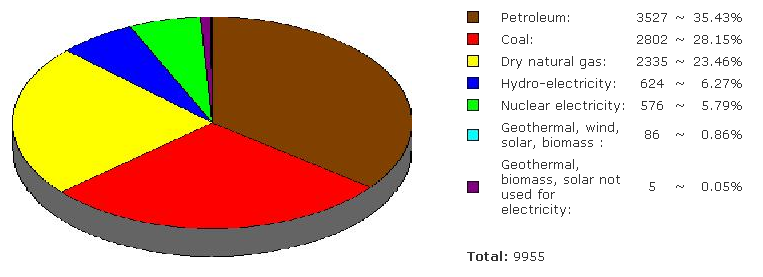
While the pie chart above is representative of global use, it follows fairly close ratio for the U.S. Or go here for a nice table.
http://www.eia.doe.gov/emeu/aer/txt/ptb0802a.html
We’re getting a much better “bang for our buck” with fossil fuel subsidies in terms of production, retail and wholesale cost. In other words, it is fallacy to pour more money down a more costly, less reliable, inefficient source of energy. Again, I’m not much on subsidizing private energy industry of any kind, but if you ask me, we’re spending way too much on the renewables for the results we’re getting.
You say, “Fossil fuel industries are already heavily subsidised. Removing these subsidies, would at least level the playing field to allow renewables to compete on a fairer footing…IMHO.”
The renewable energy market is getting almost 30% of the subsidies while producing, 13% of the energy, and that’s with traditional hydro, which I don’t believe is receiving the renewable subsidy. Without hydro, they are producing about 4.5%. Nice, we’re paying so companies can charge us more for electricity.
I’d say renewables wouldn’t even exist without the significant subsidies they get. But, that’s just my opinion, too.
You want to replace worldwide hydrocarbon energy? No problem just find me the energy output (in oil equivalent) of twenty-seven Saudi Arabias per day.
Should be easy!
Excellent post Mr Fuller….. I see you have got some of the hyper-ventilators going into super hyperventilation mode…. Ah, th’ blood is shooting from their eyes… You could run a small city on their apoplexy alone…:-)
As for me, I don’t think there is all that much of a problem…. Energy use is going to go up as societies modernize. But as they become more technologically able, they’ll strike a balance between useage and efficiency…. Secondly, as people’s standards of living rise and they adopt open liberal, free market societies, their women will on average have less babies. It has happened in our societies…. It will happen in theirs too. Thus populations will stabilize…
I see a pretty rosy, future. Don’t know what all th’ fuss is about actually.
Tim Williams – After checking out ELI ‘s web site , I have little faith in their objectivity . None the less , an interesting read . I keep hearing about how heavily subsidizes the coal is , but your report suggests that this isn’t really so – especially when compared to oil . Taxing coal royalties as a capital gain hardly qualifies as a subsidy in my opinion . Furthermore , most of the tax breaks afforded the fossil fuel industry seem fair , IMHO . Obviosly the ELI doesn’t agree .
Wrong,
Is the Economy a Perpetual Motion Machine? (William L. Anderson, Ph.D. Professor of Economics)
Thermodynamics and Money (Peter Huber, Ph.D. Mechanical Engineering, MIT)
“Eroei calculations now litter the energy policy debate. Time and again they’re wheeled out to explain why one form of energy just can’t win–tar sands, shale, corn, wood, wind, you name it…
In the real world, however, investors don’t care a fig whether they earn positive Eroei. What they care about is dollar return on dollar invested. And the two aren’t the same–nowhere close–because different forms of energy command wildly different prices. Invest ten units of 10-cent energy to capture one unit of $10 energy and you lose energy but gain dollars, and Wall Street will fund you from here to Alberta…
The economic value of energy just doesn’t depend very strongly on raw energy content as conventionally measured in British thermal units. Instead it’s determined mainly by the distance between the BTUs and where you need them, and how densely the BTUs are packed into pounds of stuff you’ve got to move, and by the quality of the technology at hand to move, concentrate, refine and burn those BTUs, and by how your neighbors feel about carbon, uranium and windmills. In this entropic universe we occupy, the production of one unit of high-grade energy always requires more than one unit of low-grade energy at the outset. There are no exceptions. Put another way, Eroei–a sophomoric form of thermodynamic accounting–is always negative and always irrelevant. “Matter-energy” constraints count for nothing. The “monetary culture” still rules. Thermodynamics And Money.”
Although most of you have good argument, remember to compare apples to apples and oranges to oranges. I hate to pick on one person, but the only person who is really really wrong is GM. Lets look at this qoute first:
“If you haven’t heard any rebuttals (as if the claim that the planet has infinite resources needs some sort of rebuttal) that’s because you have either:”
No one has claimed the planet has infinite resources. You are just repeating mathusian philosophy which has been around for over 2 centuries. If you are going to argue this philosophy, you need to go research it and come up with points that have not been already disproven by economic PHD’s who know more then philsopher’s on economics. Prove it versus just going on the “I am right” band-wagon.
There are finite resources on the Earth, but for all practical purposes, the classic economical model is that there are enough resources on the Earth for about 100k years of development if not more. The cost of mining versus taxes versus other things is what keeps the true numbers down. When something becomes scarse, its price goes up, less profitable mining sources are opened up, and the price comes down again. Classic economics…..but do not take it from me, go do your research…
Start with Population Bomb and start reading about the famous “Wager”. Economics crashed the Population Bomb theory in the 70’s, and even though his every prediction has been incorrect, this guy still has tenure and still is looked up upon. Do I dare mention his name?
The all encompassing exponential growth theory does not work either. Growth overall is slowing down as far as the exponential curve goes, but to someone unversed in mathematics, this appears like growth is accelerating. The thing to remember is that growth is never linear, its a different scale. Even a slowing growth will appear to be faster then what it will be just because most people do not understand the basic math behind the equations.
Energy usage is another one of these variables that appears to be worse then it is for those who do not understand math. Growth (acceleration) is different then the actual linear trend. Comparing these two forces is apples and oranges, and should be elementary, but for some reason its not. I have not looked at the developing countries energy curves to determine whether their exponential curves are going up or down, but that is different then their increase in energy usage and should be stated as thus.
But heck, we are all wrong sometimes, I just have this to really say. Subsidies are always mis-used, I have no problems with getting rid of them all-together personally, lets do it.
Research and development, now that is something that never has a tangible benefit, but by far economically speaking is the best way to invest money. Ask any big company this and look at what happens when you cut this budget….
What if hypothetically speaking, we would have spent every dollar we invested into subsidies (for both coal and renewables) into research and development or space exploration? The benefits are impossible to quantify, but we can go by history and look at what space exploration brought us technologically speaking from landing on the moon.
Society as a general rule would benefit much more from us investing in R&D and to me this does not mean we have to “go to Mars” or something else like that. Spending the money on clean energy is missing the point where once again we are going back to subsidies which overall just keep unproductive or less profitable alternatives in the running. Sure, coal usage would sky-rocket at first under no subsidies anywhere…you will notice that a majority of the subsidies are for oil….which I have no love affair with, but with no alternative right now, let the market take its course.
R&D will result in expensive alternatives that eventually with economics will become commercially viable someday. The thing with transforming society is that people think this can be done instantly when in reality it takes decades to achieve any tangible accomplishment/achievement with R&D. This may not always be the case (Sometimes results are quick) but you must take the long view on society.
We all think we have the one solution that will resolve the world’s problems, but the truth is any result today will produce 3 problems tomorrow in society. The best we can do is rely on capitalism which like democracy is inherently a terrible system…but like Churchill says “Its the best system we have.”
GM says:
September 1, 2010 at 9:23 am:…………..”this means is that we are in even greater need of reduction of population and consumption…”
Well, off ya go GM. You first. Show us your dedication to a smaller world population…. Don’t let the celestial door hit you on the arse on yer way out, eh….;-)
GM
That quote was from a book at the time, I have no comment on the accuracy.
If the price of oil goes up consumption eventually goes down. All I was saying was that if the resources arent there the price will go up, and consumption will go down. Solar power is supposed to be price neutral with oil round about 2018 – presumably 3rd world first, due to incident energy. Energy is just not the issue you are making it, and the replacements get cheaper every year.
Why would you not have the resources to make the solar panels? The energy required itself would be a problem nowadays if you used photovoltaics – although I didn’t actually state that. photovoltaics are currently more than 99% silicon (i.e. sand) so what did you think would not be available? It is prohibitively expensive currently but it will eventually be cost effective with oil – rapidly if the peak oil theorists are correct longer if not. If I recall you can make photovoltaics using several different materials, and the non photovoltaics can use pretty much anything reflective. Which material did you have in mind to run out of?
I wasnt actually suggesting you use the sahara, just suggesting that the energy consumed by man is a tiny percentage of the radiant energy hitting the earth. When oil gets rare enough or solar becomes cost effective everybody will fit solar – unless a cheaper alternative becomes available. Oil has competition – it is just currently the cheapest. When the price goes up the others become cost effective. The longer you delay it the less expensive the replacement is. The idea that there is a major problem because oil will peak 20 or 30 (or frankly 2) years from now is not realistic. Consumption will get squeezed and other stuff will take over unless somebody tries to co-ordinate it in which case it is liable to lead to war. The universe is absolutely full of energy and the human race will just use the most cost effective one at any given time (except when directed by real or imaginary environmental concerns). fossil fuels are currently the most cost effective because they are so plentiful. When it peaks it will not be and we will use something else or less of it. It is hardly something anybody needs to plan for at the moment.
“Using your and my tax dollars to help the poor afford electricity that comes from natural gas, nuclear and other cleaner solutions, so they can afford to buy our video games and see our movies … … I think it’s our duty to ourselves, as well as the poorest of the poor.”
Send them all the video games you want at your expense. You have no duty and no right to distribute anybody else’s largesse, thank you Karl. You also have no business thinking about what is my duty, as it is not yours either.
Thomas Fuller may be overestimating, but even conservative estimates of “third world” fossil fuel usage in 2050 show the futility of limiting CO2 emissions in only the “developed” world (and to “solve” a nonexistent problem at that!). And as others have pointed out, his idea of funneling taxpayer dollars through government development programs is probably the worst possible approach. I thank him for his article, however, and I thank commenters here for a wealth of references.
GM says (September 1, 2010 at 5:47 am): “The reality is that the Limits to Growth study projections from 1972 have been holding up quite well against the actual course of events…”
BWAHAHAHA! Good one, GM!
My calculations show that, if ………developing world to use energy efficient technologies wherever possible, ……..the world’s energy consumption in 2035 will be about 1,100 quads. However, if they proceed as they are…….throwing up dirty coal to avoid blackouts…..energy use in 2035 might well approach 2,000 quads”
You make the mistake of assuming that usage will stay the same with ever improving technology (especially that youngster nuclear).
The Nuclear technology is just starting to move to a production line type industry with manufacturer replaced power modules, when that happens there will be an explosion in production with a corresponding massive price drop.
Just as in other areas such as televisions, mp3 players where technology makes production easier – and much cheaper, we will natrually use more, how about 3000 quads using green thorium technology.
If you had actually read what those projections are instead of believing what the propaganda machine has been feeding you, you would not be laughing
Some hydrocarbons are abundant in the solar system. Lakes of liquid methane and ethane have been found on Titan, Saturn’s largest moon, confirmed by the Cassini-Huygens Mission. I suspect that before we ever come close to using up our supplies of hydrocarbons and metals, we will be mining various moons and the asteroid belt for the abundant materials that are there.
Price isn’t the issue, in fact it is tragically misleading to think about these things in terms of $ signs. Net energy is what matters, and it doesn’t look good
To begin with, the high-efficiency PV cells use rare earth elements that are in very short supply. But when I say “resources”, I don’t mean just the materials, I mean societal resources in general. What the free market religion tells you is that when the price signal comes, substitutes will be found and the infrastructure will be build. In reality, it doesn’t work that way, because we are talking about infrastructure that will take decades to build, while the price signal will come on a much shorter time scale, and when it does society will most likely not be able to organize itself into building the infrastructure. When the blackouts and food riots start, it is too late.