Guest Post by Thomas Fuller
This is a great time to talk about energy use worldwide. Not because it’s topical, or politically important, or anything like that. It’s a great time because the math is easier now than ever before, and easier than it ever will be again.
It’s similar to a time a few years ago when there were almost exactly 100 million households in the United States. It made a lot of calculations really easy to do. And this year, the United States Department of Energy calculates that the world used 500 quads of energy. Ah, the symmetry.
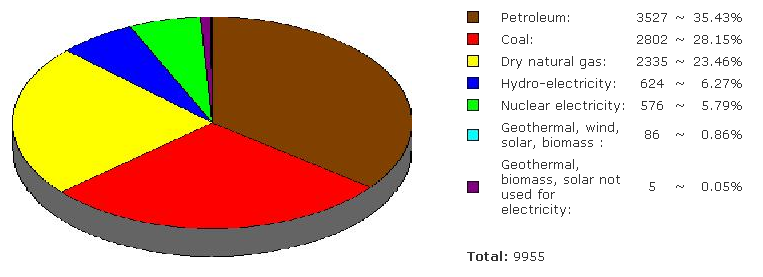
Even more conveniently, the United States and China will each use roughly 100 quads. Comparisons, contrasts–you don’t even need a calculator! A quad is a quadrillion British Thermal Units, and is roughly equivalent to the energy liberated from 36 million tons of coal. It’s a lot of energy, and 500 of those quads is really a mind stretcher. (For those of you who are counting, about 52 of those quads came from renewable energy. Of those 52 quads, about 50 came from hydroelectric power… urkk…)
In 2035, the DOE figures the world will consume about 683 quads, give or take. The UN, more ambitiously, thinks it’ll come in at about 703 quads. Either way, they anticipate a 40% growth in energy requirements. Is it okay if I say I think they’re both wrong?
Here’s why: The UN (and pretty much everybody else) believes that the world’s population will be at or around 8 billion in 2035. The UN (and pretty much everybody else) believes that world GDP will grow by about 3% per year between now and then–which is pretty much what it has been doing for quite a while. But most of that growth is projected to occur in the developing world. And most of that growth will be very energy intensive.
Here in the U.S., our energy consumption per person has been declining for a while, now. We’re down from 337 million btu’s per person to 323 mbtu’s per capita. But it’s going in the other direction in the developing world. They need the energy to actually, well, develop. And then they want the energy to enjoy the fruits of their development. Makes sense–that’s exactly what we did here.
Price Waterhouse Coopers has projected GDP growth to 2050 for major economies. For the U.S., they predict per capita growth in GDP from $40,339 in 2005 to $88,443 in 2050. Most of the very well developed countries show the same level of growth–a bit better than doubling.
The Department of Energy has energy use per person for many of the same countries. So let’s look at China. Before I start, remember that China has doubled its energy use since 2000. And they’re not done yet.
Their 2005 GDP per capita was $1,664 and their energy usage per capita was 58.8 mbtu’s. Their 2050 GDP per capita is projected to be $23,534, similar to Spain’s present GDP per person. Spain’s energy use is 164 mbtu’s. So who wants to predict China’s energy use per person in 2050? In 2035?
We’re always picking on China, and we don’t need to. The scary part is we can do the exact same thing for Indonesia, Brazil, Mexico, Turkey and India. The developing world is developing. They are going to be energy-sucking monsters for the next 80 years–just like we were.
My calculations show that, if we succeed in persuading the developing world to use energy efficient technologies wherever possible, switching from coal to natural gas, adopting wind and solar, buying best of breed turbines, etc., the world’s energy consumption in 2035 will be about 1,100 quads. However, if they proceed as they are (mostly) doing now, throwing up dirty coal to avoid blackouts and brownouts, cobbling together solutions however they can, world energy use in 2035 might well approach 2,000 quads–or even surpass it.
Imagine a world of 8.1 billion people, 7 billion of whom are using energy at the same rate as we do here in America–323 million btu’s per head. (3.23 x 7, for Joe Romm). That’s over 2,100 quads. It is at this point that some ugly questions appear. If we burn coal to obtain this energy, that’s 2,100 x 36 million tons of coal. If we withhold energy from these people, we condemn them to lives of starvation and poverty. If we subsidize clean energy solutions for them, we are spending our hard earned tax money on the poorest of the poor, many of whom live in countries that are not friendly to us. Oh, wait… we’re already doing that, aren’t we?
I favor the third solution. Using your and my tax dollars to help the poor afford electricity that comes from natural gas, nuclear and other cleaner solutions, so they can afford to buy our video games and see our movies (and, well, pay for them…). I do not expect my idea of the best solution to be very popular. Not with climate alarmists, who already don’t like natural gas or nuclear, and want to limit energy consumption by everybody except for themselves. Probably not with many readers here, who have seen taxpayer money go up in smoke on so many poorly-designed projects. But I think it’s our duty to ourselves, as well as the poorest of the poor.
GM>
Your lack of logic is astounding. If we use 500 quads per year now, then, unless we’re set to run out totally within four years, there is enough to produce 2,000 quads. We’re talking about power output over a sustained period, not a one-off event. Just bizarre, but then, about what you expect from someone who thinks peak oil a) exists and b) is related in any way to peak coal, peak gas, or any other peak.
Why does all this hand wringing remind me of the following?
In 1898, delegates from across the globe gathered in New York City for the world’s first international urban planning conference. One topic dominated the discussion. It was not housing, land use, economic development, or infrastructure. The delegates were driven to desperation by horse manure.
[…]
The situation seemed dire. In 1894, the Times of London estimated that by 1950 every street in the city would be buried nine feet deep in horse manure. One New York prognosticator of the 1890s concluded that by 1930 the horse droppings would rise to Manhattan’s third-story windows. A public health and sanitation crisis of almost unimaginable dimensions loomed.
And no possible solution could be devised. After all, the horse had been the dominant mode of transportation for thousands of years. Horses were absolutely essential for the functioning of the nineteenth-century city — for personal transportation, freight haulage, and even mechanical power. Without horses, cities would quite literally starve.
All efforts to mitigate the problem were proving woefully inadequate. Stumped by the crisis, the urban planning conference declared its work fruitless and broke up in three days instead of the scheduled ten.
“Imagine a world of 8.1 billion people, 7 billion of whom are using energy at the same rate as we do here in America–323 million btu’s per head”
Won’t happen. Half the world population will be as poor or poorer than they are now. And, as Bart said, even the middle class will consume less energy.
Technology advances, there will be new enrgy sources, new gadgets to improve efficiency.
The future is hard to predict, and harder to direct to some contrieved goal.
Developing the third world is no more than giving our wealth away to people who will eventually turn on us with the technology we gave them. China is a prime example. Does anyone think developing China is good for us. Look at the effort to build up Mexico and look at the results. And is Mexico grateful for our sacrafice, no and in fact their president slammed the US before our congress. I believe the first world is being stripped and robbed and why would we want that.
In about 2 years we may be able to start using fusion energy. Google Polywell and see one company that is working on a fusion reactor that has great potential to work where the other type fusion reactors have failed. This type energy production would solve lots of energy problems but would do nothing to solve population problems. It might keep the “war” level down somewhat.
I have long believed that subjective CAGW research has been for the purpose of finding ways to redistribute the use of those three big carbon based fuels between those that have and those that don’t. The poorest countries with the highest population densities don’t have. International treaties and national laws using carbon credits and offsets is probably the worst way to redistribute natural resources. While burning dirty coal is bad and should be controlled because it contains pollutants, CO2 is not a pollutant, does not have a measurable effect on climate, and should not be controlled. I would like to see pie charts of geographic distribution of the different energy sources(including known reserves) and energy consumption.
The problem with option #3 is that, too often, the money ends up in nefarious hands, who use it to purchase arms and proceed to use them. It follows that same old tired pattern: Here’s a couple of billion. Investigative reporters look to see what happened to the aid money. Nothing gets built, or a fraction of what could have been isn’t. The $$ goes for arms that are used to seize food aid, which doesn’ t get where it’s supposed to, or to support faction fighting.
It is not the US job to go around the world supporting governments that are bound & determined not to use that support for peaceful or productive uses. Then, as a last resort, we send our young men & women over to those places, to put the fires out that should never have been fueled in the 1st place.
No thank you.
There are already several examples in the world of “succesful” green policies which would deserve that some economist could make here a post to show all of us the wonderful consequences of these.
Why do you think governments need to take action. Real solutions grow from the bottom up. Let markets work. If resources are as scarce as the peak oil folks say, then the world economy just won’t grow that fast. Or, new technologies will emerge when someone can figure out how to make a buck. People are ingenious and resiliant. Get governments to stand asise and let the future unfold.
I doubt that there is or will be a peak uranium problem. Breeder reactors make more plutonium than they burn.
I read abook, regret not to hand, with good “back of envelope” calculations of the max possible from renewables like wind, tide, waves, hydro, solar thermal, some solar PV etc – not the economic max, but the physical max with eg all the coast of the UK surrounded by wind farms and wave machines. Result? Not enogh energy to meet even current energy demand.
Conclusion: massive energy efficiency needed in housing stock, transport (electric cars to act as store for variable renewable output, via demand management via smart “meters”). Still problematic, need nuclear/thorium or other, or population decline/mud hut living… it is the maths we need to examine, not La La land or CO2 panic…
Articles like this are a good start, more needed. Sorry I haven’t got the book at the moment, its in the UK whereas I’m in Boston USA awaiting Hurricane earl!!
“If we burn coal to obtain this energy, that’s 2,100 x 36 million tons of coal. If we withhold energy from these people, we condemn them to lives of starvation and poverty. If we subsidize clean energy solutions for them”
India and China are both net importers of coal. The price they are currently paying for imported coal exceeds $100/ton. The price for coal in Wyoming is $12/ton.
A 1,000 megawatt coal fired plant burns in about 4 million tons of coal per year.
If China or India builds a coal fired plant they are dooming themselves to spending more then $400 million per year on coal.
A Westinghouse AP1000 1,000 megawatt nuclear reactor can be built in China for $2-$3 billion. So the Chinese can build a nuclear reactor for the price of 5-7 years of coal imports for one coal fired electricity plant. Sounds like the economics is beyond brainless.
Now one wonders why anyone in China or India would build a coal fired plant.
It’s simple, Clean Coal(Coal fired plants with more then 40% efficiency) are eligible on a case by case basis for Carbon Credits under the UN’s Clean Development Mechanism and Nuclear Power isn’t.
Here we have an article about building coal fired plants in India and China
http://www.alertnet.org/thenews/newsdesk/SGE67O04X.htm
The Money Quote,
“I think it will be very difficult for such projects to survive without the CDM,” said an official at a USC plant now being built in China’s eastern province of Jiangsu by a joint venture involving state-owned utility Guodian.”
It’s both sad and historic watching the start of the perhaps “final battle” over resources on this planet and how to solve the energy needs of a growing human population. Reading this thread it’s actually amazing to me how shortsighted everyone seems to be. All they can see is the Earth. It’s like everyone has just accepted that we’re all stuck in a closet and the arguing over space and positioning for the upcoming fisticuffs are a necessary part of life.
The answer has always been space exploration. There’s incalculable amounts of resources off-planet and we know how to survive off-planet, yet instead of spending $30-50 billion a year to have a real space program, we spend $Trillions on propping up our housing values by purchasing public debt.
There is only one solution to just about every problem discussed on this site. That solution is moving humans off of Earth. It would solve our problem of impacting earths climate. It would solve our energy issues. It would solve our space issues. Yet this long-term goal is never mentioned in any arguments over peak-of-the-month. It’s like the whole world just accepts that we’ll never leave, and that’s sad.
Just throwing it out there. Please continue to bicker over how best to deal with the closet.
harrywr2 says:
September 1, 2010 at 7:46 am
Is that CDM really working? I mean “really” with real cash payments or it is just another “model” IF next Cancun jamboree is succesful. Because to make such big expenditures based on a Pachauri’s novel would be just crazy and I don’t think chinese people are either crazy or fool; instead they would fool all green–first-world-silly-believers.
I am sure they control themselves so as not to die by laughing at the utterly funny peculiarities of the occidental psyche.
They are just waiting, as the Confucius proverb reads: ” Wait at your front door and you’ll see the corpse of your enemy passing by”
Quote:
“I favor the third solution. Using your and my tax dollars to help the poor afford electricity that comes from natural gas, nuclear and other cleaner solutions, so they can afford to buy our video games and see our movies ”
That’s nothing but perty eco-Socialism. How about fixing our own problems here at home first? How about helping out our brownouts and high electricity costs? Force through the permitting of nuclear power and clean coal generation. When we have our economic and elecricity-budget problems solved, then we can worry about people who are the poorest of the poor (who don’t have money for buying cars, let alone building power plants).
Well, you nailed it. I like your assessment, (with a few caveats) and hate your solution, but you were partly correct as to why. Now, we’re to subsidize their electricity use so they can watch our movies? Uhmm, no. First, it is apparent, at least to myself, that this nation, (the U.S.) needs to do an about face regarding what comprises our GDP. We’re exporting services and other amenities of little intrinsic value.(Shown by the drop in energy use per person) We produce less and less goods with a value. If we continue in this manner, we won’t have the money to subsidize much of anything. Further, from a purely economical view, coal is the best(cheap and reliable) source of energy in forms of electricity. In some places in the developing world, hydro would be cheaper and almost as reliable. There are techniques that allow for the free flow of the poor fishies around the dams.
Gas is too expensive here. We should encourage people that can’t afford it to use it there? I like nuclear power, but obviously, put in improper hands, there are several ways things could go real bad.
So, it looks like the world is screwed………but wait! There is an answer! Things do not remain static! There is a proverb that has served mankind quite well, I believe it is attributed to Plato, “Necessity is the mother of invention.” The saying has been amended with, “if, necessity….,then ingenuity is surely its father.”(I think Challoner) There is no reason to believe mankind cannot overcome this minor difficulty with the abundance of energy sources yet untapped.
All of the predictions about GDP, population, and energy use is based upon what is known today and not what is unknown. In 40 years, the methods of transportation is likely to be significantly different as also the sources for electricity. To what or in what form, I haven’t a clue, but I know things change, and things are changing quicker now than what they had in the past. We’ll be fine if we don’t over-react and make small difficulties large ones.
I cannot really understand how anybody would think that a specific amount of energy is going to be an issue. Surely it is obvious that if we use more energy than we can extract energy will become more expensive and people will use less of it. Americans use as much as they currently do because it is so cheap. Suggesting everybody will use that much, and then saying it will not be there surely gives the obvious conclusion that the price of energy will increase, and so everybody would use less.
There are numerous sources of energy -it just so happens fossil fuels are currently the cheapest. When they are not other sources like solar will take off like a rocket. 20 years ago the energy required to make a solar panel was about the same as it generated in its entire lifetime – that is no longer the case and if oil was about to run out solar would be an option – an expensive option but an option. We would also accept nuclear more readily.
20 years ago they used to say that solar panels on 2% of the sahara desert would provide the entire energy usage of the human race. What percentage is it now, and what percentage are you predicing with this?
And will someone tell me how much energy they will be using in India or Indonesia to heat their houses? Try zero – it’s hot all the time. Such is extrapolation. In the 1970s there were rock solid predictions of mass famine by the 1990s. All the experts agreed – except they were wrong.
The problems with all future predictions – 1. You have to keep every other variable fixed which in this case means energy efficiency, and 2. you really don’t know what future technology will produce. 8 billion people will not be driving around in 2010 cars in 2050.
The one word answer is Thorium. It would only take 5000 tons a year to provide all the electricity. There are 1.2 million tons of known reserves and no-one is looking for the stuff so there will be a lot more than that. The nuclear industry gravitated around Uranium because they really wanted the Plutonium for bombs. Thorium has always been more suitable for power generation. And then there’s solar thermal…
Sorry, my previous post should read ‘It would only take 5000 tons a year to provide all the electricity used in the US’
Interesting post – thank you Thomas Fuller.
I do disagree with you that we should use our tax dollars to subsidize the developing world or that we should even fight for them. Let them fight their battles themselves. If they have a corrupt and restrictive government that is preventing them from bettering themselves, it is their problem, not ours.
I am not interested in us being the police or even the conscience of the world. I’ve had enough of it. We have plenty of problems with our own corrupt, over-grown, opportunity-killing government to deal with here at home. We’ll all be better off when we learn to mind our own business.
Martin Brumby says:
September 1, 2010 at 5:47 am
…then how come they only exist when massively subsidised and how come the actual output achieved is absolutely derisory? Have you bothered to look at the actual figures?
http://www.elistore.org/Data/products/d19_07.pdf
Applying a conservative approach, explained in further detail below, ELI found that
• The vast majority of federal subsidies for fossil fuels and renewable energy supported
energy sources that emit high levels of greenhouse gases when used as fuel.
• The federal government provided substantially larger subsidies to fossil fuels than to
renewables. Subsidies to fossil fuels—a mature, developed industry that has enjoyed
government support for many years—totaled approximately $72 billion over the study
period, representing a direct cost to taxpayers.
• Subsidies for renewable fuels, a relatively young and developing industry, totaled $29
billion over the same period.
• Subsidies to fossil fuels generally increased over the study period (though they decreased
in 2008), while funding for renewables increased but saw a precipitous drop in 2006-07
(though they increased in 2008).
• Most of the largest subsidies to fossil fuels were written into the U.S. Tax Code as
permanent provisions. By comparison, many subsidies for renewables are time-limited
initiatives implemented through energy bills, with expiration dates that limit their
usefulness to the renewables industry.
• The vast majority of subsidy dollars to fossil fuels can be attributed to just a handful of
tax breaks, such as the Foreign Tax Credit ($15.3 billion) and the Credit for Production
of Nonconventional Fuels ($14.1 billion). The largest of these, the Foreign Tax Credit,
applies to the overseas production of oil through an obscure provision of the Tax Code,
which allows energy companies to claim a tax credit for payments that would normally
receive less-beneficial tax treatment.
• Almost half of the subsidies for renewables are attributable to corn-based ethanol, the
use of which, while decreasing American reliance on foreign oil, raises considerable
questions about effects on climate.
Fossil fuel industries are already heavily subsidised. Removing these subsidies, would at least level the playing field to allow renewables to compete on a fairer footing…IMHO.
Someone has severe reading comprehension problems. Of course renewables can’t do the job, they are too diffuse. Combined with fossil fuels non-renewability, this means is that we are in even greater need of reduction of population and consumption
If you haven’t heard any rebuttals (as if the claim that the planet has infinite resources needs some sort of rebuttal) that’s because you have either:
1) you have lived all your life in the cave of free market ideology
2.) you have managed the impossible feat of learning how to write/type without ever learning how to read
3) you have never learned basic arithmetics
4) you are in dire need of mental hospitalization
There is no energy shortage. There never will be, either. Man’s ingenuity has always (Always, except when idiot governments intervene) provided more than sufficient energy to meet any situation.
Without resorting to toxic, dangerous, far-too-expensive nuclear power, the world has far more than enough oil, natural gas, wind-power, solar power, and ocean-based power to meet any need at any time.
There is no Peak Oil problem, either. Never has been, and never will be. Oil is much like picking fruit from a tree. The lowest-hanging fruit is picked easily by simply walking up to the tree and grabbing the fruit by hand. This is the equivalent of land-based, shallow oil, which is very cheap to produce. Middle-level fruit, higher up the tree, requires a ladder of some sort, so its production requires a bit more cost. This is the equivalent of deeper wells on-shore, and shallow wells off-shore. The highest fruit on the tree requires a mechanical lift, with higher cost. This is the equivalent of deep-water offshore, or from hostile environments such as the Arctic north slope, or more recently, Russia’s Sakhalin Island. The oil is there, always has been, and we know where it lies. When the price increases sufficiently, we will produce that oil. This is exactly what happened after the oil price increases of the 1970s, when drilling and production occurred in the North Sea and Alaska.
Really, it is astounding that the over-abundance of energy resources on this planet are overlooked by so many people.
There is no energy shortage. There never will be, either. The engineers will see to it, as we always have.
For those who want to read more on this, see the articles with key words “Grand Game” on my blog.
http://sowellslawblog.blogspot.com/search?q=grand+game
“Lack of logic”????????? So if oil has practically reached its all time production peak , we have no substitute for it and therefore, we’re in for severe reduction of industrial activity and energy consumption (because of the effects of that so badly neglected discipline called systems dynamics, a reduction in the availability of one resource often means that the whole system will quickly fall apart), then how exactly is there enough to consume 2000 quads in 2035??? Someone doesn’t get the concept of oil flows vs oil reserves at all