Guest post by Ben Herman and Roger Pielke Sr.
We have received a further question on our post:“The Greenhouse Effect” by Ben Herman and Roger Pielke Sr.
The question is summarized by the following text
Anyway my question refers to the common example of taking away the atmosphere and observing a cold surface. But as I understand it, the mean daytime surface temperature on the moon is over 100 C, with no greenhouse effect. The mean nighttime temp drops to -150 C. http://www.solarviews.com/eng/moon.htm
This is important to note, because encouraging a popular picture in which the presence of the atmosphere only warms the surface takes all the convection and fluid dynamics out of the discussion, and that’s where all the important complexities are.
Isn’t it more the case that the atmosphere both warms and cools the surface, depending on circumstances? The IR absorption of H2O and other GHG’s warms the surface relative to what it would otherwise be, but as the lunar case shows, convection and turbulent mixing cools the surface relative to what would happen without an atmosphere. Take away the atmosphere and you take away both warming and cooling mechanisms.
We have reproduced the substance of our follow up answer below.
Predicting the surface temperature indeed involves the interaction of the atmospheric and ocean turbulent sensible and latent fluxes, long- and short- wave radiative fluxes and interfacial fluxes between the surface and the atmosphere. I have been urging for years to move away from the surface temperature to characterize global warming and cooling (and replace with ocean heat content changes in Joules) because the surface temperature is such a limited sample of the heat content changes of the climate system as well as involving these complicated feedbacks.
On the Moon, there is, of course, no atmosphere, so its surface temperature results from the difference between the surface long wave radiative emissions, the amount of solar radiation absorbed and reflected, and the conduction of heat into and out of the surface. The effect of the atmosphere on Earth is to mute the diurnal (and seasonal) temperature range as a result of the turbulent fluxes, and other effects (such as clouds and precipitation). These atmospheric effects, for example, result in lower daytime and higher nighttime temperatures from what they otherwise would be. I presume this is the cooling and warming effects that you refer to. However, even with these effects, the surface is clearly warmer than it would be without the CO2 and water vapor IR absorption bands.
But the reasons are that the atmosphere scatters back to space some sunlight, and takes up some of the surface heating through conduction, and mixes it it by convection and turbulence. Also, the relatively rapid rotation of the earth on its axis does not permit the daytime side to reach equilibrium before it starts nighttime cooling. As a result, daytime temperatures on earth are cooler than they would be with no atmosphere, and warmer at night than with no atmosphere.
Of course, the Moon, with no atmosphere, still has to have basically the same effective radiating temperature as does the Earth. This should be
[sigma *Tmd**4 + sigma* Tmn**4]/2 = sigma*Te**4 where Tmd is the daytime temperature of of the Moon, Tmn is the night time temperature of the Moon, and Te is the effective radiating temperature of the Earth.
The fact that the daytime time temperature is warmer than the Earth’s temp is simply a result of the fact that the Moon is not in an equilibrium state – it warms up during the daytime and cools down at night, just as does the Earth. However the warming during day and cooling at night must balance each other or the Moon ( and the Earth) would be steadily heating up or cooling down over time. The daytime warming occurs because the outgoing IR cannot balance the absorbed solar during the day. The nighttime cooling occurs because the outgoing IR is greater than the non-existing solar at night. The existence of a partially absorbing atmosphere does, as you stated, keep days cooler and nights warmer.
Also, the length of a day on the Moon is 29.5 earth days, almost a full Earth month. Therefore the daylight side of the Moon heats due to solar radiation, for half a month. Then when it’s night, it cools for another half month. Thus the daytime and nighttime temperatures are much more extreme. There is no greenhouse effect on the Moon, of course, and if the Moon’s day was the same 24 hours as an Earth day, its day and night temperatures would not vary as much but its radiative equilibrium temperature would be the same.
Update #2 John Nielsen-Gamon has alerted us to more information on the Moon’s radiative temperature. John e-mailed
I read your blog post on Greenhouse Part 2. I also recently came across the Science of Doom web site; it seems to be of very high quality. You might want to link to http://scienceofdoom.com/2010/06/03/lunar-madness-and-physics-basics/ [on] your post to direct the reader to further details on the radiative temperature of the Moon.
Update – corrected text (underlined) h/t to Gerald E. Quindry
Citing Joe Lalonde:
“What confuses scientists is that the planet is 3 dimensional, yet rotation is 2 dimensional.”
Are you serious?
>> Dave Springer says:
July 28, 2010 at 10:11 pm
Moon’s average temp as recorded by two different Apollo missions is negative 23C or close enough to not be worth arguing about at mid latitudes. Thermocouples were placed on the surface and at intervals up to 3 meters deep in the regolith in the one they could bore that deep. Data was returned over a period several years. At a depth of around 1 meter IIRC (raw data is buried but accessible somewhere on Nasa web site as I found it and read it several months ago) temperature reading became constant over days and seasons.
To sum up, whatever is keeping the earth warmer appears to be keeping it a lot more than 33c warmer to offset the big difference in albedo betwixt the earth and moon.
<<
This makes sense. The moon radiates a lot faster than the mean temperature would imply because the 'T to the fourth power' relation means that the daytime radiative cooling dominates the moon's energy balance.
I had another thought cross my mind due to the comment about the Moon taking 29.5 days to rotate on it’s axis causing half of it to be in the sunlight for a month and half of it to be out of the sunlight for a month which causes the extremes in temperatures. (Again the Moon doesn’t have an atmosphere to help protect it from these extremes.) But we have places on Earth that experience either six months of daylight or six months of night and they don’t have major extremes of temperature fluctuations, since both humans and animal life actually live in these areas. So wouldn’t an actual atmosphere help the Moon regulate it’s temperature a bit more so it wouldn’t experience such large extremes?
Here is an interesting chart of the daily/diurnal change in radiation levels for the Earth’s surface, the moon’s surface and the incoming solar radiation at the Earth’s surface.
The Earth’s surface is very stable over a 24 hour period compared to the other two.
http://a.imageshack.us/img94/7123/diurnalsolarearthsurfac.png
Okay, dumb question. I thought the same face of the moon faced the Sun at all times, so what the hell is “day and night” on the moon? There’s a light side and a dark side, right? I’m happy to be corrected.
Oh, wait. The same face faces the EARTH at all times. Never mind.
“Okay, dumb question. I thought the same face of the moon faced the Sun at all times, so what the hell is “day and night” on the moon? There’s a light side and a dark side, right? I’m happy to be corrected.”
Montjoie, The same side of the moon faces the Earth all the time. I used to think that mysterious fact (the Moon rotates exactly once in one circuit of the Earth) and the fact it was the same size as the sun (To us here) meant alien’s must have put it there 😉 The real reason is that the moon and Earth are tidally locked. The creation of tides on the Earth has caused enough ‘friction’ to force the moon into sync with the Earths rotation.
The earth north and south poles get 6 months of day and 6 months of night, at the pole where solar insolation is very weak.
Even then it still doesn’t get near as cold at our poles as the moon does at its equator.
The main reason the earth doesn’t experience such huge temperature swing isn’t the earth’s atmosphere, although that helps.
The key is the conductive and convective thermal properties of the surface along with heat capacity.
Lunar regolith is poor conductor of heat. The top few centimeters see extreme day/night temperature changes but dig down a meter and it stays a constant negative minus 23C. It doesn’t have a particularly high capacity either.
Land surface of the earth is in the same thermal properties ballpark as lunar regolith.
But 70% of the earth is covered by water averaging 4000 meters deep with a bit better thermal conductivity but has two key properties that make it very much different than land or regolith. First of all it has a much higher heat capacity both latent and sensible. Secondly, it is convective, not just conductive and in shorter time frames the convective property swamps the conductive in how fast thermal energy moves around.
Ice isn’t a great thermal conductor but it’s a lot better than regolith and has a much greater heat capacity, both sensible and latent.
The atmosphere is a poor thermal conductor, pretty good at convective, and compared to water, ice, and rocks has almost no heat capacity. It’s a pretty good thermal insulator but convection cancels out a lot of that. If it weren’t for the thermal properties of the oceans though the earth wouldn’t be habitable. It would experience extreme seasonal and daily temperature extremes – not as extreme as the moon but extreme enough.
In other words what happens on the moon is the surface heats up really fast during the first few hours of daylight. Then because it’s such a good insulator, has no convection, can’t radiate downwards, and has only moderate heat capacity, the surface quickly reaches a state where the regolith is dumping heat by radiative transfer as fast as it’s getting from the sun. The opposite happens at night. It cools very quickly and then reaches a very cold equilibrium state.
The earth, with all its oceans, will keep on happily sucking up all the heat the sun can provide, buffering and diffusing it down fairly deep compared to land or regolith, and then is very miserly in giving up that heat at night.
Water in all its phases is the key to the climate on this planet. CO2 plays little if any role at all in climate control. It’s plant food and little else. Indeed, the entire atmosphere’s most important role in climate control is the simple fact that it has enough pressure at ground level to keep the boiling point of water high enough that we can have liquid water on the surface.
Just for a moment, imagine a planet like the Earth except that the trace gases in the atmosphere were just the opposite of greenhouse gases, ‘ice-locker’ gases if you will. These hypothetical gases would absorb the short wavelengths from the sun, but allow the infra-red ‘planetshine’ radiation from the surface to pass freely into space.
I believe this would create a permanent monster temperature inversion with very cold surface temperatures and an atmosphere progressively warming with altitude. There would be no convective activity on such a planet except, perhaps, at the top of the solar absorption zone. Life, as we know it, would be impossible.
Ben Herman and Roger Pielke Sr.,
First, thanks for the GHE Part II post. The GHE theory topic is at the crucial center of the climate debate and your posts add to the learning process.
Comment:
– Given that you have adequately shown in your first GHE post here at WUWT that basic conservation laws of physics and laws of thermodynamics are not violated by your stated GHE theory of the earth’s atmosphere.
– Given that you have adequately shown in your GHE Part II post the effects of earth’s atmosphere on muting daytime and nighttime temps as compared to the moon daytime and night temperature which has virtually no atmosphere. Also, you still hold that the GHE theory is operative in earth’s atmosphere during your GHE Part II discussion.
– Still, have you shown that there is a consistent/significant net warming effect on the lower atmosphere and surface temperatures when the GHE theory is added to the actual mix of time variation of many other processes here in earth’s system? From your posts, I cannot see that you have. I think that is at the heart of the debate on GHE. Namely, the issue I still see at hand is that even considering GHE theory is real does not translate to consistent/significant effect on lower atmosphere and surface temps when all other factors of earth’s system are considered.
– Therefore, I sincerely hope that you will please proceed to GHE Part III (and IV, etc) with a view to mixing the GHE theory you have described with the time and spatial variation of many other processes here in the earth’s total system and show that the GHE theory can cause a consistent/significant net warming effect on the lower atmosphere and surface temperatures.
I , for one, sincerely would like to see a continued series of GHE postings that evolve more toward an understandin of GHE theory in the mix of all other factors and to gage their relative magnitude and significance.
Anthony and team, thanks for hosting these open dialogs.
John
I am a bit perplexed about some of this. The equation given states that the average of the daytime emissions and the nighttime emissions on the moon should equal the same for the earth if one uses an “effective” radiating temperature for the latter.
The two sides of the moon have radiation power losses relating to bodies at roughly 380K and 120K (as stated in the text).These losses are in the ratio of about 90 to 1. In other words the cold side can be ignored as far as losses are concerned. Therefore the earth’s effective temperature is 380K divided by the four root of 2. This gives an effective temperature of about 320K which is more than the surface temperature of the earth. So on this basis the earth is indeed cooler than it should be.
I know that there are lots of explanations like the reflection of incident radiation by the earth’s clouds and the earth having a higher surface albedo but the equation was presumeably given to make a point. I just do not see what that point is. Have I missed something?
http://www.sciencedaily.com/releases/2009/09/090917191609.htm
Data accumulated by the lunar orbiter Diviner indicate that equatorial and mid-latitude daytime temperatures are 224 degrees Fahrenheit, and then decrease sharply poleward of 70 degrees north latitude. Equatorial and mid-latitude nighttime temperatures are -298 degrees Fahrenheit, and then decrease poleward of 80 degrees north latitude. At low and mid-latitudes, there are isolated warmer regions with nighttime temperatures of -208 degrees Fahrenheit.
The interpretation of this by David Paige, UCLA professor of planetary science, is –
“These correspond to the locations of larger, fresh impact craters that have excavated rocky material that remains significantly warmer than the surrounding lunar soil throughout the long lunar night,” Paige said.
My interpretation of this is that not only are atmosphere and ocean key ingredients in calculating planetary temps but also the surface and subsurface materials, and on earth surface conditions are complicated because soils can be either wet or dry at different times.
The happenstances of weather will move the averages of climate.
Spector says:
July 29, 2010 at 11:49 am
Just for a moment, imagine a planet like the Earth except that the trace gases in the atmosphere were just the opposite of greenhouse gases, ‘ice-locker’ gases if you will. These hypothetical gases would absorb the short wavelengths from the sun, but allow the infra-red ‘planetshine’ radiation from the surface to pass freely into space.
I believe this would create a permanent monster temperature inversion with very cold surface temperatures and an atmosphere progressively warming with altitude. There would be no convective activity on such a planet except, perhaps, at the top of the solar absorption zone. Life, as we know it, would be impossible.
It’s called the stratosphere, the gas is oxygen.
cal: I don’t think you can think of the moon as an object having half of its surface at ~380 K and the other half at ~120 K. Rather, the surface temperature ranges from 120 K (approximately) directly opposite to the sun and 380 K (approximately) directly under the sun, with other places taking on values in-between these two extremes. So, in fact, the equation that Herman and Pielke wrote down is probably too simplistic (in addition to neglecting albedo).
In an excellent post, John Whitman writes:
“I think that is at the heart of the debate on GHE. Namely, the issue I still see at hand is that even considering GHE theory is real does not translate to consistent/significant effect on lower atmosphere and surface temps when all other factors of earth’s system are considered.”
Amen, Amen, Amen. What we have been doing so far is discussing the characteristics of the CO2 molecule. We now know our catechism: CO2 captures radiation, there is back radiation, and it can heat Earth (or cause Earth to cool more slowly) to some unknown degree. In the meantime, we have excommunicated those evil “Laws of Thermodynamics” people, except maybe for the quantum theorists. OK, I got it. Can we now get to the Achilles Hill of AGW proponents, namely, that they have no physical hypotheses which could explain the warming that they proclaim? To the very best of our knowledge, there is no set of physical hypotheses which could explain the actual behavior of CO2 as a source of heat (or slowed cooling) that changes observable patterns in climate or weather. Because there are no hypotheses, there are no predictions of changes in climate or weather that come from the work of AGW proponents. Because there are no predictions, there is no science of AGW. (And please don’t say “Well, it’s all so complicated.” If you want to see complicated, we can invite Anna the quantum lady to write an essay. )
The moon does not have a magnetosphere or a plasmasphere either.
That (possibly) finely tuned relationship between solar activity, geomagnetic field strength, and weather patterns are still worth looking into. I do not mean temperature, I mean the powerful electrical events we know as weather.
Would someone be kind of enough to answer a question or two for me? 1. Where is the CO2 in the atmosphere. Climate scientists assume that it is distributed randomly throughout the atmosphere. In practical terms, that means that they can simply ignore the question I just asked. However, if CO2 is distributed randomly, it is the only thing that is. Just take anything that has interested mankind and you will find that it is not distributed randomly. Take oxygen, for example. If you ascend Mt. Everest, you learn that oxygen concentration decreases all the way up. Why does CO2 distribution matter? Well, if it tends to collect in the first ten feet above sea level then a third of Earth is not affected by its radiative properties. 2. Why do folks assume that Earth must radiate into space everything that it receives from the sun daily? I thought the sun’s energy was converted into biomass and that it might contribute to various processes on Earth. Is Al Gore right that the Gulf Stream is driven by the millions of degrees of heat just beneath Earth’s crust?
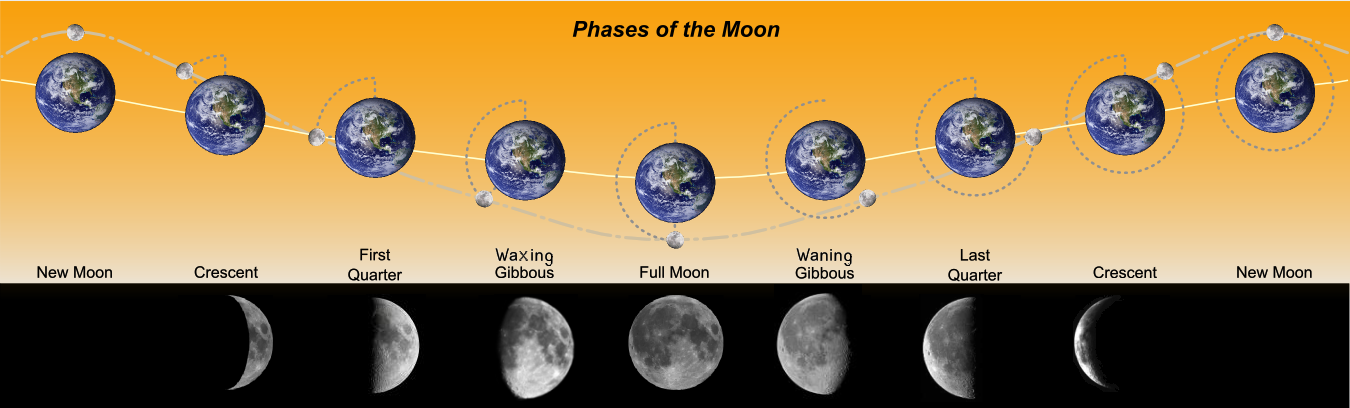
If that thick white curve is supposed to represent the orbit of the earth around the sun, then from the position of the lighted side of the earth and moon they are both heading directly toward the sun, soon to be incinerated!
Joel Shaw commented my argument does not hold because the model used is too simplistic. I would point out that it the model they chose to use although I accept that they used average temperatures which were not stated. I did consider your point before I wrote my piece but decided (right or wrong) that it was not significant. My understanding is that the termal capacity of the moon is very low. As a consequence my expectation would be that the temperature of the surface would fall dramatically within one earth day. After all the temperature on earth can drop 60K in only half that time and we have a thick atmosphere to slow the cooling down. So my guess is that the dark side of the moon really is very cold for most of the time and heats up very rapidly as soon as it comes into the sun although obliquity will be a factor that will slow the rise.
Further to my previous post I thought it might be helpful to exploit the idea of the earth’s effective temperature to discuss the greenhouse hypothesis.
The effective temperature is not defined but my assumption is that it is the temperature of a body the same size and albedo as the earth (but without any atmosphere) that would radiate the same energy as the earth. If this is the case then I would expect it to be the fourth root of the sum of the fourth powers of all the radiating elements which contribute to the earth’s losses (where these are normalised to add up to 1 in terms of total power radiated).
The main radiating elements (as far as I can see) are as follows:
1)Direct radiation into space from the earths surface particularly at wavelengths around 10micron where the atmosphere is near transparent.
2)Losses from water vapour which will be at various heights depending on wavelength. At absortion peaks the probability of a photon escaping to space will be small unless the atmosphere is thin i.e. high altitude and therefore low temperature. The temperatures will therefore range from 230K to 300K
3) Losses from CO2. This is the prime radiator at 13 to 18 micron and accounts for 18% of the energy radiated from the earth according to the Elsasser paper of 1942 that Max Hugoson gave a link to on Tuesday. The temperature of this element is about 230K.
So the effective temperature should be somewhere between all of these. The lower the effective temperature is the less the radiation losses are and the higher the surface temperature will be.
Accordingly the more radiation is absorbed and remitted by CO2 and water vapour the higher the surface temperature. This is the (badly named) greenhouse effect.
However, as I have already posted on another unrelated thread (which may have got lost), there is a question relating to CO2 which I have not yet been able to get an answer to.
The normal explanation of higher CO2 leading to higher temperatures is that as the concentration goes up the height at which the radiation is emitted goes up and therefore the temperature goes down. This leads to a higher surface temperature as per the argument above. However there is a problem as I see it. The height at which CO2 emits is already close to the tropopause which is the lowest temperature in the atmosphere. I have seen arguments which suggest that the absorbtion by CO2 will reduce the energy reaching the tropopause and therefore the tropopause will cool but I have seen to proof of this happening. In the absence of this effect I am at a loss to see how the radiation from CO2 can be any lower than it is now. Indeed as the concentration of CO2 increases I see a much stronger argument for suggesting that this will increase the cooling from the tropopause and above and have a net cooling effect on the atmosphere as a whole. So whilst I am happy with the theory that says that the presence of CO2 and water vapour makes the world warmer than it would be I am not happy with the idea that further increases will mean further warming. Indeed the relationhship between temperature and CO2 concentrations over the last 6 ice ages are explained far more easily if one postulates a negative feedback since cooling periods have always occurred while CO2 concentrations have been high and rapid warming has always occured when CO2 has been low. This is not what the AGWs say but go and have a look at the graphs for yourself. Ignore the peaks. Just look at periods with rapid temperature rises and those with rapid falls and compare these with CO2 levels at the time. You will be surprised.
peakbear, tides on earth don’t really matter do they? same side of moon facing earth has to do with moon not being completely solid object. roll a ping pong ball on the floor full of sand and it stops. same w/ moon ‘rolling’ around earth.
Theo:
Its mixing ratio (grams per kilogram of air) is constant throughout the atmosphere, except when you get beyond the stratosphere where that goes to hell. Hence why it is a “well-mixed gas”.
cal:
Simple way to think about it: increase CO2, increase the effective radiating level’s altitude. To remain in equilibrium, air at that altitude increases in temperature so it emits at the effective temperature. Assuming the lapse rate remains constant in this scenario, the surface will warm by the same amount. This is not really realistic, as the lapse rate will change, its sign depending upon how things like static stability and the water vapor feedback play out.
Also, it’s worth noting that whether you define tropopause via the WMO description or via the height of maximum eddy kinetic energy, there has been an increase in the height of the tropopause.
Nick writes:
“Its mixing ratio (grams per kilogram of air) is constant throughout the atmosphere, except when you get beyond the stratosphere where that goes to hell. Hence why it is a “well-mixed gas”.”
Does the fact that it is well-mixed mean that it is distributed randomly up through the stratosphere? Let me explain my larger concern. Climategaters seem to view the Earth statically, but clearly that is a mistake. Their own claims reveal the error. They claim that CO2 is randomly distributed but also claim that the oceans absorb huge amounts of CO2. Are they talking about CO2 that is created in the ocean? If not then the CO2 travels to the ocean, which is what one would expect of manmade CO2. If it travels to the ocean then the CO2 in the atmosphere is moving. If it is moving to the oceans then it is not randomly distributed.