Guest post by Ben Herman and Roger Pielke Sr.
We have received a further question on our post:“The Greenhouse Effect” by Ben Herman and Roger Pielke Sr.
The question is summarized by the following text
Anyway my question refers to the common example of taking away the atmosphere and observing a cold surface. But as I understand it, the mean daytime surface temperature on the moon is over 100 C, with no greenhouse effect. The mean nighttime temp drops to -150 C. http://www.solarviews.com/eng/moon.htm
This is important to note, because encouraging a popular picture in which the presence of the atmosphere only warms the surface takes all the convection and fluid dynamics out of the discussion, and that’s where all the important complexities are.
Isn’t it more the case that the atmosphere both warms and cools the surface, depending on circumstances? The IR absorption of H2O and other GHG’s warms the surface relative to what it would otherwise be, but as the lunar case shows, convection and turbulent mixing cools the surface relative to what would happen without an atmosphere. Take away the atmosphere and you take away both warming and cooling mechanisms.
We have reproduced the substance of our follow up answer below.
Predicting the surface temperature indeed involves the interaction of the atmospheric and ocean turbulent sensible and latent fluxes, long- and short- wave radiative fluxes and interfacial fluxes between the surface and the atmosphere. I have been urging for years to move away from the surface temperature to characterize global warming and cooling (and replace with ocean heat content changes in Joules) because the surface temperature is such a limited sample of the heat content changes of the climate system as well as involving these complicated feedbacks.
On the Moon, there is, of course, no atmosphere, so its surface temperature results from the difference between the surface long wave radiative emissions, the amount of solar radiation absorbed and reflected, and the conduction of heat into and out of the surface. The effect of the atmosphere on Earth is to mute the diurnal (and seasonal) temperature range as a result of the turbulent fluxes, and other effects (such as clouds and precipitation). These atmospheric effects, for example, result in lower daytime and higher nighttime temperatures from what they otherwise would be. I presume this is the cooling and warming effects that you refer to. However, even with these effects, the surface is clearly warmer than it would be without the CO2 and water vapor IR absorption bands.
But the reasons are that the atmosphere scatters back to space some sunlight, and takes up some of the surface heating through conduction, and mixes it it by convection and turbulence. Also, the relatively rapid rotation of the earth on its axis does not permit the daytime side to reach equilibrium before it starts nighttime cooling. As a result, daytime temperatures on earth are cooler than they would be with no atmosphere, and warmer at night than with no atmosphere.
Of course, the Moon, with no atmosphere, still has to have basically the same effective radiating temperature as does the Earth. This should be
[sigma *Tmd**4 + sigma* Tmn**4]/2 = sigma*Te**4 where Tmd is the daytime temperature of of the Moon, Tmn is the night time temperature of the Moon, and Te is the effective radiating temperature of the Earth.
The fact that the daytime time temperature is warmer than the Earth’s temp is simply a result of the fact that the Moon is not in an equilibrium state – it warms up during the daytime and cools down at night, just as does the Earth. However the warming during day and cooling at night must balance each other or the Moon ( and the Earth) would be steadily heating up or cooling down over time. The daytime warming occurs because the outgoing IR cannot balance the absorbed solar during the day. The nighttime cooling occurs because the outgoing IR is greater than the non-existing solar at night. The existence of a partially absorbing atmosphere does, as you stated, keep days cooler and nights warmer.
Also, the length of a day on the Moon is 29.5 earth days, almost a full Earth month. Therefore the daylight side of the Moon heats due to solar radiation, for half a month. Then when it’s night, it cools for another half month. Thus the daytime and nighttime temperatures are much more extreme. There is no greenhouse effect on the Moon, of course, and if the Moon’s day was the same 24 hours as an Earth day, its day and night temperatures would not vary as much but its radiative equilibrium temperature would be the same.
Update #2 John Nielsen-Gamon has alerted us to more information on the Moon’s radiative temperature. John e-mailed
I read your blog post on Greenhouse Part 2. I also recently came across the Science of Doom web site; it seems to be of very high quality. You might want to link to http://scienceofdoom.com/2010/06/03/lunar-madness-and-physics-basics/ [on] your post to direct the reader to further details on the radiative temperature of the Moon.
Update – corrected text (underlined) h/t to Gerald E. Quindry
How delightful somebody is distinguishing between heat and temperature.
Now the right question about energy budget can be asked:
Watt’s up with that?
To my understanding, one of the reasons why the temperature of Moon fluctuates with much larger amplitude compared with earth is the existence of water: that is, its phase transition (between ice and liquid, as well as between liquid and gas) and its global transportation. The short rotation time (compared with Moon) and water largerly equalize the temperature of the earth surface. If water existed at Moon the temperature fluctuation would be much decreased. The GHG effect of water and other gases is another story.
[sigma *Tmd**4 + sigma* Tmn**4]/2 = sigma*Te**4
Cor, I’m seeing stars!
how about (sigma.Tmd^4 + sigma.Tmn^4)/2 = sigma.Te^4
Does this show as sigma? σ
Would the 116.8 terrestrial day rotation rate of Venus have anything to do with why it is so hot?
Isn’t the atmosphere acting more like an insulator? The water and land absorb most of the heat and the atmosphere is there to slow down the release of that heat to space during night-time and slow down the heating during day-time. Change the characteristics of that insulator and the rates of heating/cooling change. That said, it is expected that the atmosphere is not homogeneous and quite different from day-time to night-time… so the rates of absorption and emission are variable.
Moon’s average temp as recorded by two different Apollo missions is negative 23C or close enough to not be worth arguing about at mid latitudes. Thermocouples were placed on the surface and at intervals up to 3 meters deep in the regolith in the one they could bore that deep. Data was returned over a period several years. At a depth of around 1 meter IIRC (raw data is buried but accessible somewhere on Nasa web site as I found it and read it several months ago) temperature reading became constant over days and seasons.
To sum up, whatever is keeping the earth warmer appears to be keeping it a lot more than 33c warmer to offset the big difference in albedo betwixt the earth and moon.
Moon albedo is 0.12 vs. earth 0.30. Moon and earth are made out of the same stuff and would have similar albedos if earth had no atmosphere. Moon rocks are darker than one might guess by looking at it from here.
Earth atmosphere allows all three phases of water to exist on the surface and in the atmosphere. Snow, clouds, and ocean double the albedo. With an extra 18% insolation being reflected by the earth vs. the moon we might guess it would be a lot colder here than moon’s average temp.
Earth’s surface temp averaged over a period of time ecompassing a full glacial/interglacial cycle should be (by proxy) about what the average ocean temperature is as 120,000 years out to be more than enough for just conduction alone to mix it up pretty good.
Average ocean temp is about 4C for an indicated temp difference provided by -some- manner of warming mechanism(s) of 27c compliments of an atmosphere, even if the atmosphere’s only role is make surface water possible. Probably a lot more than that because with such a higher albedo, which is going to be higher still on average because glacials are about 10 times longer than interglacials, the moon gets a good deal more insolation on the surface.
I tend to think Miskolczi got it right that (at least in the interglacial) greenhouse warming is running in stable self-maintained saturation i.e. this is about as warm as it gets. I don’t really agree it’s stable in the long term because it has tipped so many times into glacial periods (at least over the most recent tens of millions of years) so for the nonce glacial periods are the more stable state.
LOL. And for the last 26 years, since NASA and Hansen went nuts, I thought the sun had no effect on temperature. What a revelation this is. Takes me back to my first science fair project in 7th grade with Ms Savage. Yes. That was her name.
How about the convective effects of both the atmosphere and the oceans carrying and distributing heat?
Not impressed by Herman & Pielke. For a serious discussion of the issue may I recommend “Science of Doom” where the resident gurus do not call you names, even when you ask dumb questions as I often do:
http://scienceofdoom.com/
Sleepalot says:
July 28, 2010 at 9:51 pm
(σ.Tmd^4 + σ.Tmn^4)/2 = σ.Te^4
Works great.
Of course, the Moon, with no atmosphere, still has to have basically the same effective radiating temperature as does the Earth. This should be
The moon has a tenuous atmosphere composed of helium, argon, sodium and potassium.
Is it not possible to park properly equipped satellites at Earth’s L4 and L5 points and allow them to scan the morning and evening periods of Earth’s day, and trend the data over time? It can’t possibly be more complicated than Hansen’s tortured number crunching.
Gino says:
July 28, 2010 at 10:20 pm (Edit)
How about the convective effects of both the atmosphere and the oceans carrying and distributing heat?
Plus the multi-decadal variation in cloud albedo (ISCCP, Earthshine Project) altering the insolation at the surface where it really matters in terms of the amount of solar energy absorbed by the ocean.
But hush now Gino, we don’t want to confuse the issue by introducing empirically measured factors which cause energy variations an order of magnitude bigger than theoretical co2 radiative forcing.
People might start to think the science is not settled.
tallbloke says:
July 28, 2010 at 11:32 pm
” we don’t want to confuse the issue by introducing empirically measured factors which cause energy variations an order of magnitude bigger than theoretical co2 radiative forcing.
People might start to think the science is not settled. ”
AGW’s missing heat never was in the oceans, it couldn’t get in there in the first place.
BUT.
A lot of heat sure does come from the oceans though, in fits and spurts after the sun puts it in there in the first place.
This obviously happens on a daily (constant) basis and varies over longer time scales with oceanic currents / phases we do not understand (to any degree) as of yet (ie, Wilde’s Hot water bottle hypothesis).
Dilley’s lunar cycles / influences would also greatly help in this respect.
The atmosphere is a refrigerant between the planet’s surface and space.
GHG’s do actually cool the atmosphere, O2 and N2 “insulate” the atmosphere.
There is plenty of “settled science” physics that is actually theoretical physics,
but don’t question that yet, it just ain’t done (or openly admitted as theoretical).
So, “we” had better be quiet whilst the “settled science” rules the roost.
CO2 is king, not heat retension / release YET.
Time, though, is beginnng to tell.
Dear all,
Sorry, moderator… I couldn’t resist after reading Tallbloke’s post:
http://www.biocab.org/Convection_Surface_Atmosphere.jpg
The graph was plotted from real measurements during the period indicated in the horizontal axis. Sharp decreases happened in cloudy days. The day with negative Φq was a rainy day.
Location Coordinates: 25° 48’ North-lat- and 100° 19’ West-long. Altitude 513 m ASL
I cannot see empirically the “weakness” of the heat transfer by conduction-convection at the boundary layer. It is satisfactory for maintaining the atmosphere warm and for avoiding the “scorching” of the Earth.
Wonder how much Global Moon warming or Earth Global warming would occur if the SUN stopped shining.
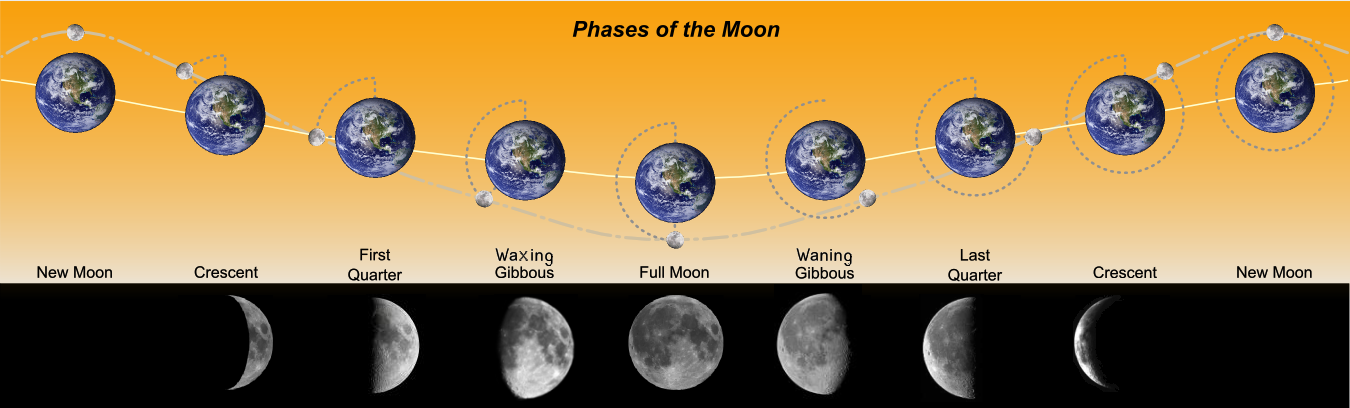
Somebody should tell wikipedia that their graph of the moon phases above seems to indicate that the Earth moon system is headed straight for the sun…
The true positions of the lunar light phases should be full where they show first quarter, if the shading of the color scheme, indicates the sun below the foreground, all though they do show the shift of the COM of the Earth, as the moon revolves around it the proportion is off. It is drawn as if the two masses were equal, the real barycenter is below the surface of the Earth about 1400Km.
Since the supposed view is from above, the North / South declinational component is not shown. There still needs to be some more work done to make this graphic right.
“Predicting the surface temperature indeed involves the interaction of the atmospheric and ocean turbulent sensible and latent fluxes, long- and short- wave radiative fluxes and interfacial fluxes between the surface and the atmosphere”
How about interactions between different layers of the atmosphere ?
There are a couple of large temperature inversions on the way up and layers with very different compositions and densities.
It is clear that not all the layers warm or cool at the same rate which introduces the probability of differential warming or cooling at different levels and thus disruption of the upward energy flux over time.
Such disruptions especially in the stratosphere would have an effect on the pressure distribution in the troposphere.
Then there is the issue as to whether variations in solar activity could provoke such variations in the upward energy flux by affecting the layers differentially.
To my mind the evidence of a cooling stratosphere when the sun was more active and now a slightly warming stratosphere with the sun less active suggests something of that nature going on.
To resolve climate observations we do need some mechanism working from above because the effect of variable energy fluxes from the ocean does not always correlate well with changes in the troposphere. During a period of active sun the El Ninos send the jets more poleward than the same strength El Nino seems to achieve when the sun is less active.
The relevance to the greenhouse issue being that those other effects are so much more powerful in causing natural climate variability via adjustments to the speed of the hydrological cycle that the significance of greenhouse gases disappears in comparison even without the system’s self adjusting process shown by Miskolczi.
Indeed such adjustments to the speed of the hydro cycle appear to be the mechanism whereby the situation revealed by his findings is achieved.
## The post by Ben Herman and Roger A. Pielke Sr.: “For those that might still question this conclusion, consider taking away the atmosphere from the Earth, but change nothing else, i.e., keep the solar albedo the same (the lack of clouds would of course change this), and calculate the equilibrium temperature of the Earth’s surface.”
That would mean a loss of only about 0.001 percent of the total Earth’s water volume, the remaining 99,999% are still available in the ocean and supply about 90% of the evaporated water to the atmosphere every 10 days, or 35 times a year. Atmospheric vapor represents the earthly greenhouse. The moon has CO2, but no water.
Herman and Pielke Sr. would have not missed this point if CLIMATE would be understood: as the continuation of the oceans by other means, particularly water and heat. Discussed at: http://www.whatisclimate.com/
I have just posted a previously unpublished laymans guide to the greenhouse effect by engineer John Eggert on my site. There is a supporting paper detailing the maths and physics for download included.
The warmista won’t like it.
http://tallbloke.wordpress.com/2010/07/29/john-eggart-laymans-guide-to-the-greenhouse-effect/
Ben Herman and Roger A. Pielke Sr: Just in case you missed the Ocean Heat Content comment on the earlier greenhouse gas thread, I’ll repeat it here. Regards.
###########
NODC Ocean heat content (OHC) data shows no sign of the effects from a rise in anthropogenic greenhouse gases. Tropical and southern hemisphere OHC show flat to declining trends that are occassionally shifted up by multiyear La Nina events. See:
http://bobtisdale.blogspot.com/2009/09/enso-dominates-nodc-ocean-heat-content.html
North Pacific OHC declined until the late 1980s, then shifted upwards with a change in the NPI. Refer to:
http://bobtisdale.blogspot.com/2009/12/north-pacific-ocean-heat-content-shift.html
And North Atlantic OHC is impacted by AMO/AMOC, sea level pressure and ENSO. See:
http://bobtisdale.blogspot.com/2009/10/north-atlantic-ocean-heat-content-0-700.html
Many factors influence temperature fluctuations on this planet.
What confuses scientists is that the planet is 3 dimensional, yet rotation is 2 dimensional. You weigh less at the equator due to centrifugal force, yet this is not included in the study of the sun. The energy at the equator of the sun is stronger and deminishes as you move towards the axis. PLANETARY DRIFT is the planet moving horizontally at an slow angle through the equator of the sun and cooling when it moves towards the poles of the sun and coming back through the hottest trail in a pattern.
The suns strong magnetic field on this hunk of iron tries to keep the planet in place by exerting it’s influence.
The speed of rotation generates the LIVE magnetic field and centrifugal force, which generates atmospheric pressure that trap gases and ALL the magnificent processes for evaporation and heat transfer, atmospheric levels, gas and moisture molecule interactions, that generates life.
This answers the question. It should be at the front, not the back.
“Also, the length of a day on the Moon is 29.5 earth days, almost a full Earth month. Therefore the daylight side of the Moon heats due to solar radiation, for half a month. Then when it’s night, it cools for another half month. Thus the daytime and nighttime temperatures are much more extreme”
It sounds like –
Determining the “Temperature ” of the Earth (or Moon, or etc.) is like determining the exact “Location” of an Electron in Space and Time, it ain’t easy. Currently, we can determine the temperature of points and must then interpolate (SWAG) the temperature of the whole. Guessing what the temperature reading on the thermometer will be in the future is a little more difficult and takes more guts. Guessing what the temperature reading is for an area not covered with thermometers is so much more difficult; the farther afield one goes, the more guts one needs. Another way of looking at the issue: currently we don’t have what we need, to do what we want to do, and we’re not that comfortable with all the guesswork.
I started thinking about this after reading “Kiminori Itoh’s” comment: “If water existed on the Moon the temperature fluctuation would be much decreased. The GHG effect of water and other gases is another story.”
My thoughts are if water exsisted on the Moon wouldn’t that give the Moon an atmosphere? (I’m creating a fictional planet and I’m looking at what actually gives Earth an atmosphere. And the thing that most sticks out to me is the amount of water on Earth.)
With water you would have the creation of clouds and the two gases of Hydrogen and Oxygen, I know you also need to add in Nitrogen and Carbon to produce plant life, but water would definitely be a big facter to start the process of creating life on any given planet or Moon.