By Steve Goddard
This summer we have had confirmation that Arctic ice behaviour has everything to do with wind. During June, winds were circulating clockwise in an inwards spiral, which caused ice extent to diminish and ice concentration to remain high. Around July 1, the patterns reversed and we have seen counterclockwise winds pushing ice away from the pole. As a result, ice area/extent has scarcely changed and instead we see a gradual decline in average ice thickness. The video below shows June/July ice movement and thickness.
The graph below shows changes in ice thickness during summer over the last five years. Based on past behaviour, we can expect the average ice thickness to flatten sometime in the next two weeks. It should bottom out somewhere between 2006 and 2009. NSIDC has warned me that PIPS is not an accurate measure of ice thickness, though I would have to say it has done remarkably well as a predictor of this summer’s behavior. As you can see below, 2010 is following a track similar to 2006.

As you can see below, we have reached the midpoint of the melt season in the high Arctic, and temperatures have been slightly below normal there for most of the last 55 days. There are only about 40 days left above freezing in the high Arctic.

http://ocean.dmi.dk/arctic/meant80n.uk.php
NCEP is forecasting below normal temperatures in most of the Arctic for the next two weeks.
The sea ice graphs have nearly flatlined since the beginning of the month. DMI’s graph is particularly interesting, since it only measures higher concentration ice, which is less likely to melt through.

http://ocean.dmi.dk/arctic/icecover.uk.php
Below is a closeup image showing that 2010 extent is now running close to 2006.

The concentration and extent appears quite similar to 20 years ago.

It has been cloudy in the Arctic and you can clearly see the counterclockwise circulation in the satellite IR image below. Clouds are white, ice is red.

The webcams continue to show a little ice on the surface of the meltponds, indicating ongoing below freezing temperatures at the North Pole.

http://psc.apl.washington.edu/northpole/webphotos/noaa2.jpg

We are at peak melt season, and there just isn’t much happening in the Arctic. The Arctic Oscillation has turned slightly positive in July, which tends to keep cold air contained in the Arctic and out of lower latitudes.

http://www.cpc.noaa.gov/products/precip/CWlink/daily_ao_index/ao.sprd2.gif

The modified NSIDC map below shows ice loss (red) and ice gain (green) over the last week. There has been slightly more loss than gain.

The modified NSIDC image below shows ice loss since early April.

The modified NSIDC image below shows the difference between 2010 (green) and 2007 (red.) There is clearly more ice now than in 2007, and this is also shown in the NSIDC extent graph.


http://nsidc.org/data/seaice_index/images/daily_images/N_timeseries.png
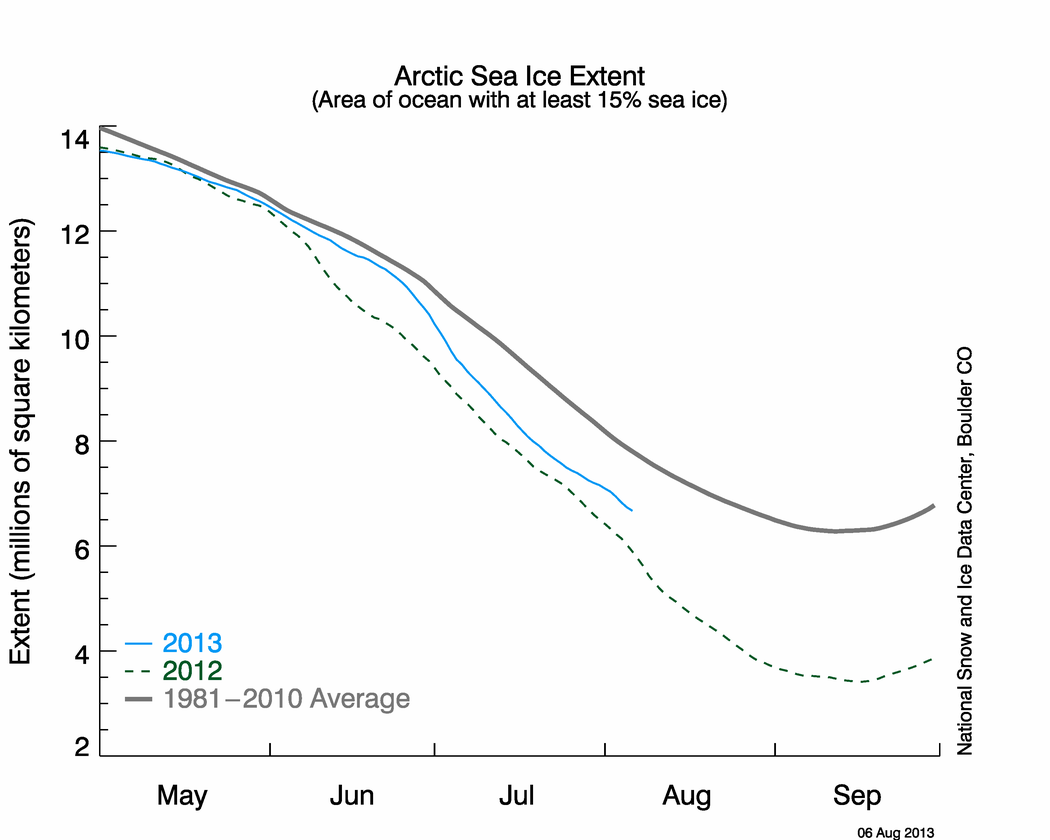
Ice has flatlined in the North, while it goes through the roof in the south.

http://nsidc.org/data/seaice_index/images/daily_images/S_timeseries.png
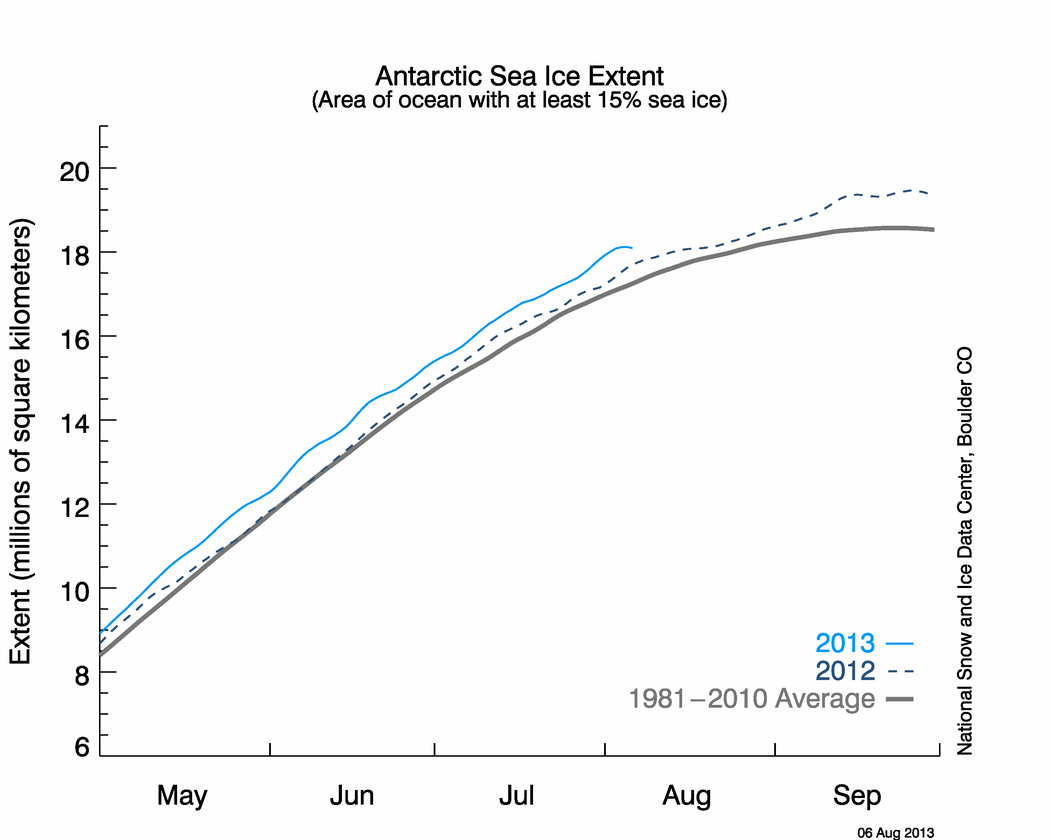
In other words, the widely claimed polar meltdown continues to be nothing more than bad fiction.
[no attacking other commenters please ~ ctm]
Do you understand what the word teleconnections means? Do you understand that everything on the planet is connected?
CO2 is a known gas that traps infrared radiation. CO2 has increased due to human activity and will continue to do so. The idea that human activities do not have an impact on the planet (not to mention how we’ve completely altered the land-cover of this planet, the climatic impact of which is not insignificant), is arrogant and dangerous. I for one am glad there are people on this planet who do understand and who do care to preserve this amazing place we live in.
Gail, have you forgotten that global warming is not global? Have you missed the part where warming in larger in the Arctic than at the equator? Do you understand that it’s the sun that is the primary input to the climate system and that the fact that the equator receives more solar input than the poles is what drives the Earth’s atmospheric and oceanic circulation? Change the equator to poles temperature gradient and you change atmospheric and oceanic circulation. It’s basic physics. No CO2 induced warming is going to be uniform because of all the feedbacks in the climate system.
Excerpt from: jeff brown on July 13, 2010 at 10:28 pm
Really? So if CO2 concentrations shot up past 600 ppm and the (C)AGW models were amazingly verified by sharply rising temperatures, the increases would not be everywhere worldwide, some places would actually get colder? Wow, that (C)AGW stuff sounds truly wonderful! So since global warming is not global, which places will get colder? They sound like good places to build resorts for people wanting to escape the heat!
Oh wait, are you saying not that some places will get colder, but rather some will see no changes in their average temperatures? So some select spots will not be affected at all by global warming, no matter how warm it gets elsewhere, at least temperature-wise? And where are those places? Imagine the far-flung future of the (C)AGW modelers, where so much of the Earth is roasting with 10°C average increases since pre-industrial times, and some places haven’t gone up at all!
From: jeff brown on July 13, 2010 at 10:25 pm
Yes, CO2 has been identified, way back around 1630 by Flemish scientist Jan Baptista van Helmont, thus it is a known gas. In that you are correct.
CO2 absorbs and then radiates infrared, but only a few wavelengths, and in the atmosphere it only radiates about 50% of the time in a direction that could be said to be inward to the Earth rather than outward to space. If I designed a device that would catch mice, but only a few select sizes, and half the time it would let them go unmolested, do you think I’d be successful selling it as a mouse trap? Do you work in advertising?
Excellent point! The increase is ongoing, will not stop, thus adaptation to whatever effects result from increased CO2 levels is the logical thing to do.
Exactly! Just look at how mankind has completely altered the land-cover of Death Valley, it used to look so much different before mankind mucked around with it. And then there’s Antarctica. Have you seen the tremendous land-cover changes man has wrought in Antarctica? Shameful!
Indeed, and here on WUWT you will find a truly impressive collection of individuals who care deeply for the environment and work hard to preserve and even improve it. Why, I myself use both the curly fluorescent light bulbs and the canvas shopping bags! I am growing my own vegetables right now!
jeff brown says:
July 13, 2010 at 10:28 pm
Gail, have you forgotten that global warming is not global? Have you missed the part where warming in larger in the Arctic than at the equator? Do you understand that it’s the sun that is the primary input to the climate system and that the fact that the equator receives more solar input than the poles is what drives the Earth’s atmospheric and oceanic circulation? Change the equator to poles temperature gradient and you change atmospheric and oceanic circulation. It’s basic physics. No CO2 induced warming is going to be uniform because of all the feedbacks in the climate system.
___________________________________________________________________
Thank you for that. ” Have you missed the part where warming in larger in the Arctic than at the equator?
You just proved my point. CO2 induced warming is not driving the climate.
Look at the spring and summer temperatures in the Arctic for the last ten years (click on each year) and you can see they have been at or below average. Therefore global warming has not occurred during the last ten years and the climate is entering a cooling phase. http://ocean.dmi.dk/arctic/meant80n.uk.php
Summer temps are the ones that will effect ice melt in the Arctic the most since you do not melt ice in the autumn and winter when the snow is falling and the sea Ice is freezing.
Basiclly CO2 vs temp graphs show CO2 if it has any effect it is miniscule:
USHCN vs CO2
the last 8 years
Lower troposphere temps
Barents Sea Temp in black and AMO in red
HERE is the ARCTIC Air Temp
CO2 vs Arctic air temperatures
Per:
#
Nightvid Cole says:
July 11, 2010 at 2:50 pm
Yes, the SSM/I sensor is showing many spurious ice pixels for July 10, so for the time being we should not trust the NSIDC data. Since they take a five-day moving average, if the problem goes away we will need to wait until July 13 (Tuesday) for the average to “roll” past the bad data.
#
Nightvid Cole says:
July 11, 2010 at 2:53 pm
Correction to previous post: We need to wait until July 16 (Friday) when the data for July 15 (Thursady) is available, assuming that the spurious pixels are gone beginning with the map of data for today which will be available tomorrow.
– – – – – – – – – – – – – – – – – – – – – – –
Yes, that Five-Day Average for a plot-prediction is a good point.
http://i28.tinypic.com/2co31gi.gif
JK says:
July 13, 2010 at 8:19 pm
Gail Combs says:
July 13, 2010 at 4:14 pm
Ug. Not “Beck’s collection of historic CO2 measurements” again! But even Beck had those measurements at Mauna Loa in his graph as the average global concentration from the 1950s….
_______________________________________________________________________-
I am not arguing the Beck collection of historic measurements. I am pointing out that either CO2 is uniformly distributed in the atmosphere or CO2 is not uniformly distributed. You must choose one or the other assumption; you cannot have it both ways.
Let’s look at how Mauna Loa measurements are done. The assumption is CO2 is uniformly distributed in the atmosphere This is actually stated and the assumption is used as a reason to toss out data that does not meet that assumption.
“4. In keeping with the requirement that CO2 in background air should be steady, we apply a general “outlier rejection” step, in which we fit a curve to the preliminary daily means for each day calculated from the hours surviving step 1 and 2, and not including times with upslope winds. All hourly averages that are further than two standard deviations, calculated for every day, away from the fitted curve (“outliers”) are rejected. This step is iterated until no more rejections occur.
As a lab manager I have fired over a dozen degreed chemists for that type of thinking. I caught them, for example, retesting a sample until they could finally make it supply a desired result. They recorded only the “good” result and tossed out the rest.
You DO NOT throw out data! It is bad science to throw out data. Omission of data points must be for scientifically validated reasons. For example, if the wiring to a sensor is loose, and the resulting signal is noisy, it is proper to mark that particular data as invalid, and to ignore it. However, the history of atmospheric CO2 measurements tends to involve throwing out data that spoils the neat picture desired by politicians and propaganda mongers.
R. Gates says:
July 13, 2010 at 2:10 pm
I don’t know what definition of spurious you’re using here, so I’ll assume you’re just saying it’s a false premise, and with that, I couldn’t disagree more. A very big part of the increased scepticism of science in recent years is the scientists’ overconfidence and claims of being absolutely certain of something or understanding something completely. And no, “known” is definitely not implied in Julienne’s comment. Perhaps if she hadn’t CAPITALIZED the word “ALL”, then maybe I’d buy that, but the tone implied by the capitalization takes away that argument in my book.
These sentences here make it clear that you didn’t properly interpret my first comment. I should have been more clear. I did not mean people should be sceptical of scientists for searching for/looking at all the factors, but for claiming they know all the factors involved in something (or worse, that all those factors are in a textbook). Huge difference there, and I would think that the majority of sceptics here at WUWT think that climate scientists focus too much on CO2 causing warming and not looking at other sources (both natural and anthropogenic). Is that not Dr. Pielke, Sr.’s viewpoint as well?
-Scott
=========================
stevengoddard says:
July 12, 2010 at 7:02 am
harvey
Can I put you down as forecasting a big melt the rest of the summer? My forecast is on the table.
==========================
Well i am no expert like you, but my gut (which I trust in complex situations) says that the ice extent for this year will be least on record, less than 2007.