By Steve Goddard
This summer we have had confirmation that Arctic ice behaviour has everything to do with wind. During June, winds were circulating clockwise in an inwards spiral, which caused ice extent to diminish and ice concentration to remain high. Around July 1, the patterns reversed and we have seen counterclockwise winds pushing ice away from the pole. As a result, ice area/extent has scarcely changed and instead we see a gradual decline in average ice thickness. The video below shows June/July ice movement and thickness.
The graph below shows changes in ice thickness during summer over the last five years. Based on past behaviour, we can expect the average ice thickness to flatten sometime in the next two weeks. It should bottom out somewhere between 2006 and 2009. NSIDC has warned me that PIPS is not an accurate measure of ice thickness, though I would have to say it has done remarkably well as a predictor of this summer’s behavior. As you can see below, 2010 is following a track similar to 2006.

As you can see below, we have reached the midpoint of the melt season in the high Arctic, and temperatures have been slightly below normal there for most of the last 55 days. There are only about 40 days left above freezing in the high Arctic.

http://ocean.dmi.dk/arctic/meant80n.uk.php
NCEP is forecasting below normal temperatures in most of the Arctic for the next two weeks.
The sea ice graphs have nearly flatlined since the beginning of the month. DMI’s graph is particularly interesting, since it only measures higher concentration ice, which is less likely to melt through.

http://ocean.dmi.dk/arctic/icecover.uk.php
Below is a closeup image showing that 2010 extent is now running close to 2006.

The concentration and extent appears quite similar to 20 years ago.

It has been cloudy in the Arctic and you can clearly see the counterclockwise circulation in the satellite IR image below. Clouds are white, ice is red.

The webcams continue to show a little ice on the surface of the meltponds, indicating ongoing below freezing temperatures at the North Pole.

http://psc.apl.washington.edu/northpole/webphotos/noaa2.jpg

We are at peak melt season, and there just isn’t much happening in the Arctic. The Arctic Oscillation has turned slightly positive in July, which tends to keep cold air contained in the Arctic and out of lower latitudes.

http://www.cpc.noaa.gov/products/precip/CWlink/daily_ao_index/ao.sprd2.gif

The modified NSIDC map below shows ice loss (red) and ice gain (green) over the last week. There has been slightly more loss than gain.

The modified NSIDC image below shows ice loss since early April.

The modified NSIDC image below shows the difference between 2010 (green) and 2007 (red.) There is clearly more ice now than in 2007, and this is also shown in the NSIDC extent graph.


http://nsidc.org/data/seaice_index/images/daily_images/N_timeseries.png
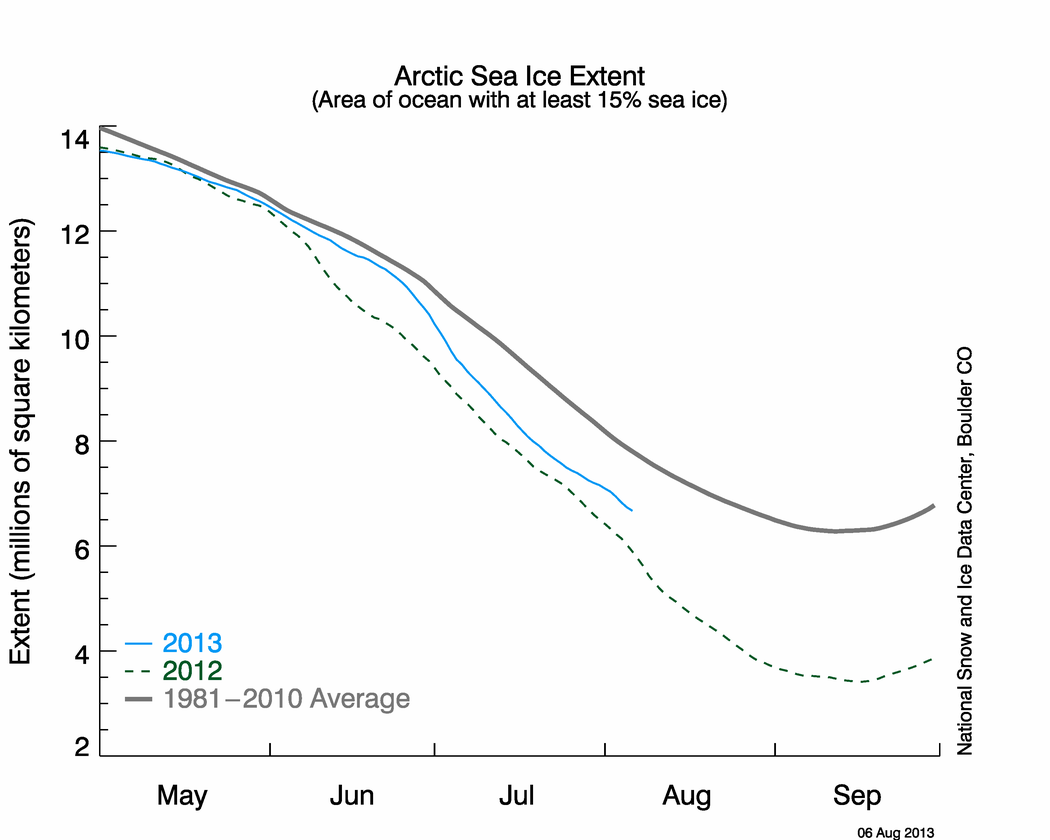
Ice has flatlined in the North, while it goes through the roof in the south.

http://nsidc.org/data/seaice_index/images/daily_images/S_timeseries.png
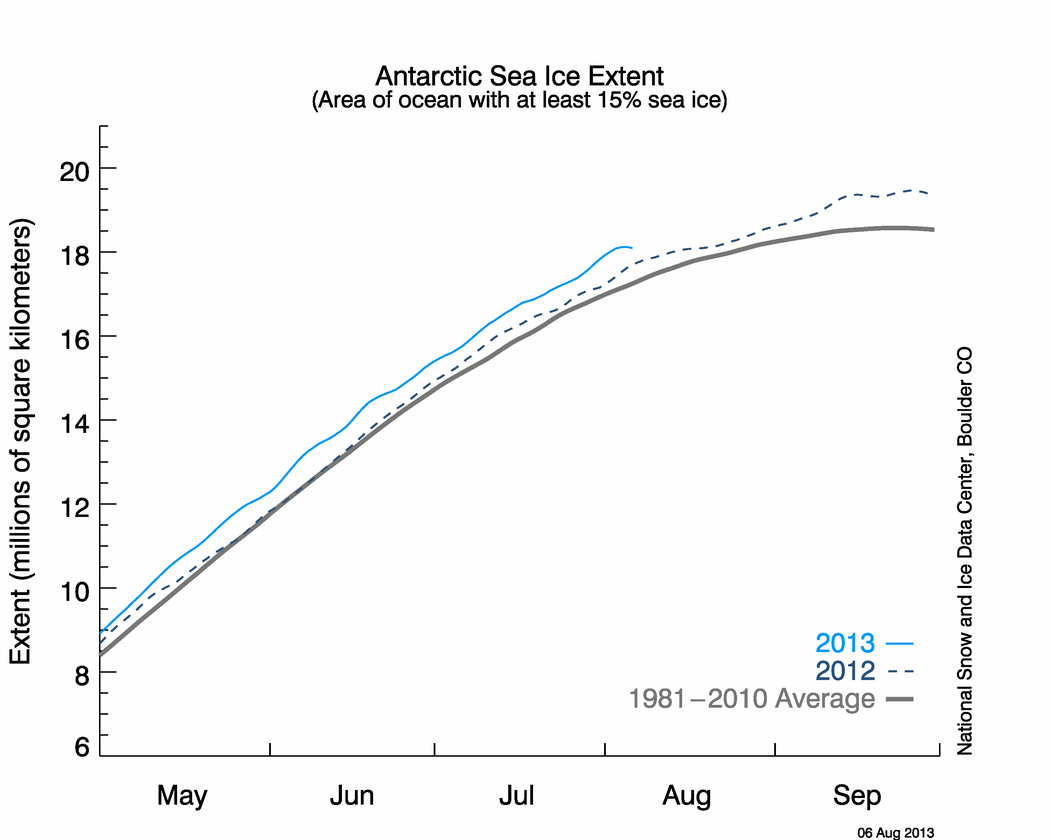
In other words, the widely claimed polar meltdown continues to be nothing more than bad fiction.
Pamela Gray,
In posting these videos on the sun I’m not trying to find difference with you because I do respect your viewpoints. But there is a relationship in the sun/climate graphs. And I want to pursue where they are going. What do you think of this one? I am interested to know:
kadaka (KD Knoebel) says:
July 12, 2010 at 11:38 pm
From: Pamela Gray on July 12, 2010 at 2:34 pm
… Thus we now have attractors. Systems can look stochastic but really be deterministic, the chaos is illusionary, and if they are deterministic then they can be accurately modeled. … It does not even matter that a grand model using attractors with absolutely everything included to accurately predict the climate would need to be run on a mega-supercomputer the approximate size of Titan.
Because they can cite attractors, they can say there is no randomness, climate can be successfully modeled, accurate predictions can be made. Only those at the highest levels fully understand attractors, thus only they can truly understand climate
—…—…—…—
But even with the attractiveness of chaotic theory, the CAGW alarmists fail: They praise with great verse the great smooth curves of the beach, the rocky headlands jutting out into the ocean, and the strength of the individual waves; then attempt to model the individual grains of sands and forecast what the beach will look like in 100 years, then claim doom and catastrophy by extrapolating their model to 1000 years for political purposes. And money, power, glory, and fame. They extrapolate “up” from each grain of sand the chaos attractors and Mandelbrot curves that, in the world’s truth, can only be calculated “down” from the massive to the infinitely small. And, at the world’s level of a grain of sand being moved by the waves irregularly, randomly, and catastrophically, don’t exist at all.
All the while their 100 year modeled forecasts – and 1000 year predictions of doom – ignore the river flowing into the cove and the ocean current flowing down the coast.
Gates: “However, as one begins to track the frequency of certain types of weather anomalies over the longer term, how those frequencies change over time (i.e. droughts, extreme rainfall or snowfall) can tell you something about climate change….but any individual event is simply weather noise.”
That does sound reasonable, and that is one reason why I no longer am a believer in CAGW. Increased frequency of adverse weather is not there. And I do not see anything unusual in temperature trends or sea level trends, especially when you consider long term trends that started before CO2 became an issue.
VILLABOLO: “. . . do you know the difference between “advocates”, as you call them, (I refer to them as those who are uneducated and slightly educated on the subject) and the actual Climatologists and those who know enough to speak carefully on the subject.”
Well, I was referring to statements by Hansen, Schmidt, Jones, Mann, . . . . Some may refer to them as Climatologists, but if you prefer to call them “uneducated and slightly educated on the subject,” I’ll let it go at that.
For myself, in the latter category, I would put statements like the Red River flooding was a global warming event. (Red River flooding is actually caused by large snowfall, frozen ground, and slow ice melt up north, but our president pointed to it as a global warming event.)
kadaka (KD Knoebel) says:
“…the chaos is illusionary, and if they are deterministic then they can be accurately modeled.”
________
This quote alone shows me that perhaps you don’t understand the nature of chaotic attractors as well as you think. Chaos theory is not about randomness, but about unpredictable but determinisitic factors, i.e. real causes that have real effects at very specific threasholds, but none that we can predict exactly. Put a pan of water on a hot burner and I can tell you that it will come to boil, and if you tell me exactly how hot the burner is and the heat transfer properties of the pan, and the purity of the water, and the atmospheric pressure, etc. I can tell you reasonably well when the pan of water will reach the boiling point…however, I can never tell you exactly where and when the first few bubbles will form– this is the heart of chaos theory. Deterministic and unpredictable and leads to real effects. Chaos is not illusionary, it is simply not predictable, and certainly NOT random.
R. Gates says:
July 13, 2010 at 7:28 am (Edit)
and if you tell me exactly how hot the burner is and the heat transfer properties of the pan, and the purity of the water, and the atmospheric pressure, etc. I can tell you reasonably well when the pan of water will reach the boiling point…
Except there are always the deux ex machina to worry about. The cat which walks across the edge of the hob controls, the steam from the pan which sets off the sprinkler system etc.
This is why the models are crap. That and they don’t know that clouds are a negative forcing.
savethesharks says:
July 12, 2010 at 11:36 pm
I post this one more time. Will he have honor enough to respond thoughtfully?
July 12, 2010 at 10:53 pm
RGates..
3) Finally, even if some additional TW of heat is coming in to the Arctic from the Atlantic (and also from the Pacific), we know that there are some who would state that even some of this heat is coming from the additional forcing from the 40% additional CO2 in the atmosphere since the 1700′s.
But provide some links to research, and I’d gladly read up on this conjecture.
=========================
No the burden of proof is upon you to provide your references to real-world, scientifically proven evidence for your theory.
But you won’t becuase you can not. You are as slippery as the jellyfish they are catching in our starving seas.
Explain (and back up with evidence) what you said in number 3 above.
We’re waiting.
Chris
Norfolk, VA, USA
______________
http://environmentalchemistry.com/yogi/environmental/200611CO2globalwarming.html
http://earthguide.ucsd.edu/globalchange/global_warming/03.html
http://www.pmel.noaa.gov/pubs/PDF/feel2899/feel2899.pdf
http://www.pnas.org/content/early/2009/01/28/0812721106.abstract
http://www.msnbc.msn.com/id/37812221/
And hundreds of others that you can easily google and find for yourself. If you really actually read the literature and research, it is not an issue of whether or not the oceans have been warming and acidifying, (with CO2 as the culprit) it is really that they seem to not have warmed as much as the should (i.e. the travesty of the missing heat from Dr. Trenberth). But I’m quite aware that nothing I post shall satisfy you for you are a true believer.
tallbloke says:
July 13, 2010 at 7:42 am
R. Gates says:
July 13, 2010 at 7:28 am (Edit)
and if you tell me exactly how hot the burner is and the heat transfer properties of the pan, and the purity of the water, and the atmospheric pressure, etc. I can tell you reasonably well when the pan of water will reach the boiling point…
Except there are always the deux ex machina to worry about. The cat which walks across the edge of the hob controls, the steam from the pan which sets off the sprinkler system etc.
This is why the models are crap. That and they don’t know that clouds are a negative forcing.
_____________
You are talking about randomness, and that has nothing to do with Chaos theory or chaotic attractors, nor the weather, nor the climate. The climate is not a random event. And yes, some asteroid could strike and send us all back to an ice age quicker than we might get there otherwise, but climate is not random. There are very specific real deterministic factors, acting over hundreds of thousands of years down to a few years, that affect climate. One of those is CO2 levels, and they’ve increased 40% since the 1700’s. This is rapid in geologic terms, and you’d expect some effect in a dynamic chaotic system like the climate.
This graph of the radiative forcing of CO2 isn’t random, but simple physics, and just one of the variables (albeit perhaps the most important) that has affected the earth’s climate over the past few hundred years.
http://www.esrl.noaa.gov/gmd/aggi/aggi_2008.fig3.png
R. Gates says:
July 13, 2010 at 8:53 am
We are all still waiting for your 25% skeptic side to show, but still 100% of your posts are from your 75% CAGW side. You are in cheerleader territory at this point.
The following paper demonstrates that net and downwelling longwave radiation coincides with SST/ENSO events, it does not precede the warming of the oceans. Therefor the cause of warming oceans has to be found outside rising atmospheric CO2 levels. This fact is easy to mathematically calculate based on the ability of longwave radiation to heat oceans enough to bring an ocean area out of neutral to an El Nino event. LW radiation cannot do that in the time span observed between neutral and El Nino events, nor is there sufficient heat-making energy in LW to do that.
The paper does show that net and downwelling longwave radiation are a good descriptor for El Nino events, as good as three month running averages of SST’s are. Therefore increasing levels of CO2’s ability to increase re-emittance of LW cannot be involved in warming the oceans to an El Nino event, but changes in downwelling and net LW coincides with the event and is probably an immediate EFFECT of an ENSO event. The case against CO2 warming the oceans is pretty tight.
Other papers, past and present, demonstrate a clear and convincing correlation between SST and air temps/pressure gradients.
Regarding the Arctic atmospheric systems then, it is still my position that the juxtaposition of oceanic pools and currents of warm and cool areas affecting atmospheric pressure gradients is the lion’s share of the cause of the atmospheric change over to what you refer to as the Arctic Dipole. You are left with determining what additional influence warmer/cooler air not already warmed/cooled by oceanic currents and pools has in bringing about a sustained or more frequent dipole.
http://www.atmos-chem-phys.net/7/2013/2007/acp-7-2013-2007.pdf
In making your case, my previous reference (IE Polyyakov) show that evidence strongly suggests that the dipole is not a new occurrence, nor a more frequent one, and shows no correlation whatsoever to increasing CO2.
Gates and Julienne have not brought a convincing argument for CO2 influence on the Arctic Dipole. The mathematical mechanism for CO2 is not there.
However, I might be willing to contemplate that land temps warmed by increasing CO2 may have a role when confronting a cooler air mass. However, land temps cool rapidly, regardless of what heats them during the day, when the Sun goes down, something the Arctic is rather well known for.
For CO2 to be the driver for sustained, stronger, or more frequent dipoles, you must demonstrate it’s ability to keep the air heated 24/7, even when SST’s are changing back to neutral or cool events.
Jon P says:
July 13, 2010 at 9:08 am
R. Gates says:
July 13, 2010 at 8:53 am
We are all still waiting for your 25% skeptic side to show, but still 100% of your posts are from your 75% CAGW side. You are in cheerleader territory at this point.
_____________
I’ve listed my areas of skepticism (where’s the missing heat? for example), but the basic science of increased radiative forcing from increased CO2 I believe is pretty rock solid. Some have suggested that CO2 is purely a logarithmic effect, but chaos theory would preclude that assumption even if it looks good on paper. It seems a lot of time is spent by some skeptics talking politics, which interests me not in the least. In total, of the thousands of pages of research that I’ve read, it’s made me a (75%) believer in the overall AGW hypothesis, and the Arctic sea ice, in my estimation, is the best single place to put my interest in moving that percentage significantly one way or another.
I don’t for example, happen to believe that the Arctic has been ice free in recorded human history. Yes, parts of Greenland were warmer during the MWP, but nothing that I find credible would indcate that one could sail across the Arctic at any time during recorded history without encountering ice.
Could the current downtrend in Arctic Sea ice be from some natural variation, and not caused by the 40% increase in CO2 since the 1700’s. It is possible, of course, and, so I’ll gladly read any scientific study that could suggest some other reasonable natural forcing agent that could be warming the Arctic and melting both sea ice and permafrost in the ways we’ve seen the past decade or longer. Historic accounts are interesting, but hardly comprehensive, and leave me rather skeptical about their credibility for documenting the climate of the entire Arctic.
What probably turns me away from skeptics in general is their only looking at some relatively short term trend, (such as weather), or denying basic facts such as the 40% increase in CO2 since the 1700’s. These basic scientific facts are really not in dispute,(though the causes might be for some) but unless they are recognized as such, then I tend to shy away from certain skeptical types. A true skeptical friend of mine, who has a bit less grasp of the science in my estimation, but loves Rush Limbaugh, was crowing and was beside himself with glee this past spring during the March “bump up”. And then when we had the cold spell in the deep south this past winter, I again had to endure the daily “some global warming!” comments from him. I tried to explain about the AO index and how Greenland had been unusually warm while the cold air was forced south, etc. but he simply said I was “holding on to a dead theory.”
It is this kind of skepticism that I have no time for. There’s real mysteries to figure out, and that to me is the fun of science, but spending time listening to recycled talking points from some skeptics who would know the first thing about how CO2 really behaves in the troposphere doesn’t interest me.
So looking for the very best and truly knowledgable skeptics does interest me, as it give me a chance to actually learn something. Hence, why I make WUWT part of my daily routine, and frequently applaud Anthony for providing this excellent forum. But you’ll note, I rarely comment about things political, as that side of the skepticism I find quite uninteresting…
Pamela, I never said the CO2 is responsible for the Arctic Dipole Anomaly. What I disagree with is your continued assumption that SSTs drive the Earth’s atmospheric circulation on both a global and regional scale and that nothing else matters. I suggest opening up any atmospheric text book to educate yourself on ALL the factors that control atmospheric circulation.
A good book to start with is Meteorology Today by C. Donald Ahrens. It is an introduction to weather, climate and the environment and explains things on a level that any college student should be able to easily comprehend.
I already showed you how an anomalous heating source, such as more open water in the Arctic Ocean influences atmospheric circulation within the Arctic and I’ve pointed you to references so that you can read the studies for yourself. I don’t understand your stubborn refusal to expand your mind.
Pamela,
Thanks for the link on DLW radiation and the ENSO cycles. Very interesting. I would also like to direct you to a few links showing a general increase in DLW radiation over the past few decades and a link to the increase in CO2 and other GHGs:
http://www.agu.org/pubs/crossref/2009/2009JD011800.shtml
http://www.agu.org/pubs/crossref/2008/2008GL034842.shtml
http://ams.confex.com/ams/Annual2006/techprogram/paper_100737.htm
http://www.agu.org/pubs/crossref/2004/2003GL018765.shtml?fb_page_id=11296750277&
Thus, if there is a link between DLW radiation and ENSO, and there is a link to increased CO2 and increased DLW, then it stands to reason that there is some linkage between increased CO2 and ENSO events, though I would guess it is more complicated than it would first appear (i.e. because it is a dynamic chaotic system, it is certainly far from any linear type of relationship and probably involving multiple feedback loops, both positive and negative).
Julienne says:
July 13, 2010 at 11:13 am
Pamela, I never said the CO2 is responsible for the Arctic Dipole Anomaly.
______________
Julienne,
I just wanted a point of clarification on your point here. I also have never said that CO2 is responsible for the “existence” of the Arctic Dipole Anomaly, as it certainly exists a phenomenon separate from CO2 concentrations, but do you believe that the frequency or intensity of the DA might not be enhanced through general Arctic warming, (especially open water later in the season?) and to the extent that this warming is caused by increased CO2, then the DA’s frequency and intensity is related to increased CO2 concentrations? Perhaps you disagree with the direction that some research is going in this area, and that would be interesting in itself, or perhaps I’ve misunderstood the concept of polar amplication of general anthropogenic GW. Any clarification here would be helpful.
Julienne says:
July 13, 2010 at 11:13 am
I was unaware that humans undertstood ALL the factors controlling atmposheric circulation, or ALL the factors for any real system for that matter. And people don’t seem to grasp why people are becoming more sceptical of scientists these days…
-Scott
R. Gates,
It is widely agreed that as atmospheric greenhouse gas concentrations continue to rise,
this will invoke changes in atmospheric circulation. This makes sense because (1)
there will be changes in the vertical temperature structure of the atmosphere; (2) different regions will warm at different rates, changing horizontal temperature gradients. However, just what the changes will look like is still pretty much a wild card – different climate model sensitivity studies give a wide range of outcomes.
In the Arctic, the recent large declines in the summer sea ice cover strongly warms the lower atmosphere in the cold season (especially autumn; we have already seen this happen). Arguably, this Arctic warming will reduce the basic temperature gradient from the equator to to pole, meaning that extratropical cyclones (the low pressure systems that accomplish much of the heat transport from low to high latitudes) will be fewer, less intense or both (with a smaller temperature gradient, there is less of a need to transport heat). However, there is no observational evidence that this is happening, and in fact there is some evidence for more frequent and intense autumn cyclones (I have a paper in press in Tellus about changes in autumn cyclones and their relationship to more open water in September).
On a more regional scale, the recent warming that extends through a considerable depth in the lower troposphere decreases the atmospheric air density and raises the height of upper-air-constant-pressure levels over the Arctic Ocean, which weakens north-to-south pressure gradient that drives the west-to-east airflow in the upper troposphere. Some recent work by J. Overland shows a 40% reduction in the west wind component for October, November and December. Some studies have shown this then favors a negative AO state.
But as to your question, will we see a more common Arctic Dipole Anomaly as greenhouse gas concentrations increase? The best answer based on our present knowledge is that we simply don’t know, but I would expect to see more atmospheric variability as we lose the stabilizing affect of the sea ice.
Scott says:
July 13, 2010 at 1:34 pm
Julienne says:
July 13, 2010 at 11:13 am
I suggest opening up any atmospheric text book to educate yourself on ALL the factors that control atmospheric circulation.
I was unaware that humans undertstood ALL the factors controlling atmposheric circulation, or ALL the factors for any real system for that matter. And people don’t seem to grasp why people are becoming more sceptical of scientists these days…
-Scott
_______________
Scott, I find your comment spurious, especially as some justification for why “people are becoming more sceptical of scientists.” This was a discussion about SST’s and their influence on global circulation and Julienne was making the valid point that all factors should be considered, not just SST’s. The additional adjective “known” is obviously implied in her comment, as you can’t consider what you don’t know, nor can you find it in textbooks. Any implication that there is any cause to be skeptical of scientists for trying to look at ALL factors (obviously known ones) is ludicrous…for that is what science is all about, and even more so, the most exciting thing about science is to be on the cutting edge where unknown factors are discovered and moved into the category of the known.
Well then Julienne, since the test of your hypothesis resides in relatively short term weather pattern variations, we should soon know whether or not you are on the right track. Or are you supposing that we have not yet reached a tipping point and that the test of your hypothesis is somewhere yet in the future? And just so you understand my point, if you say that, I will dismiss your hypothesis straight away.
So I find your hypothesis weak. Why? Because trade winds, El Nino, La Nina, the NAO, the AO, and other oscillations that have known and very strong affects on weather pattern variations, can beat CO2 warming all to heck and gone as far as the affects you list. Each and every one of the patterns you mention have natural causes already in place. How will you know which is the cause if your dipole continues to exist? Will you admit that if natural parameters are in place you still won’t know whether or not it is CO2 related? What do you consider to be the definitive tests of your hypothesis, since there are several I can think of right off the top of my head?
Julienne,
Thanks for your in depth response. Some great points for me to follow up on. I take it you are familiar with this research:
http://www.agu.org/pubs/crossref/2009/2009GL039810.shtml
By Ian Simmonds and Kevin Keay? We certainly know the term “anomalous” and the phrase “we simply don’t know” will apply to much that goes on in the Arctic for many years, and certainly as long as it is undergoing such rapid changes. An exciting time to be studying the cryosphere!
richcar 1225 says:
July 12, 2010 at 7:02 am
Alex the sceptic said:
” One other point: Arctic and Antarctic sea ice covers have been monitored for only a few decades,…
_______________________
Alex,
Much work has been done to hindcast the arctic sea ice volume
_________________________________
After looking at harry readme you expect anyone to trust a CAGW scientists computer generated stuff????
The use of computer models instead of real life data is what skeptics are so upset about to begin with. That and hiding the decline and nature tricks and adjusting data arbitrarily and homogenization….
R. Gates, yes my paper is basically a follow-up to the Simmonds and Keay paper, though I reach slightly different conclusions. My conclusions are:
Recent increases in autumn cyclone associated precipitation (CAP) are clearly associated with a shift in atmospheric circulation, with the 2004-2008 pentad characterized by anomalous low pressure over the Barents Sea extending eastwards into the E. Siberian Sea. This is reflected in regional increases in cyclone frequency and cyclone intensity, as well as an Arctic-wide increase in column water vapor. The latter two changes are consistent with the tendency for higher precipitation efficiency of cyclones for most (not all) areas in which CAP has increased. The tendency towards regional increases in cyclone intensity is consistent with findings from Simmonds and Keay (2009).
But, even though these results are consistent with physical reasoning and with expectations of 21st century changes from climate model simulations (e.g., in accord with Finnis et al. (2007) and other efforts, a greater precipitation efficiency of cyclones attends an increase in column water), I do not find a compelling reason to attribute them to reduced sea ice extent. The results may be more simply interpreted in terms of a circulation shift independent of any forcing by sea ice change. Note in this regard that while the most pronounced open water anomalies in September in recent years have been north of Alaska and eastern Siberia, in turn associated with strong positive autumn anomalies in sensible and latent heat fluxes as well as column water vapor, positive precipitation anomalies have actually been largest in the Greenland, Norwegian, Barents and Kara seas.
Nevertheless, cause and effect cannot be separated from a purely observational perspective; the possibility that altered sea ice cover has in fact forced part of the observed circulation change should not be dismissed. It is notable in this regard that at least two recent observational studies besides Simmonds and Keay (2009) cite evidence of circulation anomalies following Septembers with low ice extent (Francis et al., 2009; Overland and Wang, 2010). .
Another issue is that apart from a general increase in high latitude precipitation, there is limited agreement between existing modeling studies as to the changes in circulation, cyclone frequency, intensity and cyclone associated precipitation that can be expected in a warmed world, let alone signals linked to attendant changes in sea ice. An effective comparison between observed and expected change will require a coordinated set of simulations with different models each adopting the same experimental design.
Julienne, now we are in a agreement. Nice conclusion. Make sure the spread of models include several that do not consider CO2 factors. Polyakov would be a good source for those models. If several different forcings and feedbacks, both natural and anthropogenic, cause the same outcome, you will still be at a null hypothesis and must fall back on natural variation.
Julienne says:
July 12, 2010 at 8:59 pm
You keep saying that CO2 can in no way affect atmospheric circulation. By saying that you are saying that CO2 has no effect on air temperature, and that air temperature does not influence atmospheric circulation. You are also saying that the location of the ice edge does not influence atmospheric circulation, or that more open water influences the transfer of latent and sensible heat fluxes, or that a change in distribution of snow cover can influence atmospheric circulation, etc. etc. I do not agree.
So we can start with the basics. Show me how CO2 does not affect atmospheric temperature and how atmospheric temperature does not affect atmospheric circulation. That would be a good place to start in order for you to prove your point.
______________________________________
I am going to wade in here. After my knock-down, drag-out fight with Willis about CO2 measurements, for the sake of this argument let’s say that he was right, and accept the premise that CO2 has been accurately measured since the 1950s and is uniformly distributed throughout the atmosphere. If CO2 is uniformly distributed then the effect of CO2 is also uniformly distributed. Since air circulation is caused in part by temperature gradients and the resulting pressure differentials (and not by the absolute temperature) the net effect of CO2 on air circulation is thus zero.
If on the other hand Willis was incorrect and I was correct, then CO2 is not uniformly distributed and the nice neat curve put out by Mauna Loa Observatory and the others is a farce, Ernest Beck’s collection of historic CO2 measurements varying from 250 to 500ppm was correct, and CO2 varies all over the place. Even then if we are talking a doubling of CO2 causing a localized increase in temperature of 0.6C, this is hardly a drop in the bucket when compared to the increase in temperature from 60F to 90F I saw in four hours this morning from the sun’s insolation.
Oh, and if CO2 is such a big player, how come we tend to see more thunderstorms building in the afternoon after the sun has caused a rapid temperature increase, instead of at night when photosynthesis has stopped and plants are actually releasing CO2 instead of absorbing it.
Sorry you can not have it both ways. Either CO2 is uniform (giving the possibility of accurate global measurement) or else it varies greatly across the earth’s surface and over short time intervals, making an accurate global measurement extremely difficult, and making all historic global data (except for satellite data) useless.
From: R. Gates on July 13, 2010 at 7:28 am
Chaos: (with emphasis added)
Minuscule variations in initial conditions can lead to large divergences in results, however perfectly identical initial conditions will always yield identical results. Chaotic systems are deterministic systems and are completely predictable. The chaos, as the term is widely used outside of mathematics, is illusionary.
Gail Combs says:
July 13, 2010 at 4:14 pm
Ug. Not “Beck’s collection of historic CO2 measurements” again! But even Beck had those measurements at Mauna Loa in his graph as the average global concentration from the 1950s on (which looks pretty weird tacked on to all the other spliced-together measurements from various Northern European cities). But he says “During time after the 1942 CO2 peak the CO2 concentration dropped down in the 50s to values around 320 ppm.” And, you can get his conspiracy theories, too! (http://www.biomind.de/nogreenhouse/daten/EE%2018-2_Beck.pdf)
Besides, they take measurements at many more places than Mauna Loa.