By Steve Goddard
This summer we have had confirmation that Arctic ice behaviour has everything to do with wind. During June, winds were circulating clockwise in an inwards spiral, which caused ice extent to diminish and ice concentration to remain high. Around July 1, the patterns reversed and we have seen counterclockwise winds pushing ice away from the pole. As a result, ice area/extent has scarcely changed and instead we see a gradual decline in average ice thickness. The video below shows June/July ice movement and thickness.
The graph below shows changes in ice thickness during summer over the last five years. Based on past behaviour, we can expect the average ice thickness to flatten sometime in the next two weeks. It should bottom out somewhere between 2006 and 2009. NSIDC has warned me that PIPS is not an accurate measure of ice thickness, though I would have to say it has done remarkably well as a predictor of this summer’s behavior. As you can see below, 2010 is following a track similar to 2006.

As you can see below, we have reached the midpoint of the melt season in the high Arctic, and temperatures have been slightly below normal there for most of the last 55 days. There are only about 40 days left above freezing in the high Arctic.

http://ocean.dmi.dk/arctic/meant80n.uk.php
NCEP is forecasting below normal temperatures in most of the Arctic for the next two weeks.
The sea ice graphs have nearly flatlined since the beginning of the month. DMI’s graph is particularly interesting, since it only measures higher concentration ice, which is less likely to melt through.

http://ocean.dmi.dk/arctic/icecover.uk.php
Below is a closeup image showing that 2010 extent is now running close to 2006.

The concentration and extent appears quite similar to 20 years ago.

It has been cloudy in the Arctic and you can clearly see the counterclockwise circulation in the satellite IR image below. Clouds are white, ice is red.

The webcams continue to show a little ice on the surface of the meltponds, indicating ongoing below freezing temperatures at the North Pole.

http://psc.apl.washington.edu/northpole/webphotos/noaa2.jpg

We are at peak melt season, and there just isn’t much happening in the Arctic. The Arctic Oscillation has turned slightly positive in July, which tends to keep cold air contained in the Arctic and out of lower latitudes.

http://www.cpc.noaa.gov/products/precip/CWlink/daily_ao_index/ao.sprd2.gif

The modified NSIDC map below shows ice loss (red) and ice gain (green) over the last week. There has been slightly more loss than gain.

The modified NSIDC image below shows ice loss since early April.

The modified NSIDC image below shows the difference between 2010 (green) and 2007 (red.) There is clearly more ice now than in 2007, and this is also shown in the NSIDC extent graph.


http://nsidc.org/data/seaice_index/images/daily_images/N_timeseries.png
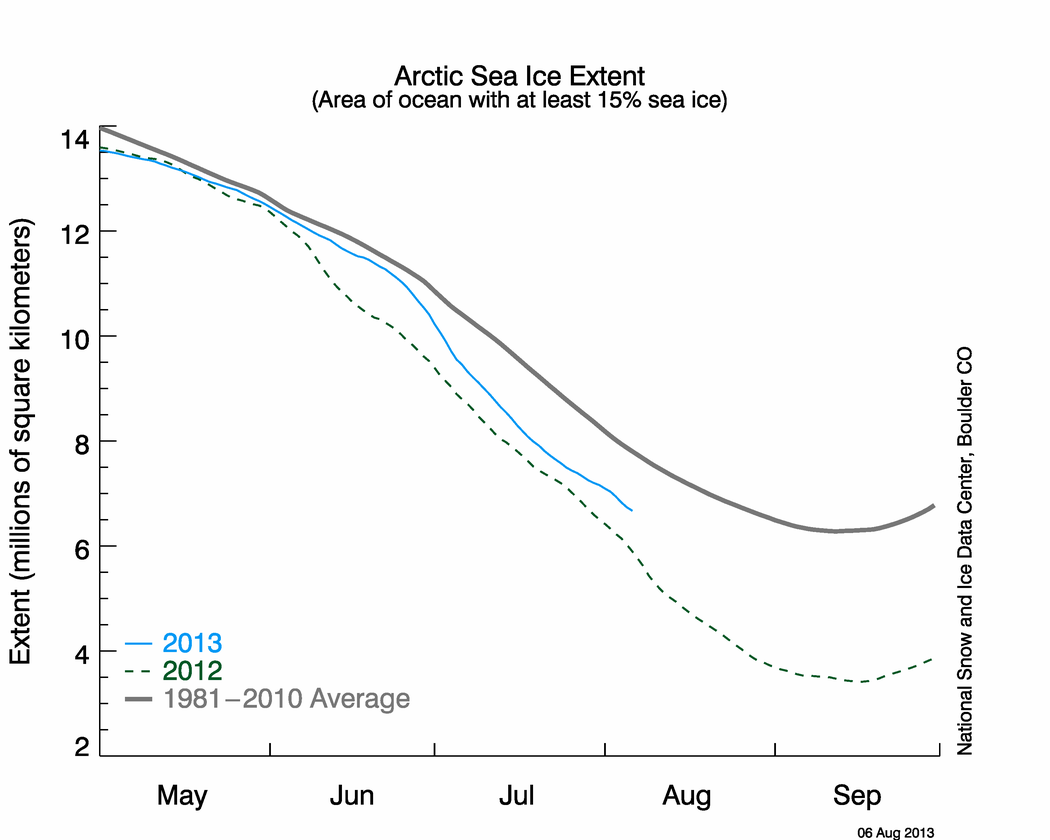
Ice has flatlined in the North, while it goes through the roof in the south.

http://nsidc.org/data/seaice_index/images/daily_images/S_timeseries.png
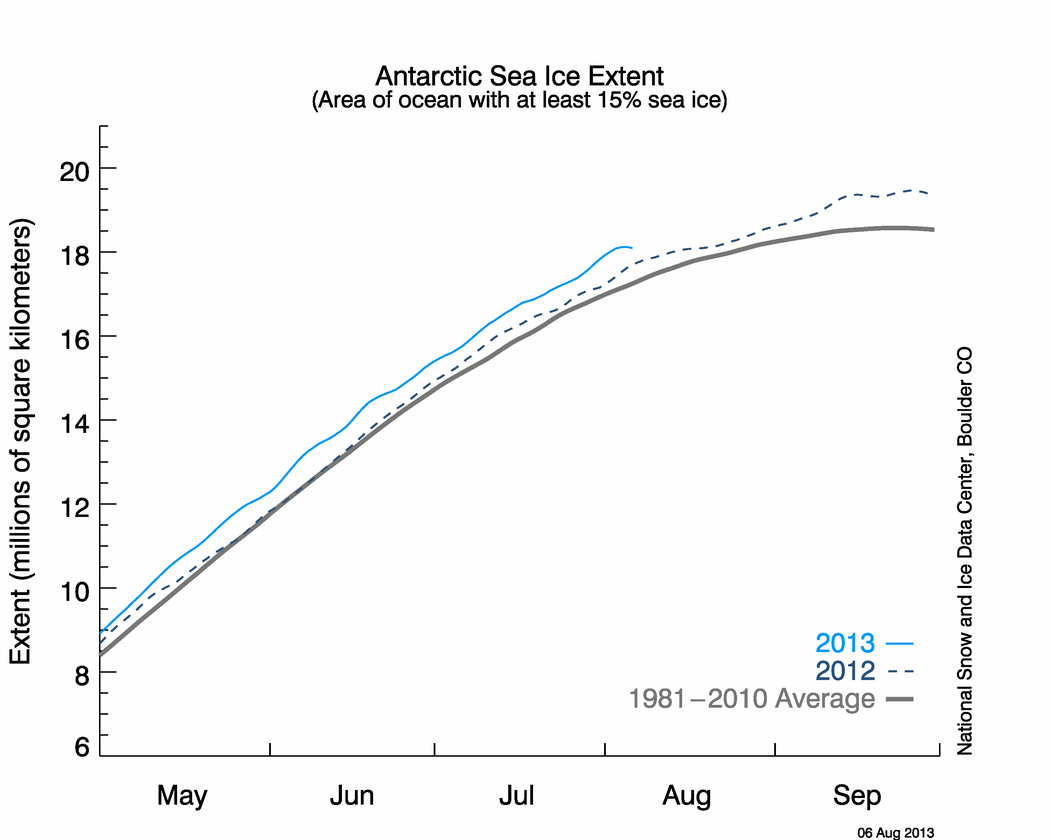
In other words, the widely claimed polar meltdown continues to be nothing more than bad fiction.
R. Gates says: “If we have a decent El Nino near the Solar Max of 2013, global record high temps will be shattered– and you can take that to the bank.”
I will remember that. 2013 stands in my mind for another reason. Back in 2008, Gavin Schmidt was being pestered about what would cause him to reconsider his dogmatic view that CO2 emissions were leading to problematic temperature increases. Though he tried to avoid the question several times, he eventually said that if the 1998 record was not exceeded by 2013, then he would reconsider. So I am looking forward to 2013!
Pamela, it’s a matter of linkages and it seems you don’t want to examine those. Any impact from increased concentrations of atmospheric greenhouse gases starts first in the atmospheric temperatures, which can then also affect atmospheric circulation and oceanic circulation, distribution of snow/ice, precipitation, clouds, etc. etc.
Take a look at the Arctic for example:
By having more open water in September, there is a new heat source to the atmosphere. Observations show clear autumn temperature anomalies in recent years of > 1C well up into the lower troposphere. These higher temperatures decrease the atmospheric air density and raise the height of upper-air-constant-pressure levels over the Arctic Ocean. These increased heights north of 75 °N weaken the normal north-to-south pressure gradient that drives the normal west-to-east airflow in the upper troposphere. In this sense, the effect of higher air temperatures in the lower Arctic atmosphere is contributing to changes in the atmospheric circulation in both the Arctic and northern mid-latitudes. For example, Honda et al. (2009) suggest a remote connection between loss of Arctic sea ice and colder temperatures over eastern Asia. See Francis et al., 2009 for more discussion.
The bottom line: changes in air temperatures influence atmospheric circulation. You can argue how much a change in CO2 has affected a change in air temperature, but to argue that air temperature changes do not influence atmospheric circulation has no basis in reality.
Now that IARC-JAXA is showing 2010 Arctic sea ice extent just a hair above 2007, I think I have to agree with WUWT sea ice news #12 that the melt can slow dramatically when the ice on Hudson Bay is (almost) totally gone. For this reason I really like Cryosphere Today’s “basin-specific” extent graphs…but they haven’t been updating reliably for some time 🙁
Goodness. Do not put words or sentences or assumptions in my writing. I have never indicated in any post that the AO has become a dipole. All I am saying is that dipole pressure gradients have been a component of the Arctic for as long as we have records of ice behavior. A dipole is simply two different pressure gradients next to each other. Sometimes it physically shifts so that only one is prevalent over the area in consideration, or sometimes the strengths between the two are weaker or stronger. Atmospheric dipoles are in places other than the Arctic as well and also show no influence from CO2.
Those recent increasing tropospheric temps welling up are most likely the result of warm Atlantic currents invading the Arctic, not CO2. The correlation is stunning between that current and Surface Air Temperatures that rise into the troposphere. So you must, for your hypothesis to stand, show how CO2 is correlated to the SST of the North Atlantic current into the Arctic. Graphs clearly show it is not.
Further, I do not disagree that changes in air temps influence circulation patterns (I am all too aware of thunderheads and storm cells occurring around rising warm air), but large pressure gradients between warm and cold fronts are dictated by oceanic parameters in the area we are considering, and it is that interaction that determines air temps. Topography comes into play over vast land tracks but even then, oceanic influences are strong. Greenhouse gasses and aerosols affect air temps, but only a bit and only temporarily. To state your anthropogenic case, you must correlate CO2 with oceanic SST oscillations. And you cannot. Period. End of argument.
Pamela, the autumn warming that I talk about is not a result of warm Atlantic currents invading the Arctic, it is a direct result of more open water in September from the loss of Arctic sea ice. You might want to read up on the impacts of the loss of sea ice on atmospheric circulation and latent and sensible heat fluxes. There are also several papers on how snow cover fluctuations also impact on atmospheric circulation. You seem to only want to believe that ocean currents are responsible for atmospheric circulation. Guess you’ve never lived near the rocky mountains. Nevertheless, I challenge you to find a publication that shows that the Arctic’s atmospheric circulation is only influenced by SSTs.
Julienne says, “Any impact from increased concentrations of atmospheric greenhouse gases starts first in the atmospheric temperatures, which can then also affect atmospheric circulation and oceanic circulation, distribution of snow/ice, precipitation, clouds, etc. etc.”
Julienne, I have to say that your comment about CO2 affecting weather related precip, clouds, etc, means that you are saying CO2 affects weather. Right? That is quite a statement.
Have you ever lived on the coast? Air temps do not affect ocean temps. It is the other way around. There are books and books of research that shows that oceanic temperature is the beginning of weather in coastal areas. If we go back a step from oceanic temps we are left to discuss ENSO, trade winds and the Coriolis affect. So now you must tell me how CO2 changes have affected ENSO, trade winds and the Coriolis affect.
Worth noting at this point that average daily ice loss for the past 2 weeks has been about 65,000 sq km per day. For the period 13th July to 31st July 2009, the ice loss according to IARC-JAXA data, was about 91,000 sq km per day.
If the current slower rate of ice loss continues, by the end of July, the 2010 ice extent will closely match the 2009 result. Unless of course R Gates is right in forecasting an increase in the rate of ice loss in line with what happened 2007. Personally I don’t really see the 2 years as comparable but we’ll know soon enough.
Pamela Gray says:
July 12, 2010 at 7:56 pm
Those recent increasing tropospheric temps welling up are most likely the result of warm Atlantic currents invading the Arctic, not CO2.
_______________
Pamela,
Do have any research to back this up? I would tend to doubt this from several perspectives as:
1) It is the late season release of heat from open water that seems to be a key factor in the SLP changes.
2) The location of inbound warm Atlantic currents would not seem to match of with areas of open water.
3) Finally, even if some additional TW of heat is coming in to the Arctic from the Atlantic (and also from the Pacific), we know that there are some who would state that even some of this heat is coming from the additional forcing from the 40% additional CO2 in the atmosphere since the 1700’s.
But provide some links to research, and I’d gladly read up on this conjecture.
Pamela, I’m not sure how I can explain it so that you understand. I’m not saying CO2 is responsible for all the warmer air temperatures. Yes I believe GHGs result in warmer temperatures than without them, but I understand the difficulties in separating out the signal of CO2 in the current temperature record.
You keep saying that CO2 can in no way affect atmospheric circulation. By saying that you are saying that CO2 has no effect on air temperature, and that air temperature does not influence atmospheric circulation. You are also saying that the location of the ice edge does not influence atmospheric circulation, or that more open water influences the transfer of latent and sensible heat fluxes, or that a change in distribution of snow cover can influence atmospheric circulation, etc. etc. I do not agree.
So we can start with the basics. Show me how CO2 does not affect atmospheric temperature and how atmospheric temperature does not affect atmospheric circulation. That would be a good place to start in order for you to prove your point.
What does the data show about the troposphere? Global warming is not adding up:
I think negative feedbacks are overlooked in the climate models, aren’t they? This is a persistent counterpoint to global warming that is either not believed or not understood by those who think co2 is causing warming. There is a pendulum in weather/climate that is not controlled by co2 but rather negative feedbacks seem to have the last word.
By the way, warming stopped in 2001, or 1998, depending on your point of view. I prefer 1998.
Willis Eschenbach covers some of the physics of negative feedback:
part 1
Willis Eschenbach
part 2
The following is an excellent pdf of the interplay between trade winds, SST, air temps, etc. I am sure that SST is a huge driver of weather (including over the Rockies), but what causes SST changes? I think it is the larger atmospheric weather pattern we refer to as Trade Winds. What causes changes in trade winds? Don’t exactly know but I wonder if it is the energy imbalance involved in a pendulum system. So Julienne, we are not far off in an agreement. I just don’t think CO2 is driving the changes, any more than I think Solar influences are driving the changes. And I don’t think the changes are anything new.
http://www.gfdl.noaa.gov/cms-filesystem-action/user_files/gav/publications/kv_09_airseacouple.pdf
RGates..
3) Finally, even if some additional TW of heat is coming in to the Arctic from the Atlantic (and also from the Pacific), we know that there are some who would state that even some of this heat is coming from the additional forcing from the 40% additional CO2 in the atmosphere since the 1700′s.
But provide some links to research, and I’d gladly read up on this conjecture.
=========================
No the burden of proof is upon you to provide your references to real-world, scientifically proven evidence for your theory.
But you won’t becuase you can not. You are as slippery as the jellyfish they are catching in our starving seas.
Chris
Norfolk, VA, USA
Pamela Grey:
I just don’t think CO2 is driving the changes, any more than I think Solar influences are driving the changes.
=======
With all due respect, Ms. Pamela….please do not lump the solar example in with the CO2 one.
They are not remotely in the same league and are a false comparison between the two.
Chris
Norfolk, VA, USA
Pamela Gray,
I saw this in video from one of the presenters at the 4th Conference. It’s an interesting way to think of smaller oscillations that happen in climate within larger warming or cooling changes in climate. I also, like you, don’t think co2 is the larger arm.
savethesharks says:
July 12, 2010 at 10:56 pm
Pamela Grey:
I just don’t think CO2 is driving the changes, any more than I think Solar influences are driving the changes.
=======
With all due respect, Ms. Pamela….please do not lump the solar example in with the CO2 one.
They are not remotely in the same league and are a false comparison between the two.
Chris
Norfolk, VA, USA
____________
You’re right, the cyclical solar influence (via solar cycles) is far smaller than the steady 40% increase in CO2 we’ve seen since the 1700’s– so don’t compare the two.
You’re right, the cyclical solar influence (via solar cycles) is far smaller than the steady 40% increase in CO2 we’ve seen since the 1700′s– so don’t compare the two.
===================================
Red Herringus Maximus.
Not even worth responding but I will anyways. You are gonna be a lot harder pressed to show any (zero zilch nada) correlation with Co2 whatsoever., than you are maybe making a link with the thing that takes up 90% of the mass in the solar system and may just affect our climate.
The worst part about this debate is not dealing with logic but with your constant spin, R.
Chris
Norfolk, VA, USA
CORRECTION: This first quote came from R Gates, DEFINITLEY not me. 🙂
You’re right, the cyclical solar influence (via solar cycles) is far smaller than the steady 40% increase in CO2 we’ve seen since the 1700′s– so don’t compare the two.
I post this one more time. Will he have honor enough to respond thoughtfully?
July 12, 2010 at 10:53 pm
RGates..
3) Finally, even if some additional TW of heat is coming in to the Arctic from the Atlantic (and also from the Pacific), we know that there are some who would state that even some of this heat is coming from the additional forcing from the 40% additional CO2 in the atmosphere since the 1700′s.
But provide some links to research, and I’d gladly read up on this conjecture.
=========================
No the burden of proof is upon you to provide your references to real-world, scientifically proven evidence for your theory.
But you won’t becuase you can not. You are as slippery as the jellyfish they are catching in our starving seas.
Explain (and back up with evidence) what you said in number 3 above.
We’re waiting.
Chris
Norfolk, VA, USA
From: Pamela Gray on July 12, 2010 at 2:34 pm
Attractors are very easy to understand.
The climate models don’t work, there is too much complexity to keep track of, there is too little known of how climate works and all the processes involved to successfully model it anyway. The evidence that what is happening now is within normal variability and that there are natural feedback mechanisms that will prevent catastrophic warming with devastating effects, is growing. Faith in (C)AGW is failing, as the planet itself reveals the deficiencies of the theories used by the modelers. Climate and weather, the two sides of the same coin, is known to be stochastic, chaotic, its capricious nature refusing to be accurately modeled. Plus, most damning of all, sites like WUWT and others are showing you do not need a special PhD in Climatology to understand or just grasp what are the real drivers of climate and realize why the models fail. Ordinary people can be shown why (C)AGW as presented does not work.
Thus we now have attractors. Systems can look stochastic but really be deterministic, the chaos is illusionary, and if they are deterministic then they can be accurately modeled. It does not matter how pitifully little is really understood about how climate works, which will not be resolved for many decades. Nor does it matter how tiny is the amount of actual physical data we can currently meaningfully measure of things that are considered related to climate, and it is very likely there are many other things that need to be measured to get the whole picture that we are not accurately and comprehensively measuring at all. It does not even matter that a grand model using attractors with absolutely everything included to accurately predict the climate would need to be run on a mega-supercomputer the approximate size of Titan.
Because they can cite attractors, they can say there is no randomness, climate can be successfully modeled, accurate predictions can be made. Only those at the highest levels fully understand attractors, thus only they can truly understand climate, thus those who do not know attractors do not know climate thus they are not to be trusted as they attempt to disprove the models despite their appalling ignorance. Appeals to authority are now perfectly reasonable, because attractors explain climate and only Climatologists understand attractors and how they explain climate, and no one else but them really understands climate, and really understands why this excess CO2 will kill us all if we don’t immediately initiate a strongly-enforced global carbon regulating regime.
Attractors are the new robes worn by the High Priesthood of (C)AGW to reaffirm their superiority by displaying how once again they are the sole Keepers of the Deep Mysteries of Climate, thus the heretics and pagans know not what they don’t know thus are automatically discredited and their dissent is worthless. Said new robes being sorely needed since the old ones were stripped from their backs, shredded, trampled, then maliciously burned in the street without the purchasing of carbon offsets.
See, I told you attractors were easy to understand. 😉
Actually there is correlation with the sun and climate. I’ll post two videos of Nicola Scaffeta. I wasn’t aware that the IPCC had used a solar proxy starting in 1975 instead of instrumental reading for their solar data until I saw these videos. The proxy shows no increase in solar activity from 1975 onward. Instrumental readings do. Now I understand how they claimed there had been no increase in solar activity. “Trick”y, huh.
And, by the way, I don’t know what the mechanism is between sun and climate. But I can see the graphs and I see that the sun does influence climate. I don’t know the mechanism that makes a woman smile when I compliment her or what makes her frown when I criticize. But I do know my compliments and criticisms are the driver. 😉
Nicola Scafetta
PART 1
Nicola Scafetta
PART 2