By Steve Goddard
This summer we have had confirmation that Arctic ice behaviour has everything to do with wind. During June, winds were circulating clockwise in an inwards spiral, which caused ice extent to diminish and ice concentration to remain high. Around July 1, the patterns reversed and we have seen counterclockwise winds pushing ice away from the pole. As a result, ice area/extent has scarcely changed and instead we see a gradual decline in average ice thickness. The video below shows June/July ice movement and thickness.
The graph below shows changes in ice thickness during summer over the last five years. Based on past behaviour, we can expect the average ice thickness to flatten sometime in the next two weeks. It should bottom out somewhere between 2006 and 2009. NSIDC has warned me that PIPS is not an accurate measure of ice thickness, though I would have to say it has done remarkably well as a predictor of this summer’s behavior. As you can see below, 2010 is following a track similar to 2006.

As you can see below, we have reached the midpoint of the melt season in the high Arctic, and temperatures have been slightly below normal there for most of the last 55 days. There are only about 40 days left above freezing in the high Arctic.

http://ocean.dmi.dk/arctic/meant80n.uk.php
NCEP is forecasting below normal temperatures in most of the Arctic for the next two weeks.
The sea ice graphs have nearly flatlined since the beginning of the month. DMI’s graph is particularly interesting, since it only measures higher concentration ice, which is less likely to melt through.

http://ocean.dmi.dk/arctic/icecover.uk.php
Below is a closeup image showing that 2010 extent is now running close to 2006.

The concentration and extent appears quite similar to 20 years ago.

It has been cloudy in the Arctic and you can clearly see the counterclockwise circulation in the satellite IR image below. Clouds are white, ice is red.

The webcams continue to show a little ice on the surface of the meltponds, indicating ongoing below freezing temperatures at the North Pole.

http://psc.apl.washington.edu/northpole/webphotos/noaa2.jpg

We are at peak melt season, and there just isn’t much happening in the Arctic. The Arctic Oscillation has turned slightly positive in July, which tends to keep cold air contained in the Arctic and out of lower latitudes.

http://www.cpc.noaa.gov/products/precip/CWlink/daily_ao_index/ao.sprd2.gif

The modified NSIDC map below shows ice loss (red) and ice gain (green) over the last week. There has been slightly more loss than gain.

The modified NSIDC image below shows ice loss since early April.

The modified NSIDC image below shows the difference between 2010 (green) and 2007 (red.) There is clearly more ice now than in 2007, and this is also shown in the NSIDC extent graph.


http://nsidc.org/data/seaice_index/images/daily_images/N_timeseries.png
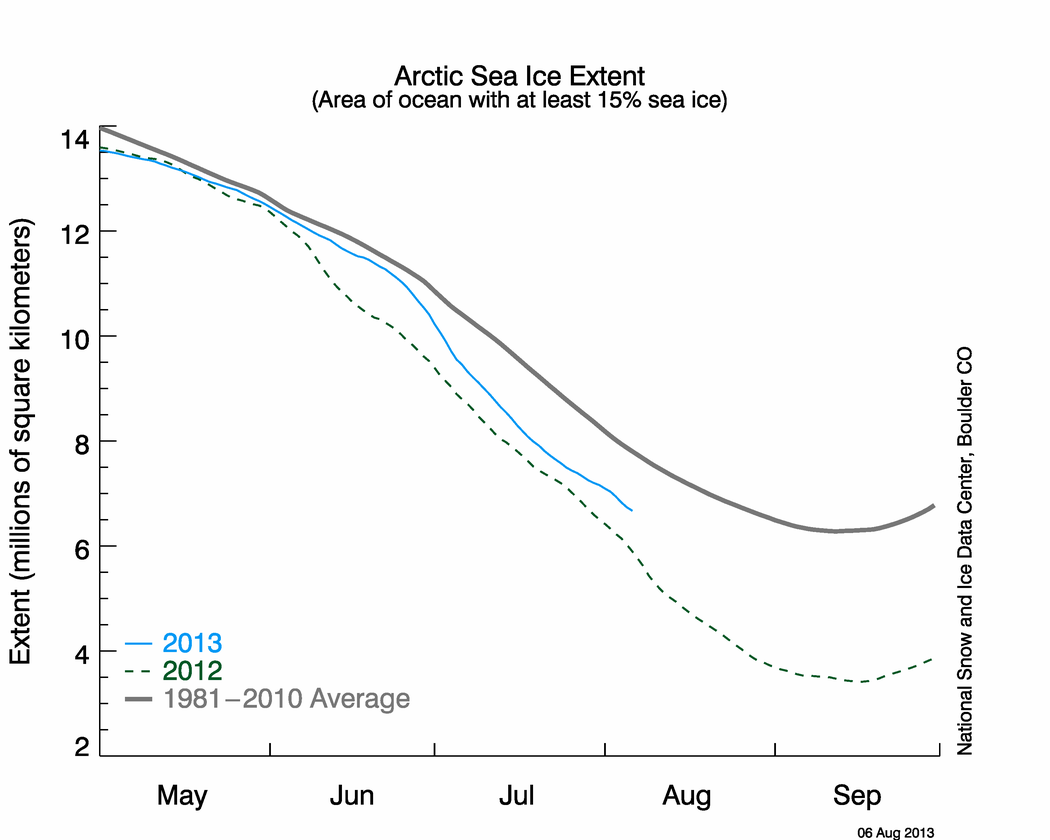
Ice has flatlined in the North, while it goes through the roof in the south.

http://nsidc.org/data/seaice_index/images/daily_images/S_timeseries.png
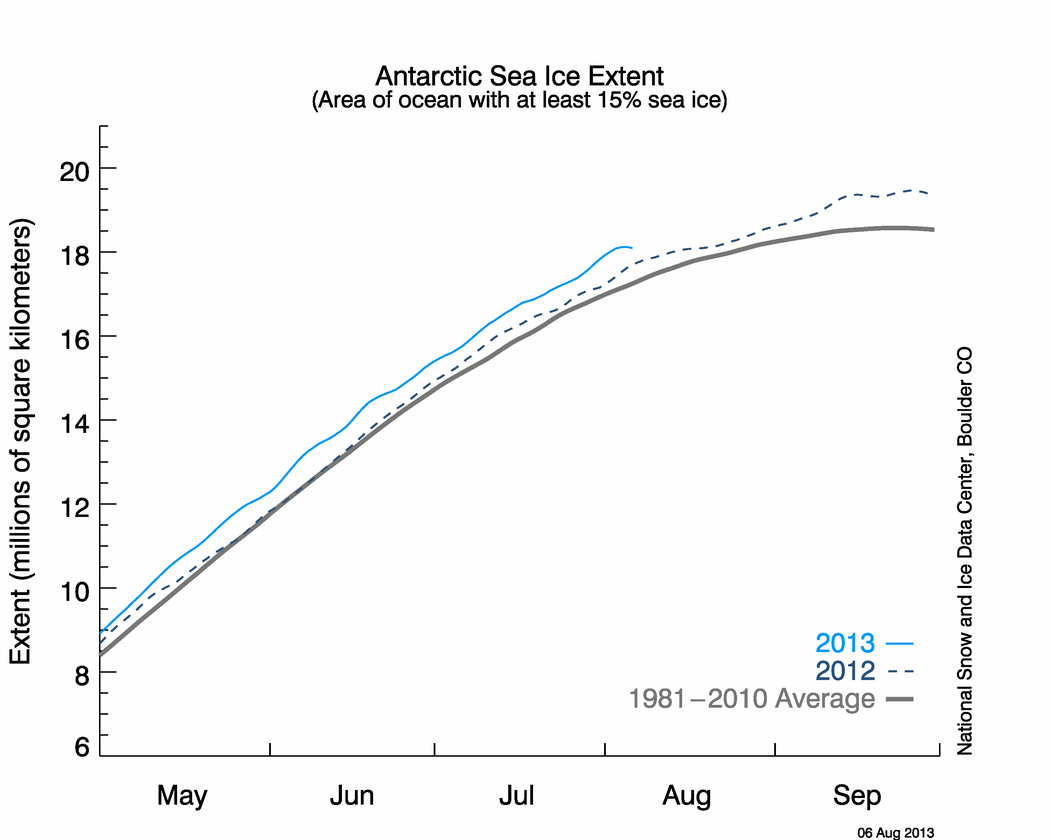
In other words, the widely claimed polar meltdown continues to be nothing more than bad fiction.
Peter, I disagree with you that Barber completely destroys his credibility by saying “we can argue whether it’s been 1.4 or 5 million years since that happened.” The reality is we don’t know with certainty when the last time the Arctic Ocean was completely ice-free in summers. I would think if the Arctic Ocean was completely ice-free during summers in the Medieval Warm Period, there would be evidence (stories,songs,writings, etc.) that talk about people sailing across the Arctic Ocean. Dr. Barber has done a lot of great work in regards to sea ice, and I don’t see how this statement makes all of his work invalid.
I also disagree with the statement that temperatures were warmer in the MWP than today. Northern Hemisphere reconstructions do not show that (nor does it appear that the Roman warm period was warmer than today). Of course you can argue about the accuracy of such reconstructions, but doing temperature reconstructions is not my field of expertise, so I’ll bow out of those arguments and leave it to the experts working in that field.
I predict that Arctic ice will increase in extent this winter, and decrease again next summer.
It “reverses” twice a year – every year.
Djon
All of the graphs show the same thing. Flattening since July 1.
Richard Holle says:
“Let me know what part of the year (2013) you think will be affecting the Ice growth / loss the most?”
___________
April-September, 2013 will affect Arctic Sea ice loss the most. Judging by the rising solar activity (to peak in 2013’s Solar Max event), and the rising frequency of the Dipole Anomaly, you can put me down for a very early forecast of 2.5 million sq. km. Arctic Sea ice extent in September of 2013– less of a forecast than an educated guess, but more importantly, I’m still quite comfortable with the 4.5 million sq. km. forecast for the minimum this September 2010.
Gates, every time you bring up CO2 related changes in the Arctic Dipole my opinion of your posts plummets, but when you bring up anything related to some kind of solar max connection to all this my opinion disappears all together.
But just to give you the floor, explain what you mean by “chaotic attractor” as it relates to weather events (and make no mistake about it but atmospheric dipoles are weather related events) under your CO2 scenario. That phrase is meant to sound scientific. So explain it in scientific terms instead of tossing it around like salad croutons.
And you still haven’t explained how CO2 is related to dipoles. Dipoles are not caused by warm water. They are caused by warm and cool ocean pools setting up next to each other. How in the heck can CO2 set that up? Longwave infrared cannot force ocean pools to warm up. So what is your mechanism? And don’t refer to a paper. Tell me exactly what the CO2 mechanism is that can powerfully and sustainably set up a dipole. I know how trade winds and oceanic current oscillations set up dipoles. And I don’t need to just refer to a paper. I can tell you how it happens AND refer to references. Please do the same.
stevengoddard says:
July 12, 2010 at 2:19 pm
I predict that Arctic ice will increase in extent this winter, and decrease again next summer.
It “reverses” twice a year – every year
____________
I don’t know Steve, that seems like a pretty bold prediction. You’re really going out on a limb there and putting your sea-ice god reputation here on WUWT on the line. Would you even go so far as to say that those reversals will be approximately 6 months apart? That would be quite daring of you!
Notice Gates that I didn’t ask you to explain your solar max comment somehow being connected to strengthening the effects of El Nino’s which are somehow strengthened by CO2 in the atmosphere. Please don’t explain the solar max connection to me. It won’t help your response in this debate in my opinion.
Gates, the frequency of dipoles have not risen when referenced to the long term reconstructed record. Please state your opinions as opinions and not facts. Your belief in a rising frequency is an opinion, not a fact. There are AGW scientists who have reported peer reviewed evidence that there is no correlation between CO2 and dipole frequency.
Hmmm, 2010 is close to 2006 on JAXA…. Interesting!
Maybe there is natural cycles after all?
Will someone inform Hollywood, Al Gore and the IPCC, please?
hehe.
Julienne said:
“I also disagree with the statement that temperatures were warmer in the MWP than today. ”
Lets look at temperature reconstructions from ice cores in Greenland (GISP2) as it is as close to the arctic as we are likely to find data.
http://en.wikipedia.org/wiki/File:GISP2_ice_core_eng.svg
It sure looks like to me that Greenland has been primarily warmer than today for the last ten thousand years.
I think that it is clear that the models predict that this information will be homogenized by The Warmists Consensus.
Pamela, I’m sure you do understand how outsized warming in the Arctic can alter the temperature gradient between the equator and the poles, and subsequently influence atmospheric and oceanic circulation. And you probably understand how regional changes in sea ice extent can influence the development of cyclones (low pressure systems) via the strong temperature gradient between ice and open water, and perhaps you are also aware of other regional influences on atmosphere circulation such as those caused by differential heating between the land and the ocean.
So if rising concentrations of CO2 are in any way responsible for warmer Arctic air temperatures, changes in the ice edge position, changes in the timing of snow melt, etc. that is how CO2 can influence atmospheric circulation patterns.
Nevertheless, to say the DA is caused by CO2 is inherently difficult. Cause and effect cannot be separated from a purely observational perspective. It is only in climate models simulations that you can run controlled experiments to try to isolate such a linkage. Some earlier studies suggested a positive AO would be expected under increasing concentrations of CO2. Other studies suggest more negative winter AO state as there is more open water in September. I don’t know of any specific modeling studies looking at the DA however.
Pamela Gray says:
July 12, 2010 at 2:45 pm
Gates, the frequency of dipoles have not risen when referenced to the long term reconstructed record.
———-
Pamela, what long-term reconstructed record of the Arctic Dipole Anomaly are you referring to here? R. Gates is specifically talking about the Arctic Dipole Anomaly, perhaps you do not understand how this is computed?
Pamela Gray says:
July 12, 2010 at 2:34 pm
“Gates, every time you bring up CO2 related changes in the Arctic Dipole my opinion of your posts plummets…”
__________
Then you must not think much of these scientists either:
http://earth.scichina.com:8080/sciDe/fileup/PDF/05yd1529.pdf
http://www.arctic.noaa.gov/reportcard/ArcticReportCard_full_report.pdf
___________
“But when you bring up anything related to some kind of solar max connection to all this my opinion disappears all together.”
_____________
Then you must not study charts of earth’s temperature fluctuations vs. solar activity very closely. If you had, you’d know that global temps are influenced partially by solar activity. Study some of the charts in this page:
http://www.climate4you.com/ (click on “sun” in left hand column)
We see that global temps do rise and fall slightly with solar activity, but among this solar noise, you can see the effects of ENSO, etc. Peaks in solar activity=peaks in solar irradiance. I would postulate that much of the “flattening” of the rise in global warming over the past 5 years (prior to 2010) is due to the long and deep solar minimum, but I would also direct you to this article:
http://www.physorg.com/news129483836.html
___________
“But just to give you the floor, explain what you mean by “chaotic attractor” as it relates to weather events (and make no mistake about it but atmospheric dipoles are weather related events) under your CO2 scenario. That phrase is meant to sound scientific. So explain it in scientific terms instead of tossing it around like salad croutons.”
_______________
I am only now really getting into understanding the heart chaos theory, and it has so many parts to it, but let me attempt to give chaotic attractors, as they might relate to the weather and climate a very simple (and I hope, fairly accurate) explanation. Dynamical systems, such as the weather and climate can be described in terms of their phase space, or the projection or mapping of their dynamic qualities or current state for any point in time. A chaotic system is one in which (while still governed by deterministic causes) have far too many interrelated causes that an exact prediction of where in phase space a system might be is impossible. Also, of course, the smallest change in any one of the interrelated elements of the system, such as CO2 for example, can cause big changes in the entire system. A attractor is essential a set of points in phase space where a dynamical system is trending towards. This phase space project could be as simple as a measurement for example of an average monthly sea surface temperature and sea level pressure over a region of the Arctic, such as the Beaufort sea.
So, in a very simplified way, a chaotic attractor is a unpredictable yet deterministic set toward which a dynamical system is trending toward. Attractors (or the set of points in phase space) are self-reinforcing, meaning that once a dynamical system begins to trend toward them, it will be reinforced and accelerate toward that attractor. This is not unlike the pull of gravity and the inverse square law, though attractors have far more elaborate shapes than a simple gravitational field.
So, the hypothesis is that increasing CO2 (40% increase since the industrial revolution, not the 30% I mistakenly gave before) is all of the nudge, that the dynamical system of the Arctic needed to send it toward a new attractor (or more likely, attractors), and that one of these new attractors involves a more frequent and stronger Dipole Anomaly, which like all attractors, has a self-sustaining consistency based on it’s shape in phase space, such that the more the dynamical system is pushed toward that attractor, the more it will exist in that region of the attractor’s phase space. In physical terms, especially related to the Dipole Anomaly, which contrary to your contention, seems to be showing increased frequency, and is self-reinforcing. The climate experts would state this a positive feedback loop related to the polar amplification of AGW, specifically related to more open water in the Arctic releasing heat later in the season, that tends to change the wind patterns, creating the warm conditions for more open water in the Arctic, changing the wind patterns, etc.
So to answer your statement: “Dipoles are not caused by warm water.” Well, yes the Arctic Dipole ANOMALY does seem to be related to warm water releasing heat later in the season, creating the conditions that will favor more open water the next season. The above referenced links speak to this. But it may be better for someone such as Julienne to explain the release of heat from the larger areas of open water we’ve seen the past few years, and how this might help reinforce or create the DA. Of course, underneath all of this is the energy imbalance of the planet created by the 40% increase in CO2 that has happened since the industrial revolution– from 280 ppm to now around 390 ppm. This seems to be all the nudge the dynamical system needed to send it toward one (and probably several) new attractors, as CO2 continues to increase.
Steven,
Your response “All of the graphs show the same thing. Flattening since July 1.” is plainly incorrect. The 2010 line in the chart at http://www.ijis.iarc.uaf.edu/seaice/extent/AMSRE_Sea_Ice_Area.png was clearly declining less steeply on July 1 than it has been since. In my version of English, “steepening” is the opposite of “flattening”. I expect that is the case in your version as well.
Richard, when you click on the source link inside the link you pointed to you can also link to: http://commons.wikimedia.org/wiki/File:2000_Year_Temperature_Comparison.png
that shows NH temperature reconstructions from several different groups doing this kind of work (plus links to their papers published on the subject). Perhaps some papers by Richard Alley would be worth reading…he has done numerous ice cores in Greenland.
Hi Julienne,
Do you have any idea why the southern sea ice extent uptick disappeared?
Before, July 10
http://climateinsiders.files.wordpress.com/2010/07/s_timeseries1.png
After, July 11
http://nsidc.org/data/seaice_index/images/daily_images/S_timeseries.png
No mention of it anywhere
http://nsidc.org/arcticseaicenews/
Seems rather odd to make such a correction and not notify end users of such a change. This lack of notice then leads to speculative phrases, like “death spirals”. 😉
Alex the skeptic says:
July 11, 2010 at 3:51 pm
Typo: meant to say: non-record braking heatwaves in summer in NH,…
At least China has been having a record-breaking heat wave this summer, and then, what about the record setting heat in the Eastern US the first week of July?
Alex the skeptic says:
July 11, 2010 at 4:00 pm
This winter, the sea ice cover at the SP is at an ALL TIME RECORD.
No, the largest anomaly was in late 2007 –
http://arctic.atmos.uiuc.edu/cryosphere/IMAGES/seaice.anomaly.antarctic.png
I think you need to be more skeptical.
Julienne, take the time to read Polyakov’s research on oscillation (both long and short term) interactions in setting up ice build up and ice flush. The “Arctic Dipole” is nothing new. The pressure gradients necessary to set up the “Arctic Dipole” can be done with modeling of the various reconstructed records of atmospheric positive and negative pressure systems (AO, NAO, etc), including their short, noisy fluctuations and long term oscillations, without regard to CO2. The system being talked about in AGW circles as the “Arctic Dipole” is not new nor is it increasing in frequency because of CO2. It has been demonstrated in the records and modeled, to be a naturally occurring event caused by the unique parameters of the oscillating oceanic and weather pressure systems that press upon the Arctic Circle and it’s ice behavior.
“Arctic decadal and interdecadal variability”
Igor V. Polyakov
International Arctic Research Center, University of Alaska Fairbanks
Mark A. Johnson
Institute of Marine Science, University of Alaska Fairbanks
Very excellent website on the multidecadal research project. Meant to educate in laymen terms. The graphs are eye candy.
http://research.iarc.uaf.edu/multidecadal_variability/intro.php
Hi Anthony, I see that Walt replied to you directly. I’ll include his response here so that your readers can see it as well (note I also mentioned the bad scans earlier in this posting):
“Hi Anthony,
It was an error in the source data we use in the sea ice algorithm we run. We have an automated QC that will take it out, but it requires data from the following day. We can QC manually too, but since it happened on a Sunday no one was around to address it. It did get corrected automatically when processing occurred this morning.
We generally don’t post a notice for isolated incidents like this since it is just a part of routinely dealing with near-real-time data. We do a general discussion on our FAQ: http://nsidc.org/arcticseaicenews/faq.html#quality_control “
Pamela Gray et. al,
You may want to have a look at this article: (may need to purchase if you’re not a member)
http://www.agu.org/pubs/crossref/2008/2008GL035607.shtml
Of which this is the summary:
“Arctic climate system change has accelerated tremendously since the beginning of this century, and a strikingly extreme sea-ice loss occurred in summer 2007. However, the greenhouse-gas-emissions forcing has only increased gradually and the driving role in Arctic climate change of the positively-polarized Arctic/North Atlantic Oscillation (AO/NAO) trend has substantially weakened. Although various contributing factors have been examined, the fundamental physical process, which orchestrates these contributors to drive the acceleration and the latest extreme event, remains unknown. We report on drastic, systematic spatial changes in atmospheric circulations, showing a sudden jump from the conventional tri-polar AO/NAO to an unprecedented dipolar leading pattern, following accelerated northeastward shifts of the AO/NAO centers of action. These shifts provide an accelerating impetus for the recent rapid Arctic climate system changes, perhaps shedding light on recent arguments about a tipping point of global-warming-forced climate change in the Arctic. The radical spatial shift is a precursor to the observed extreme change event, demonstrating skilful information for future prediction.”
But there is a nice chart in this article:
http://www.wunderground.com/blog/JeffMasters/comment.html?entrynum=1398
That is interesting to study. There is also a link given (that Julienne gave once before) where you can do your own study of the Arctic Dipole, by going to NOAA:
http://www.esrl.noaa.gov/psd/cgi-bin/data/composites/printpage.pl
Now I know that Dr. Zhang (of the PIOMAS fame) and Jeff Masters from the Weather Underground are possibly not too popular with some on WUWT, but I think the data they present, and your own further research may lead you to see that the Arctic Dipole Anomaly has been far less of an anomaly (i.e. occurring far more frequently) in the past decade, and as the charts from NOAA clearly show, there is a relationship to warming in the region. Hence, the DA, while a wind/pressure anomaly, seems to be spawned by temperature anomalies. The real question gets back to the cause of the warming and whether or not it is part of a natural oscillation or has been set in motion by the (geologically speaking) rapid increase in CO2 since the industrial revolution.
Pamela Gray says:
July 12, 2010 at 4:50 pm
Pamela, I have read all the papers on the Arctic Dipole Anomaly, some more than once. I simply am unaware of anyone providing a long-term data record on the Arctic DA. I suppose by here you mean the work by Polyakov that goes back to 1880? I thought you were talking about longer term work.
BTW..the DA is the second EOF of SLP north of 70N (so it does not take into consideration exchange of atmospheric mass between the mid and high latitudes) that the AO index does. I’m not sure if you’re suggesting the AO has become a dipole pattern. That is not the case. The dipole pattern has become more prevalent in recent years, with some indication that it’s not more common into spring than previously. It also seems that the dipole is simply one finer-scale component that combines with others to manifest as the annular mode. Any interpretation that the AO as become a dipole is a complete misunderstanding of the literature.
I would say that the greatest driver is one step back from wind. The drivers are atmospheric pressure gradients driven by SST changes that contribute to land and surface air temperatures. These atmospheric pressure weather pattern variations, both long and short term, drive the ice to build or melt, and to move or stay in place.
To wit, they can change the temperature rather quickly in the same spot under the exact same conditions with just a change in pressure gradient. We have had lots of Sun today. And lots of Sun yesterday. But the temperatures throughout the day have been significantly different between the two days. Hot and still yesterday, cooler today. Nothing has changed physically. No one peeled back the grass to reveal concrete or asphalt where I live (IE albedo has been the same). The Sun was shining as brightly on my porch today as it was yesterday and there was no difference in clouds (we had none). So why the change in temperature (from over 90 to under 80)? Pressure gradient changes have kicked up a cooler and much dryer air mass that is moving rather quickly from West to East over these high plains and mountains.
In my opinion, and from what I have read in the literature, changes in pressure gradients cause changes in ice.
Interesting that AGW’ers are now saying that CO2 affects pressure gradients (Re: Arctic Dipole). Somehow. Meaning that CO2 will eventually be said to cause weather, the current bad boy in the class, while they run through the teacher’s pets. And so the search continues for a correlation, any correlation, Ferris Bueller, anything at all, to connect the rather odd looking straight CO2 trend with our incredibly noisy oceans, lands, and atmosphere. I’m almost to the point where I wish they would find the damned thing.
Pamela Gray says:
July 12, 2010 at 5:55 pm
I would say that the greatest driver is one step back from wind. The drivers are atmospheric pressure gradients driven by SST changes that contribute to land and surface air temperatures.
___________
You’ve just described the behavior of the Arctic Dipole Anomaly exactly.