By Steve Goddard
This summer we have had confirmation that Arctic ice behaviour has everything to do with wind. During June, winds were circulating clockwise in an inwards spiral, which caused ice extent to diminish and ice concentration to remain high. Around July 1, the patterns reversed and we have seen counterclockwise winds pushing ice away from the pole. As a result, ice area/extent has scarcely changed and instead we see a gradual decline in average ice thickness. The video below shows June/July ice movement and thickness.
The graph below shows changes in ice thickness during summer over the last five years. Based on past behaviour, we can expect the average ice thickness to flatten sometime in the next two weeks. It should bottom out somewhere between 2006 and 2009. NSIDC has warned me that PIPS is not an accurate measure of ice thickness, though I would have to say it has done remarkably well as a predictor of this summer’s behavior. As you can see below, 2010 is following a track similar to 2006.

As you can see below, we have reached the midpoint of the melt season in the high Arctic, and temperatures have been slightly below normal there for most of the last 55 days. There are only about 40 days left above freezing in the high Arctic.

http://ocean.dmi.dk/arctic/meant80n.uk.php
NCEP is forecasting below normal temperatures in most of the Arctic for the next two weeks.
The sea ice graphs have nearly flatlined since the beginning of the month. DMI’s graph is particularly interesting, since it only measures higher concentration ice, which is less likely to melt through.

http://ocean.dmi.dk/arctic/icecover.uk.php
Below is a closeup image showing that 2010 extent is now running close to 2006.

The concentration and extent appears quite similar to 20 years ago.

It has been cloudy in the Arctic and you can clearly see the counterclockwise circulation in the satellite IR image below. Clouds are white, ice is red.

The webcams continue to show a little ice on the surface of the meltponds, indicating ongoing below freezing temperatures at the North Pole.

http://psc.apl.washington.edu/northpole/webphotos/noaa2.jpg

We are at peak melt season, and there just isn’t much happening in the Arctic. The Arctic Oscillation has turned slightly positive in July, which tends to keep cold air contained in the Arctic and out of lower latitudes.

http://www.cpc.noaa.gov/products/precip/CWlink/daily_ao_index/ao.sprd2.gif

The modified NSIDC map below shows ice loss (red) and ice gain (green) over the last week. There has been slightly more loss than gain.

The modified NSIDC image below shows ice loss since early April.

The modified NSIDC image below shows the difference between 2010 (green) and 2007 (red.) There is clearly more ice now than in 2007, and this is also shown in the NSIDC extent graph.


http://nsidc.org/data/seaice_index/images/daily_images/N_timeseries.png
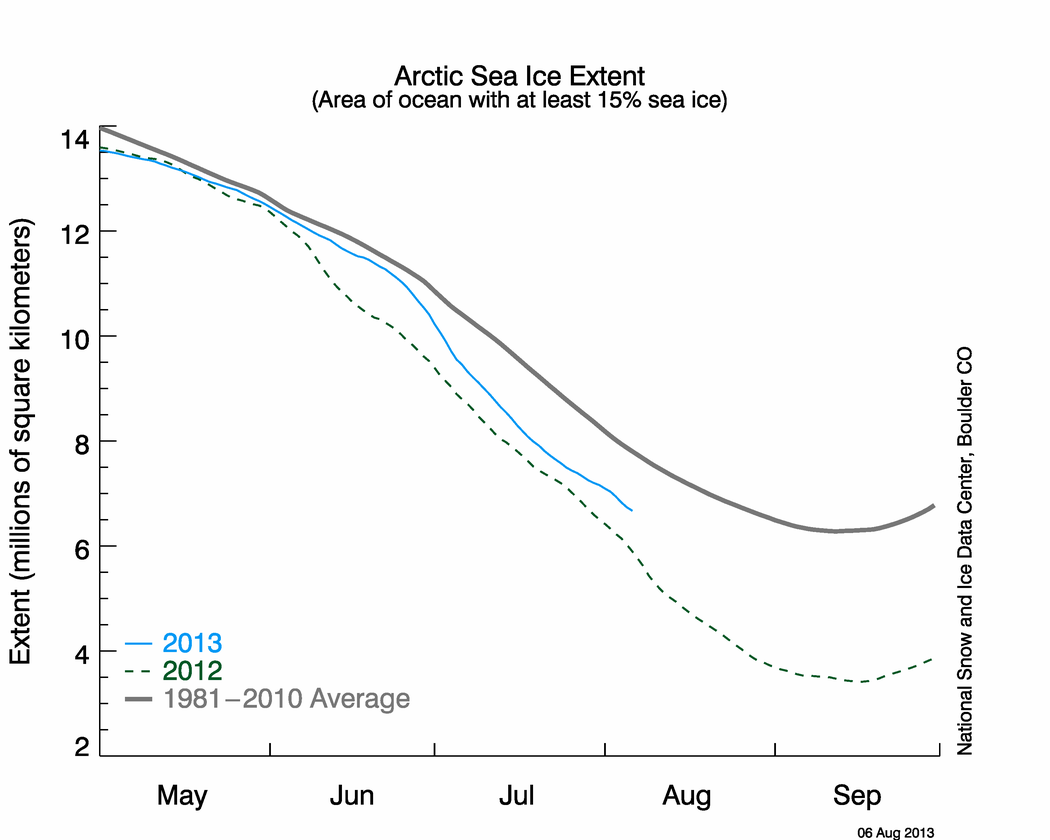
Ice has flatlined in the North, while it goes through the roof in the south.

http://nsidc.org/data/seaice_index/images/daily_images/S_timeseries.png
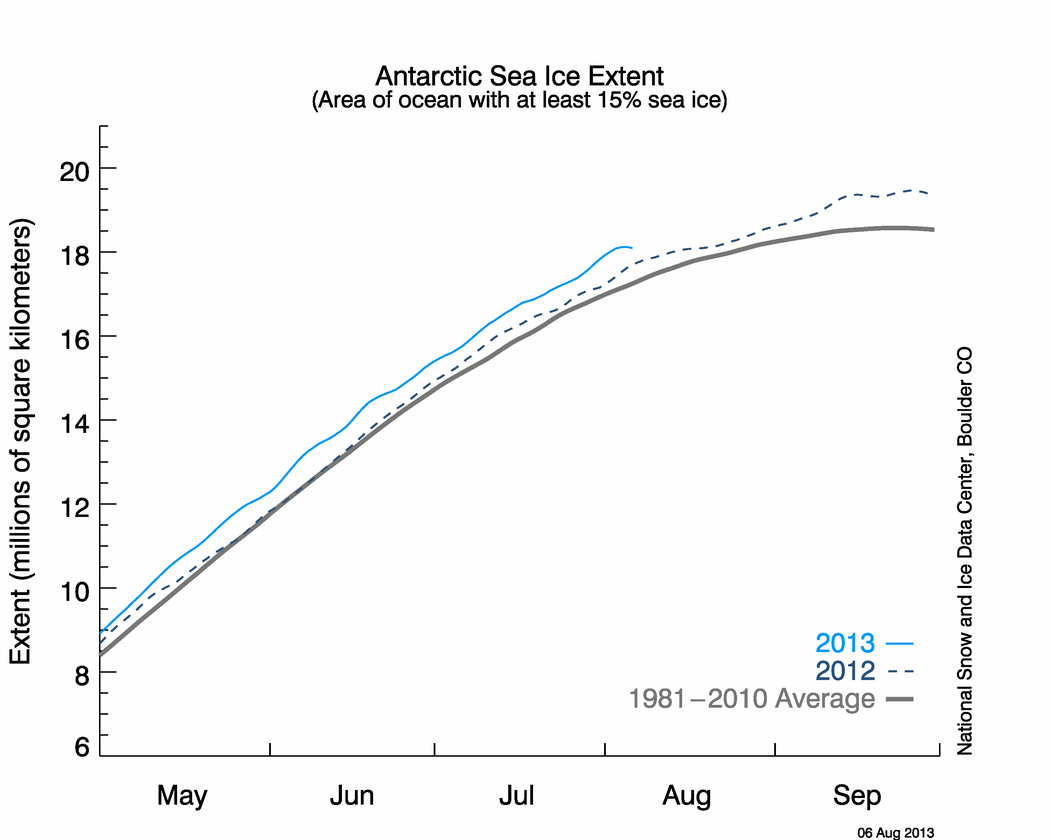
In other words, the widely claimed polar meltdown continues to be nothing more than bad fiction.
Steven Goddard says:
“This summer we have had confirmation that Arctic ice behaviour has everything to do with wind.”
***************
Harvey says:
July 11, 2010 at 11:46 am
“I was wondering if you attended this symposium “Steve Goddard” :
http://www.igs2010.org/programme.html
Or are you still just a bystander, not at all knowledgeable of the basic research being done.”
***************
VILLABOLO SAYS:
I love your subtlety, Harvey. 😀
An Inquirer says:
July 11, 2010 at 5:55 pm
Gates, perhaps you know how ironic it is that you chastise skeptics for looking at weather rather than climate, when it has been CAGW advocates who have been claiming weather events to be their proof of CAGW. Whether it was 2005 hurricances or 98 El Nino or 2010 summer Eastern heat wave or 2003 European heat wave or 2006 Canadian cold wave or 2009 above normal precipitation or 2007 droughts or 1993 Iowa rains or . . . these weather events are given as evidence of CO2-induced climate change.
*******************************
VILLABOLO:
An Inquirer, do you know the difference between “advocates”, as you call them, (I refer to them as those who are uneducated and slightly educated on the subject) and the actual Climatologists and those who know enough to speak carefully on the subject.
It is when these events are taken collectively that they constitute proof of Global Warming. Once you give the big picture you can then highlight specific events.
For example. 2003 was one of the hottest years GLOBALLY in record, along with a rise in temperatures that started in 1998 and has not reversed since. Once you give that type of overview you can then highlight the “European heat wave of 2003”
It is the Skeptics who are always failing to give the big picture in both time and space making them perpetual cherry pickers.
Bottom line, according to Climatologists 30 years minimum is what makes a trend as far as the Arctic Sea is concerned.
DR says:
July 11, 2010 at 6:20 pm
R Gates said:
Meanwhile, the first half of 2010 has seen a string of months with record high global temps. Yes, some of this is related to the El Nino, but the El Nino was not as strong as 1998, and we are not even close to a solar max. If we have a decent El Nino near the Solar Max of 2013, global record high temps will be shattered– and you can take that to the bank.
Wasn’t that supposed to happen in 2007 and 2010? Pretty soon it will be “just wait until 2016, just wait and see!”
R. Gates says:
July 11, 2010 at 10:09 pm
[snip]
Finally, one poster was mentioning the chaotic nature of both weather and climate, and that is true. But it is actually more difficult to predict the weather than the climate, because individual weather events seldom leave much in the way of a long term record, whereas the climate leaves us lots of clues in ice cores, tree rings, ocean sediments, etc. I like the example of boiling water to understand the difference between weather chaos and climate chaos. When you put a pan of water on a hot burner, you can predict that the water will boil at some point, and even predict with reasonable accuracy when that water will reach a full boil, if you know variables such as the conductivity of the pan, atmospheric pressure, purity of the water etc. This is like predicting the climate. However, you can’t predict exactly where the first few bubbles will appear or where subsequent bubbles will appear except until a few seconds before they actually appear. This is like predicting the weather.
____________________________________ Reply;
If you click my name link and open the little calendar Icon, then fast forward to 2013, you will be able to see my daily forecast for all of 2013. Thanks for the compliment on how tough it is to forecast weather years into the future.
Let me know what part of the year you think will be affecting the Ice growth / loss the most?
R. Gates says:
July 11, 2010 at 4:32 pm
____________
Alex, during this past winter……….,
R. Gates, the link you provided got me to a report headed: “Europe, US to see snowy, cold winters: expert”. You see, that is why I am skeptical about AGW or, as it is now being called ACC. Because AGWers are always changing the goalposts to suit the erratic antics of climate change.
During the nineties, snow was very lacking in Europe. In 1994, in Denmark 6 year old kids did not know what snow was. IT HADN’T SNOWED FOR YEARS. So, AGWers took this 5 year old graph and extrapolated it into the future, telling us what we have been hearing since then, such as, ‘children will not know what snow is’ etc etc. But climate being climate, chaotic and all that, we are now having record snow covers, low temperatures etc etc. This proves one thing at least: That climate is UNPREDICTABLE and no computer model will be able to predict it.
My point: 15 years ago we had low or no snow in Europe, now it has returned with a bang. 15 years ago we were told children will not know what snow is, now we are being told to prepare for snowy, cold winters. How’s that for integrity?
One other point: Arctic and Antarctic sea ice covers have been monitored for only a few decades, since we started putting satellites in orbit and I think that there cannot be any proxy measurements of past sea ice cover anomalies. However I have seen photos taken by submariners during the 50’s that show a near ice free sea at the north pole. That was when CO2 level increases were still insignificant.
Then there are other reasons why we should be skeptical about AGW, such as peer reviewed scientific reportson:
Solar influence
Cosmic radiation
CO2 resident time = 15 years
Anthropogenic component of CO2= 5%
90% of Greenhouse effect due to H2O molecule
Negative cloud feedback not positive
No temperature rise detected in oceans
No temperature rise detected in upper atmosphere
These last two were supposed to be the smoking gun of AGW.
And much more.
AGW theory rests on one single parameter: Increase in CO2=Temperature rise, which, in my opinion, is a very simplistic theory that does not take into account the other forcings and parameters and the chaotic climate
Meanwhile, Mister Mann has told us an ice free artic is on the way!
http://www.cleanskies.com/videos/exonerated-climategate-professor-speaks-out
Villabolo
Reality is more important. What happens is more important than what was predicted .I cannot change what will happen this September by hoping some outcome will occur , I don’t have to accept your model of what will happen this September I would rather wait and see what happens.
Meanwhile, Mister Mann has told us an ice free artic is on the way!
As has Steve. In 2065 I believe (sooner than the IPCC).
Harvey
You know, I missed that symposium. Please detail which papers disprove my conclusions.
Steve Goddard
Thanks again for this-and your other- articles.
You cite several graphs showing ice thickness. How much reliance should we place on these do you believe?
i seem to recall that last year it took a German plane flying low over the Arctic ice with an elaborate radar device to establish thickness over the part of the Arctic the Catlin team had just wasted their time measuring.
If satellites are so good surely the German expedition would have been pointless-I don’t think they were claiming 100% accuracy either.
Also, I thouight that satellites found it difficult to distinguish between melt water on top of ice and the ocean. Is that still so or has that problem been resolved?
Tonyb
tonyb,
NSIDC keeps telling me that the PIPS ice thickness data is not accurate, and at the same time they tell me that PIPS is constantly updated with the best real time data.
Go figure. The PIPS data seems to be working extremely well as a predictor of trends, particularly the current similarity to 2006.
stevengoddard says:
July 12, 2010 at 4:51 am
Harvey
You know, I missed that symposium. Please detail which papers disprove my conclusions.
I don’t think he was ready for you to say that. I think he wanted the reader to infer that just because you weren’t there that disproves your conclusion. Nothing deeper than that. I wouldn’t wait for any details from papers from him.
Global warmers, just know I have a bag full of ‘shhh’ with your name on it.
=======================
stevengoddard says:
July 12, 2010 at 4:51 am
Harvey
You know, I missed that symposium. Please detail which papers disprove my conclusions.
=============================
I take it that this is your conclusion:
“In other words, the widely claimed polar meltdown continues to be nothing more than bad fiction.”
This paper may be of interest to you:
http://www.igs2010.org/Abstracts/57A042.html
also this talk which points out that the ice that is present is not very solid ice 🙂
http://video.hint.no/mmt201v10/osc/?vid=55
Alex the sceptic said:
” One other point: Arctic and Antarctic sea ice covers have been monitored for only a few decades, since we started putting satellites in orbit and I think that there cannot be any proxy measurements of past sea ice cover anomalies. However I have seen photos taken by submariners during the 50′s that show a near ice free sea at the north pole. That was when CO2 level increases were still insignificant”
Alex,
Much work has been done to hindcast the arctic sea ice volume before satellite records. The following graph on the retro page of the Polar Science Center Retro page illustrates the estimated thin ice during the 1950’s and the rapid growth during the sixties.
http://psc.apl.washington.edu/zhang/IDAO/retro.html#Satellite_ice
The main PIOMASS page starts in 1980 I think in order to make the current sea ice volume look worse.
http://psc.apl.washington.edu/ArcticSeaiceVolume/IceVolume.php
The current estimate of the sea ice volume from PIOMASS as Steve points out is suspect. They made the estimate without the use of the iCESAT satellite to keep them honest. I think Steve is dead on with the PIPS data and will be vindicated from CryoSAT 2.
harvey
Can I put you down as forecasting a big melt the rest of the summer? My forecast is on the table.
From: harvey on July 12, 2010 at 6:48 am :
Which is actually a brief abstract with no link to an actual paper and really nothing that says it was anything more than a presentation.
Which looks like the presentation by the esteemed Dr. David Barber of “rotten ice” fame that various Arctic Ice Death Spiral proponents have been posting links to on WUWT for well over a month now.
In other words, you have supplied nothing of interest.
harvey
the rotted ice thing isn’t panning out. Look at what is really happening in the real world.
the rotted ice thing isn’t panning out.
have you watched the presentation? he is talking about high temperatures (-2°C) on the sea and ice, when land based stations are reporting very low temperatures (-20°C).
some of us are simply a little bit sceptical about Steven being better informed than the guys who have been out in the ice this year, and for 30 years.
kadaka (KD Knoebel) says:
July 12, 2010 at 7:26 am
Kadaka, those presenters who also chose to write a paper will have their results published in the next issue of Annals of Glaciology. Dr. Notz’s presentation was one of the more interesting papers presented at the IGS meeting last month. My talk will be published in Tellus and Climatic Change (both papers have been accepted for publication).
cheers, Julienne
sod
I guess we will know in about seven weeks.
Dr Notz writes (from abstract):
“Using this natural variability to analyze the recent retreat, we find that even with very conservative estimators the sea-ice minimum that was reached in 2007 would occur far less than once in 10 000 years without an anthropogenic cause. We also discuss possible inhomogeneities in the available observational record that might cause an overestimate of the recent retreat”
Granted I have not read the paper, but one in 10,000 years? Does He really believe that sea ice extent/volume was lower in 2007 than during the time of the Viking settlements of Greenland? He acknowledges “inhomogeneities” in the available observational record like maybe Captain Cook’s search for the Northwest Passage when there appeared to be a low in sea ice extent possibly similar to today.
Steve
I’ve written my ice forecast down and sealed it in an envelope which I will open Mid September. I will let you all know if I was correct, but I am very good at these forecasts and suspect I will be. 🙂
Tonyb
Steven,
Whatever else may be the case, R. Gates has a point about you being selective about the data you choose to display. A mere 6 days ago, when Berényi Péter linked to the IARC-JAXA AMSR-E Sea Ice Area chart (http://www.ijis.iarc.uaf.edu/seaice/extent/AMSRE_Sea_Ice_Area.png) your reaction was “Excellent link! I hadn’t seen that one before. Worthy of an article.”. The next day you featured it prominently in your post “Take a right turn to Ice Station Zero”. Now it doesn’t seem to merit inclusion, nor does any other measurement of arctic sea ice area, despite your stated belief that “Area is a better indicator (than extent) of melt, because it is not affected as much by wind shifting the ice around.”. A cynic might be tempted to think you no longer consider that chart worth showing because it now shows the arctic sea ice area dropping over the last several days at a similar rate as during the same period in 2007, which wouldn’t be very helpful in supporting your statement in this post that “The sea ice graphs have nearly flatlined since the beginning of the month.”.
From the Times Online about Captain Cooks logs:
“The log from HMS Isabella, which set out in 1818 to seek the fabled Northwest Passage, reveals that there was a small but significant decline in the sea ice in Baffin Bay over the past 190 years. Until now, scientists tracking sea ice formation have largely relied upon observations from satellites. However, some of the logs suggest that there has been little or no change in sea temperatures elsewhere in the Arctic. Climate change sceptics are likely to seize on these records as evidence that man-made greenhouse gases are having less impact than many scientists have claimed. “
Harvey says:
July 11, 2010 at 11:56 am
Here is one of the plenary lectures by Professor David Barber:
http://video.hint.no/mmt201v10/osc/?vid=55
any comments?
Barber betrays his propagandising intentions in the first few minutes: He gives the usual “ice free arctic” forecast scare, then says something like “we can argue whether it’s been 1.4 or 5 million years since that happened.”
that completely destroys his credibility. was the arctic ice free during the medieval warming period, which was much warmer than today? was the arctic ice free during the roman warming period, which was even warmer than the medieval? The holocene optimum, even warmer yet?
how about, was the arctic ice free during the eemian, which was so much warmer than the holocene that trees grew above the arctic circle, much of northern europe was under water, and hippos swam in the rhine?
does julienne have an opinion?