By Steve Goddard
This summer we have had confirmation that Arctic ice behaviour has everything to do with wind. During June, winds were circulating clockwise in an inwards spiral, which caused ice extent to diminish and ice concentration to remain high. Around July 1, the patterns reversed and we have seen counterclockwise winds pushing ice away from the pole. As a result, ice area/extent has scarcely changed and instead we see a gradual decline in average ice thickness. The video below shows June/July ice movement and thickness.
The graph below shows changes in ice thickness during summer over the last five years. Based on past behaviour, we can expect the average ice thickness to flatten sometime in the next two weeks. It should bottom out somewhere between 2006 and 2009. NSIDC has warned me that PIPS is not an accurate measure of ice thickness, though I would have to say it has done remarkably well as a predictor of this summer’s behavior. As you can see below, 2010 is following a track similar to 2006.

As you can see below, we have reached the midpoint of the melt season in the high Arctic, and temperatures have been slightly below normal there for most of the last 55 days. There are only about 40 days left above freezing in the high Arctic.

http://ocean.dmi.dk/arctic/meant80n.uk.php
NCEP is forecasting below normal temperatures in most of the Arctic for the next two weeks.
The sea ice graphs have nearly flatlined since the beginning of the month. DMI’s graph is particularly interesting, since it only measures higher concentration ice, which is less likely to melt through.

http://ocean.dmi.dk/arctic/icecover.uk.php
Below is a closeup image showing that 2010 extent is now running close to 2006.

The concentration and extent appears quite similar to 20 years ago.

It has been cloudy in the Arctic and you can clearly see the counterclockwise circulation in the satellite IR image below. Clouds are white, ice is red.

The webcams continue to show a little ice on the surface of the meltponds, indicating ongoing below freezing temperatures at the North Pole.

http://psc.apl.washington.edu/northpole/webphotos/noaa2.jpg

We are at peak melt season, and there just isn’t much happening in the Arctic. The Arctic Oscillation has turned slightly positive in July, which tends to keep cold air contained in the Arctic and out of lower latitudes.

http://www.cpc.noaa.gov/products/precip/CWlink/daily_ao_index/ao.sprd2.gif

The modified NSIDC map below shows ice loss (red) and ice gain (green) over the last week. There has been slightly more loss than gain.

The modified NSIDC image below shows ice loss since early April.

The modified NSIDC image below shows the difference between 2010 (green) and 2007 (red.) There is clearly more ice now than in 2007, and this is also shown in the NSIDC extent graph.


http://nsidc.org/data/seaice_index/images/daily_images/N_timeseries.png
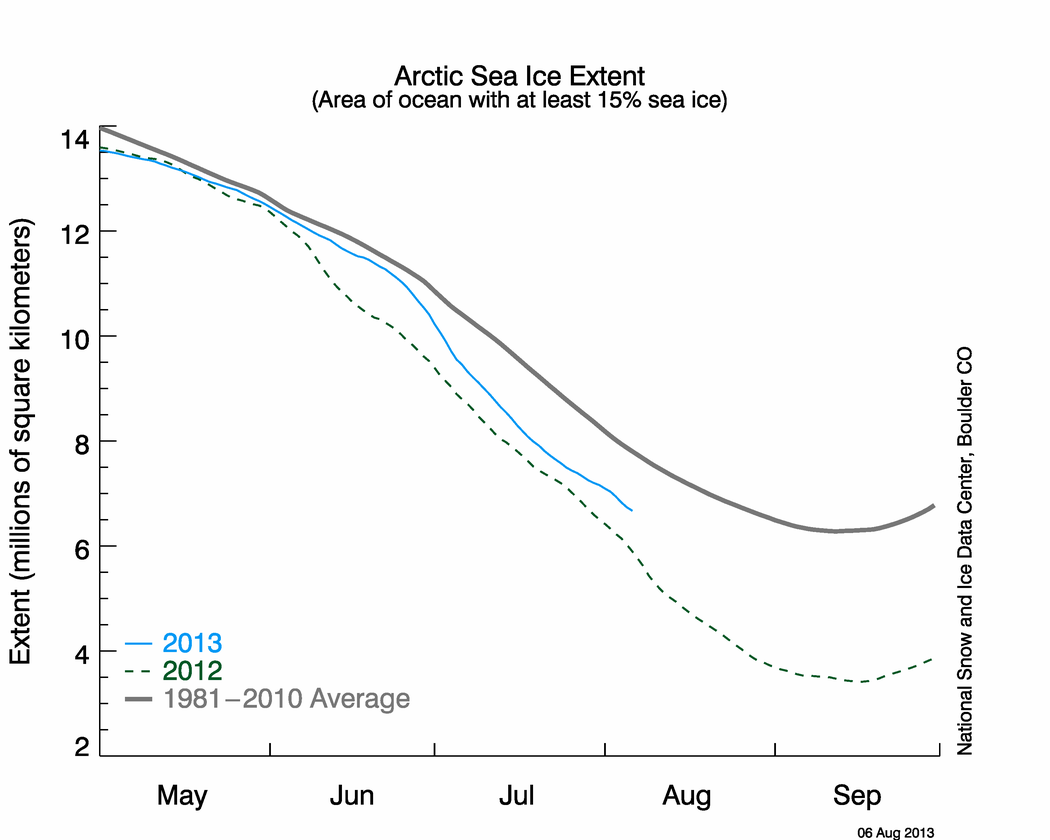
Ice has flatlined in the North, while it goes through the roof in the south.

http://nsidc.org/data/seaice_index/images/daily_images/S_timeseries.png
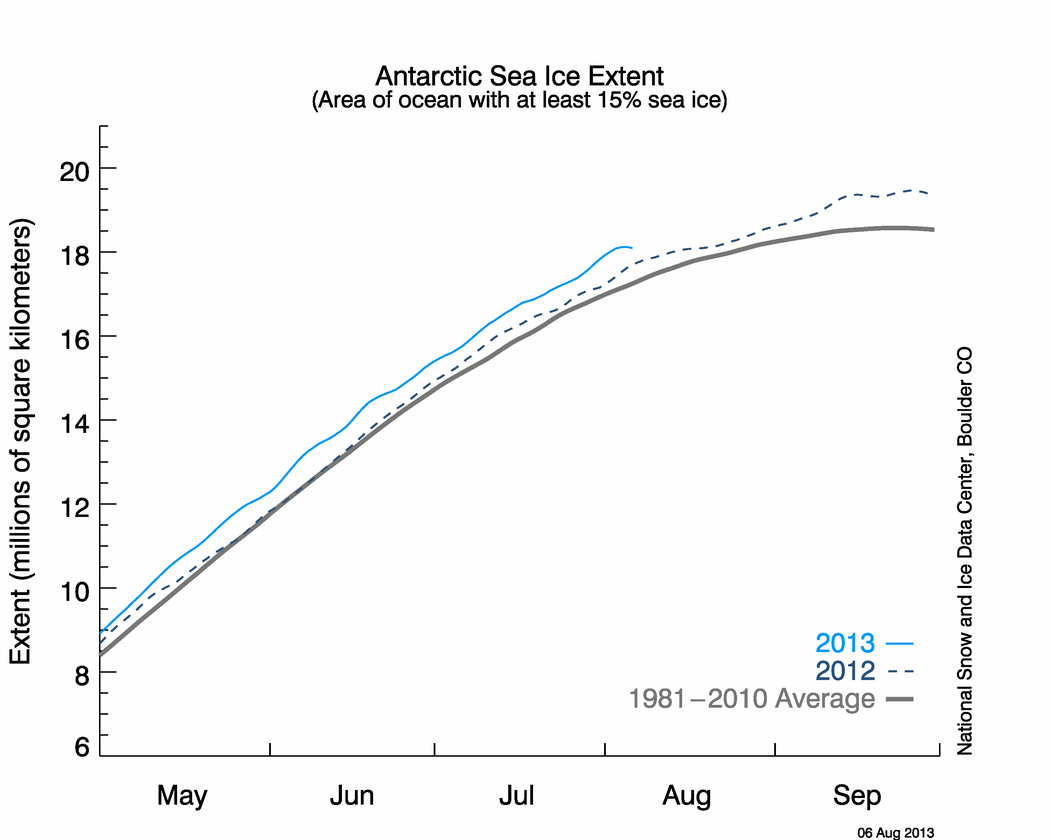
In other words, the widely claimed polar meltdown continues to be nothing more than bad fiction.
Tony B 2:30
Wow! Fascinating!
Robben has a legitimate gripe:
“When I got my second chance the referee should have given us a free kick and Puyol a (second) yellow card,” Robben told reporters.
http://www.reuters.com/article/idUSTRE66B00920100712
R Gates said:
Wasn’t that supposed to happen in 2007 and 2010? Pretty soon it will be “just wait until 2016, just wait and see!”
How many decades must we wait for Greenhouse to kick in?
So when weather metrics (SST, SAT, LT, Arctic, Antarctic, ENSO et al) tumble in the next 12 months, very possibly below that of 1999, and since El Nino will rear it’s ugly head again in 2-3 years, it will make 1998 look like a blip on the radar?
Historically, an El Nino Modoki (which is 2010) results in a neutral SST, yet looking at the latest SST indicates it is plummeting.
I don’t know, it just seems like with each El Nino since 1998, the outcome is earth losing more and more heat, quite the opposite of what we’ve been told the last 20+ years.
R Gates said
How does the Arctic continue to warm unabated when OHC continues to drop?
According to Polyakov, arguably the foremost expert on the Arctic, the Arctic region temperatures have peaked and are setting up to decline. Newdscientist is like any other pro-AGW ragazine; they cherry pick only those studies that fit the paradigm.
Douglas DC says:
July 11, 2010 at 1:25 pm
“Dirk G. LPG isn’t a bad idea with the new drilling technology the game is about to change:
The article talks mainly about Methane which is CH4 and appears to be abundent with new drilling technology although the administration is threatening to ban it because of potential water pollution.
LPG is liquid petroleum gas which is mostly propane (some butane and isobutane) that is C3H8 and is mostly produced in (USA) refneries as the result of processing crude oil. LPG is also a by product of natural gas extraction that comes along with the methane and is separated from the methane.
I spent some time in Trinadad several years ago and LPG powered cars were quite common there. I rode in a taxi that could run on either LPG or gasoline.
” the first half of 2010 has seen a string of months with record high global temps”
How do they look without “adjustment”?
See, that is the problem. The “adjustments” applied to the raw temperatures and the removal of practically all the rural and high altitude stations biases modern results warmer.
For example, in the temperature record for the state of California in the 1930’s are data from many stations in the Sierra Nevada, foothills, and the rural coastal areas. In the temperature record for the state of California in 2010 are three stations. All three are urban, all three are coastal.
Want to know what the difference is between a 65F day and a 95F day in San Francisco? Wind direction. All you need is a wind out of the East to bring you a day in the 90’s. Get a wind from the West and you have marine layer gloom all day. “Back in the day” you had stations in areas where there was no such difference or it was much less. The temperature doesn’t vary as much in Truckee, or Davis depending on wind direction as it does in SF.
Bottom line is that to compare today’s temperature “records” to those of 30 years ago is to compare apples to oranges. The networks are completely different with a completely different mix of station location types. Today’s data are worthless.
“‘DR says:
How does the Arctic continue to warm unabated when OHC continues to drop?””
DR, the New Scientist article that Gates linked said it was the last warm spell before another ice age/glaciation.
quote
“”At that time, CO2 levels are thought to have been close to current levels – around 390 parts per million – but global temperatures were around 2 to 3 °C warmer than today. It was the last warm period before the onset of the Pleistocene glaciation,””
Even though they think CO2 levels were about where they are now, and think global temperatures were +2-3 degrees warmer……
……..we still went into another ice age
I think they are agreeing with you.
I don’t think Gates meant to.
R. Gates says:
July 11, 2010 at 4:32 pm
I would refer you to this basic overview article about what future winters could be like, and you can follow up with your own research:
http://www.physorg.com/news195485722.html
“The polar ice cap shrank to its smallest surface since records have been kept in 2007, and early data suggests it could become even smaller this summer.
“It is unlikely that the Arctic can return to its previous condition,” Overland said. “The changes are irreversible.”
And your point is?
OK totally OT but Steve G did mention the world cup.
After Nigeria was eliminated from the world cup The Nigerian goalkeeper has personally offered to refund all the expenses of fans who travelled to South Africa.
He said he just needs their bank details and pin numbers to complete the transaction.
To: Dirk H…. I stand Corrected about Germany. I Assumed: ugh !
Re: ENSO/ La Nina:
— Globe is DEFINATELY headed to COOLING:
At :http://www.cpc.ncep.noaa.gov/data/indices/sstoi.indices
I have Averaged their indexes (the 1st number) then paired numbers are the temperature & the Anomaly or difference from Average (oC)
Month Avg. NINO1+2 ____ NINO3 ____ NINO4 ____ NINO3.4
2010 4 +.69 26.05 & 0.57 28.05 & 0.65 29.25 & 0.84 28.36 & 0.68
2010 5 +.14 24.28 -0.05 26.97 -0.09 29.03 0.37 27.68 -0.09
2010 6 -.28 22.81 -0.22 25.87 -0.51 28.69 0.06 27.06 -0.43
Now to see if Wayne Davidson’s Forecast of Clear Skies applies, look at 2007:
2007 1 +.72
2007 2 +.26 26.24 0.21 26.45 0.09 28.62 0.61 26.81 0.12
2007 3 -.07 25.74 -0.73 26.79 -0.30 28.57 0.48 27.18 0.03
2007 4 -.24 24.30 -1.18 27.13 -0.27 28.70 0.30 27.78 0.10
2007 5 -.58 22.73 -1.60 26.35 -0.70 28.86 0.21 27.57 -0.19
2007 6 -.40 21.59 -1.44 25.83 -0.55 28.98 0.34 27.55 0.06
2007 7 -.60 20.27 -1.55 24.79 -0.79 28.81 0.24 26.79 -0.29
2007 8 -.78 19.16 -1.64 23.86 -1.10 28.58 0.12 26.20 -0.50
… It looks to me as if we are about 2 months behind.2007.
2010’s Melt Engine definately sputtering — when will it be at Full Speed again ?
These are Equatorial indexes so there Is a Time-lag:
… weeks ? … or Months ??
Jaxa Sea Ice just saw 2007 pass 2010; latest:
Daily Loss:____2007________2010___(in million km2)
July 9-10 ___ – 135.157 ____ – 66,250 behind 24,688
July10-11 ___ – 106.750 _____ ? ?
James Allison
Good one!
Mr Gates
For my edification would please show this layman the evidence that proves recent increases in atmospheric CO2 has caused the Arctic sea ice extent to be in a state of steady decline since the LIA.
Also would you please explain to me why the same CO2 increase is causing a observed dramatic increase in Antarctic ice during the recent past.
R. Gates says:
July 11, 2010 at 5:18 pm
“AGW skeptics should pay no attention to these kinds of recent studies:
http://www.newscientist.com/article/dn19155-soaring-arctic-temperatures–a-warning-from-history.html”
================
Now I’m worried. You link “newscientist”
You need to convert to “the dark side”, before it’s too late.
So what if it melts? Aee we all gonna die, be poorer, go infertile.
It freezes, it melts, it freezes. Not only is melting ice NOT proof of anything CO2, is it even scary.
R Gates,
You know, I think I’m getting it now….because of this trace of CO2…. The arctic is/will be warmer, except when it isn’t…. and Ice will… diminish, except that it won’t…. and we’ll see greater NH snow extent….but none of the children will know what snow looks like….maybe because they’ll be drowning in a hurricane storm surge.. which is…. also a heatwave/drought…..?
A couple tabs of LSD and it will be crystal clear!
It’s a little early to claim victory just yet. The winds could change in a week, the clouds could depart and an increased melt could certainly follow.
However, it is interesting to see the believers scramble. I suspect it has something to do with the recent El Niñ0. If polar amplification does not kick in with the increased temperatures over the last year, it would seem to indicate the so called “experts” got it wrong. This is a major blow to cAGW. If they got this wrong, how much more did they get wrong?
I think this is one reason why we are seeing all the hopes and prayers of the believers displayed every time Steve has an article.
latitude,
Thanks.
Ok, now I’m confused. 2010 is being hailed as the resumption of global warming as predicted by climate models, yet NOAA climate models show blue covering both Poles. When was the last time that happened?
http://www.cpc.noaa.gov/products/analysis_monitoring/lanina/images3/glbT2mSea.gif
Joe B is toying with the idea by next summer, temps will descend deeper than 1999. Looking at daily UAH satellite data, SST are about cross over into 2007 territory; quite a steep drop occurring.
http://discover.itsc.uah.edu/amsutemps/execute.csh?amsutemps
Any thoughts?
That should be ….”NOAA climate models show blue covering both Poles by Spring 2011.”
Steve, if you look closely at the NSIDC graphs from today you will notice that there are some bad scans that caused that uptick in the SH and the NH today (take a look at the actual spatial extent of the NH and SH ice—it’s particularly bad in the SH). I’ll have to look more into this problem tomorrow, but the data definitely have a problem today.
In the meantime, I will point out that ice divergence happened in 2002 and 2003 (and I think also in summer 2004), and yet the first record low extents were observed. While ice divergence does spread the ice extent out, helping to slow down the ice extent loss, it can also cause open water areas to develop within the icepack, enhancing the ice-albedo feedback. Thus, at some point it could be that the ice divergence will actually hurt the extent by exposing the ice not only to warmer ocean temperatures (by pushing it southwards) but also cause enhanced lateral and basal melt from open water areas forming withing the icepack. Paper by Serreze et al. 2003 details how ice divergence led to the minimum of 2002…If the ice is indeed thin like the PIOMAS model suggests, I would expect to see an acceleration in ice loss in the coming weeks…This was especially true in August 2008 when it was clear the ice began to run out of thickness and the fastest rate of ice loss in 2008 actually occurred in August (and was the fastest on record).
Julienne,
I can see the problem in the SH maps, but the NH graph seems to match what I have been seeing over the last four or five days.
I agree that the lower concentration ice now could cause a rapid melt later, though I don’t believe the PIOMAS numbers. Their forecast maps are already way off the mark.
stevengoddard says:
July 11, 2010 at 5:32 pm
R. Gates
What if changes in Arctic temperatures had nothing to do with CO2?
____________
Then my 25% skeptical side will feel validated. Though my 75% AGW side believes this is very unlikely. I expect at least one, and possibly several new record lows in arctic sea ice extent between now and 2015. We should see lows hitting in the 2.0 million sq. km. extent in this time frame. This is based on the increasing influence of the Dipole Anomaly as well as the increasing solar irradiance and decreasing GCR’s we’ll see between now and the Solar Max of 2013. Should we get a strong El Nino in 2012-2014, we could see even lower than 2.0 million sq. km. In this time period, I expect that the Arctic Dipole Anomaly will become stronger and and even more self-reinforcing. The only change strong enough to have created this new chaotic attractor is CO2. Solar Irradiance doesn’t explain it, PDO doesn’t explain it, NAO doesn’t, ENSO doesn’t. They all have their influence, but compared to the 30% increase in CO2 since the industrial revolution, these other naturally occuring oscillations are simply not strong enough. The polar amplification of AGW, now being reflected in the increasingly frequent chaotic attractor known as the Dipole Anomaly is most likely related to CO2. All other known natural cycles are simply not strong enough. This does not preclude the discovery of some as yet unknown cycle that is longer than our current accruate measurement of these other cycles. It is this type of potential discovery (though unlikely) of an unknown natural cycle that my 25% skeptical side looks out for.
Steve, it doesn’t appear as bad in the NH, but if you look closely you do see it in Hudson Bay, Baffin Bay and there seems to be more coastal contamination than normal. Since these near-real-time brightness temperature data come from Marshall Space Flight Center (and are not the higher quality controlled data from RSS) problems like this occasionally occur (usually it’s geolocation errors).
James Allison says:
July 11, 2010 at 7:44 pm
Mr Gates
For my edification would please show this layman the evidence that proves recent increases in atmospheric CO2 has caused the Arctic sea ice extent to be in a state of steady decline since the LIA.
Also would you please explain to me why the same CO2 increase is causing a observed dramatic increase in Antarctic ice during the recent past.
___________________
There are dozens of excellent books, articles, and studies on the predicted effect of CO2 on the climate and specifically on how it will be reflected first and most extremely at the polar regions, but all AGW/GCM’s show the N. Pole to be warming more and earlier than the S. Pole. This has to do primarily with the large heat sink that is the S. Pacific ocean, as well as the fact that Antarctica is covered with a pretty large piece of ice that will keep the region somewhat immune from the full effects of AGW at first. Greenland provides some level of buffering, but no where to the same extent as the Antarctica, plus of course, the Arctic has no large Southern Ocean to act as a heat sink, and with the relatively smaller volume of water in the Arctic ocean, we are seeing that the extra heating of the open water will actually work as an amplifier of warming, releasing heat later in the season, and creating positive feedback effects.
For a very interesting paper of why the sea ice might actually grow (for a few decades at least) during AGW, I would suggest you read:
http://psc.apl.washington.edu/zhang/Pubs/Zhang_Antarctic_20-11-2515.pdf
Seems JAXA is showing 2010 just a shade under 2006 … if it continues like that it will be interesting.
An Inquirer says:
July 11, 2010 at 5:55 pm
Gates, perhaps you know how ironic it is that you chastise skeptics for looking at weather rather than climate, when it has been CAGW advocates who have been claiming weather events to be their proof of CAGW. Whether it was 2005 hurricances or 98 El Nino or 2010 summer Eastern heat wave or 2003 European heat wave or 2006 Canadian cold wave or 2009 above normal precipitation or 2007 droughts or 1993 Iowa rains or . . . these weather events are given as evidence of CO2-induced climate change.
________________
First, I am not a C-AGW believer. I’ve never talked about catastrophe’s or any such thing. First, I simply want to understand what is happening and why. What it means, in term of the implications for ecosystems, food supplies, species survival, etc. is something I’ll leave for the next few years of study. I know lots of work is being done in this area, but it’s not my main focus at the present time.
Second, I try to (though I’m not perfect) look at the longest term of reliable data we have. Short term weather events are interesting, but tend to noise. Even events such as ENSO, solar cycles, the PDO, etc. are also noise, and must be carefully accounted for to see the longer term signal underneath the noise. When people talk about any specific snowstorm or heatwave or cool spell, or whatever, it is only weather noise. However, as one begins to track the frequency of certain types of weather anomalies over the longer term, how those frequencies change over time (i.e. droughts, extreme rainfall or snowfall) can tell you something about climate change….but any individual event is simply weather noise.
Finally, one poster was mentioning the chaotic nature of both weather and climate, and that is true. But it is actually more difficult to predict the weather than the climate, because individual weather events seldom leave much in the way of a long term record, whereas the climate leaves us lots of clues in ice cores, tree rings, ocean sediments, etc. I like the example of boiling water to understand the difference between weather chaos and climate chaos. When you put a pan of water on a hot burner, you can predict that the water will boil at some point, and even predict with reasonable accuracy when that water will reach a full boil, if you know variables such as the conductivity of the pan, atmospheric pressure, purity of the water etc. This is like predicting the climate. However, you can’t predict exactly where the first few bubbles will appear or where subsequent bubbles will appear except until a few seconds before they actually appear. This is like predicting the weather.