By Steve Goddard
This summer we have had confirmation that Arctic ice behaviour has everything to do with wind. During June, winds were circulating clockwise in an inwards spiral, which caused ice extent to diminish and ice concentration to remain high. Around July 1, the patterns reversed and we have seen counterclockwise winds pushing ice away from the pole. As a result, ice area/extent has scarcely changed and instead we see a gradual decline in average ice thickness. The video below shows June/July ice movement and thickness.
The graph below shows changes in ice thickness during summer over the last five years. Based on past behaviour, we can expect the average ice thickness to flatten sometime in the next two weeks. It should bottom out somewhere between 2006 and 2009. NSIDC has warned me that PIPS is not an accurate measure of ice thickness, though I would have to say it has done remarkably well as a predictor of this summer’s behavior. As you can see below, 2010 is following a track similar to 2006.

As you can see below, we have reached the midpoint of the melt season in the high Arctic, and temperatures have been slightly below normal there for most of the last 55 days. There are only about 40 days left above freezing in the high Arctic.

http://ocean.dmi.dk/arctic/meant80n.uk.php
NCEP is forecasting below normal temperatures in most of the Arctic for the next two weeks.
The sea ice graphs have nearly flatlined since the beginning of the month. DMI’s graph is particularly interesting, since it only measures higher concentration ice, which is less likely to melt through.

http://ocean.dmi.dk/arctic/icecover.uk.php
Below is a closeup image showing that 2010 extent is now running close to 2006.

The concentration and extent appears quite similar to 20 years ago.

It has been cloudy in the Arctic and you can clearly see the counterclockwise circulation in the satellite IR image below. Clouds are white, ice is red.

The webcams continue to show a little ice on the surface of the meltponds, indicating ongoing below freezing temperatures at the North Pole.

http://psc.apl.washington.edu/northpole/webphotos/noaa2.jpg

We are at peak melt season, and there just isn’t much happening in the Arctic. The Arctic Oscillation has turned slightly positive in July, which tends to keep cold air contained in the Arctic and out of lower latitudes.

http://www.cpc.noaa.gov/products/precip/CWlink/daily_ao_index/ao.sprd2.gif

The modified NSIDC map below shows ice loss (red) and ice gain (green) over the last week. There has been slightly more loss than gain.

The modified NSIDC image below shows ice loss since early April.

The modified NSIDC image below shows the difference between 2010 (green) and 2007 (red.) There is clearly more ice now than in 2007, and this is also shown in the NSIDC extent graph.


http://nsidc.org/data/seaice_index/images/daily_images/N_timeseries.png
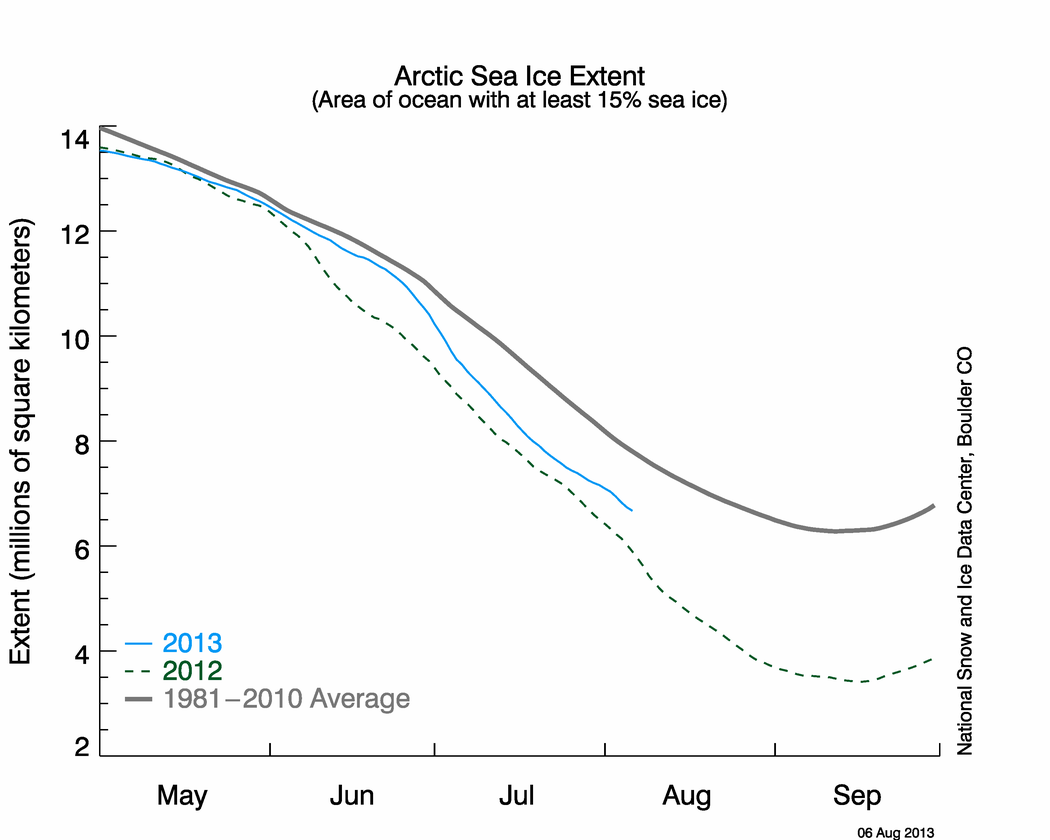
Ice has flatlined in the North, while it goes through the roof in the south.

http://nsidc.org/data/seaice_index/images/daily_images/S_timeseries.png
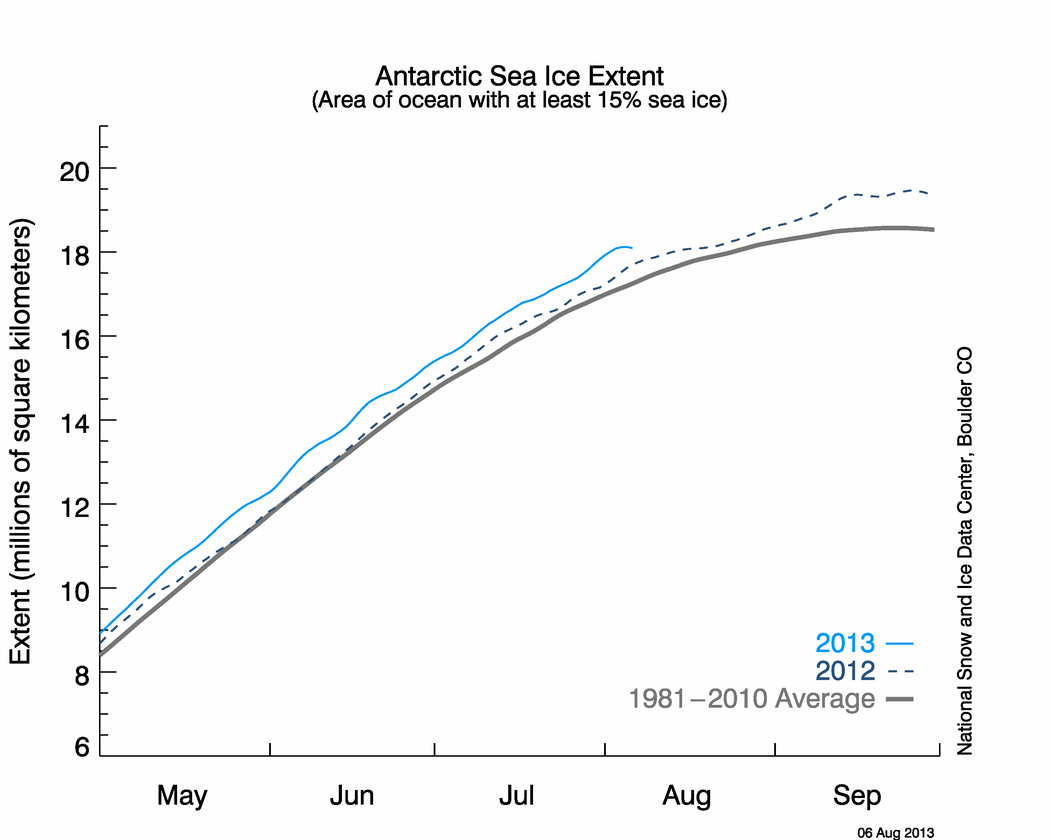
In other words, the widely claimed polar meltdown continues to be nothing more than bad fiction.
Dirk G. LPG isn’t a bad idea with the new drilling technology the game is about to change:
http://online.wsj.com/article/SB10001424052702303491304575187880596301668.html
This is from the WSJ May 10th…
R. Gates says:
July 11, 2010 at 11:33 am
“……of more interest is the long term climate trend in Arctic sea ice.”
==========
Your graph starts at peak ice of the late 70’s cooling “scare”.
I, for one, know you didn’t even try on this comment.
Natural cycles can explain your graph.
Benjamin P. says: ” ‘Arctic ice behaviour has everything to do with wind’
“Everything?”
It’s hyperbole, Benj.
R. Gates says:
July 11, 2010 at 11:33 am
Listen.
It’s the sound of the Climate Men workin’ on the Trend Gang.
jack morrow says:
July 11, 2010 at 11:29 am
“When I arrive in Sargents, CO. in Sept. I hope the Arctic ice is on your forecast and there is still a little snow along the continental divide this year which has been missing for about 3-4 years. This is based on my observation for about 20 years or so. I would feel much better about the climate if these minor things happened.”
What part of the Continental Divide do you visit? I’ve hiked the CD in Summit County every summer for the past five years and see snow fields right up until the September snowfall begins to start the next season’s snowpack. I’ve seen permanent snow fields in other areas of the Rockies every summer. A friend of mine a few days ago skied a couloir with plenty of snow up near the CD. Meanwhile, it’s another cold and rainy day in Breckenridge. I’ve noticed the wildflowers are late in blooming this season. Not much warmth in Summit County this summer.
Wind is the dominant factor in arctic ice ablation. Sun light would be the second most important. Temperatures don’t vary much in the summer.
R. Gates says: “N-Icely done update Steve. Very thorough, and it seems you’ve carefully chosen your data to support your final conclusion….
“I hope everyone bookmarks this quote of yours, or cuts and pastes it somewhere with the data of 7-11-2010. It should be forever connected with you, as it seems to be your deeply held belief.
[yatta-yatta]”And speaking of weather, as I said in the last of Steve’s updates, look for big spike down later in July and into August in Arctic Sea ice, with particularily strong melt coming from the Atlantic side of the Arctic Basin.”
Not one iota of which proves that any of this is caused by human activity. Get a life.
DirkH says:
July 11, 2010 at 1:01 pm
“Charles Wilson says:
July 11, 2010 at 11:06 am
[…]
Your information about Germany is wrong. Wherever you got it.”
Charles, maybe you got the impression that there is a Diesel craze in Germany because VW and Audi have started promoting their Diesel technology in the USA. But i can assure you that they have developed this technology continuously over the past 30 years, and also Ford – who has developers in Cologne AFAIK – sells a lot of Diesel-equipped cars here for a long time now.
Every few years VW tries to break into the US market with their Turbo Diesel’s and usually they fail because it’s just not that attractive without extra tax incentives.
So there’s nothing new here with the Diesel’s in Germany and surely no craze; i had a Diesel by VW from 1984 to 1994 and one by Ford from 2003 to 2008. Now i’m on Gasoline/LPG.
Douglas DC says:
July 11, 2010 at 1:25 pm
“Dirk G. LPG isn’t a bad idea with the new drilling technology the game is about to change:
http://online.wsj.com/article/SB10001424052702303491304575187880596301668.html
This is from the WSJ May 10th…”
Thanks for the link. Some test projects in Lower Saxony are underway, there’s some shale at the border to Holland. The companies keep a low profile and it didn’t hit the news big time yet.
Got a bit ahead of ourselves, didn’t we….
http://arctic-roos.org/observations/satellite-data/sea-ice/ice-area-and-extent-in-arctic
Steve,
I think the NSIDC needs to hire you to replace the fools they have now.
I think that the arctic ice might be increasing on tonights satelite image,hope this continues up to september and your predictions are confirmed
Another nice article Steve. It will be intriguing to see where ice levels will be at the end of the summer.
Arctic ice melt is by no means a modern trait and the NSIDC and IPCC seem reluctant to accept the concept of natural cycles of cooling and warming. The start of Satellite measuring in 1979 coincided with something approaching peak ice, following a extemded cooling period, which is why they always speak of subsequent decline;
History suggests you should look at a much longer time scale than thirty years which will put the modern era into its proper context..
Link 1 Ice extent maximum- Depends if you are talking winter or summer but ‘decline’ starts around 1976/9 from a high point.
http://geology.com/articles/northwest-passage.shtml
Link 2 This also shows the same;
http://arctic.atmos.uiuc.edu/cryosphere/IMAGES/current.area.jpg
Link 3 The IPCC report confirms this p351/2 figures 4.8 4.9 4.10
http://www.ipcc.ch/pdf/assessment-report/ar4/wg1/ar4-wg1-chapter4.pdf
Link 4 The concerns over ‘global cooling’ in the 70’s which caused the arctic ice peak did have some basis in fact. There were a series of low temperatures in many arctic areas during the 70’s which ice would have corresponded to by growing.
http://www.greenworldtrust.org.uk/Science/Scientific/Arctic.htm
Link 5 From the CIA further confirmation of the cold period during this time.
http://www.climatemonitor.it/wp-content/uploads/2009/12/1974.pdf
As the IPCC show, the start of the satellite period therefore roughly coincided with a period of peak ice-so it is not at all surprising that as part of its natural cycle it should subsequently decline.
Link 6: The IPCC are not very good at their historic reconstructions and generally view actual observations as ‘anecdotal.’ They seem to believe that history did not start before 1979. My article examines the arctic melting in the period 1810-1860 -see notes at bottom of article with additional references.
http://wattsupwiththat.com/2009/06/20/historic-variation-in-arctic-ice/#comments
Link 7: The next two links are good studies showing the arctic melting from the 1920’s to 1940’s; The first shows a warm period during the 1930s and 1940s with temperatures as high as those of today ftp://ftp.whoi.edu/pub/users/mtimmermans/ArcticSymposiumTalks/Smolyanitsky.pdf
Link 8: The second link illustrates reduced sea ice extent during this period, which only later returned to the high levels measured at the start of the latest retreating cycle in 1979 (when satellite measurements started).
http://meteo.lcd.lu/globalwarming/Chylek/greenland_warming.html
Link 9: The melting in the period 1920-1940 is very well documented.
Expeditions to the arctic to view the melting ice became the equivalent of todays celebrity jaunts to the area. The most famous were those mounted by Bob Bartlett on the Morrissey. I have carried extracts from his diary before-amongst the observation are a description of a mile wide face of a glacier falling in to the sea. There are pathe news reels of his voyages dating from the era, as well as books on the subject. Here is a bibliography of material relating to him. The diaries are of particlar interest.
http://www.nlpubliclibraries.ca/nlcollection/pdf/guides/NL_Collection_Guide_11.pdf
Link 10 Bernaerts, A. (2007). Can the “Big Warming” at Spitsbergen from 1918 to 1940 be explained? PACON 2007 Proceedings 325-337.
http://www.arctic-heats-up.com/pdf/Submitted_conference_paper.pdf
Link 11 This comes from contemporary 1922 newspaper reports showing Arctic ice melting in 1922
http://www.examiner.com/x-32936-Seminole-County-Environmental-News-Examiner~y2010m3d2-Arctic-Ocean-is-warming-icebergs-growing-scarcer-reports-Washington-Post
Link 12 Apparent warming in 1969 Arctic
http://wattsupwiththat.files.wordpress.com/2008/07/nyt_arctic_77442757.pdf
Link 13 This shows a variety of arctic warming events over the last 150 years
http://www.examiner.com/x-32936-Seminole-County-Environmental-News-Examiner~y2010m3d2-Arctic-Ocean-is-warming-icebergs-growing-scarcer-reports-Washington-Post
Link 14: We have got this far citing instances of warming and not even mentioned the Vikings 1000 years ago…instead let’s look at another Arctic culture that thrived 1000 years before the Vikings;
From the Eskimo Times Monday, Mar. 17, 1941
“The corner of Alaska nearest Siberia was probably man’s first threshold to the Western Hemisphere. So for years archeologists have dug there for a clue to America’s prehistoric past. Until last year, all the finds were obviously Eskimo. Then Anthropologists Froelich G. Rainey of the University of Alaska and two collaborators struck the remains of a town, of inciedible size and mysterious culture. Last week in Natural History Professor Rainey, still somewhat amazed, described this lost Arctic city.
It lies at Ipiutak on Point Hope, a bleak sandspit in the Arctic Ocean, where no trees and little grass survive endless gales at 30° below zero. But where houses lay more than 2,000 years ago, underlying refuse makes grass and moss grow greener. The scientists could easily discern traces of long avenues and hundreds of dwelling sites. A mile long, a quarter-mile wide, this ruined city was perhaps as big as any in Alaska today (biggest: Juneau, pop. 5,700).
On the Arctic coast today an Eskimo village of even 250 folk can catch scarcely enough seals, whales, caribou to live on. What these ancient Alaskans ate is all the more puzzling because they seem to have lacked such Arctic weapons as the Eskimo harpoon.
Yet they had enough leisure to make many purely artistic objects, some of no recognizable use. Their carvings are vaguely akin to Eskimo work but so sophisticated and elaborate as to indicate a relation with some centre of advanced culture — perhaps Japan or southern Siberia —certainly older than the Aztec or Mayan.
This link leads to the Academy of science report of the same year regarding the Ipiutak culture described above
http://www.pubmedcentral.nih.gov/articlerender.fcgi?artid=1078291
Link 15 A mention for the Vikings at last
“…The settlers found that the area to the north of the Western Settlement, called the Nordseta, was good for hunting, fishing and gathering driftwood. A stone inscribed with runes has been found telling that in 1333, three Greenlanders wintered on the island of Kingigtorssuaq just below 73 degrees north. There is also evidence of voyages to the Canadian arctic. Two cairns have been discovered in Jones Sound above 76 degrees North and two more have been found on Washington Irving Island at 79 degrees north….” http://www.mnsu.edu/emuseum/prehistory/vikings/Greenland.html
This is situated on Eastern ellesmere island-Map here
http://en.wikipedia.org/wiki/File:Canada_geopolitical_map_trim.jpg
Link 16 This from the late John Daly has numerous references to previous periods of arctic warming.
http://www.john-daly.com/polar/arctic.htm
Link 17 We seem to have known more about dispersal of ice by wind and currents 150 years ago than we do now, factors which have a profound efect on extent, area, and melting. Many books date from the scientific expeditions mounted since 1820 that examined the ‘unprecdented ice melt in the arctic reported to the Royal Sociery. This book dates from 1870
http://www.archive.org/stream/arcticgeographye00roya#page/28/mode/2up
Link 18: I supply this link as a curiosity, some of the findings appear to be rooted in fact, some certainly not, but readers will undoubtedly find it intersting. This link shows various historic maps which again appear to show that modern ice melt is the norm, not the exception. One of Greenland shows it as two separated islands and was cited by a polar French expedition which asserted that there is an ice cap joining what it is actually two islands. This extraordinary claim is backed up by observations from an 1820 Greenland expedition whereby locals remarked on folk lore which said the same thing. (see reference in Link 6)
http://www.nymapsociety.org/FEATURES/TRAGER.HTM
Certain of us seem reluctant to learn the lessons of history-in this case that there are periods of melting and refreeze of the Arctic area that appear to follow a roughly 60/70 year cycle. The satellite record coincided with one of the High spots of Arctic ice following a long cool period and we may or may not be at the low point in the cycle-that will become clearer over the next five years.
Whatever the alarmists may believe, at present our modern era is not displaying any climate characteristics that have not been experienced in past ages of humanity.
tonyb
If you want a conclusion not based upon data or anything else in the real world look to R. Gates.
Wilky says:
July 11, 2010 at 2:16 pm
Steve,
I think the NSIDC needs to hire you to replace the fools they have now.
Not likely to happen. But it is a nice wish. The NSIDC is a government agency. Politics control government agencies. To change the NSIDC you need a change of politicians. And that is something that can happen. 🙂
Yes, the SSM/I sensor is showing many spurious ice pixels for July 10, so for the time being we should not trust the NSIDC data. Since they take a five-day moving average, if the problem goes away we will need to wait until July 13 (Tuesday) for the average to “roll” past the bad data.
Correction to previous post: We need to wait until July 16 (Friday) when the data for July 15 (Thursady) is available, assuming that the spurious pixels are gone beginning with the map of data for today which will be available tomorrow.
tonyb says:
July 11, 2010 at 2:30 pm “”
Tony, that is one excellent post
thank you for that
On top of the flat-lining of the arctic ice smelt I notice that AMSU-A has also started to flat-line a bit. http://discover.itsc.uah.edu/amsutemps/execute.csh?amsutemps (near surface layer) is down to 0.53F and http://discover.itsc.uah.edu/amsutemps/execute.csh?amsutemps (sea surface) is up to 0.37F cooler than 9 July last year. So it would appear that air temperatures are heading downwards and overall sea ice extent is average. Not much sign of a boiling/burning globe (as yet) here.
Only a few more weeks of this theatre and someone will get a trophy.
Ah, Gates. your stained-glass Window view of the world is heart-warming, at least.
An Inquirer
Summer temperatures in Barrow have been running well below normal
http://www.wunderground.com/cgi-bin/histGraphAll?day=2&year=2010&month=6&dayend=11&yearend=2010&monthend=7&ID=PABR&type=6&width=500
Arctic ice is doing this:
http://img24.imageshack.us/img24/56/dmicloseup2.jpg
……………………………………………………………………………………………………………………
Antarctic ice is doing this:
http://img130.imageshack.us/img130/2739/stimeseries1.png
……………………………………………………………………………………………………………………
Meanwhile the PIOMAS graph is doing this:
http://img88.imageshack.us/img88/9018/bpiomasicevolumeanomaly.png
……………………………………………………………………………………………………………………
(No, the PIOMAS graph is not upside down. It is showing a plunge down.)
Wilky
I should point out that Julienne at NSIDC forecast the same minimum I did – 5.5 million km^2
It stinks that the world cup ended without 22 players on the pitch. Congratulations to Spain though for finding the back of the net.