And we thought we knew Earth’s mountains. Nope.

Radar imagery
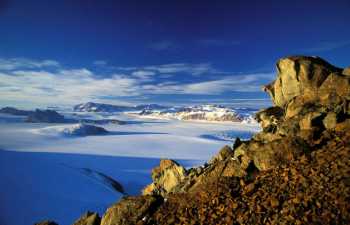
Scientists at the International Polar Year conference in Norway this week revealed startling new images of the Gamburtsev Mountain Range of Antarctica, a huge and mysterious “ghost range” buried beneath more than a mile of ice.
The images are the result of radar technology, and reveal a dramatic landscape of rocky summits, deep river valleys, and liquid, not frozen, lakes, all hidden beneath the ice. The range itself rivals the Alps in size and cover an area that is roughly the size of New York State.
“What we’d shown before was an estimate based on gravity data — a little bit of a coarse resolution tool,” said Robin Bell, a senior research scientist at Columbia’s Lamont-Doherty Earth Observatory in New York. “What we showed at this meeting was the radar data. It’s like going from using a big, fat sharpie to using a fine-tipped pencil.”
Flying twin-engine light aircraft the equivalent of several trips around the globe and establishing a network of seismic instruments across an area the size of Texas, a U.S.-led, international team of scientists in 2009 not only verified the existence of the mountain range, which is thought is to have caused the massive East Antarctic Ice Sheet to form, but also has created a detailed picture of the rugged landscape.
Read the rest of the story here
Who can’t wait for global warming to melt
all the Antarctic ice? Imagine the fun of being the first person to climb those virgin mountains?
Relevance?
Little did the dinos of old knew that in a short period of geological time they’d be dead and buried under a mile of ice, frozen in time while an entire new sprung population of flightless birds of empire penguins looks up into the sky while squatting just the tinniest bit to take a shat on the mile high ice while a small flying contraption with a couple glee full humanoids buzzes past maybe pondering how to sell this picture from mile high.
Jbar: June 12, 2010 at 5:44 am
Relevance?
Perfectly relevant to the purpose of the blog — to wit:
“Commentary on puzzling things in life, nature, science, technology, recent news events…”
wayne,
at one time Antarctica was very close or part of Australia, it wasn’t until Antarctica drifted south (or Australia drifted north) and allowed the ocean currents to avoid it’s , up until then movement around the combo continent , that the ocean cooled enough for the Antarctica to chill.
Meaning, for a lot of time there was no ice down there.
This is great news! Must get a hold of those maps. I shall sell everything and buy a nice plot on a southern slope, overlooking some nice valley with a (liquid) lake. With this runaway global warming and all, my property will emerge no later than 2025. Then I’ll build a little chalet, and spend my retirement watching pretty antarctic shepherdesses walk by…
So then why are all you science-haters celebrating the discoveries of this government-funded research project?
Dr. Bell, quoted above, is an internationally respected polar scientist, and understands Antarctic ice perhaps even better than our experts at WUWT. Here’s the summary and a short excerpt from her 2008 Scientific American article, “The Unquiet Ice Speaks Volumes on Global Warming.”
http://www.scientificamerican.com/article.cfm?id=the-unquiet-ice
“Abundant liquid water newly discovered underneath the world’s great ice sheets could intensify the destabilizing effects of global warming on the sheets. Then, even without melting, the sheets may slide into the sea and raise sea level catastrophically.
….
In the mid-1980s all our flights were survey flights: we had 12 hours in the air once we left our base in southern Chile, so we had plenty of time to chat with the pilots about making a forced landing on the ice shelves. It was no idle chatter. More than once we had lost one of our four engines, and in 1987 a giant crack became persistently visible along the edge of the Larsen B ice shelf, off the Antarctic Peninsula—making it abundantly clear that an emergency landing would be no gentle touchdown.
The crack also made us wonder: Could the ocean underlying these massive pieces of ice be warming enough to make them break up, even though they had been stable for more than 10,000 years?”
Anu says:
It’s a pretty safe bet that a nation pursuing government sponsored Science will quickly surpass a nation pursuing voluntary, donation based Science.
If the science has a hard goal, such as putting a man on the moon, government sponsored science seems to work well (perhaps not as efficiently as private enterprise but at least has the resources) and produce all sorts of “pure research” in the process plus side benefits such as computer technology. If the science is soft pure research with politically driven goals, it works much less efficiently. Not that there was no political motivation in the space race. Perhaps the military aspect and concerns about survival keep things on track and away from junk science the best. For those who recall, we were concerned that the Russians would build missile bases on the moon and be a big threat to us from there. Of course this was not as efficient as ICBM’s, but we did not know it at the time and there was also the pride factor of whose system of government would win the race.
Flying twin-engine light aircraft the equivalent of several trips around the globe and establishing a network of seismic instruments across an area the size of Texas, a U.S.-led, international team of scientists in 2009 not only verified the existence of the mountain range . . . but also has created a detailed picture of the rugged landscape.
Stunning news. Who’d’ve thought Antarctica was as big as Texas?
Anu says:
It’s a pretty safe bet that a nation pursuing government sponsored Science will quickly surpass a nation pursuing voluntary, donation based Science.
——-
REPLY: Anu, we already had that with the Soviet Union. They brought us wonderful knowledge such as Lysenkoism, large-scale biological weapons production via Biopreparat, etc.
There’s nothing wrong with government-sponsored science, but the political aspects need to be controlled in order to prevent bias. Case closed.
http://www.v-j-enterprises.com/dvhancok.html
Based on the latest scientific findings, Hancock’s controversial re-examination of our past argues that humanity’s history may date as far as the last ice age—10,000 years earlier than has been previously thought. Based on ancient maps that show Antarctica as a warm-weather region 2,000 mails north of its present location, and a crust-displacement theory of the earth’s surface supported by Einstein, Hancock suggests that this highly intelligent civilization existed in Antarctica and was subsequently destroyed by a global catastrophe. A catastrophe that may strike again soon.
ANTARCTIC
A whole series of ancient world maps in the Library of Congress portray, in great detail, the continent of Antarctica as it looks beneath its ice cap. Geologists estimate that the last time Antarctica may have been ice-free would have been between 17,000 and 12,000 years ago.
>>>lying twin-engine light aircraft the equivalent of several trips
>>>around the globe and establishing a network of seismic
>>>instruments across an area the size of Texas
Que?
Why did they not have a team dragging sledges in -50 degrees temperatures. Is that not how these things are done?
Sorry, what did you say? That was just a propaganda tool – or a media show? I don’t understand, what do you mean?
.
Perhaps this is the answer to the mystery of our southern hemisphere’s missing polar bears. They may be down there sunning themselves on the banks of the liquid lakes.
Re: Gneiss
>>Abundant liquid water newly discovered underneath the world’s
>>great ice sheets could intensify the destabilizing effects of global
>>warming on the sheets.
Actually, there has always been water under the ice-sheets. It is liquid because of geothermal energy and the pressure of the ice above (average water temperature -3 degrees).
Look at the size and depth of Lake Vostok
http://en.wikipedia.org/wiki/Lake_Vostok
.
Gneiss says:
June 12, 2010 at 8:45 am
So then why are all you science-haters celebrating the discoveries of this government-funded research project?
I don’t hate science – I love science when done properly. Science based on distortion, obfuscation, premeditated data selection and code and data concealment – that’s what I hate.
I can’t speak for anyone else here of course.
“Geologists estimate that the last time Antarctica may have been ice-free would have been between 17,000 and 12,000 years ago.”
And which geologists would that be?
Gneiss says:
June 12, 2010 at 8:45 am
“The Unquiet Ice Speaks Volumes on Global Warming.” What kind of overblown BS title is that? There is nothing in the SA article to warrant such hyperbolic nonsense. Dr. Bell’s speculations are worthy of stimulating scientific dialogue but when you wear your CAGW agenda so clearly on your sleeve, you invite dismissal.
Dwight D. Eisenhower said 1961
“Yet, in holding scientific research and discovery in respect, as we should, we must also be alert to the equal and opposite danger that public policy could itself become the captive of a scientific-technological elite.”
Is that new ice, or old ice? Crumpled up ice, or recycled ice? Clean ice, or dirty ice?
Looks like a lot more money needs to be dolled out to the usual suspects grazing at the public trough at the taxpoayers expense to find the answers to these and other obtuse questions.
sandyinderby wrote,
“I don’t hate science – I love science when done properly. Science based on distortion, obfuscation, premeditated data selection and code and data concealment – that’s what I hate.”
Well, we all hate that! But what I see on this site, time after time, is strong hostility toward an ever-growing list that contains many of the best scientists in the world. People don’t need any evidence of those data crimes you mention, they just “know” bad things happened because they don’t like the findings.
Too bad he had to write this as a PR (cAGW) story. Only make me now wonder if the data is pure and true since it’s so sprinkled with agenda. Could have been a great paper instead of junk science.
Unfortunately, Gneiss, a good many of “the best” scientists, and “the best” engineers are not who we hear from by way of the clowns and monkeys of the mainstream media circus, and a good many of those who do get media coverage aren’t particularly knowledgeable about science in areas other than their own field of specialization.
I have seen and read more than enough from “scientists” who seem, in their specialization in one very small category of science, to have forgotten the fundamentals of chemistry and physics, let alone having much knowledge of biology and other “sciences”. The lack of a broad knowledge of science (which isn’t to be had except over a long time) causes far too many of them to attribute effects to the entirely wrong causes. Too, statistics isn’t science, however properly it is done.
Gneiss says:
June 12, 2010 at 8:45 am
So then why are all you science-haters celebrating the discoveries of this government-funded research project?
I don’t hate science. I love science! I am a scientist who researches and publishes, but in industry. I left academia because it’s a joke. It’s politically motivated and overly pedantic. And AGW “research” is the worst of the worst.
>>Gneiss:
>>But what I see on this site, time after time, is strong hostility
>>toward an ever-growing list that contains many of the best scientists
>>in the world.
Many of these ‘top scientists’ have been bought. Bought science is not science, it is propaganda.
.
LarryOldtimer writes,
“Unfortunately, Gneiss, a good many of ‘the best’ scientists, and ‘the best’ engineers are not who we hear from by way of the clowns and monkeys of the mainstream media circus, and a good many of those who do get media coverage aren’t particularly knowledgeable about science in areas other than their own field of specialization.”
Certainly the world’s full of clowns and monkeys, but I suspect we see them in different places. I have a pretty good sense, for certain areas, of who the top folks really are. They’re people whose state-of-the-art reviews and fresh research ideas I read in leading journals; whose recent work gets hundreds of citations from their scientific peers; who are invited as plenary speakers at major international conferences (where hundreds of other experts gather to listen) and as key participants contributing to smaller task-focused workshops; who show a broad, synthetic and interdisciplinary perspective even in quiet conversation ….
So by my criteria, they’re among the top scientists. These definitely are people we often hear from, on climate-related topics. As a result, they come in for heavy attacks here and elsewhere. Look at how the mood changed against Robin Bell (a top scientist) when people on this thread learned she’d written about climate. I felt as if I had outed her, which was not my intent.