By Steve Goddard

The sea ice concentration game.

Arctic Ice is more concentrated in 2010 than in past years
The record low Arctic Oscillation during the past winter led to a very tightly compacted central Arctic ice mass – which is clearly evident in the UIUC images above. Some commentors have found this confusing because according to NSIDC, extent is slightly lower this year than previous years. (NORSEX disagrees with the NISDC assessment, but that is a topic of a separate discussion.)
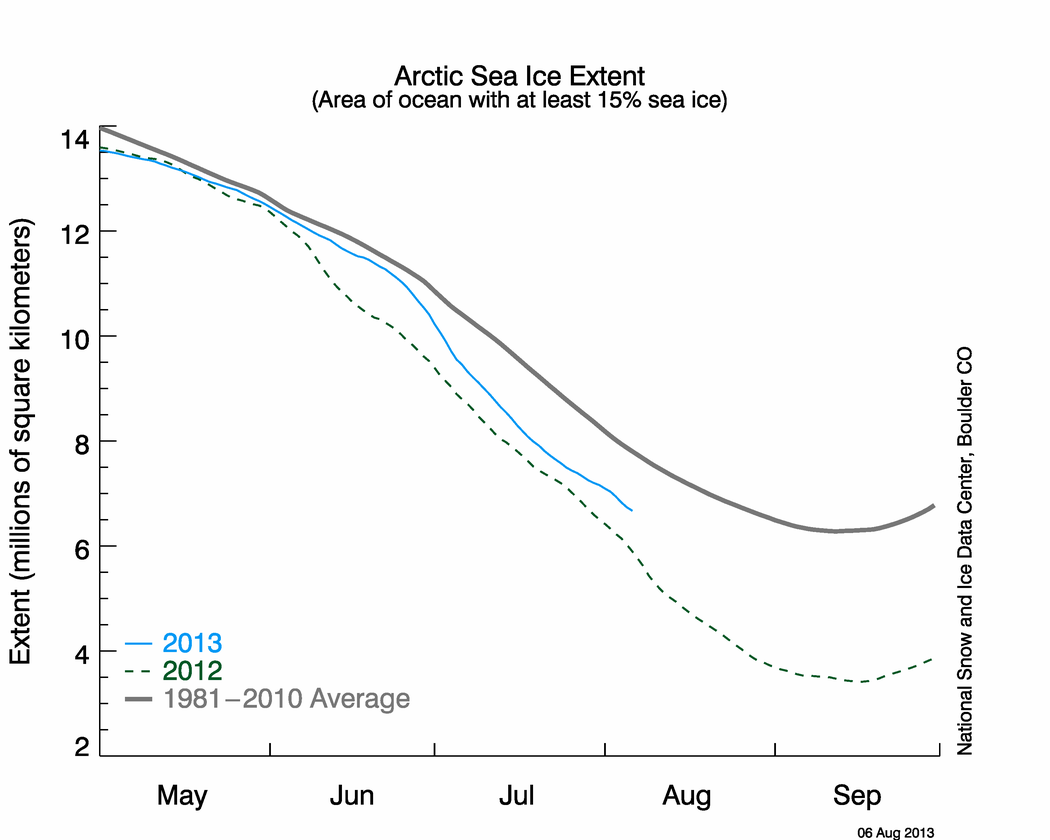

Is it possible to have higher concentration and lower extent? Of course, it is expected. If you put a 10 kg block of ice in a swimming pool, the ice will occupy a much smaller extent (and area) of the pool than a 10kg bag of ice cubes poured into the pool. Which one would melt faster? The bag of ice cubes would, because it has more surface area exposed to the water. We have an analogous situation with Arctic ice in 2010. The ice (by some measures) occupies a smaller area than the past three years – but is more concentrated.This bodes well for less melt later in the summer.
Now, let’s look at the current stats for the Arctic Basin, measured from PIPS maps.

2010 ice volume is above 2007-2009 and just below 2006.

2010 average ice thickness is approximately the same as 2006 and 2007. It is higher than “rotten ice” 2008 and 2009.

2010 Arctic Basin ice area is just below 2006 and 2007. It is higher than 2008 and 2009. When I refer to the Arctic Basin, I am considering only the region below – which corresponds approximately to the maximum September extent in the NSIDC records.
 ‘
‘
Below is yesterday’s Arctic satellite photo. The ice is very concentrated.

Conclusion : Current conditions continue to indicate a larger minimum ice extent than 2007-2009. This could change if the weather is very warm, windy or sunny during July. The ice has started to melt offshore at Barrow.

http://seaice.alaska.edu/gi/observatories/barrow_webcam
Comparison of June 10, 2008 with June 10, 2010 below. There is a lot more thick ice this year.
It should be noted that the two predictions from PIOMAS (from different methods) of 4.7 million and 4.5 million are for *average* September ice extent, not minimum September ice extent. Thus in all likelihood they are predicting a record, or something very close to it, as the September minimum would be below the September average by somewhere around 250,000.
Still, the PIOMAS people, using their own data, are not predicting the record to be ‘smashed’, so it is difficult to understand why someone who accepted the PIOMAS model as being relatively accurate would need to do so.
Really? This was too much?
GeoFlynx says:
Your comment is awaiting moderation.
June 12, 2010 at 11:12 am
In your side by side comparison of Arctic sea ice from 06/09/1990 and 06/09/2010 you neglegted to mention that the later dated diagram includes historic snow cover data (in white) whereas the earlier photo does not (not white). This oversight gives the false impression, to the less informed, that there is much more “ice” in the 2010 cryosphere than there was in 2009. May I suggest that these diagrams be relabeled so that a misrepresentation does not occur?
Phil. says:
June 13, 2010 at 9:15 pm
“That should be amusing,”
Yeah almost as amusing as your whining on another thread about accusations against your honest that only you see. I have some cheese for you.