By Steve Goddard and Anthony Watts
The Navy requires accurate sea ice information for their operations, and has spent a lot of effort over the years studying, measuring, and operating in Arctic ice both above and below, such as they did in the ICEX 2009 exercise.

So, if you are planning on bringing a $900 million Los Angeles class submarine through the ice, as the captain might say to the analyst after receiving an ice report: “you’d better be damn sure of the ice thickness before I risk the boat and the crew”.
Below is a blink comparator of U.S. Navy PIPS sea ice forecast data, zoomed to show the primary Arctic ice zone.

The blink map above shows the change in ice thickness from May 27, 2008 to May 27, 2010. As you can see, there has been a large increase in the area of ice more than two metres thick – turquoise, green, yellow and red. Much of the thin (blue and purple) ice has been replaced by thicker ice.
Source images for the blink comparator:
http://www7320.nrlssc.navy.mil/pips2/archive/pips2_thick/2008/pips2_thick.2008052700.gif

http://www7320.nrlssc.navy.mil/pips2/archive/pips2_thick/2010/pips2_thick.2010052700.gif

This was quantified by measuring the area percentage in the Arctic Basin of the 0-1, 1-2, 2-3, 3-4, and 4-5 metre ranges. The graph below shows the results. This technique assumes an equal area projection, which should be fairly accurate north of 70N.
In 2008, less than half of the ice (47%) was greater than two metres thick. Now, more than 75% of the ice is greater than two metres thick. In 2008, 18% of the ice was more than three metres thick. This year that number has increased to 28%. There has been nearly across the board ice thickening since 2008. There was slightly more 4-5 metre ice in 2008, due to the big crunch in the summer of 2007.

Now on to calculating the volume. That calculation is straightforward :
volume = (A1 * 0.5) + (A2 * 1.5) + (A3 * 2.5) + (A4 * 3.5) + (A5 * 4.5)
Where A1 is the area of ice less than one metre, A2 is the area of ice less than two metres, etc. The 2010/2008 volume ratio came out to 1.24, which means there has been approximately a 25% increase in volume over the last two years. The average thickness has increased from about 2.0 metres to 2.5 metres. That means an extra 20 inches of ice will have to melt this summer. So far, this seems unlikely with the cold Arctic temperatures over the last couple of weeks.

http://ocean.dmi.dk/arctic/plots/meanTarchive/meanT_2010.png
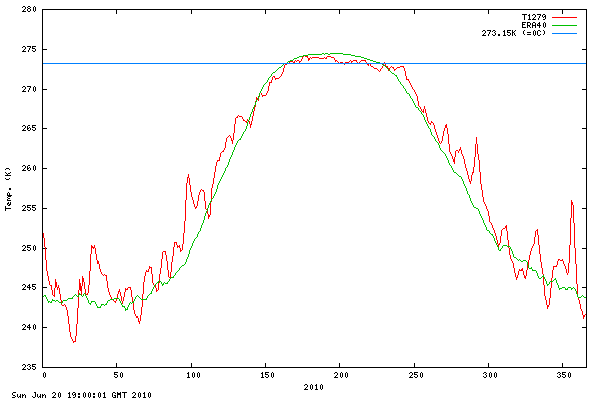
Now let’s look at the volume percentages. In 2010, 87% of the ice (by volume) is greater than two metres thick. But in 2008, only 64% of the ice (by volume) was greater than two metres thick.

A few weeks ago, when extent was highest in the JAXA record, our friends were asking for “volume, not extent.” Their wishes have been answered. Ice volume has increased by 25% in the last two years, and those looking for a big melt are likely going to be disappointed.

Here is the measured data:

Do you think it odd that this increase isn’t prominently mentioned on the PIOMAS site? It seems very relevant.
———————————————–
If a man will begin with certainties, he shall end in doubts; but if he will be content to begin with doubts he shall end in certainties.
– Sir Francis Bacon
Sponsored IT training links:
If your are looking for quick success in 350-018 exam then join today to explore useful 642-974 resources and pass EX0-101 on first try guaranteed.
Gneiss
Do you support the idea of an ice free Arctic by 2020?
Steven Goddard wrote, “Do you support the idea of an ice free Arctic by 2020?”
I’m no Arctic ice expert, but I’ve listened to many people who are. Consensus seems to be that the IPCC projection of late-summer ice almost entirely gone in the late 21st century was too conservative, perhaps way too conservative.
Gneiss
90 years ago was right after WWI. Making predictions 90 years into the future is well … pointless.
If the Arctic is Ice Free in September by 2020, then the Antarctic Sea Ice will expand to cut off the flow between the Pacific and Atlantic:
http://www.robertb.darkhorizons.org/seaice.anomaly.Ant_arctic.jpg
The poles are locked in a dance, while the alarmists are locked in a trance.
I guess we have to wait and sea if the estimate of increse in thickness is correct. The amount of ice left in the end of summer will probably give us a clue. 🙂
Maslowski’s 2013 was a major outlier and simply not representative of mainstream climate science. The cautious modelers talk about 2050 at the absolute earliest for ice-free summers. My guess, based on PIOMAS, is there will be a summer minimum of 2.5 M km2 by 2020 and 0.5 M km2 by 2030. That latter can be called effectively ice-free.
Without Comment.
http://psc.apl.washington.edu/ArcticSeaiceVolume/images/BPIOMASIceVolumeAnomalyCurrent.png
rbateman says:
May 30, 2010 at 2:27,
Great graphic. Mind if I swipe it for my collection?
GeoFlynx,
Do you think they could have stretched the y-axis a little more? Say, zero to ±5,000 cu km top & bottom, instead of zero – 10,000? It doesn’t seem quite steep enough to scare every last person on Earth. [/sarc]
Sorry, false alarm. You can relax now.
GeoFlynx,
I have seen that PIOMAS graph, and it appears to be way off the mark.
http://wattsupwiththat.files.wordpress.com/2010/05/pips_anim.gif
I have measured the current volume, and it is higher than the same date in 2007, 2008 and 2009.
Smokey says:
May 30, 2010 at 5:45 pm
rbateman says:
May 30, 2010 at 2:27,
Great graphic. Mind if I swipe it for my collection?
Why certainly. Here’s another one:
http://www.robertb.darkhorizons.org/seaice.area.ANT_arctic.jpg
I’d like to see Steve or Willis put the data cruncher to work on where the average Di-Polar Sea Ice Area and Anomaly has been.
Seems rather narrow-minded to focus solely on the Arctic as it is but one Pole.
GeoFlynx says:
May 30, 2010 at 5:32 pm
With comment: BPIOMAS is a computer model generated WAG based on data that, so far, has not nose dived.
The credibility of such models is already been found wanting, as the goalpost of predicted disaster never materializes.
In software we called it VaporWare, and it sunk many companies unable to deliver the goods.
It now sinks AGW, as it has NOT delivered on any prediction, and therefore the product that Gore/Hansen/Mann have
attempted to sell is resoundly rejected.
Nobody wants to buy VaporWare, no matter how powerful a supercomputer it was generated on.
It’s AGW Marketing Divisions worst nightmare.
The product sucks.
stevengoddard says:
May 30, 2010 at 6:00 pm
GeoFlynx,
I have measured the current volume, and it is higher than the same date in 2007, 2008 and 2009.
Really, and exactly how did you do that?
I am still surprised by the attempts to either proove or disproove CAGW by referrence to melting ice. Non of this has any relevence to the central question.
What real evidence is there that clearly shows that a small increase in the concentration of a trace atmospheric gas (CO2) is a major driver of Global Warming that will ultimately destroy the earth? It is a belief in this hypothesis that requires us to all retreat to a stone age level of civilisation. So for all of you CAGW cultists. Please present the evidence for CO2 caused CAGW. In effect Put up or shut up.
Steve,
“I have measured the current volume, and it is higher than the same date in 2007, 2008 and 2009.”
How do your values compare to the numbers derived by the PIPS team for May 2007 and 2008 here?
http://www.nrl.navy.mil/content_images/09_Ocean_Posey.pdf
Phil,
You should read the article before commenting.
http://www.nasa.gov/home/hqnews/2010/may/HQ_10-122_MRO_On_Ice_Cap.html
NASA Spacecraft Penetrates Mysteries Of Martian Ice Cap PASADENA, Calif. — Data from NASA’s Mars Reconnaissance Orbiter (MRO) have helped scientists solve a pair of mysteries dating back four decades and provided new information about climate change on the Red Planet.
The Shallow Radar, or SHARAD, instrument aboard MRO revealed subsurface geology allowing scientists to reconstruct the formation of a large chasm and a series of spiral troughs on the northern ice cap of Mars. The findings appear in two papers in the May 27 issue of the journal Nature.
Data from Mars now points to both the canyon and spiral troughs being created and shaped primarily by wind. Rather than being cut into existing ice very recently, the features formed over millions of years as the ice sheet grew. By influencing wind patterns, the shape of underlying, older ice controlled where and how the features grew.
So. Mars has it’s spiral N. Hem. Ice pattern, and Earth has the Arctic Beaufort Gyre.
How interesting.
NASA at it’s finest. Worth every last penny, and then some.
Phil. says:
May 30, 2010 at 7:00 pm
Steve measured the same way Greenwich Royal Observatory measured umbra, penumbra and faculae for 100 years, and how Debrecen Observatory, Hungary measured umbra, penumbra and faculae on the Sun. They count the unit areas and strengths.
It’s really quite elementary these days, what with digitized images having pixel intensities.
Good solid science stuff.
I highly reccomend it. Layman’s spot count is based on the very same principle.
I measured the volume using the same mathematical technique which anyone would have to do – i.e. integrating thickness across area.
Mack 520 thinks that the models are science and we should ignore the data. That is the problem, we have relied on the models and ignored data. If the model does not agree with the data, chuck the model!
Next to be thrown out is the theory of greenhouse gasses!
AndyW says:
May 30, 2010 at 12:08 pm
R.Gates said
“An excellent presentation, and if the PIPS 2.0 data had any validity or accuracy I would almost believe it. Unfortunately, PIPS 2.0 was quite inaccurate with low fidelity and is no longer used by the Navy for any serious applications …”
I work in imaging technology and quantitative analysis. The effect of spatial resolution on accuracy of measurements is not always what you expect. With lower spatial resolution you lose ability to spatially resolve structures, but the ability to detect differences between samples analysed over an extensive volume (rather than at a single location only), or the ability to detect changes with time in a sample, is surprisingly well preserved with lower (or artificially degraded) resolution. Overall changes in volume and architecture of objects both in 2D and 3D remain detectable when ability to resolve individual structural components is degraded, to a surprising extent. Some studies even indicate increased precision of trend / difference analysis with lower resolution. This might be due to signal to noise and stability issues with higher resolution.
I’m not arguing that low is better than high resolution, but that if we assume from R Gates’ comments that PIPS 3 has a higher spatial resolution than PIPS 2, this does not mean that the ability of PIPS 2 to detect changes year on year in ice amount is necessarily significantly different to that of a higher-res PIPS 3.
phlogiston says:
May 31, 2010 at 7:49 am
“I’m not arguing that low is better than high resolution, but that if we assume from R Gates’ comments that PIPS 3 has a higher spatial resolution than PIPS 2, this does not mean that the ability of PIPS 2 to detect changes year on year in ice amount is necessarily significantly different to that of a higher-res PIPS 3.”
___________________
Actually I agree with this, and I think Steve and Anthony did an excellent job with the data they had, but the data used, PIPS 2.0 has a stated error of up to 25%, and as other posted pointed out, even large open areas of known open water were shown
as having ice in the PIPS 2.o data– and this is just one of the reasons that the NAVY needed to go to PIPS 3.0 and the HYCOM suite. Furthermore, to suggest that the NAVY was putting hundreds of million of dollars in expensive hardware and the lives of personnel at risk based on data that has up to 25% error rates is rediculous, especially to suggest that that was a reason that it should be trusted over PIOMAS, when PIOMAS is more sophisticated (i.e. CICE based) model.
PIPS 3.0 and the HYCOM suite (and other related tools) are what the Navy uses, and they are based on CICE from Los Alamos, and the full operational details and capabilities of these newer models are classified, as the Arctic is becoming an increasingly important strategic area, and will continue to grow as such as the ice continues to recede from year to year. The the Superpowers are planning for an ice free Arctic :
http://www.navy.mil/search/display.asp?story_id=48533
http://books.sipri.org/files/insight/SIPRIInsight1002.pdf
And they have a lot more sophisticated models than PIPS 2.0 to base their projections on, and PIOMAS is more closely allied with those models than is PIPS 2.0. Having said all that, I don’t think Steve and Anthony wasted their time in the analysis, and they might even be right, the point is, with a 25% known inaccuracy in PIPS 2.0, to state with any confidence that sea ice volume has increased by 25% is not quite science.
Finally, here’s a great link to watch the ice break up in the Bering Strait in detail:
http://ice-map.appspot.com/?map=Arc&sat=ter&lvl=7&lat=67.940426&lon=-168.991006&yir=2010&day=149
You can used the calendar on the top right hand side to update the image each day.
R. Gates says:
May 31, 2010 at 8:55 am
The superpowers may be planning for an Ice-Free Arctic as a one-time event, a continual event or a non-event. They may also be planning on using the Arctic as a training ground, for a Little Ice Age event that makes a lot of places, currently traversable, blocked to surface shipping.
The military doesn’t just plan for one contingency, they plan for ALL contingencies.
There’s no room for a computer-generated Dyle Plan.
Ice Volume Site:
http://psc.apl.washington.edu/ArcticSeaiceVolume/images/BPIOMASIceVolumeAnomalyCurrent.png
Steve,
I’ve tried a similar approach to quantify ice volume from these images, but I used Wu quantization to unambiguously map the pixels to the thickness key. I get average ice thicknesses similar to yours, but which are much lower than those reported by either PIOMAS or PIPS.
I believe the problem is that the PIPS maps do not show ice coverage. Hence much open water is contributing to the average and pulling down the calculated thicknesses. Subtract the area of open water and a more realistic ice thickness should be obtained.
I therefore think deriving volumes from these images is highly problematic. Unless you can incorporate the appropriate coverage data, I think these simple calculations from what is an incomplete dataset are of dubious merit.
R.Gates
“The the Superpowers are planning for an ice free Arctic :”
I’ll quote the good Admiral from the article.
http://www.navy.mil/search/display.asp?story_id=48533
“What I mean by the ‘when’ question is ‘when do you need to spend money?'” he explained. “When do you need to invest in communications? In infrastructure? When do the policy experts come up with specific missions? And when are we going to have a lot of water to work with?”
According to Titley, the complexities of the Arctic environment make it difficult to determine that timeline. “There’s a lot of variability, it is very complex, and that is why the predictions you see have pretty wide confidence intervals,” Titley noted.”
Russia is developing a contingency plan to knock the Apophis asteroid off course in 2029.
http://cbs13.com/technology/russia.rocket.asteroid.2.1397103.html
NASA predicts the odds of the Apophis asteroid hitting earth at 1 in 45,000.
http://neo.jpl.nasa.gov/apophis/
Just because someone prepares a contingency plan for a ‘what if’ doesn’t have any bearing on the odds of the ‘what if’ actually occurring.
In the 1920’s the US military drew up plans for the invasion of Canada. 90 Years later it still hasn’t happened.