By Steve Goddard and Anthony Watts
The Navy requires accurate sea ice information for their operations, and has spent a lot of effort over the years studying, measuring, and operating in Arctic ice both above and below, such as they did in the ICEX 2009 exercise.

So, if you are planning on bringing a $900 million Los Angeles class submarine through the ice, as the captain might say to the analyst after receiving an ice report: “you’d better be damn sure of the ice thickness before I risk the boat and the crew”.
Below is a blink comparator of U.S. Navy PIPS sea ice forecast data, zoomed to show the primary Arctic ice zone.

The blink map above shows the change in ice thickness from May 27, 2008 to May 27, 2010. As you can see, there has been a large increase in the area of ice more than two metres thick – turquoise, green, yellow and red. Much of the thin (blue and purple) ice has been replaced by thicker ice.
Source images for the blink comparator:
http://www7320.nrlssc.navy.mil/pips2/archive/pips2_thick/2008/pips2_thick.2008052700.gif

http://www7320.nrlssc.navy.mil/pips2/archive/pips2_thick/2010/pips2_thick.2010052700.gif

This was quantified by measuring the area percentage in the Arctic Basin of the 0-1, 1-2, 2-3, 3-4, and 4-5 metre ranges. The graph below shows the results. This technique assumes an equal area projection, which should be fairly accurate north of 70N.
In 2008, less than half of the ice (47%) was greater than two metres thick. Now, more than 75% of the ice is greater than two metres thick. In 2008, 18% of the ice was more than three metres thick. This year that number has increased to 28%. There has been nearly across the board ice thickening since 2008. There was slightly more 4-5 metre ice in 2008, due to the big crunch in the summer of 2007.

Now on to calculating the volume. That calculation is straightforward :
volume = (A1 * 0.5) + (A2 * 1.5) + (A3 * 2.5) + (A4 * 3.5) + (A5 * 4.5)
Where A1 is the area of ice less than one metre, A2 is the area of ice less than two metres, etc. The 2010/2008 volume ratio came out to 1.24, which means there has been approximately a 25% increase in volume over the last two years. The average thickness has increased from about 2.0 metres to 2.5 metres. That means an extra 20 inches of ice will have to melt this summer. So far, this seems unlikely with the cold Arctic temperatures over the last couple of weeks.

http://ocean.dmi.dk/arctic/plots/meanTarchive/meanT_2010.png
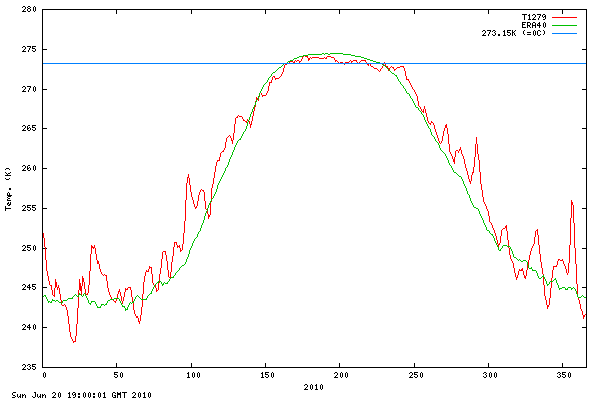
Now let’s look at the volume percentages. In 2010, 87% of the ice (by volume) is greater than two metres thick. But in 2008, only 64% of the ice (by volume) was greater than two metres thick.

A few weeks ago, when extent was highest in the JAXA record, our friends were asking for “volume, not extent.” Their wishes have been answered. Ice volume has increased by 25% in the last two years, and those looking for a big melt are likely going to be disappointed.

Here is the measured data:

Do you think it odd that this increase isn’t prominently mentioned on the PIOMAS site? It seems very relevant.
———————————————–
If a man will begin with certainties, he shall end in doubts; but if he will be content to begin with doubts he shall end in certainties.
– Sir Francis Bacon
Sponsored IT training links:
If your are looking for quick success in 350-018 exam then join today to explore useful 642-974 resources and pass EX0-101 on first try guaranteed.
Mike says:
May 29, 2010 at 7:02 pm
You are picking the sources that say what you want to believe.
[…]
Go figure.
—
I went and figured. You are somewhat right Mike, about choosing data. You look at various sets of data and ask, who do I trust. The U.S. military so far is enough for me. They are one of the last entities I put complete trust in collecting and reporting data, knowing the caliper of most of its members. I use to trust in most science data without question but no longer, especially in this ‘environmentalist’ AGW arena. And you Mike, your questioning the military as being the distorters of data with your “credible scientists” being unquestionable just tell me my decisions are correct. Keep the words flowing Mike.
EFS_Junior
May 29, 2010 at 8:45 pm
Hi EFS,
Instead of the usual hackneyed barrage of propaganda that is so five years ago would you present data that shows North Pole ice is not increasing in volume?
Devil’s Advocate says:
May 29, 2010 at 9:43 pm
Here’s the explanation:
http://wattsupwiththat.com/2010/05/27/shear-ice-decline/
It was posted here 2 days ago. Are you new to this issue?
Is the assumption being made that the melting is the only explanation for reducing ice volume in the Arctic?
From my experience doing ice reconnaissanse in the Canadian arctic, albeit a long time ago, circulation appeared to be a factor as well. While the eastern part of Parry Channel (Lancaster Sound) would reliably be free of ice for one to two months a year. The western portion of the channel (west of Resolute) was much less likely to become ice free. This appeared to be due to the several small islands scattered across the channel just west of Resolute Bay. These appear to significantly obstructed eastern pack ice movement (the general circulation flow).
In the Beaufort Sea, the Beaufort gyre tends to retain the sea ice over a multi year period, while the transpolar drift stream offers an exit for pack ice.
So, the changes in ice volumes alre likely to be impacted by the complex interaction of the two circulation patterns. The question is how much?
In the case of the 2008 vs 2010 data, the 2008 data shows the major ridging (ice well over 3 metres thick) on the “right” pushing against the tip of Canada, and of Greenland. The 2010 data shows the major ridging against the opposite side. This would suggest very different circulation patterns between the 2008 data and the 2009 data.
Hello again, Steve.
I thought a death spiral was continuously downwards……..
Huh? Where did I say anything about death spirals? Are you talking to me or about someone else?
I remember some ice scientist saying something like, “we could be seeing a death spiral”. I don’t think much of the comment – but I doubt the scientist envisioned a monotonous trajectory month-to-month. It’s a figure of speech, and it’s about a climate trend, not about weather, which is what your post is about. I’m interested in data and meaningful trends, not sound bytes. How about you?
Please describe the technique you envision for continuously monitoring ice thickness.
I’m sure you’re familiar with the methods and data sets utilized to estimate ice thickness. Are you asking me to speculate on alternative methods?
I’m not sure what you’re trying to imply. Are you suggesting that ice volume data is significantly lacking? I see no such qualification in your post. If data is porous, then why doesn’t that caveat appear in the post? And what would that mean for the message therein? But let’s deal directly, rather than with innuendo.
I’m interested in actual data, not modeling (on this subject). Do you have any? I’ll go searching when I’ve more than 10 minutes to sit down and bring what I find here.
Considering the mistrust of models and the strong predilection for access to observational data, why is there no call out for such on this subject? The answer is obvious to me – when the message is favourable to opinion, the standards change. Let’s not fall for that one. And let’s not mistake daily, monthly, or interannual variability for climate trends. The popular press may make errors of this kind, but there is no merit to responding in kind – unless the aim is counter-propaganda rather than objective analysis.
What is your motivation, if I may ask? Mine, for the record, is to sort the wheat from the chaff. I don’t need anyone to get on any bandwagon, just to get the facts straight.
mack520 says:
May 29, 2010 at 10:32 am
Try Google scholar for “Polar Ice Prediction System”
It seems to be well and truely published.
Pamela Gray says:
May 29, 2010 at 2:38 pm
The Ocean skin is not warmed further from the addition of AGHG’s, which constitute a very small fraction of natural GHG’s. Even water vapor can’t do it. Longwave infrared radiation does NOT like the barrier to water penetration that is known as surface tension. Even natural sources of GHG’s re-radiation cannot get LW past the thin surface tension skin to layers that could melt ice. In addition, the small bit of warming from LW is nearly immediately evaporated off. To wit: your backyard pool.
You can do an experiment if you own a pool. Fill it with cold water. Let it sit in the Summer Sun on a clear day and measure temp change at different depths. You can measure heat penetration quite easily. If you don’t shake up the pool, you will notice layering. If you then give it a good mix, the surface will be cooler than it was under calm conditions. You are measuring shortwave radiation penetration. The properties of shortwave allow it to move through the water’s surface tension to amazing depth. The properties of longwave cannot do this.
Another thing about your pool or hot tub. Water’s desire to evaporate when it is warm is greater than “eh hem” animal sex drive. This is why the pool you own, or the hot tub you have on your porch, comes with blankets to keep that warm water in there.
If incoming Arctic currents are warmer, it is because the trade winds that blow at the equator calmed down, thus disallowing mixing between the warmer top layer and colder layers underneath it (as in your calm pool). This results in the current going into the Arctic to be warmer than usual. When the trade winds kick back up again, you get cooler currents (as in your agitated pool). AGHG has nothing whatsoever to do with ocean warming or cooling.
========================
You can tell Pamela is a fine teacher. And I reposted her explanation again because it was so damn on the money and worth seeing again…in case you missed it the first time.
Chris
Norfolk, VA, USA
Just to follow from above.
PIPS has been published since the 1980’s.
I can only find references to PIOMAS back to 2008.
It seems PIPS has survived the rigours of public review for longer. I’m surprised given PIOMAS is newer that papers don’t make mention of the PIPS model or indicate how well the two models match or work.
Something weird on the PIOMAS website.
They published a paper in GRL using PIOMAS predicting the 2008 minima based on 2007 data.
The paper predictings in the conclusion.
“If 2008 has the same forcing conditions as
2007, as represented by ensemble member 7, its summer ice
extent would be reduced only slightly against September
2007 (Figure 3g). Of course that would be another record
low, but it would be nothing like summer 2007 when the ice
extent plummeted dramatically.”
http://psc.apl.washington.edu/zhang/Pubs/Zhang_etal2008GL033244.pdf
This paper was submitted to GRL 10 January 2008
On the website they have this
“Latest Summary (updated on 8/1/2008)
The September 2008 arctic sea ice extent is predicted to be 5.1 million square kilometers, significantly higher than September 2007 at 4.3 million square kilometers ”
http://psc.apl.washington.edu/IDAO/seasonal_outlook.html
Seems like PIOMAS can predict just about anything. It’s worrying they submitted a more dire prediction for publication.
Mike says:
May 29, 2010 at 11:19 am
If you look back you will find a year where the ice volume is larger or smaller than today. Instead one could do science:
http://psc.apl.washington.edu/ArcticSeaiceVolume/images/BPIOMASIceVolumeAnomalyCurrent.png
http://psc.apl.washington.edu/ArcticSeaiceVolume/IceVolume.php
________________________________________________________________________
After the major loss of Sea Ice extent in the summer of 2007 we heard “oh my gosh, it’s a death spiral, the arctic will soon be ICE free, we are all going to drown…”; or words to that effect from the Climate Alarmists and their tame media. Therefore it is entirely logical to look at ice volume after the winter of 2008 and compare it to today to see if the “death spiral” of sea ice is happening as prophesied. The answer is a resounding NO. The THICKNESS of the sea ice is recovering nicely and that is the key issue.
Steve Caryl
• The chief cause of death for Polar Bears is bullets.
• At one time, the chief cause of death for man in the arctic was Polar Bears. It still happens.
My vote goes to you on this thread! My brain’s Nyquist calculator has totally lost the signal on this thread! But I’m still loving it!
Fortunately I can look out my window (Computer) and see that the Arctic Ice is still there and increasing. The ‘official settled science’ models said it should be gone by now!
jcrabb, you would do yourself well by including why you think sea ice extent is falling. Increased air temp? Increased oceanic current temp? Winds blowing it out Fram Strait like it did in 07? Extent is a valuable piece of data but must be taken with other factors. Ice extent that is spread out from strong wind will certainly look good on paper but runs the risk of underestimating melt. Thick ice staying in place and being melted by the incoming Atlantic current and solar radiation looks bad on paper but runs the risk of overestimating melt.
The opposing views will be tested this Summer and I think this is the place to keep up on the discussion. My opinion may turn out to be wrong. But at least I am involving some reasoning based on possible parameters at play. So add to the discussion. Your post is in need of science.
For those who believe that the Arctic is on a death spiral and have spoken of rotten ice and decreasing thickness as a measure of this, thanks for that early discussion. I know I frequently snorted when I read that word “rotten” ice. But I think differently about it now. It added a dimension that I should have been following, and learning about, all along. It is possible, indeed necessary, to learn from opposing views in order to get the science right.
If you truly wish to know if artic sea ice is being impacted by AGW, don’t look at it, look at the planet Mars. If the ice caps on Mars are growing (or shrinking) in step with Earths’ ice caps, then the argument that AGW is a cause of artic ice melt is not supportable. It would seem that the sun alone is the deciding factor. If on the other hand the Martian ice caps are not in step with Earths’ ice caps then there is some room for the argument of AGW. So far, from the polar ice cap pictures I have seen of Mars recently, AGW loses the argument, and ice cap expansion is solar dependent. However, others may come to a different conclusion.
GeoFlynx says:
Your comment is awaiting moderation.
May 29, 2010 at 5:22 pm
stevengoddard says:
May 29, 2010 at 4:02 pm
Tom P
This article covers 2008-2010 and I didn’t calculate any numbers prior to that. The death spiral period from 2008-2010 has seen a significant gain.
Steve – The point is that you can not measure a long period trend by projecting between two short period points (cherry pick). Basically, you would have to filter out the high frequency noise to see the long period trend. The year 2007 was an unusual ice minimum and those that projected undue alarm and exaggerated consequences then are just as wrong as you are now. The Arctic ice is bound to recover somewhat from the 2007 low. This should be no surprise.
GeoFlynx
My understanding is that spiral only goes one direction, and that an ice free Arctic by 2013 would require significant acceleration of ice loss.
GeoFlynx said:
“The year 2007 was an unusual ice minimum and those that projected undue alarm and exaggerated consequences then are just as wrong as you are now. The Arctic ice is bound to recover somewhat from the 2007 low. This should be no surprise.”
_____________
Yes, 2007 was an usual minimum based on the past three decades of data, but it is very hard to know beyond that how unusual in any accurate way. However, going forward, the test of global climate models is really in the longer term predictions they make, and the models would say that 2007 is a harbinger of things to come, sooner or later. We may not not see a new low this year for summer sea ice extent or we might, but we certainly ought to see a new low sometime in the next few years. The models would say it will be a case of a zig-zag pattern sloping downward over the next few decades until we see a summer minimum that is at zero sometime in the next 10 to 30 years. Here’s one future projection of how it might play out:
http://psc.apl.washington.edu/zhang/IDAO/z_movie_heff_proj_summer.mpg
So, yes, the arctic sea ice did recover a bit from the 2007 low in both 2008 and 2009, and might even in 2010 (but I’m not betting on that). I think the lower solar output in 2008-2009 combined with the La Nina helped the ice recover a bit in those seasons, but that’s all behind us now, and the sun is heading toward solar max in 2013, solar output is increasing, (http://www.climate4you.com/Sun.htm#Recent solar irradiance)
the first few months of 2010 have been the warmest on instrument record, and arctic sea ice is running lower than 2007, 2008, and 2009 for the same date…but the real melt season is just ahead of us now, so we’ll see.
Steve Goddard writes, “I thought a death spiral was continuously downwards……..”
If that was what he meant, he would have called it a “free fall.” Did anyone in the Arctic science community actually predict monotonic change?
Alright. This is really getting out into left field on the “nobody knows anything for sure” viscious circle.
Let’s have some fun for a change. We’ll superimpose the N. Hemisphere Sea Ice Anomaly from Cyrosphere Today on the corresponding S. Hemisphere Sea Ice Anomaly and see what the data say:
http://www.robertb.darkhorizons.org/seaice.anomaly.Ant_arctic.jpg
What’s this? Looks like the Arctic and the Antarctic are doing a dance.
Might even make the final week on Dancing with the Stars. Nice footwork.
Look folks, it doesn’t get any simpler or straightforward as the picture above.
The Earth just bounced the CAGW sponsored Sea Ice Loss Car into the wall in turn #2010 at Daytona.
You may have identified a very Inconvenient Truth.
Sea Hunter says:
May 30, 2010 at 8:20 am
You are very correct. The test of whether Earth is warming anthropogenica katastrophē is to compare it with the other planets. Mars will do just fine. Now all we need is data on Mars Polar Caps from 1979-2010 and see what’s up with that.
Gneiss
How do you go from five million km2 in 2007 to zero km2 in 2013, without being fairly monotonic?
R.Gates said
“An excellent presentation, and if the PIPS 2.0 data had any validity or accuracy I would almost believe it. Unfortunately, PIPS 2.0 was quite inaccurate with low fidelity and is no longer used by the Navy for any serious applications, and especially not to navigate their way through the Arctic. PIPS 3.0 has been on-line for many years and is assimilated into the HYCOM suite (HYBRID COORDINATE OCEAN MODEL)
The PIPS 2.0 model had very low resolution and large errors.”
Now I don’t agree with the comment “any validity or accuracy” at least without backup which fails to be supplied, but R.Gates does seem to have a point on low resolution when the PIPs forecast for tomorrow seems to be saying 3m thickness compared to AMSR-E which shows clear water in parts, perhaps due to shear.
http://www.iup.physik.uni-bremen.de:8084/amsr/arctic_AMSRE_nic.png
one of them’s got to be wrong.
Actually two of them have to be wrong, because the Canadian ice service show clear water as well for where PIPS shows ice
http://ice-glaces.ec.gc.ca/Ice_Can/CMMBCTCA.gif
Andy
Steven Goddard wrote, in response to my question whether anyone in the Arctic community had actually predicted monotonic change,
“How do you go from five million km2 in 2007 to zero km2 in 2013, without being fairly monotonic?”
Slide 8 of this 2008 presentation by Maslowski also shows such behavior (wobbling up and down but with a downward trend in mean), together with the “2013” date based on a projection of the post-1997 trend.
http://198.7.238.201/cnws/wardept/documents/State%20of%20Arctic%20Sea%20Ice%20(NPS).pdf
Maslowski probably wishes he’d shaded in some uncertainty bands around that date, as he seems more comfortable with “before 2020” as a guess.
AndyW
The PIPS forecast shows holes in the ice in the same places as AMSR-E
http://www7320.nrlssc.navy.mil/pips2/ithi.html
Looks to me like you are just spreading FUD