By Steve Goddard and Anthony Watts
The Navy requires accurate sea ice information for their operations, and has spent a lot of effort over the years studying, measuring, and operating in Arctic ice both above and below, such as they did in the ICEX 2009 exercise.

So, if you are planning on bringing a $900 million Los Angeles class submarine through the ice, as the captain might say to the analyst after receiving an ice report: “you’d better be damn sure of the ice thickness before I risk the boat and the crew”.
Below is a blink comparator of U.S. Navy PIPS sea ice forecast data, zoomed to show the primary Arctic ice zone.

The blink map above shows the change in ice thickness from May 27, 2008 to May 27, 2010. As you can see, there has been a large increase in the area of ice more than two metres thick – turquoise, green, yellow and red. Much of the thin (blue and purple) ice has been replaced by thicker ice.
Source images for the blink comparator:
http://www7320.nrlssc.navy.mil/pips2/archive/pips2_thick/2008/pips2_thick.2008052700.gif

http://www7320.nrlssc.navy.mil/pips2/archive/pips2_thick/2010/pips2_thick.2010052700.gif

This was quantified by measuring the area percentage in the Arctic Basin of the 0-1, 1-2, 2-3, 3-4, and 4-5 metre ranges. The graph below shows the results. This technique assumes an equal area projection, which should be fairly accurate north of 70N.
In 2008, less than half of the ice (47%) was greater than two metres thick. Now, more than 75% of the ice is greater than two metres thick. In 2008, 18% of the ice was more than three metres thick. This year that number has increased to 28%. There has been nearly across the board ice thickening since 2008. There was slightly more 4-5 metre ice in 2008, due to the big crunch in the summer of 2007.

Now on to calculating the volume. That calculation is straightforward :
volume = (A1 * 0.5) + (A2 * 1.5) + (A3 * 2.5) + (A4 * 3.5) + (A5 * 4.5)
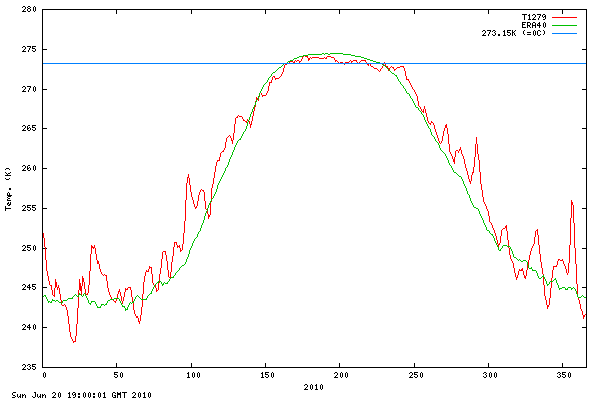
Where A1 is the area of ice less than one metre, A2 is the area of ice less than two metres, etc. The 2010/2008 volume ratio came out to 1.24, which means there has been approximately a 25% increase in volume over the last two years. The average thickness has increased from about 2.0 metres to 2.5 metres. That means an extra 20 inches of ice will have to melt this summer. So far, this seems unlikely with the cold Arctic temperatures over the last couple of weeks.

http://ocean.dmi.dk/arctic/plots/meanTarchive/meanT_2010.png
Now let’s look at the volume percentages. In 2010, 87% of the ice (by volume) is greater than two metres thick. But in 2008, only 64% of the ice (by volume) was greater than two metres thick.

A few weeks ago, when extent was highest in the JAXA record, our friends were asking for “volume, not extent.” Their wishes have been answered. Ice volume has increased by 25% in the last two years, and those looking for a big melt are likely going to be disappointed.

Here is the measured data:

Do you think it odd that this increase isn’t prominently mentioned on the PIOMAS site? It seems very relevant.
———————————————–
If a man will begin with certainties, he shall end in doubts; but if he will be content to begin with doubts he shall end in certainties.
– Sir Francis Bacon
Sponsored IT training links:
If your are looking for quick success in 350-018 exam then join today to explore useful 642-974 resources and pass EX0-101 on first try guaranteed.
Why do people assume that co2 always has to do with “green house effect”.
And why do almost everyone assume that polar bears need the ice, what with they’re living on land and only uses the ice when its there to be used. Actually why do everyone who seems to assume that polar bears live on ice assumes that every polar bear out there are the smartest one around? After all there’s most likely a really good reason for why the stupid polar bears who swims for a hundred miles and drowns don’t survive. :p
Steve,
Your second bar chart is mislabelled then, with 2007 and 2009. Nevertheless you should calculate the values for 2007 and earlier to show that you can derive the same ice volumes as the Navy and hence validate your approach.
R. Gates
Thanks. If the PIPS 2 data is so bad, why are they still updating the maps every day? Where are the PIPS 3 maps? I’m perfectly happy to use them, and no doubt they will show approximately the same trend.
Also, why hasn’t PIOMAS mentioned this increase on their web site?
I’ve commented recently that IF Arctic area, extent and volume go back to ‘normal’ the Warmists will move to the ‘warming’ Antarctic peninsula; and if that ‘warming’ turns to ‘normal’ they’ll head off to Death Valley with thermometer in hand.
Each day my prediction comes closer. :o)
Maybe this is off topic but I think not.
Why do almost every greenie out there want to prohibit the poor people electricity?
In pretty much every culture on this planet there’s a proverb about practicing what you preach right, but I wonder how many good and honest superbly greenies practice what they preach every time they argue, directly or indirectly, that poor have to make due with what they have rather than using oil, coal, let a alone nuclear.
If European union didn’t have ready access to coal, oil, and nuclear power, how many would have died this last winter? And why did so many good and honest superbly greenies need “power” from coal, oil, and nuclear generation to survive?
So if the western hubris suffering greenies can’t live without and as they preach why should not people of africa, china, india, south america, and et cetera not even have the ability to power themselves with oil, coal, and nuclear, even though they’re the only ones willing to pay for up to date filter and otherwise new and environmentally approved technology?
I was a Navy Sonar tech on a US submarine that has operated in the arctic and elsewhere so I am fully qualified to comment with a more expert opinion than pretty much anyone else here as I have taken these measurements and been there. So for some clarification on the Navies methodology in regards to it’s ice forcasts.
1 the navy has more expereince and knowledge of the arctic ocean than the other scientists data has been hidden one example is the depth of the arctic ocean itself the civilian climate experts were off in thier espimates by a factor of 10 up until the late 90’s and the sciexces.
2 all data is taken real measurement merged with historical records ans tracked meticulously,
3 Depth is only measured where a ship aftually goes there are very large holes even in the Navies records,
Much of the data is classified becuase it was recorded by submarines and information can only be relaeased in such a way that no submarine traack can be duplicated because officially submarines never do anything. Godd blog keep up the good work. and the one who said the Navy aren’t climate scientists I put my life on the line with the Navies data would you trust your life to the Climate scientists?
I read calls of cherry-picking upthread, so I ran the ap for all the years from 2005. Lo and behold, 2008, pictorially, was the lowest ice volume of all them. But I couldn’t find data to crunch the numbers.
That certainly seems like (visual) cherry-picking.
Could the authors (or anyone else) direct me to a website that
1) Gives observation instead of forecast values
2) Has actual data for sea ice volume
Thanks in advance.
I’ll search for the same when I have time later tonight.
GeoFlynx says:
May 29, 2010 at 5:22 pm
I think you missed the point of the post.
Jim Clarke says:
May 29, 2010 at 2:50 pm:
“So the Navy says the ice volume in the Arctic is up 25% in the last two years and the group whose very existence likely depends on the threat of global warming for most of their funding says the volume is way down. Hmmmm…who do you believe is the most accurate, the Navy trying to navigate the Arctic or the scientists trying to navigate Washington funding protocols?”
1. The Navy gets its money from Washington too.
2. Where did the Navy say ” ice volume in the Arctic is up 25% in the last two years”? Can you provided reference? Steve and Anthony don’t as a credible source. I want to see where the Navy said this. Also, a two year trend does not trump a 30 year trend.
3. Do you have a thoughtful critic of of the Polar Center Center’s work? You can’t just say, “I do not like them.”
http://psc.apl.washington.edu/ArcticSeaiceVolume/IceVolume.php
I know A tried to say something to discredit them in an earlier post here, but all he could come up with was that he did not understand part of one graph.
http://wattsupwiththat.com/2010/05/28/does-piomass-verify/
You are picking the sources that say what you want to believe. The credible scientists say the Arctic sea ice is declining and that this has multiple causes about which there is still debate. If AGW is some massive conspiracy, why do papers that assess possible non AGW causes of Arctic ice loss get published? They also say the Antarctic is gaining ice. Explain why they would lie about the Arctic and not about the Antarctic?
Now you can find mangled press stories that exaggerate the evidence for or likely impacts of AGW. But there are also plenty of stories in the media that do the reverse. Journalists are not scientists. Go figure.
I’m still waiting for a climate scientist to come forward and demonstrate that it isn’t the ocean current or geothermal induced Arctic warming that is responsible for the small increase in global temperatures. Cart/horse.
In fact, you’d think with all those climate scientists out there producing worthless papers on things like micron sea levels rises, you’d have at least a couple looking at other possible scenarios. Of course, I guess there could be ones working on it that simply can’t get their work published.
As for the claims of cherry picking … there is a good reason. The press has been playing out one press release after another about reduced volume of Arctic ice since the low extent in 2007. How does one respond to those claims without studying the years in question? Clearly, you can’t. However, this analysis shouldn’t be taken beyond that discussion or it does become cherry picking.
Barry,
I thought a death spiral was continuously downwards……..
Please describe the technique you envision for continuously monitoring ice thickness.
stevengoddard says:
May 29, 2010 at 5:19 pm
I see what you are saying. But I think some people may think that because there was so much snow in places like Washington D.C. that snow is just deeper in some places and not covering ground farther south. So something like a blink map of the past 5 years or so showing the snow line going farther south would make it unmistakable.
It seems that the Arctic ice is, ahem, very “robust” 🙂
STS2/SS Smith:
Thank you so much for posting here, we know your information is accurate. You are in a class such as pre-80’s scientists where no data is trusted and it is a shame, yours and their measurements were accurate, to point, honest, and important, not a polital or environment statement. Well, welcome to the “skptical of modern science methods” camp, you’ll always find honest and true friends here.
Great Post
Don’t tell John P. Reisman (OSS Foundation), over at RC. He thinks volume is decreasing.
stevengoddard says:
May 29, 2010 at 5:37 pm
Also, why hasn’t PIOMAS mentioned this increase on their web site?
Because it didn’t happen.
With all the logical fallacies the author throws at others, it’s not too surprising that the author engages in outright and blatent cherry picking of data.
An equally and valid logical fallacy, put forth directly by the author himself.
Second, it is important to realize that the changes in extent, area, and volume have there largest gradients during the months of May, June, and July.
Third, this is a blog with a clear and present bias, that’s a fact, just like AGW blogs have a clear and present bias.
Fourth, as with other methods of analysis typiclly presented in non-peer reviewed bloge, the author does not explain himself at all with respect to how the area calculations were made, total areas of coverage, etceteras. For examply, I’d like to see PDF’s and CDF’s, thank you very much.
Fifth, given that 2007 was the current all time low in terms sea ice extent, area, and perhaps volume to date, leads to only one conclusion, cherry picking of a data set that in and of itself can not be independently verified.
GIGO.
This model and Steve and Anthony’s results seem much more realistic than the Piomas model (which has also been proven to have the worst predictive capability of any model available).
The US Navy has the best ocean data and modelling. At stake are $2 billion submarines and $4.5 billion aircraft carriers.
Have a look at what the Gulf Stream really looks like.
http://www7320.nrlssc.navy.mil/global_nlom32/navo/GFSTRSST_nlomw12930doper.gif
or what the La Nina ocean currents are really doing right now.
http://www7320.nrlssc.navy.mil/GLBhycom1-12/navo/equpacsst_nowcast_anim30d.gif
stevengoddard says:
May 29, 2010 at 5:37 pm
R. Gates
Thanks. If the PIPS 2 data is so bad, why are they still updating the maps every day? Where are the PIPS 3 maps? I’m perfectly happy to use them, and no doubt they will show approximately the same trend.
Also, why hasn’t PIOMAS mentioned this increase on their web site?
________________
Steve,
As I said, PIPS 3.0 is quite active (if you go to page 33 on this pdf link you can see that):
http://www.hycom.org/attachments/101_F.Bub.pdf
It has been active since 2005, and updated since then even and that’s when PIPS 2.0 was mothballed. The most I can tell you is that PIPS 3.0 is part of a larger suite of products now used by the NAVY, and it’s exact features, and certainly any charts of sea ice volume and thickness derived from PIPS 3.0 are classified. These charts can be used, and are used, by ships and submarines for navigation under across the Arctic. With the increasing focus on the Arctic for resources, it is not surprizing that the NAVY would not release this data. You can go to this site:
http://www.oc.nps.edu/~pips3/
For a bit more information, but you’ll come to a dead end if you’re trying to get any actual charts. However, as I’ve been saying for some time, the same model information is used by PIOMAS and PIPS 3.0 known as CICE, (http://oceans11.lanl.gov/trac/CICE)
PIOMAS will give you raw projected anomaly, but of course no maps, but both it and PIPS 3.0 have the same data. PIOMAS did in fact show some slight recovery or at least an uptick in the overall downtrend in sea ice volume in 2009-2009, but it wasn’t as dramatic as you and Anthony’s exercise would indicate, and that’s probably why it was not addressed– it didn’t exist.
I don’t think PIOMAS is perfect, but because it is tied into CICE, and that model is getting better and better, and is certainly far better than PIPS 2.0, I tend to trust the model.
We in the civilian sector will have to wait for CryoSat-2 to start putting out data later this year to get very accurate 3-D views of sea ice (and I would suspect that data will be incorporated into CICE on some level, even just for validation).
Really though, I thought your presentation was excellent, and gave me much to think about. We’ve got a long summer of melt ahead, and it will be interesting to see how the melt does or doesn’t progress…
Bill Illis
May 29, 2010 at 8:52 pm
Again, you have the coolest animations!!
05,29,2006,11163438
<
05,29,2010,11170625
Unless there's a rare downward correction to JAXA it looks like some will have to wait for the record to be broken until May 30th. 2060 perhaps.
EFS_Junior says: May 29, 2010 at 8:45 pm
“Fifth, given that 2007 was the current all time low in terms sea ice extent, area, and perhaps volume to date…”
Why is it a given, and who gave it? And what the heck is a “current all time low”? Do you mean since satellite measurements began ~30 years ago?
If the extent and volume are both up, and the comparator shows that there’s ice everywhere how do you explain JAXA going from a 10 year high in early April to a 10 year low less than 2 months later — and this isn’t even supposed to be the time of fastest melt, and the temperatures are below normal as well. Huh?
Mike
What part of this don’t you understand?
http://wattsupwiththat.files.wordpress.com/2010/05/pips_anim.gif