By Steve Goddard and Anthony Watts
The Navy requires accurate sea ice information for their operations, and has spent a lot of effort over the years studying, measuring, and operating in Arctic ice both above and below, such as they did in the ICEX 2009 exercise.

So, if you are planning on bringing a $900 million Los Angeles class submarine through the ice, as the captain might say to the analyst after receiving an ice report: “you’d better be damn sure of the ice thickness before I risk the boat and the crew”.
Below is a blink comparator of U.S. Navy PIPS sea ice forecast data, zoomed to show the primary Arctic ice zone.

The blink map above shows the change in ice thickness from May 27, 2008 to May 27, 2010. As you can see, there has been a large increase in the area of ice more than two metres thick – turquoise, green, yellow and red. Much of the thin (blue and purple) ice has been replaced by thicker ice.
Source images for the blink comparator:
http://www7320.nrlssc.navy.mil/pips2/archive/pips2_thick/2008/pips2_thick.2008052700.gif

http://www7320.nrlssc.navy.mil/pips2/archive/pips2_thick/2010/pips2_thick.2010052700.gif

This was quantified by measuring the area percentage in the Arctic Basin of the 0-1, 1-2, 2-3, 3-4, and 4-5 metre ranges. The graph below shows the results. This technique assumes an equal area projection, which should be fairly accurate north of 70N.
In 2008, less than half of the ice (47%) was greater than two metres thick. Now, more than 75% of the ice is greater than two metres thick. In 2008, 18% of the ice was more than three metres thick. This year that number has increased to 28%. There has been nearly across the board ice thickening since 2008. There was slightly more 4-5 metre ice in 2008, due to the big crunch in the summer of 2007.

Now on to calculating the volume. That calculation is straightforward :
volume = (A1 * 0.5) + (A2 * 1.5) + (A3 * 2.5) + (A4 * 3.5) + (A5 * 4.5)
Where A1 is the area of ice less than one metre, A2 is the area of ice less than two metres, etc. The 2010/2008 volume ratio came out to 1.24, which means there has been approximately a 25% increase in volume over the last two years. The average thickness has increased from about 2.0 metres to 2.5 metres. That means an extra 20 inches of ice will have to melt this summer. So far, this seems unlikely with the cold Arctic temperatures over the last couple of weeks.

http://ocean.dmi.dk/arctic/plots/meanTarchive/meanT_2010.png
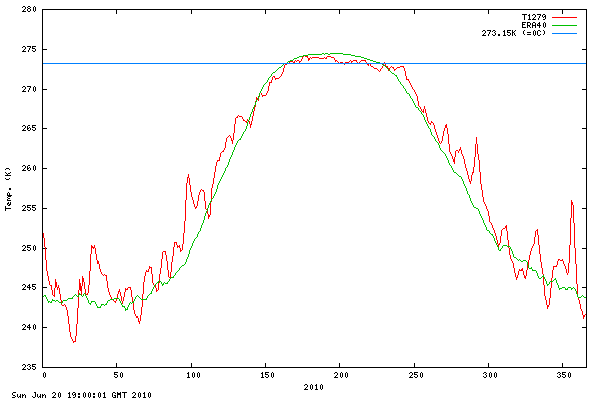
Now let’s look at the volume percentages. In 2010, 87% of the ice (by volume) is greater than two metres thick. But in 2008, only 64% of the ice (by volume) was greater than two metres thick.

A few weeks ago, when extent was highest in the JAXA record, our friends were asking for “volume, not extent.” Their wishes have been answered. Ice volume has increased by 25% in the last two years, and those looking for a big melt are likely going to be disappointed.

Here is the measured data:

Do you think it odd that this increase isn’t prominently mentioned on the PIOMAS site? It seems very relevant.
———————————————–
If a man will begin with certainties, he shall end in doubts; but if he will be content to begin with doubts he shall end in certainties.
– Sir Francis Bacon
Sponsored IT training links:
If your are looking for quick success in 350-018 exam then join today to explore useful 642-974 resources and pass EX0-101 on first try guaranteed.
so where has all of the rapid and alarming sea ice melt been occurring?
A quick check of the global dipstick (sea levels) reveals that the system is doing just fine.
False Alarm.
Excellent post – yet again. Thank you. It just dawned on me (and not for the first time) that it’s actually quite sad that as a result of such political corruption of the scientific process, and the use of governmentally sponsored warped science to justify controlling our lives, many of us are actually looking forward to the return of an ice age – or at least another ‘little’ one. As devastating as this would be to lives and economies, I feel it would be the lesser of two evils. I fear anything less (e.g. a continuation of the minor cooling we’ve had over the last 10-15 years) would not be enough to stop the alarmist train.
Richard111 says:
May 29, 2010 at 11:38 am
I have problems trying to understand how air temperatures, which only exceed zero degrees for about 70 days each year, and never seem to exceed +3C, can melt different amounts of ice each year. In fact the melting starts long before air temperatures get close to 0C.
Hey, there you go, thinking like a scientist! Kind of makes you think that maybe, just maybe, any variance in polar ice must primarily come from a few other prime factors, like the solar insolation levels and clouds, oceean currents and their temperatures, and purely wind velocities, not the surface air temperature per se. Don’t doubt yourself, you seem to be on the right track.
Mike says:
May 29, 2010 at 12:35 pm
Here’s my support for natural causes of ocean waters affecting / not affecting Sea Ice :
http://www.cpc.noaa.gov/products/analysis_monitoring/ensostuff/ensoyears.shtml
Pop in 3 decades or so of predominant El Nino’s and you have toasty oceans.
Do the opposite with 3 decades or so of La Nina’s and you get shiver me timber oceans.
False Alarm. All units return to base.
Steve,
Your approach does not agree with the calculations from the the team actually producing these maps. The Navy PIPS team derive a loss in the May ice volume from 2007 to 2008 of 22%.
http://www.nrl.navy.mil/content_images/09_Ocean_Posey.pdf
Your figures give a corresponding loss of around 13%. You might want to contact the PIPS team to see how they derive their volume estimates and hence understand how best to use this data.
Maybe the doomsayers were right. One of the four horsemen’s horses ( I believe it was Pestilence ) just took a dump on my front lawn, ………… You will all know me as I will be the one mooning you as I ascend into the sky during the “rapture”. Just kidding, I phoned and cancelled the order for thermaggedon. There is the small issue of the “re-stocking” fee that I would like to discuss,…….
While I’m here, many thanks to Steve, Anthony and Willis for the some very excellent articles as usual. Thanks all for the great science work!
Quick! Defame, insult, bury, assassinate, debunk, dismiss, before this gets to the press!
I wonder how Al Gore is going to receive this tragic information.
“The North Atlantic has seen especially large changes in recent years.
The temperature of the water that flows into the Arctic has increased by as much as 3.5 degrees F (2 degrees C) since the 1990s, says Helge Drange, professor of oceanography at Norway’s University of Bergen. “This can only be understood as a combined effect of natural variability and manmade warming,” he says. “
So GHG increases measurably contributed to 2 degrees C warming in 15 years??? The one thing that can be surely understood is that incremental GHG related warming effects in that time period are a rounding error on the natural variability required to create such a temperature change.
roger, next step is to use CAGW when that is the point of argument:
29 May: BBC: Roger Harrabin: Harrabin’s Notes: Getting the message
In his regular column, BBC environment analyst Roger Harrabin looks at the fall-out from complaints that some of the Royal Society had oversimplified its messages in public statements on climate change.
Even at the Heartland Institute climate sceptics’ conference in Chicago last week most scientists seemed to agree that CO2 had probably warmed the planet at the end of the 20th century, over and above natural fluctuations.
But they did not agree that the warming will be dangerous – and they object to being branded fools or hirelings for saying so.
The attitude of the establishment to the sceptics shines through the succession of inquiries into controversial science at the University of East Anglia’s Climatic Research Unit (CRU).
When at the launch of the Sir Muir Russell inquiry I asked about the credibility of the review panel in the blogosphere, Sir Muir dismissed the enquiry with the flick of a wrist – he had been a senior civil servant and he had run a university, his bona fides were beyond question.
But the blogosphere does not respect past reputations, only current performance. And some of the top performers in the blogosphere are critics of the establishment.
Steve McIntyre, for instance, is a mining engineer who started examining climate statistics as a hobby. He has taken on the scientific establishment on some key issues and won.
He arguably knows more about CRU science than anyone outside the unit – but none of the CRU inquiries has contacted him for input.
I have been told by the review teams that they can read McIntyre’s blog if they want to learn about his views. But they can’t have read all his blog entries surely? And they would have saved a lot of time and effort if they had asked him to summarise his scientific scrutiny on a couple of sheets of A4….
http://news.bbc.co.uk/2/hi/science_and_environment/10178454.stm
The Ocean skin is not warmed further from the addition of AGHG’s, which constitute a very small fraction of natural GHG’s. Even water vapor can’t do it. Longwave infrared radiation does NOT like the barrier to water penetration that is known as surface tension. Even natural sources of GHG’s re-radiation cannot get LW past the thin surface tension skin to layers that could melt ice. In addition, the small bit of warming from LW is nearly immediately evaporated off. To wit: your backyard pool.
You can do an experiment if you own a pool. Fill it with cold water. Let it sit in the Summer Sun on a clear day and measure temp change at different depths. You can measure heat penetration quite easily. If you don’t shake up the pool, you will notice layering. If you then give it a good mix, the surface will be cooler than it was under calm conditions. You are measuring shortwave radiation penetration. The properties of shortwave allow it to move through the water’s surface tension to amazing depth. The properties of longwave cannot do this.
Another thing about your pool or hot tub. Water’s desire to evaporate when it is warm is greater than “eh hem” animal sex drive. This is why the pool you own, or the hot tub you have on your porch, comes with blankets to keep that warm water in there.
If incoming Arctic currents are warmer, it is because the trade winds that blow at the equator calmed down, thus disallowing mixing between the warmer top layer and colder layers underneath it (as in your calm pool). This results in the current going into the Arctic to be warmer than usual. When the trade winds kick back up again, you get cooler currents (as in your agitated pool). AGHG has nothing whatsoever to do with ocean warming or cooling.
Arctic sea ice extent has hit below 2007 levels, one wonders what happened to the return?
Does this blog have any scientific consistency or is it just engaged in a perpetual search for an escape from reality?
Mike said on May 29, 2010 at 11:19 am:
If you look back you will find a year where the ice volume is larger or smaller than today. Instead one could do science:
http://psc.apl.washington.edu/ArcticSeaiceVolume/images/BPIOMASIceVolumeAnomalyCurrent.png
http://psc.apl.washington.edu/ArcticSeaiceVolume/IceVolume.php
So on on side we have the Navy and on the other side we have a group called the Polar Science Center. A quick look at the PSC website reveals this:
“Most of the funding for PSC’s research comes from grants and contracts with U.S. Federal agencies such as NSF, NASA, NOAA and ONR. ”
So the Navy says the ice volume in the Arctic is up 25% in the last two years and the group whose very existence likely depends on the threat of global warming for most of their funding says the volume is way down. Hmmmm…who do you believe is the most accurate, the Navy trying to navigate the Arctic or the scientists trying to navigate Washington funding protocols?
Jim Clarke
Do you really think NASA’s funding rely’s on the existence of Global warming? it is bizarre Americans are so quick to forget about NASA’s heroic conquest of space, this short term memory is reminescent of some sort of Soviet [snip].
From: bubbagyro on May 29, 2010 at 1:26 pm
Not helpful. And what is this “Ask Sam” you speak of? I hit up Wikipedia. Surprisingly enough, the laws of physics haven’t changed. Still takes the same amount of energy inputted to change ice to water as needs to be removed to change water to ice.
If I was looking at a solid block of ice, then there would be a long period where energy is absorbed before the ice rapidly melts. For solidification energy needs to be extracted from the water before freezing can start, then as more is removed the amount of ice will grow. Thus different slopes for freezing and thawing.
But the Arctic sea ice is not a solid block, and heat doesn’t instantaneously transmit through the water. Generally the heat comes in at the southern edges, where there are many small pieces of thin ice. They start soaking up the energy first, they melt first. The heat works its way northward where there are thicker pieces requiring more energy to melt, thus they take longer. The refreeze then goes from the north downward as heat is lost, moving outwards from ice that survived the melt, ending again with the thin outer edges. This is my basic thought picture of the process, which is admittedly quite simplified. It does not account for the graphed sudden drop in volume, so much faster than the refreeze. But it is more realistic than considering what happens in a beaker in the lab.
I’m afraid you’ll have to supply some more and better info to explain the dramatic differences on that graph to me.
jcrabb says:
May 29, 2010 at 2:39 pm
“Arctic sea ice extent has hit below 2007 levels, one wonders what happened to the return? Does this blog have any scientific consistency or is it just engaged in a perpetual search for an escape from reality?”
It is Mr Crabb who avoids facing reality.
The basic question regards global ice cover. By avoiding the uncomfortable fact that the growth in the Antarctic ice cover offsets the Arctic, crabb is allowing his CAGW alarmism to cloud his thinking. Now he’s gone into a belief system, and as a result he should discuss his beliefs with similar believers. I recommend RealClimate, climate progress, tamino or deltoid. They cater to believers to the extent that they all censor posts contrary to their belief system.
It is also bizarre that crabb believes that by NASA resting on its past laurels, it should still be entitled to continued high levels of funding — which takes much needed dollars out of uncorrupted areas of science.
Tom P
This article covers 2008-2010 and I didn’t calculate any numbers prior to that. The death spiral period from 2008-2010 has seen a significant gain.
OK, there is plenty of ice, now, where is the whiskey?
It’s less than four months until Arctic ice starts regrowth. Time goes by fast. We will know very soon who is right and who is wrong (again). 🙂
Steven Goddard,
this is OT to Arctic ice but is still about global warming predictions. Could you do a post (if Anthony approves) on how far south snow lines are reaching in recent years? Global warming predictions say snow lines will recede ever northward as global warming years go by. But it appears the snow line is heading south. Is that right?
How come pips doesn’t pick up the huge area of low ice concentration to the north and west of Novosibirskiye Ostrova ?
Andy
Darn, now that death spiral looks just like a tangled ball of Slinky.
Never could straighten those out.
Better to just deem it permanently damaged and send it to the trash!
Amino Acids in Meteorites
I’ve done a number of posts recently about record winter snow extent, which implies that the snow is falling further south. The reason being that the only direction the snow line can move is towards the south – because the areas closer to the pole are already covered.
Steve & Athony,
An excellent presentation, and if the PIPS 2.0 data had any validity or accuracy I would almost believe it. Unfortunately, PIPS 2.0 was quite inaccurate with low fidelity and is no longer used by the Navy for any serious applications, and especially not to navigate their way through the Arctic. PIPS 3.0 has been on-line for many years and is assimilated into the HYCOM suite (HYBRID COORDINATE OCEAN MODEL)
The PIPS 2.0 model had very low resolution and large errors. Unfortunately, the Much of the capabilities of the PIPS 3.0 model are classified, as you can understand how valuable that information could potentially be for military applications. With the planting of a flag on the bottom of the Arctic Ocean by Russia a few years back, and the vast untapped resources of the region, one can certainly understand. However, a general unclassified example of what 3.0 is capable of can be found here:
http://www.oc.nps.edu/~pips3/pips.gif
An unclassified presentation of the HYCOM suite of applications (including PIPS 3.0) can be found here:
http://www.hycom.org/attachments/101_F.Bub.pdf
In general though, a nicely done effort, but I think your data is suspect, and I think you should realize that the modeling done by PIOMAS is much closer to the more updated PIPS 3.0, as they both use CICE from Los Alamos, and thus, I would tend to stick to the projections of PIOMAS and the volume loss anomlay they project for the arctic over software that the Navy abandoned many years ago in PIPS 2.0…
stevengoddard says:
May 29, 2010 at 4:02 pm
Tom P
This article covers 2008-2010 and I didn’t calculate any numbers prior to that. The death spiral period from 2008-2010 has seen a significant gain.
Steve – The point is that you can not measure a long period trend by projecting between two short period points (cherry pick). Basically, you would have to filter out the high frequency noise to see the long period trend. The year 2007 was an unusual ice minimum and those that projected undue alarm and exaggerated consequences then are just as wrong as you are now. The Arctic ice is bound to recover somewhat from the 2007 low. This should be no surprise. I know you guys can do good science, but too often you let your prejudice get in the way. The science is what it is and a more accurate understanding will come if you just let it.