By Steve Goddard and Anthony Watts
The Navy requires accurate sea ice information for their operations, and has spent a lot of effort over the years studying, measuring, and operating in Arctic ice both above and below, such as they did in the ICEX 2009 exercise.

So, if you are planning on bringing a $900 million Los Angeles class submarine through the ice, as the captain might say to the analyst after receiving an ice report: “you’d better be damn sure of the ice thickness before I risk the boat and the crew”.
Below is a blink comparator of U.S. Navy PIPS sea ice forecast data, zoomed to show the primary Arctic ice zone.

The blink map above shows the change in ice thickness from May 27, 2008 to May 27, 2010. As you can see, there has been a large increase in the area of ice more than two metres thick – turquoise, green, yellow and red. Much of the thin (blue and purple) ice has been replaced by thicker ice.
Source images for the blink comparator:
http://www7320.nrlssc.navy.mil/pips2/archive/pips2_thick/2008/pips2_thick.2008052700.gif

http://www7320.nrlssc.navy.mil/pips2/archive/pips2_thick/2010/pips2_thick.2010052700.gif

This was quantified by measuring the area percentage in the Arctic Basin of the 0-1, 1-2, 2-3, 3-4, and 4-5 metre ranges. The graph below shows the results. This technique assumes an equal area projection, which should be fairly accurate north of 70N.
In 2008, less than half of the ice (47%) was greater than two metres thick. Now, more than 75% of the ice is greater than two metres thick. In 2008, 18% of the ice was more than three metres thick. This year that number has increased to 28%. There has been nearly across the board ice thickening since 2008. There was slightly more 4-5 metre ice in 2008, due to the big crunch in the summer of 2007.

Now on to calculating the volume. That calculation is straightforward :
volume = (A1 * 0.5) + (A2 * 1.5) + (A3 * 2.5) + (A4 * 3.5) + (A5 * 4.5)
Where A1 is the area of ice less than one metre, A2 is the area of ice less than two metres, etc. The 2010/2008 volume ratio came out to 1.24, which means there has been approximately a 25% increase in volume over the last two years. The average thickness has increased from about 2.0 metres to 2.5 metres. That means an extra 20 inches of ice will have to melt this summer. So far, this seems unlikely with the cold Arctic temperatures over the last couple of weeks.

http://ocean.dmi.dk/arctic/plots/meanTarchive/meanT_2010.png
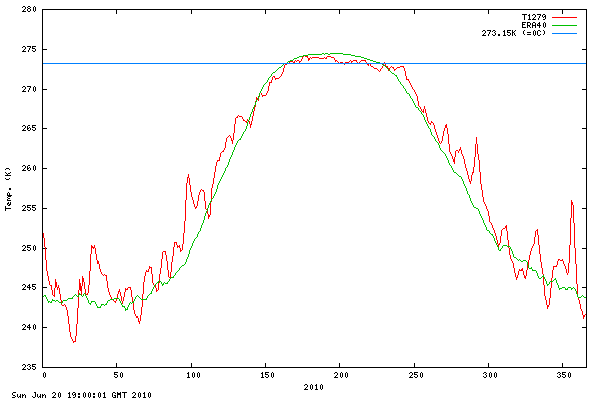
Now let’s look at the volume percentages. In 2010, 87% of the ice (by volume) is greater than two metres thick. But in 2008, only 64% of the ice (by volume) was greater than two metres thick.

A few weeks ago, when extent was highest in the JAXA record, our friends were asking for “volume, not extent.” Their wishes have been answered. Ice volume has increased by 25% in the last two years, and those looking for a big melt are likely going to be disappointed.

Here is the measured data:

Do you think it odd that this increase isn’t prominently mentioned on the PIOMAS site? It seems very relevant.
———————————————–
If a man will begin with certainties, he shall end in doubts; but if he will be content to begin with doubts he shall end in certainties.
– Sir Francis Bacon
Sponsored IT training links:
If your are looking for quick success in 350-018 exam then join today to explore useful 642-974 resources and pass EX0-101 on first try guaranteed.
I have problems trying to understand how air temperatures, which only exceed zero degrees for about 70 days each year, and never seem to exceed +3C, can melt different amounts of ice each year. In fact the melting starts long before air temperatures get close to 0C. Therefore melting must occur mostly under the ice. That can only be reported by measuring the ice thickness. Measuring area and relating it to ice melt seems meaningless when ice gets fractured and broken up at the edges by wind and wave action. That is not melting due to temperature. So whos reports to believe?
stevengoddard says:
May 29, 2010 at 11:06 am
Hockeystickler
I’m sure you are correct that people will criticize, but looking at the PIPS images there can be little doubt that there is widespread thickening over the last two years.
Based on that model perhaps but the actual data contradicts it, so there is plenty of doubt that there is ‘widespread thickening’, the balance of evidence supports thinning. Just after that supposed consolidation the old ice in that area broke up and flushed out, for example see here: http://ice-glaces.ec.gc.ca/app/WsvPageDsp.cfm?Lang=eng&lnid=48&ScndLvl=no&ID=11892
So I guess people will just have to set up strawmen, change the subject, engage in ad homs, appeal to authority, etc.
That is your usual behavior:
E.g. appeal to authority:
Steve Goddard says:
May 28, 2010 at 2:28 pm
Anu
You are the one determined to prove pips wrong. Please come back when you have that proof.
The models contradict this. The Navy are not qualified Climate Scientists. Will you believe peer reviewed models or will you deny science?
The sea ice thickness graphs from the Navy are forecasts predicted by…. models.
This is the first sentence from the front page of the section Steve and Anthony got the graphs from.
http://www7320.nrlssc.navy.mil/pips2/
Models bad, right?
manfredkintop says:
May 29, 2010 at 10:53 am
Peer reviewed models, now that’s a hoot.
Must be a new form of AI : Artificially Imagined
The GCM Supercomputer breathes as billions are pumped through it’s veins (some leeches are naturally attached) while immersed in a brine of fear. Someobody put the wrong fluid in, and the thing is screaming as embalming fluid sears the circuits.
Peter Miller says:
Pete, Tinyurl.com is your friend.
I would put lots of trust in the USN.
mack520 says:
May 29, 2010 at 10:32 am:
“The models contradict this.”
Funniest on thread, whether sarcastic or not!
There is more ice cover in 2008. There is less 5 metre ice in 2010. There is less 2 metre ice in 2010.
On the same day in 2007, the year of record melt, there is similar ice cover to 27 May 2010, but there is much more thick ice in 2007. In 2010, the thickest ice apparent in 2007 is nearly all gone.
I wouldn’t be too confident about placing bets.
So Arctic Sea Ice Volume seems to have increased in the last two years, and Antarctic Sea Ice Area (Can anyone figure out the Volume?) has been trending above average over that period;
http://arctic.atmos.uiuc.edu/cryosphere/IMAGES/seaice.recent.antarctic.png
so where has all of the rapid and alarming sea ice melt been occurring?
sunsettommy says:
May 29, 2010 at 10:57 am
“Meanwhile there is no apparent connection between CO2 and Ice levels in the Arctic.”
From what I have read you are right. The greenhouse effect is not the major direct cause of Arctic warming. Ocean currents that are warmer than because of greenhouse effect warm and melt the ice. Less ice cover increases the direct heat absorption setting off a positive feedback.
http://www.skepticalscience.com/What-causes-Arctic-amplification.html
http://www.nature.com/nature/journal/v464/n7293/full/nature09051.html
http://www.skepticalscience.com/Melting-ice-isnt-warming-Arctic.htm
Another factor maybe “black carbon,” basically soot.
http://www.nasa.gov/topics/earth/features/warming_aerosols.html
Note: These references do not support my claim that GHG caused warmer ocean currents to reach the Arctic. I do recall reading this and will continue look for a reference.
RE
AGW-Skeptic99 says:
May 29, 2010 at 11:10 am
Other than the interest in questioning the validity of the CAGW models, does the Arctic ice really matter to anyone except the polar bears who are not land based? Would the climate of the rest of the world be impacted by ice free water at the North Pole in August or September, even presuming that it was to happen during this cycle?
————————————————————–
I’m no expert but have conceived the Arctic as a major vehicle for getting rid of heat from the Earth, esp during Autumn & Spring: radiation to space from open water during darkness, including the heat load from freezing the ice being lost to space over the winter. In Spring, the melting (if any) would absorb heat into water vapour I suppose….anyway, I had thought it a negative feedback system, with heat transported from the Tropics. Whether or not the Arctic is frozen must affect all this and hence the relationship between heat and temperatures on a global scale??
Happy to be corrected, but my take is that the Arctic has a global impact.
FergalR said on May 29, 2010 at 10:46 am
That chart is referenced on the Polar Science Center page thusly:
I find that graph troubling, as it looks like a sine wave mixed with an alternating ramping-up sawtooth wave. It says the volume goes down rapidly in the melt season yet takes a much longer time to go back up again. This seems in variance with the normal sinusoidal look of an extent graph like from IARC-JAXA. It tells me the waters will heat up quickly yet cool down slowly. Yet after so much of the insulating ice layer has vanished by the end of the summer melt, wouldn’t all that open water quickly radiate the heat away, cooling off rapidly? I thought all that thin ice at the edges was supposed to melt away first. But with such a steep decline in volume versus the extent graphs, doesn’t this mean the thicker ice is melting away fastest?
Of course the data for that chart, well, doesn’t appear to exist. It looks like somehow they were hindcasting, running the model backwards to get the data, then punching the data into the model for that daily average. There is no database of continuous measurements of volume from 1979 to 2009 to use for that chart, thus the model would seem to be the only source available for a comprehensive set of numbers they could use.
Here is support for my claim that oceans currents warmed by AGW are a factor is Arctic sea ice loss.
“The North Atlantic has seen especially large changes in recent years.
The temperature of the water that flows into the Arctic has increased by as much as 3.5 degrees F (2 degrees C) since the 1990s, says Helge Drange, professor of oceanography at Norway’s University of Bergen. “This can only be understood as a combined effect of natural variability and manmade warming,” he says. “
Warming ocean melts Greenland glaciers
http://www.physorg.com/news172917431.html
But this 2004 article attributes most changes in Arctic climate to natural causes.
Winds, Ice Motion Root Cause Of Decline In Sea Ice, Not Warmer Temperatures
http://www.sciencedaily.com/releases/2004/12/041220010410.htm
Would be great if someone found balanced overview of the causes of Arctic warming. Many factors are likely at play.
Mike said on May 29, 2010 at 11:19 am:
Ah, “doing science.” So that’s what you young people are calling it these days.
“mack520 says:
May 29, 2010 at 10:32 am
The models contradict this. The Navy are not qualified Climate Scientists. Will you believe peer reviewed models or will you deny science?”
mack, I got it, and thanks for the laugh.
The AGW theory consensus will soon be, the theory doesn’t hold water.
Richard111
Wind, clouds and sea temperature are the variables which affect the amount of energy melting the ice during summer.
What does the Caitlin crew have to say?
Did the US Navy consult them?
I think old mother Gaia has had enough of threats of an ‘ice free Arctic’, I do keep an eye on the ice expanse and the observations, the sea ice has recovered and that has quietened some MSM TV stations – notably the BBC (no more panic reportage of Inuit hunters losing their livelihoods, though the polar bears plight is still news).
I am awaiting a report on the ‘recovering sea ice’ but alas they choose to ignore the facts……….. if they don’t suit the meme…….. of CAGW, then eyes and heads (at the BBC) are averted/stuck firmly in the sand.
Steve
I am sure there will be an ‘attack of the Deltoidoids’ for this!
It’s never been about length, always about thickness.
The article’s reference to the USS Helena has some personal interest to me, since our boy was stationed on her for most of his 6 year Navy hitch. He was a nuclear reactor specialist.
He’s just been accepted into UC Berkeley’s nuclear engineering program. I tried to convince him windmills were the future, but he was having none of it…
Maybe this is the data that got confused with snowpack in Arizona.
Keith at hastings UK says:
May 29, 2010 at 12:14 pm :
“I’m no expert but have conceived the Arctic as a major vehicle for getting rid of heat from the Earth, esp during Autumn & Spring: radiation to space… Happy to be corrected, but my take is that the Arctic has a global impact.”
It does. Pretty much equal to the Antarctic’s.☺
kadaka (KD Knoebel) says:
May 29, 2010 at 12:27 pm
Please look up a couple of things on Ask Sam:
1) heat capacity of water in its various forms
2) latent heat of crystallization or evaporation.
Then get back to us. Then you will know why freezing and thawing cycles have different slopes.
For models buffs, forecasting science is appropriate for small time frames when there are few variables. For example, I can record that my fingernails grow one mm/month in the past year. I can then forecast that they will grow one mm ± a few percent next month. I would bet the farm on it.
I can also take ice records, such as the sinusoidal ones shown. I can predict that there will be ice loss ± a certain percentage for June 2010, for example, and be right on the money.
∴, Few variables, very short time frames, models aren’t too bad.
But, hundreds of variables, scores or hundreds of years, models are not so good. In fact, with the warm-earther models, most seem to be dead wrong.
Why all this fuss? I just read a CNN advice article that told me “Size doesn’t matter”. I was vastly relieved at the news.
• Ice melts from the bottom because the volumetric heat capacity of water is almost 4000 times that of air.
• Wind and ocean currents move ice around a LOT.
• Polar bears are opportunistic feeders. They forage on the ice because that is the easiest way to access the prey in the arctic, and that’s where the most prey lives. When there is no ice, they hunt on land (duh).
• The chief cause of death for Polar Bears is bullets.
• At one time, the chief cause of death for man in the arctic was Polar Bears. It still happens.
Just some observations.